


The Executive Summary
Founders at $100K/month cap out at roughly 20% growth on 50–60 hour weeks when they run eight separate systems instead of one integrated Founder’s OS that compounds them.
Who this is for: Operators and founders around $100K/month with a signal grid, offer stack, delegation systems, time fence, and dashboard, still working 50–52 hours weekly while growth feels slow and fragmented.
The integration gap problem: You’re running eight separate systems instead of one operating system, so strategic hours idle, quarterly projects feel random, and you sit at $97K → $115K in 12 months (+19%) with capacity for 30–55% growth.
What you’ll learn: The five-layer Founder’s OS Framework—Signal Layer, Execution Layer, Capacity Layer, Time Layer, Energy Layer—and how The Clear Edge OS, The Five Numbers, The 3% Lever, The Delegation Map, The Time Fence, and The Founder Fuel System run as one machine.
What changes if you apply it: Metrics trigger protocols, owners are pre-assigned, time fences protect Tier 1–2 work, and you shift from 52 hours at $108K with scattered initiatives to 30 hours at $167K after 12 months as the OS compounds across layers.
Time to implement: Expect 6–12 months and 75–110 hours total (about 1.5–2 hours weekly) to connect metrics to action, automate capacity allocation, sync time and energy, and refine the OS—freeing 20–30 hours weekly and creating $880K–$1.44M in annual value at $100K/month.
Written by Nour Boustani for $100K-month founders and operators who want a 30-hour Founder’s OS that scales to $150K+ without adding systems, sacrificing health, or living in permanent firefighting mode.
Most founders at $100K–$125K/month aren’t missing tactics; they’re missing The Clear Edge OS that connects The Five Numbers and The 3% Lever. Install it—consider upgrading to premium.
› Library Navigation: Quick Navigation · The Clear Edge OS
Why Founders At $100K Months Need An Integrated Founder’s OS Instead Of Disconnected Systems
At $100K–$125K months, most founders already run a full stack of growth and delivery systems across their business.
Systems pile up. Signal grid here, Momentum systems there, Delegation frameworks, Time Fences, Offer Stacks, Exit-Ready Protocols—built in sequence, never wired into one thing.
That’s the pattern.
Your Time Fence holds space, but the strategy isn’t obvious.
Delegation moves work, but the team can’t see the real opportunities.
The dashboard tracks numbers that don’t yet trigger specific plays.
You’re running eight separate systems when you need one integrated Founder’s OS.
A consultant at $115K/month had this exact problem after two years of building:
Systems in place:
Weekly time fence (10 hours protected for strategy)
Three-tier offer stack
Tier 1: $497 product
Tier 2: $797/month group
Tier 3: $6,500/month service
Delegation protocols (15 decisions documented)
Five-number dashboard
Lead flow
Conversion
Value
Retention
Capacity
Exit-ready systems (business runs 80% without the founder)
The problem: Each Monday, she’d sit in her protected time fence asking, “What should I work on?”
Check dashboard—all metrics look fine.
Check offer stack—all tiers performing.
Check team—no escalations needed.
She had 10 hours weekly of protected strategic capacity with no system telling her how to use it.
Her quarterly reviews showed the issue:
Q1: Optimized lead flow (+12%)
Q2: Built new Tier 2 program (launched successfully)
Q3: Focused on retention (+8%)
Q4: Redesigned Tier 3 service (client satisfaction up)
Good work, but disconnected. Each quarter, she chose a focus based on what felt right instead of what the integrated system actually required.
Revenue growth: $97K → $115K over 12 months (+19%).
Solid. But she had the capacity for 30–40% growth if systems were integrated and compounding.
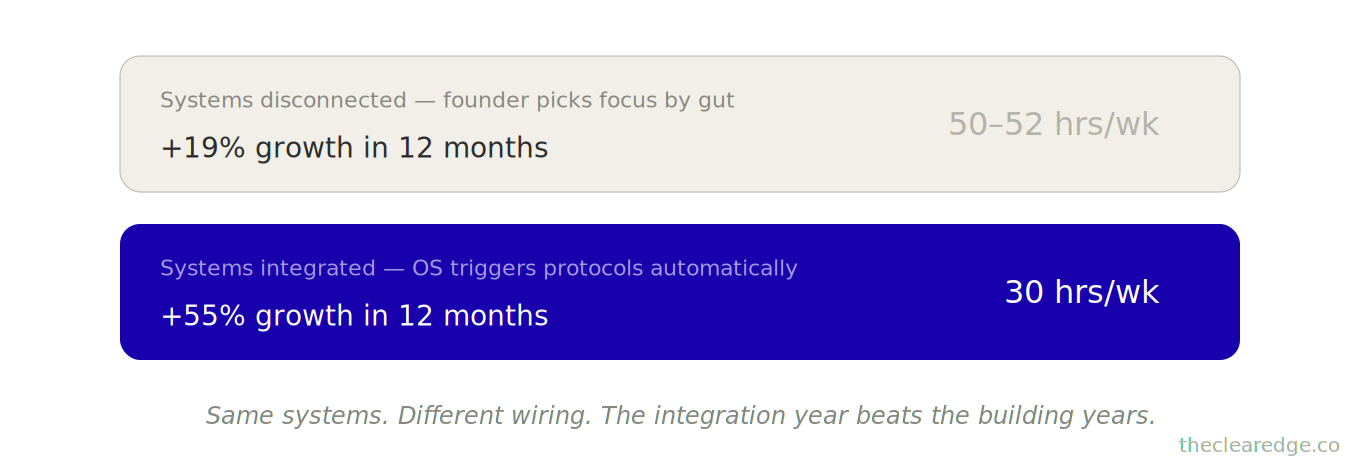
Instead of treating each win in isolation, you are about to see how the five-layer Founder’s OS turns scattered systems into one compounding machine.
The Five-Layer Founder’s OS Framework For Scaling $100K–$150K Months On 30 Hours Weekly
The Founder’s OS isn’t another system you bolt on. It’s the integration layer that connects everything you’ve already built into one self-optimizing machine.
The OS has five interconnected layers:
Layer 1: Signal Layer (What to optimize)
Your five-number dashboard (The Five Numbers) identifies constraints automatically. Metrics trigger protocols, not founder intuition.
Layer 2: Execution Layer (How to optimize)
Your compound improvement system (The 3% Lever) applies 3% monthly gains to constraints identified by the Signal Layer.
Layer 3: Capacity Layer (Who optimizes)
Your delegation and exit-ready systems (The Delegation Map, The Quality Transfer, The 30-Hours Week, The Exit Ready Business) determine which optimizations the founder does vs. the team executes.
Layer 4: Time Layer (When to optimize)
Your time fence and role redesign (The Time Fence, The Designer Shift) protect hours needed for high-value work while eliminating low-value activities.
Layer 5: Energy Layer (How to sustain)
Your mode-switching and fuel systems (The Founder Fuel System, $100K Without Burnout) ensure optimization happens without burnout.
Each layer feeds the next:
The Five Numbers dashboard identifies constraint
The 3% Lever improvement system targets it
The Delegation Map determines who executes
Time Fence protects execution hours
Founder Fuel energy systems sustain the work
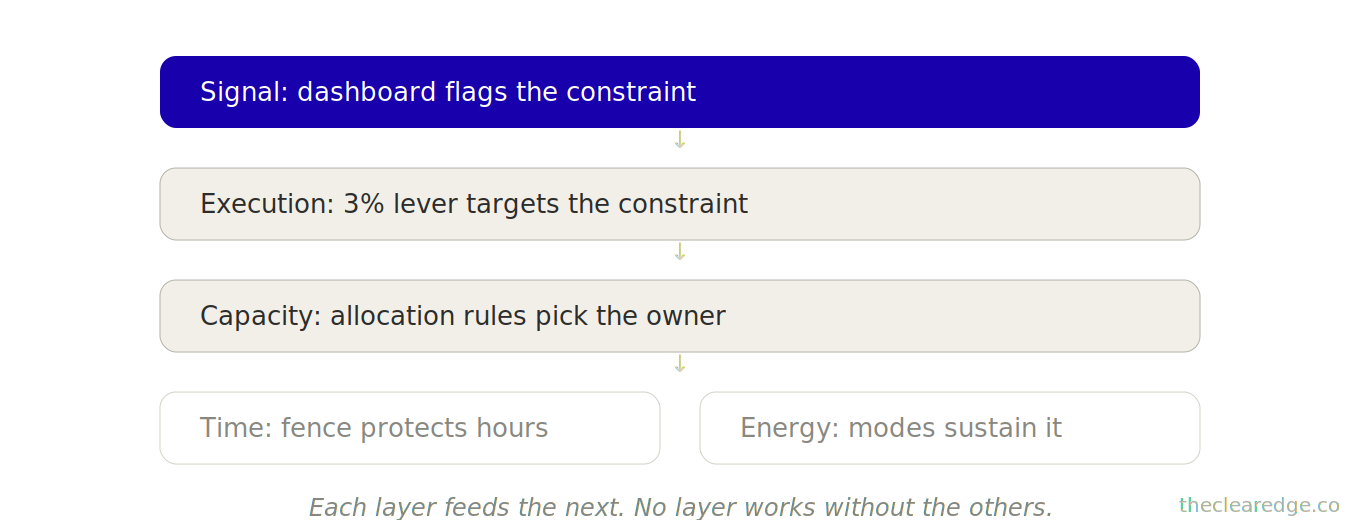
No layer works without the others.
Together, they achieve compound growth on 30 hours per week without the founder burning out.
When 19% Isn’t Enough
If sitting at $97K → $115K in 12 months (+19%) feels like underperformance for your capacity, use premium to install the OS that closes that gap.
Before we zoom into specific moves, you need to see how the OS turns raw metrics into automatic plays rather than another weekly guessing session.
Move 1: How To Connect Your Five Numbers Dashboard To Automatic Execution Protocols
The first integration is simple: dashboard metrics automatically trigger improvement protocols so most founders stop checking the dashboard, seeing numbers, and guessing what to do—the OS eliminates guessing.
Integration structure:
Metric drops >5% → Activate investigation protocol
Metric drops >10% → Activate correction protocol
Metric flat 2 months → Activate improvement protocol
Metric growing <3% monthly → Activate acceleration protocol
Each protocol has pre-defined actions from your compound improvement playbook (The 3% Lever).
A coaching business at $121K/month integrated metrics to action:
Signal Layer (Dashboard shows):
Lead flow: 92/month (flat for 2 months)
Conversion: 34% (growing 4% monthly – strong)
Transaction value: $3,600 (flat for 3 months)
Retention: 11 months (growing 2% monthly)
Capacity: 28 clients (room for 32)
Without OS:
Founder reviews dashboard.
Feels good about conversion and retention.
Maybe considers lead flow work or pricing test.
Decides based on gut.
With OS: Dashboard triggers protocols automatically
Lead flow (flat 2 months) → Improvement protocol activates:
Team launches 1 new lead source (pre-approved tactic from playbook)
Timeline: 30 days
Target: +10–15 leads monthly
Owner: Mini-CEO of Revenue (no founder involvement needed unless stuck)
Transaction value (flat 3 months) → Improvement protocol activates:
Team tests payment plan expansion (extend from 6 to 12 months)
Timeline: 14 days to implement, 30 days to measure
Target: $3,600 → $4,100 average
Owner: Mini-CEO of Revenue
No founder decision required. Metrics triggered protocols. Team executed.
Month 1 results:
Lead flow: 92 → 107 (+16% from new LinkedIn strategy)
Transaction value: $3,600 → $4,050 (+12.5% from payment plan)
Revenue: $121K → $137K (+13%)
Founder time spent: 2 hours (reviewing results, approving continuation).
The integration
Signal Layer identified constraints.
Execution Layer applied improvements.
The Capacity Layer was delegated to the team.
Time Layer kept the founder focused on a 30-hour role.
Connect metrics to action.
[Weekly Energy Sync]

Build Mode:

Mon-Wed mornings
=> Tier 1 deep work

---

Maintain Mode:

Wed pm-Fri
=> Reviews, leadership

---

Recovery Mode:

Fri pm
=> Light work, admin
Move 2: How To Automate Capacity Allocation So The Right Owner Executes Every Improvement
The second integration is simple: improvement protocols automatically determine who executes (founder vs. team), so instead of personally doing every improvement you let the OS allocate work to the optimal owner.
Allocation Rules
Tier 1 work (Strategic, >$1,000/hour): Founder only
Examples:
Market positioning
Offer architecture
Strategic partnerships
Key client relationships
Tier 2 work (Leadership, $500-$1,000/hour): Founder oversight, team execution
Examples:
Process design
Mini-CEO development
High-stakes decisions
Tier 3 work (Operational, $100-$500/hour): Team execution, founder review
Examples:
Campaign launches
Client delivery improvements
Operational decisions
Tier 4 work (Tactical, <$100/hour): Team execution, no founder involvement
Examples:
Implementation
Scheduling
Admin
Routine optimization
When the dashboard triggers the improvement protocol, allocation rules determine the owner automatically.
An agency at $104K/month automated allocation:
Improvement needed: Lead flow (85/month → target 95/month)
Without OS:
Founder builds LinkedIn strategy.
Founder writes content.
Founder manages execution.
Total: 12 hours founder time.
With OS: System evaluates using allocation rules:
Strategy design (identify best channel + positioning): Tier 1 → Founder, 2 hours
Content creation (write posts): Tier 3 → Content manager, 6 hours
Campaign setup (scheduling, tracking): Tier 4 → Marketing coordinator, 4 hours
Execution monitoring: Tier 3 → Mini-CEO of Revenue, 3 hours
Result: Same improvement.
Founder input: 2 hours vs. 12 hours. 10 hours saved by automated allocation to optimal owners.
Over 12 months, this pattern repeated across 36 improvements:
Average improvement: 8 hours of work
Without OS: 8 hours × 36 = 288 hours founder time
With OS: 2 hours founder × 36 = 72 hours founder time + 216 hours team time
Founder time saved: 216 hours yearly, equal to 5.4 work weeks redirected to strategic work.
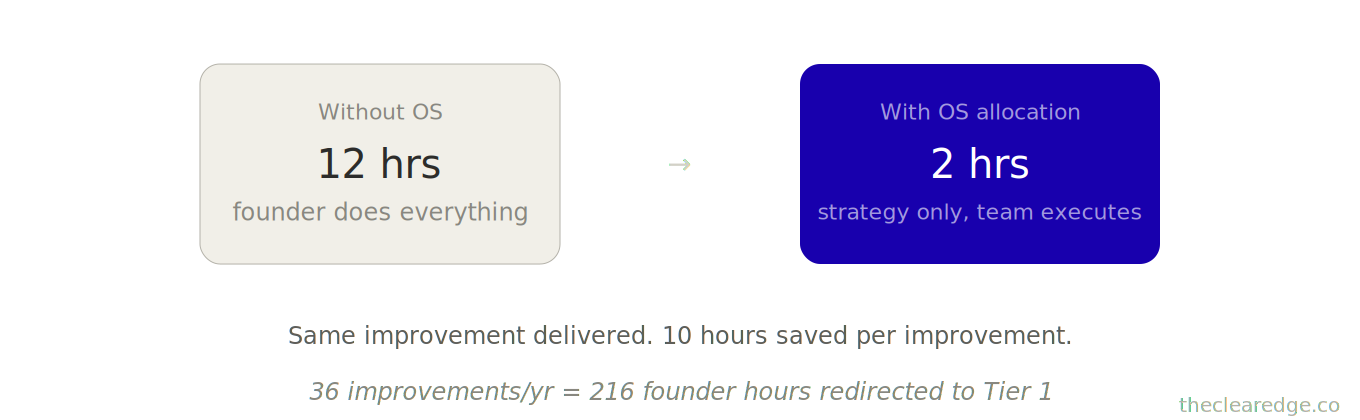
Revenue impact:
216 hours shifted to Tier 1 strategic work (vs. Tier 3 execution)
$27K monthly additional revenue
$104K → $131K monthly run rate
Automate capacity allocation. Let the system determine who does what.
The real test is whether those rules still hold once you factor in energy, because mis-timed work quietly destroys the gains you just created.
Move 3: How To Synchronize Time And Energy For A Sustainable 30-Hour Founder Week
The third integration is simple: capacity allocation must respect time windows and energy modes, not just who owns the task.
Most founders delegate work but don’t wire when that work happens or what state it requires, so the team delivers at the wrong time and the founder reviews when depleted.
Synchronization rules:
High-energy work (Build Mode)
Happens in a protected time fence, requires full cognitive capacity.
Schedule: Monday–Wednesday mornings, founder + key team members.
Medium-energy work (Maintain Mode)
Happens outside the fence, requires moderate attention.
Schedule: Wednesday afternoon–Friday, whole team.
Low-energy work (Recovery Mode)
Happens in scattered blocks, requires minimal activation.
Schedule: Friday afternoons, optional participation.
Team delivery: Aligned with the founder’s review availability.
Rule: Team completes Tier 2–3 work by Thursday, so the founder reviews Friday (low-energy task).
Case — a consultant at $132K/month synchronized everything:
Monday–Wednesday mornings (Build Mode in Time Fence)
Founder: Strategic decisions, key client work, offer design (Tier 1).
Mini-CEOs: Process improvements, strategic planning for their functions (Tier 2).
Team: Minimal meetings, execution-focused.
Wednesday afternoon–Friday (Maintain Mode)
Founder: Team leadership, reviews, approvals (Tier 2).
Mini-CEOs: Team coordination, operational decisions (Tier 3).
Team: Delivery work, client communication, implementation (Tier 3–4).
Friday afternoons (Recovery Mode)
Founder: Light reviews, planning next week, learning time (Tier 2).
Mini-CEOs: Team check-ins, week wrap-up (Tier 3).
Team: Administrative tasks, cleanup work (Tier 4).
Result: Founder operates at 90%+ cognitive capacity during strategic work (vs. 60–70% when unsynchronized).
The team knows when to expect founder input; no surprise escalations during protected time.
Quarterly comparison:
Before sync: Founder handled 47 interruptions monthly during strategic time, causing 18–24 hours of fragmented capacity.
After sync: Founder handled 6 interruptions monthly (true emergencies only), creating just 2–3 hours of managed disruption.
Capacity recovered:
15–21 hours monthly
3.75–5.25 hours weekly of unfragmented strategic time
Revenue impact: the founder completed five strategic initiatives in Q4 (vs. 2–3 typical) and unlocked $22K in monthly growth.
Synchronize time and energy. Respect when work happens and what state it requires.
What Happens Over 12 Months When Your Founder’s OS Is Fully Integrated Across All Five Layers
Here’s what happens when all five layers run as an integrated OS.
Month 1:
Dashboard identifies constraint (Signal).
Protocol activates improvement (Execution).
Team executes, founder strategizes (Capacity).
Work happens in optimal time windows (Time).
No one burns out (Energy).
Month 2:
Same pattern, different constraint.
The previous month’s improvement compounds.
Team learns, gets faster.
The founder has more strategic capacity.
Systems get stronger.
Month 3:
Systems now self-optimizing.
Team anticipates constraints before metrics drop.
The founder focused purely on Tier 1 work.
Energy sustainable, quality maintained.
Compound momentum visible.
A service business tracked an integrated OS over 12 months:
Starting state:
$108K monthly
Systems disconnected
Founder 52 hours weekly
After 3 months:
$119K monthly (+10%)
Systems integrated
Founder 45 hours weekly
After 6 months:
$134K monthly (+24%)
OS running smoothly
Founder 38 hours weekly
After 9 months:
$151K monthly (+40%)
Full automation
Founder 32 hours weekly
After 12 months:
$167K monthly (+55%)
OS self-optimizing
Founder 30 hours weekly
The pattern: first 3 months integrate systems, next 3 months optimize integration, final 6 months reap compound benefits.
Without integration, it might hit 30–35% growth in 12 months (solid, typical).
With integration, it hit 55% growth in 12 months while reducing hours by 42%.
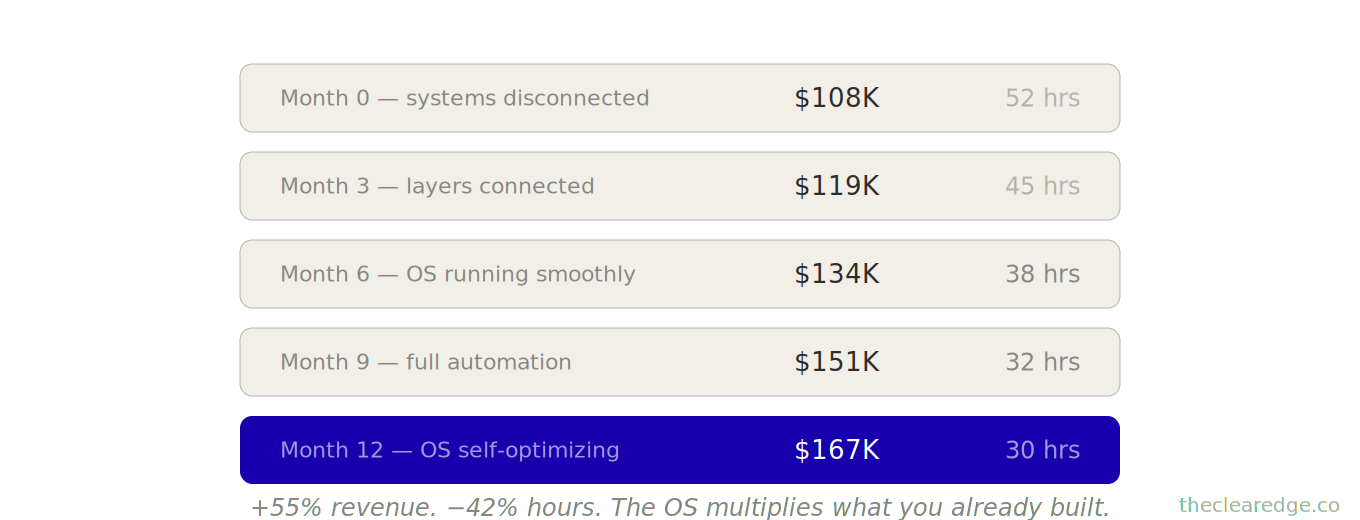
The OS doesn’t just add systems—it multiplies their effectiveness through integration.
[12-Month OS Journey]

Months 1-3: Integrate systems

--> Connect layers

---

Months 4-6: Optimize

--> Fix friction, refine rules

---

Months 7-12: Compound

--> Systems self-improve

--> Hours drop, profit climbs
That multiplication only matters if it shows up in your actual calendar, so the next step is seeing how a 30-hour week looks when everything is wired together.
30-Hour Founder Week Using An Integrated Founder’s OS
Here’s what 30 hours weekly looks like with a fully integrated OS.
Monday (6 hours) – Build Mode
9–11 am: Strategic planning using dashboard insights (Signal Layer identifies focus)
11 am–12 pm: Key client relationship work (Tier 1)
2–4 pm: Offer architecture or market positioning (Tier 1, protocol-triggered work)
Tuesday (6 hours) – Build Mode
9–11 am: High-stakes sales or partnership development (Tier 1)
11 am–1 pm: Mini-CEO development (coaching leadership team) (Tier 2)
2–3 pm: Strategic content creation (Tier 2)
Wednesday (6 hours) – Transition
9–11 am: Process design or systems improvement (Tier 2)
11 am–1 pm: Team leadership meeting (reviewing protocol execution) (Tier 2)
2–3 pm: Opportunity evaluation (Tier 1)
Thursday (6 hours) – Maintain Mode
9–11 am: Client strategy sessions (Tier 1)
11 am–1 pm: Review team-executed improvements (Tier 2)
2–3 pm: Financial review and decisions (Tier 2)
Friday (6 hours) – Maintain/Recovery
9–11 am: Light strategic work or learning (Tier 2)
11 am–1 pm: Weekly review and next week planning (Tier 2)
2–3 pm: Industry research, skill development (Tier 2)
Total: 30 hours, all Tier 1–2, fully integrated with OS.
What’s automated:
Dashboard monitoring (team watches, escalates only when protocols trigger)
Improvement execution (team implements, founder approves results)
Operational decisions (mini-CEOs decide using protocols)
Client delivery (team handles, founder only for strategic issues)
All Tier 3–4 work (delegated, documented, running independently)
ROI: $100K–$150K monthly (depending on business maturity and optimization)
The 30 hours generate the same or better results than 50–60 hours of pre-OS work because every hour is integrated, optimized, and compounding with other layers.
[30-Hour Founder Week]

Mon-Tue: Build Mode

--> Strategy, offers, deals

---

Wed: Transition

--> Systems, leadership

---

Thu: Maintain

--> Clients, reviews, money

---

Fri: Maintain / Recovery

--> Review, plan, learn
Time Investment And Timeline To Build Your Integrated Founder’s OS From Existing Systems
Building an integrated OS from individual systems requires 6–12 months:
Phase 1 (Months 1–3): Connect Signal to Execution
Integrate dashboard metrics with improvement protocols.
Build trigger rules.
Test with the team.
Time: 20–30 hours founder time to design integration.
Phase 2 (Months 4–6): Automate Capacity Allocation
Build allocation rules.
Train team on Tier 1–4 framework.
Delegate execution of Tier 3–4 improvements.
Time: 30–40 hours founder time to build and train.
Phase 3 (Months 7–9): Synchronize Time and Energy
Align work schedules with energy modes.
Set team expectations.
Protect the founder’s strategic windows.
Time: 15–25 hours founder time to implement and communicate.
Phase 4 (Months 10–12): Optimize and Refine
Let OS run.
Collect feedback.
Adjust protocols.
Remove friction.
Time: 10–15 hours founder time quarterly to optimize.
Total investment: 75–110 hours over 12 months, averaging 1.5–2 hours weekly.
The return:
20–30 hours weekly founder time saved permanently
30–55% revenue growth (vs. 20–30% without integration)
$1M–$2M additional enterprise value (integrated systems worth premium)
Sustainable operations that don’t degrade over time
For a founder at $100K/month with $500/hour capacity:
Value of freed time: $520K–$780K yearly (20–30 hours weekly × 52 weeks × $500)
Revenue acceleration: $360K–$660K yearly (from 30–55% growth vs. a $1.2M baseline)
Investment cost: $37.5K–$55K (75–110 hours × $500 opportunity cost)
Net value: $880K–$1.44M yearly from 75–110 hours invested.
ROI: safely north of $15 in value for every $1 of time invested.
One founder’s reflection after 12 months: “I spent two years building systems, then one year integrating them—and the integration year generated more value than the building years.”
When Disconnected Systems Quietly Tax Your Year
The hard truth is that staying at +19% growth on 50–52 hour weeks is you choosing to leave $880K–$1.44M on the table instead of wiring one OS that compounds; start the integration, not another sprint.
Run Your Founder’s OS Quick-Gate Checklist
Use this every week before you enter your protected Time Fence for strategic work.
☐ Scored all five dashboard metrics against OS trigger rules and logged which improvement protocol activated for each constraint this week.
☐ Wrote the single Signal → Execution protocol you’ll run in this Time Fence block and linked it to all relevant Five Numbers criteria.
☐ Checked the protocol’s tasks against Tier 1–4 allocation rules and documented who owns each step, including your exact Tier 1 contribution.
☐ Compared scheduled work to Build, Maintain, and Recovery modes and reslotted any mis-timed tasks so Build Mode holds only Tier 1–2 work.
☐ Logged whether you stayed inside a 30-hour founder role this week while OS protocols ran, or noted where disconnected systems pulled you over.
Every week you skip this, you trade compound 30–55% OS growth for another +19% year at 50–52 hours.
First Steps To Audit And Start Integrating Your Existing Systems Into A Founder’s OS
Start here if you’re sitting on eight disconnected systems and want one integrated Founder’s OS instead.
Audit your current systems. Which pieces exist (dashboard, delegation, time fence, offer stack, improvement protocols) but aren’t connected?
Build your first integration. Connect dashboard metrics to improvement protocols. When metrics move, protocol triggers automatically.
Train your team on OS layers. They need to understand how Signal → Execution → Capacity → Time → Energy work together.
The shift from individual systems to an integrated OS typically takes 6-12 months: 3 months to design, 3 months to implement, then 3-6 months to optimize and see compound effects.
FAQ: Using The Founder’s OS At $100K–$150K Months
Q: How do I know if I need the Founder’s OS instead of just another system or framework?
A: You need it when you’re already at roughly $100K/month with a signal grid, offer stack, delegation, time fence, and dashboard, but those eight-plus systems run separately and only produced about $97K → $115K (+19%) over 12 months while you work 50–52 hours weekly.
Q: How does the Founder’s OS actually help me run $100K–$150K months on a 30-hour week?
A: It integrates five layers—Signal, Execution, Capacity, Time, and Energy—so metrics trigger protocols, ownership and time windows are pre-defined, and over 12 months founders typically shift from 52 hours at $108K to around 30 hours at $167K as improvements compound.
Q: How do I connect my Five Numbers dashboard to concrete actions instead of guessing what to work on each week?
A: You set rules where drops over 5–10%, flat metrics for 2–3 months, or sub-3% growth auto-trigger investigation, correction, improvement, or acceleration protocols, as in the $121K coaching business that turned flat lead flow and transaction value into $137K/month (+13%) with just 2 founder hours.
Q: How do I use the Founder’s OS with its allocation rules so I stop doing Tier 3–4 work myself?
A: You classify work into four tiers by strategic value, then let protocols send Tier 1 to the founder, Tier 2 to founder + leadership, Tier 3 to leaders, and Tier 4 to the team, which is how the $104K agency cut founder involvement per improvement from 8–12 hours to about 2 hours and saved 216 founder hours yearly.
Q: How do I synchronize time and energy so my protected Time Fence actually multiplies output?
A: You run Build Mode (high-energy, Tier 1 work) in morning fences, Maintain Mode for reviews and leadership later in the week, and Recovery Mode for light work Friday, which reduced one consultant’s monthly interruptions during strategic time from 47 to 6 and recovered 15–21 hours of focused capacity.
Q: What does a 30-hour founder week look like once the OS is fully integrated?
A: It’s five 6-hour days where every block is Tier 1–2 work—strategy, partnerships, key clients, leadership, and process design—while all Tier 3–4 delivery, implementation, and monitoring runs through mini-CEOs and documented systems.
Q: How long does it take to build the Founder’s OS and what’s the actual time investment?
A: Expect 6–12 months and roughly 75–110 hours total—20–30 hours to hook metrics to protocols, 30–40 to automate capacity allocation, 15–25 to sync time and energy, and 10–15 to optimize—averaging about 1.5–2 hours per week when you commit to integration work.
Q: What kind of revenue and time changes have founders seen after 12 months of running the integrated Founder’s OS?
A: One service business went from $108K at 52 hours to $119K at 45 hours (3 months), $134K at 38 hours (6 months), $151K at 32 hours (9 months), and $167K at 30 hours (12 months), a 55% revenue increase with a 42% drop in founder hours.
Q: How much value does integrating existing systems into the Founder’s OS create compared to leaving them separate?
A: For a $100K/month founder at about $500/hour capacity, the OS typically frees 20–30 hours weekly and adds 30–55% annual revenue, yielding roughly $880K–$1.44M in yearly value from a 75–110 hour build—more value in one integration year than in the prior years of piecemeal system-building.
Up Next: The Quarterly Wealth Reset
Next article covers “The Quarterly Wealth Reset: Audit, Pivot, and Accelerate in 90 Days for $110K–$130K Operators” I will show you the quarterly ritual that keeps the OS optimized and prevents drift.
Navigate The Clear Edge OS Systems for Scaling From $5K to $150K
Start here: The Complete Clear Edge OS — Your roadmap from $5K to $150K with a 60-second constraint diagnostic.
Use daily: The Clear Edge Daily OS — Daily checklists, actions, and habits for all 26 systems.
LAYER 1: SIGNAL (What to Optimize)
The Signal Grid • The Bottleneck Audit • The Five Numbers
LAYER 2: EXECUTION (How to Optimize)
The Momentum Formula • The One-Build System • The Revenue Multiplier • The Repeatable Sale • Delivery That Sells • The 3% Lever • The Offer Stack • The Next Ceiling
LAYER 3: CAPACITY (Who Optimizes)
The Delegation Map • The Quality Transfer • The 30-Hour Week • The Exit-Ready Business • The Designer Shift
LAYER 4: TIME (When to Optimize)
Focus That Pays • The Time Fence
LAYER 5: ENERGY (How to Sustain)
The Founder Fuel System • $100K Without Burnout
INTEGRATION & MASTERY
The Founder’s OS • The Quarterly Wealth Reset
AMPLIFICATION (AI & Automation)
The Automation Audit • The Automation Stack
⚑ Found a Mistake or Broken Flow?
Use this form to flag issues in articles (math, logic, clarity) or problems with the site (broken links, downloads, access). This helps me keep everything accurate and usable. Report a problem →
› More to Explore: Quick Navigation · The Clear Edge OS
➜ Help Another Founder, Earn a Free Month
If this system helps you avoid another year stuck at +19% growth on 50-hour weeks, share it with one founder who needs that relief.
When you refer 2 people using your personal link, you’ll automatically get 1 free month of premium as a thank-you.
Get your personal referral link and see your progress here: Referrals
Get The Founder’s OS Toolkit To Implement The Integrated 30-Hour Week
You’ve read the system. Now implement it.
Premium gives you:
Ready-to-use PDF toolkit—every template, diagnostic, and formula pre-filled, zero setup, immediate use
Plug-and-play AI diagnosis sessions—drop into Claude, Gemini or ChatGPT, answer a few questions, save hours of guessing, get your exact next move
Audio key points—concentrated frameworks you can absorb in minutes, implement while you move
Unrestricted access to the complete library—every system, every update
What this prevents: Spending another year at $108K on 52-hour weeks instead of aiming toward the $167K on 30 hours pattern shown here.
What this costs: $49/month.
Download everything today. Implement this week. Cancel anytime, keep the downloads.
Already upgraded? Scroll down to download the PDF, audio, and your AI session.
