


The Executive Summary
Founders at $100K/month quietly burn 30–40 extra hours weekly by treating all work as equal; the Designer Shift frees 25 hours by redesigning which hours you work, not how hard you work.
Who this is for: $100K–$130K/month founders and operators working 50–60 hours weekly who still spend large chunks of time on Tier 3–4 ($0–$500/hour) work instead of high-stakes decisions.
The hours trap problem: A $117K/month consultant worked 55 hours weekly for 18 months, giving 6 hours to $1,600–$2,000/hour strategy and 8 hours to $0/hour email and admin, leaking $26,780–$31,980 monthly (up to $384K yearly) in misallocated founder time.
What you’ll learn: You’ll use the Designer Shift Framework to audit hours by value tier, cut 20–30% of low-value work, then move everything below $500/hour to EAs, senior operators, and sales so you stay in Tier 1–2 ($500–$3,000/hour).
What changes if you apply it: Over 6–12 months you move from 55-hour mixed-tier weeks to a 23–31 hour schedule built around strategy, leadership, revenue, and learning, freeing 25–35 hours weekly (up to 1,560–2,080 hours yearly) while maintaining $100K–$130K/month and opening space for $150K–$200K moves.
Time to implement: Expect 2 weeks for the time audit, 2–3 months to cut 10–15 hours weekly, 3–6 months to delegate another 15–25 hours weekly through hires and systems, plus a one-time 40–60 hour documentation push that turns the Designer Shift into a durable 25-hour founder role.
Written by Nour Boustani for $100K–$130K/month founders and operators who want to keep $100K+ income on 25-hour weeks without shrinking revenue, drowning in admin, or guessing what to delegate first.
The Hours Trap keeps $100K–$130K founders working long weeks on low-value work instead of the decisions that move the business. Upgrade to premium and use the Designer Shift to redesign your week.
› Library Navigation: Quick Navigation · The Clear Edge OS
The Hours Trap For $100K–$130K Founders Working 50–60 Hour Weeks
You’re at $100K/month, working 55 hours weekly. Revenue is solid, the team and systems exist, but your calendar still feels full.
You tell yourself, “When this hits $150K, I’ll work less.”
You reach $150K and the number jumps, but the week doesn’t; you’re still at 55 hours with new issues and the same schedule.
A consultant at $117K/month saw the same pattern when she finally tracked her time:
Client delivery: 22 hours weekly
Sales calls: 8 hours weekly
Team management: 7 hours weekly
Strategy/planning: 6 hours weekly
Email/Slack: 5 hours weekly
Content creation: 4 hours weekly
Administrative: 3 hours weekly
Total: 55 hours weekly to maintain $117K monthly.
She’d been working these hours for 18 months.
Revenue climbed from $89K to $117K (+31%). Her hours? Stayed at 55 the entire time.
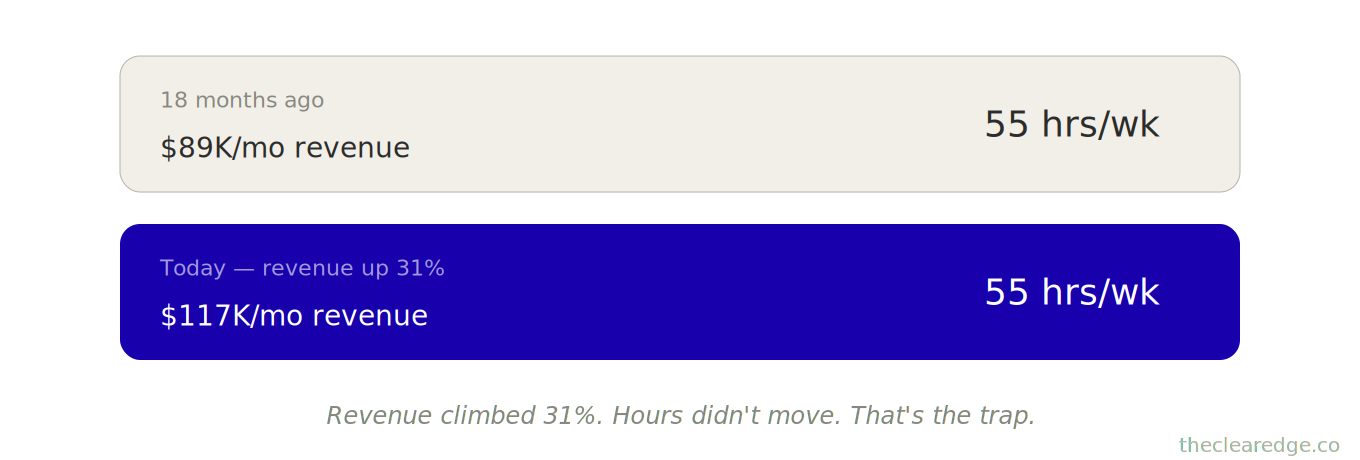
The math revealed the issue
At $117K monthly, her per-hour value was: $117,000 ÷ 220 hours monthly ≈ $532/hour
But not all hours were equal:
Strategy/planning
Generated $40K–$50K monthly in new opportunities → $1,600–$2,000/hour value
Sales calls
Generated $25K–$30K monthly in new revenue → $750–$900/hour value
Email/Slack
Generated $0 revenue → $0/hour value
Administrative
Generated $0 revenue → $0/hour value
She was spending 8 hours weekly (32 hours monthly) on $0/hour work, while $1,600–$2,000/hour work got 6 hours weekly.
The trap is she was working 55 hours to maintain $117K, when she could maintain $117K working 25 hours if she redesigned which 25 hours she was working.
[Pattern Over 18 Months]

$89K  -->  $117K revenue
55 hrs --> 55 hrs time

---

[Hidden Cost]

- More revenue
- SAME total hours
- MORE Tier 3-4 work

--

[Core Fix]

Redesign WHICH 25 hours
you keep as founder
The Hours Trap shows you the cost of staying where you are; the Designer Shift Framework shows you how to rebuild your week around different, higher-value hours instead.
The Designer Shift Framework To Build A 25-Hour Founder Role At $100K–$130K Months
The Designer Shift isn’t about working harder or chasing efficiency hacks. It’s about redesigning your role so you only do $500+/hour activities and either eliminate or delegate everything else.
At $100K/month, here’s the breakdown:
Your time value: $100K ÷ 200 hours monthly = $500/hour baseline capacity
— Activities in your business
Tier 1 ($1,000–$3,000/hour)
Strategic decisions
Key client relationships
High-stakes sales
Revenue architecture
Tier 2 ($500–$1,000/hour)
Team leadership
Process design
Content strategy
Partnership development
Tier 3 ($100–$500/hour)
Client delivery
Sales calls
Team meetings
Operational decisions
Tier 4 ($0–$100/hour)
Email
Admin
Scheduling
Low-level client communication
Routine management
Most founders at $100K spend 30–40% of their week in Tier 3–4 work. That’s 12–16 hours every week where low-value tasks consume high-value founder time.
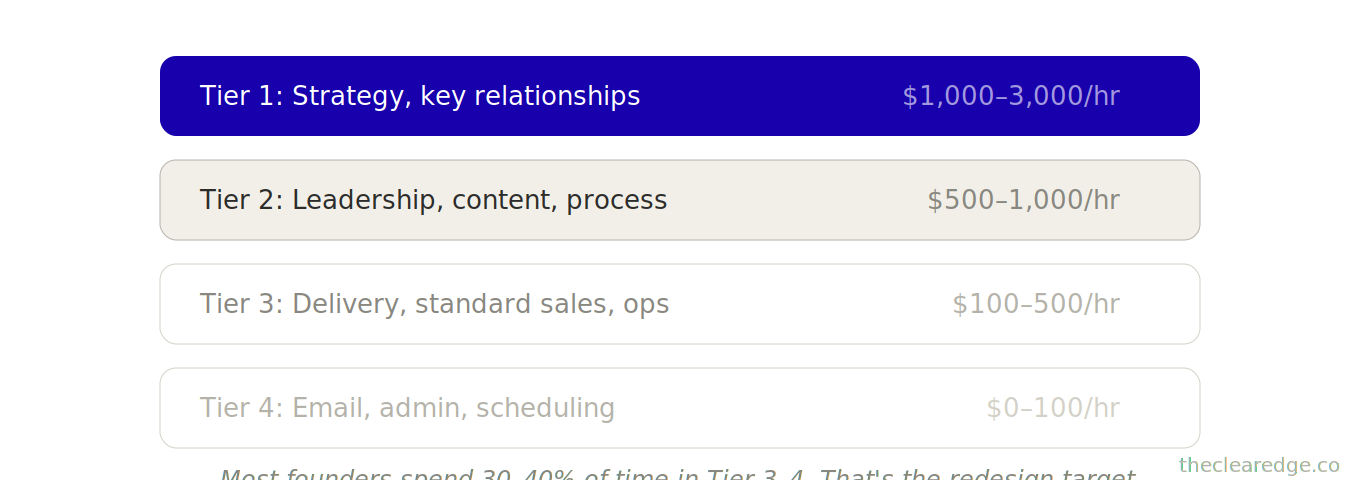
The redesign: keep only Tier 1–2 activities (the 25 hours that generate or protect $100K), eliminate or delegate Tier 3–4 (the 25–35 hours that maintain but don’t multiply).
The 25-Hour Founder Role
Strategic (8–10 hours weekly)
Revenue architecture
Market positioning
Opportunity evaluation
Long-term planning
Leadership (6–8 hours weekly)
Team development
Culture building
Key decisions
Mini-CEO coaching
Revenue (6–8 hours weekly)
High-stakes sales
Key client relationships
Strategic partnerships
Brand building
Learning (3–5 hours weekly)
Industry research
Competitive intelligence
Skill development
Pattern recognition
Total: 23–31 hours weekly. Everything else gets eliminated or delegated to the team.
You’ve seen the 25-hour role on paper; now you’ll walk the three moves that turn scattered 55-hour weeks into a focused, tiered schedule you can actually run.
Move 1: How To Audit Founder Hours By Value Tier At $100K Months
Before you redesign your role, you need to see which hours actually generate $100K and which ones only keep things running.
Track for two weeks and log every hour, noting what you did and which value tier it falls into.
Tracking Method
End of each day, categorize every hour:
Activity: What you actually did
Value tier: 1 ($1K–$3K/hour), 2 ($500–$1K/hour), 3 ($100–$500/hour), 4 ($0–$100/hour)
Delegable: Could someone else do this? (Yes/No/Maybe)
Eliminable: Does this actually matter? (Yes/No/Maybe)
Case — a coaching business at $123K/month audited her hours:
Week 1 breakdown:
Tier 1: 6 hours (strategic planning, key client calls)
Tier 2: 9 hours (team leadership, content strategy)
Tier 3: 19 hours (client delivery, standard sales calls, team meetings)
Tier 4: 14 hours (email, admin, scheduling, Slack management)
Week 2 breakdown:
Tier 1: 7 hours
Tier 2: 8 hours
Tier 3: 21 hours
Tier 4: 12 hours
Averages:
Tier 1: 6.5 hours/week
Tier 2: 8.5 hours/week
Tier 3: 20 hours/week
Tier 4: 13 hours/week
The revelation: she spent 13 hours weekly (52 hours monthly) on Tier 4 work worth $0–$100/hour, when her time was worth $615/hour baseline ($123K ÷ 200 hours).
What It Costs Right Now
Cost of misallocated time:
52 hours monthly × $515–$615 opportunity cost = $26,780–$31,980 monthly in lost capacity.
That’s $321K–$384K yearly of founder capacity spent on work someone earning $20–$35/hour could handle.
How this pattern shows up for most founders at $100K:
Tier 4: 25–35% of time (12–17 hours weekly) on $0–$100/hour work.
Tier 3: another 35–45% (18–23 hours weekly) on $100–$500/hour work.
Total low-value time: 30–40 hours weekly that could be eliminated or delegated.
Audit your hours first. You can’t redesign your role until you measure where every hour actually goes.
[Weekly Time Scan]

Tier 1-2:  ? hrs
Tier 3:   18-23 hrs
Tier 4:   12-17 hrs

Total low-value: 30-40 hrs

---

--> Circle:

- What can I eliminate?
- What can I delegate?
- What must I keep?
The Hours Trap Cost
If you’re still leaking $26,780–$31,980 monthly in Tier 3–4 time, premium gives you the concrete Designer Shift tools to rebuild a 25-hour, $100K–$130K week.
Move 2: How To Eliminate Low-Value Founder Work Before Delegating It
Once you see where your hours actually go, most founders jump straight to delegation. Wrong move.
First step is elimination. Around 30–40% of Tier 3–4 work doesn’t need to exist at all; it’s organizational debt that piled up because no one ever questioned it.
Elimination framework:
Question 1: “What happens if I don’t do this for 30 days?”
If the answer is “nothing breaks” or “minor inconvenience,” eliminate it.
Question 2: “Does this directly generate or protect revenue?”
If the answer is “no” and it’s not legally required, eliminate it.
Question 3: “Am I doing this because it matters or because it’s always been done?”
If the answer is “always been done,” eliminate it.
Case — Agency at $110K/month eliminated work before delegating
Activity: Weekly status report (compiled by founder, sent to team)
Time: 2 hours weekly
Elimination test: “What if I don’t do this for 30 days?” → If nothing breaks and the team doesn’t use the reports (they already check Slack or the project tools), eliminate it.
Decision: Eliminated.
Result: Zero impact on operations. 2 hours weekly freed.
Activity: Monthly all-hands meeting (founder prepared slides, presented updates)
Time: 3 hours monthly (prep + meeting)
Elimination test: “Does this protect revenue?” → The team already knew the updates from daily work.
Decision: Eliminated, replaced with 20-minute async video update
Result: Same information, 80% less time. 2.5 hours monthly freed.
Activity: Monitoring the project management tool daily
Time: 30 minutes daily → 2.5 hours weekly
Elimination test: “Am I doing this because it matters?” → They were checking out of habit, not because issues needed founder attention.
Decision: Eliminated. Told team: “Tag me if something needs attention, I’m not monitoring daily”
Result: 2 tags monthly (vs. 10 hours monthly monitoring). 8 hours monthly freed.
They eliminated 2 hours weekly, 2.5 hours monthly, and another 8 hours monthly—about 12 hours of work each month that simply stopped with no negative impact.
She then audited the remaining Tier 3–4 work and found 8 more activities that could be eliminated with minimal restructuring:
Attending meetings she wasn’t needed in
Reviewing work the team could self-check
Responding to emails that didn’t require her input
Scheduling that an assistant could handle
Client check-ins that account managers could do
Additional elimination: 16 hours monthly.
Total elimination: 28 hours monthly → 7 hours weekly of work that stopped happening.
Revenue impact: $0 (nothing broke).
Time freed: 7 hours weekly before any delegation occurred.
The pattern: at $100K/month, 20–30% of founder work can be eliminated with zero negative impact—that’s 10–15 hours weekly freed just by stopping non-essential work.
Eliminate first. Delegate second.
[Eliminate First]

List all tasks

--> Tag: Revenue / Legal / Habit

---

If NOT revenue or legal AND nothing breaks in 30 days

--> ELIMINATE

---

Target: 20-30% of tasks gone before delegating
Move 3: How To Delegate Every Sub-$500/Hour Task As A $100K Founder
After elimination, you’re left with work that actually matters. Now you delegate everything below your $500/hour baseline.
The delegation threshold is simple. If someone earning $25–$75/hour can do it 80% as well as you, delegate it.
Tier 3–4 delegation targets:
Client delivery → Senior team members (if quality is maintained)
Standard sales calls → Sales team or trained closers
Team meetings → Mini-CEOs run their own meetings
Email management → Executive assistant with response protocols
Scheduling → Executive assistant or automation
Low-level client communication → Account managers
Operational decisions → Mini-CEOs using decision protocols (from The Exit-Ready Business)
Content execution → Content manager (you provide strategy, they execute)
Case — consultant at $128K/month delegated strategically
Delegated to Executive Assistant ($28/hour):
Email triage and response (80% of emails handled, 20% escalated)
Scheduling all meetings
Travel logistics
CRM updates
Invoice follow-ups
Expense tracking
Time saved: 12 hours weekly
Cost: $1,344 monthly (12 hours weekly × 4 weeks × $28/hour)
Net value:
12 hours × $640/hour founder value = $7,680 monthly capacity freed
Cost: $1,344 monthly
Monthly net gain: $6,336
Delegated to Senior Consultant ($65/hour):
All client delivery (founder moved to strategic advisory only)
Standard client check-ins
Implementation support
Problem-solving for routine issues
Time saved: 18 hours weekly
Cost: $4,680 monthly (18 hours weekly × 4 weeks × $65/hour)
Net value:
18 hours × $640/hour = $11,520 monthly capacity freed
Cost: $4,680 monthly
Monthly net gain: $6,840
Delegated to Sales Manager ($55/hour):
Discovery calls (founder only joins high-value prospects $50K+)
Proposal creation
Follow-up sequences
Pipeline management
Time saved: 8 hours weekly
Cost: $1,760 monthly
Net value:
8 hours × $640/hour = $5,120 monthly capacity freed
Cost: $1,760 monthly
Monthly net gain: $3,360
Total delegation math:
Time freed: 38 hours weekly
Delegation cost: $7,784 monthly
Net capacity gain: $16,576 monthly (38 hours × $640/hour − $7,784 cost)
Founder hours after delegation: 55 hours − 38 hours = 17 hours weekly.
But she wasn’t done. She added 8 hours weekly back for Tier 1 strategic work (previously squeezed out by operational tasks).
Final state:
25 hours weekly
8 hours strategic
7 hours leadership
6 hours revenue
4 hours learning
Revenue maintained: $128K monthly (unchanged)
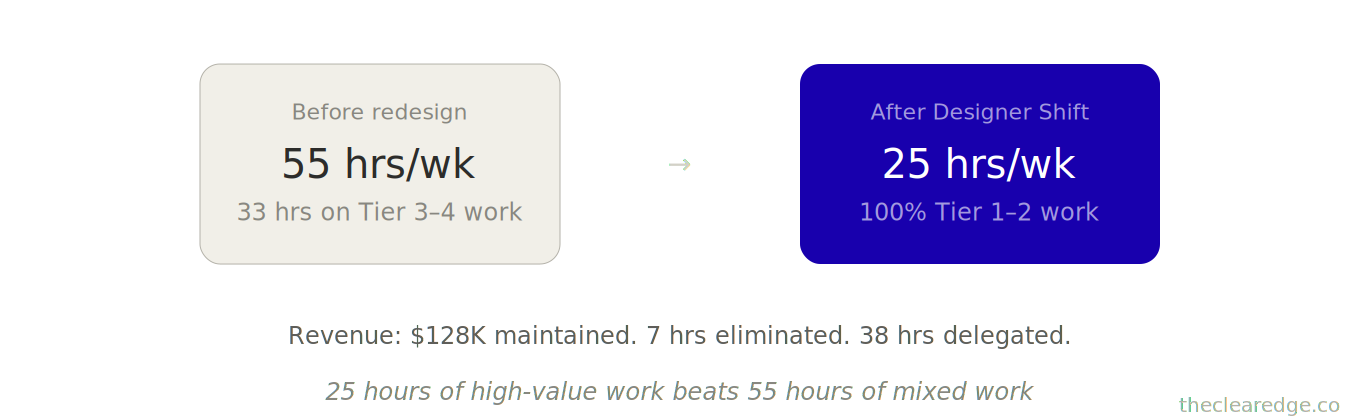
$7,784 monthly delegation cost generated $16,576 monthly in freed capacity, plus maintained $128K revenue while working 30 hours less weekly.
ROI: $2.13 of value per $1 delegation cost, plus 1,560 hours yearly of life returned.
Delegate everything below $500/hour. The math always works.
[Delegate Below $500/Hour]

Step 1: List all tasks
Step 2: Mark hourly value
Step 3: Under $500/hour?
Step 4: Can someone do 80% as well?
Step 5: Assign to EA / senior / sales

You keep only Tier 1-2 work
You have the numbers on elimination, delegation, and net capacity; next is seeing how those choices reshape a real 25-hour calendar you can run at $100K–$130K.
The 25-Hour Founder Role Schedule At $100K–$130K Months
Once you’ve eliminated and delegated, here’s what the 25-hour founder role looks like at $100K/month.
Monday (5 hours):
9–11 am: Strategic planning for the week (Tier 1)
11 am–12 pm: Key client relationship call (Tier 1)
2–4 pm: Team leadership meeting with mini-CEOs (Tier 2)
Tuesday (5 hours):
9–11 am: Revenue architecture work (offer design, pricing strategy, market positioning) (Tier 1)
11 am–1 pm: High-stakes sales calls ($50K+ opportunities only) (Tier 1)
2–3 pm: Learning time (industry research, competitive intel) (Tier 2)
Wednesday (5 hours):
9–11 am: Strategic content creation (thought leadership that builds brand) (Tier 2)
11 am–1 pm: Partnership development calls (Tier 1)
2–3 pm: Opportunity evaluation (assess new business directions) (Tier 1)
Thursday (5 hours):
9–11 am: Team development (coaching mini-CEOs, culture building) (Tier 2)
11 am–1 pm: Key client strategy sessions (Tier 1)
2–3 pm: Process design (systems that scale without a founder) (Tier 2)
Friday (5 hours):
9–11 am: Financial review and strategic decisions (Tier 1)
11 am–1 pm: Long-term planning (Tier 1)
2–3 pm: Skill development (Tier 2)
Total: 25 hours weekly, all Tier 1–2 work.
What’s missing:
Client delivery (delegated to team)
Email management (delegated to EA)
Scheduling (delegated to EA)
Standard sales calls (delegated to sales team)
Routine meetings (eliminated or delegated)
Operational decisions (delegated to mini-CEOs)
Admin work (delegated or eliminated)
Revenue generated by 25 hours: $100K–$130K monthly (same as 50–60 hours of mixed-tier work).
The pattern: 25 hours of high-value work generates the same (or better) revenue as 50+ hours of mixed work because you’re only doing $500–$3,000/hour activities.
What The Designer Shift Changes At $100K Months And What It Costs To Implement
Redesigning your role from 50–60 hours to 25 hours requires three investments.
Investment 1: Executive Assistant
Cost:
$28–$45/hour = $2,000–$3,500 monthly (part-time)
or $4,500–$7,500 monthly (full-time)
Returns: 10–15 hours weekly of founder time freed
Investment 2: Senior Team Member(s)
Cost: $55–$85/hour = $4,000–$7,000 monthly per person
Returns: 15–25 hours weekly of founder delivery time delegated
Investment 3: Systems Documentation
Cost: 40–60 hours founder time, one-time, to document decision protocols, delegation playbooks, and role definitions
Returns: Team operates independently, reducing founder involvement permanently
Total economics:
Total monthly cost: $6,000–$14,500 (depending on team size and rate)
Total time freed: 25–40 hours weekly → 1,300–2,080 hours yearly
For a founder at $100K/month with $500/hour capacity:
Value of freed time: $650K–$1.04M yearly (1,300–2,080 hours × $500)
Cost of delegation: $72K–$174K yearly
Net gain: $476K–$866K yearly in freed capacity
ROI: $6.61–$4.97 value per $1 delegation cost
Plus non-financial returns:
25–35 hours weekly returned to life
8–12 weeks yearly vacation possible (vs. 2–4 weeks before)
Mental clarity from removing Tier 3–4 cognitive load
Strategic capacity to pursue $150K–$200K opportunities
One founder’s reflection after 12 months at 25 hours weekly: “I make the same money in half the time. The business runs better because I’m only doing what I’m uniquely good at.”
The Trade You’re Actually Making
Keeping 50–60 mixed-tier hours instead of a 25-hour Designer Shift week is choosing to spend $26,780–$31,980 every month propping up work your team could own; start reducing, not just rearranging.
Run Your Designer Shift Quick-Gate Checklist
Next time you’re staring at a 50–60 hour week at $100K–$130K months, run these before you accept one more Tier 3–4 task.
☐ Listed today’s hours by activity and Tier 1–4, then totaled how many sit below $500/hour
☐ Calculated today’s Tier 3–4 total against the 30–40 hours weekly benchmark and wrote the monthly $26,780–$31,980 misallocation cost
☐ Scored every sub-$500/hour task with the 30-day elimination questions and marked each as eliminate, delegate, or keep
☐ Compared each “delegate” task to your EA, senior operator, or sales owner and assigned it if they can do it 80% as well
☐ Logged whether today’s schedule stayed inside 23–31 hours of Tier 1–2 work or slid back toward a 55-hour mixed-tier week
Every pass stops another slice of that $321K–$384K yearly founder-time leak from surviving this week.
How To Start The Designer Shift And Build Your Own 25-Hour Founder Week
Start your own Designer Shift by reclaiming 25 hours weekly and rebuilding a $100K–$130K role around Tier 1–2 work only.
Audit your current hours by value tier.
Track for two weeks.
Categorize every hour as Tier 1–4.
Calculate how much time you spend below $500/hour.
Eliminate first.
List every activity you do and ask: “What if I stopped this for 30 days?”
Stop anything that won’t break the business.
Delegate everything below $500/hour.
Hire an EA for Tier 4 work.
Promote or hire a senior team for Tier 3 work.
Document protocols so the team operates independently.
The shift from 50–60 hours to 25 hours typically takes 6–12 months:
2–3 months to eliminate
3–6 months to delegate fully
1–3 months to stabilize the new role
FAQ: Applying The Designer Shift Framework At $100K–$130K Months
Q: How do I know if I need the Designer Shift instead of just better time management?
A: You need it when you’re at $100K–$130K/month, working 50–60 hours weekly, and spending 30–40% of your week on Tier 3–4 work worth $0–$500/hour instead of high-leverage decisions.
Q: How does the Designer Shift free 25 hours a week while keeping $100K–$130K income?
A: It audits your hours by value tier, eliminates 20–30% of low-value tasks, and then delegates everything below $500/hour so your schedule contracts to 23–31 hours weekly of Tier 1–2 work without cutting revenue.
Q: How do I use the value tiers to see which hours are silently wasting $26,780–$31,980 every month?
A: You track two weeks of work, categorize each hour into Tier 1–4, and compare those hours to your baseline $500–$615/hour capacity, just like the $117K/month consultant who discovered 52 monthly hours in Tier 4 worth $0/hour but $321K–$384K/year in lost capacity.
Q: How do I start the Designer Shift if my calendar is already maxed at 55 hours weekly?
A: You begin with a two-week time audit and nightly tier tagging, then use elimination questions to stop 10–15 hours of low-value work before you add any new projects, creating the space needed for documentation and delegation.
Q: How do I decide what to eliminate versus delegate when I’m at $100K months?
A: You first kill anything that won’t break the business if you stop it for 30 days, which typically removes 20–30% of Tier 3–4 work (10–15 hours weekly), then delegate the remaining sub-$500/hour tasks like email, scheduling, standard check-ins, and routine meetings.
Q: How do I use the Designer Shift with an executive assistant, senior operator, and sales to reclaim 25–35 hours weekly?
A: You give your EA all Tier 4 work (email, scheduling, logistics, admin), your senior operator the bulk of delivery and operations decisions, and your sales lead standard calls and follow-ups so your own time drops from 55 hours to around 25 hours while netting $16,536/month in freed capacity after $7,784 in delegation costs.
Q: What does a 25-hour founder role actually look like week to week at $100K months?
A: It’s a 23–31 hour schedule built around 8–10 hours of strategy, 6–8 hours of leadership, 6–8 hours of high-stakes revenue work, and 3–5 hours of learning, with zero recurring client delivery, admin, or low-level communication on your calendar.
Q: How long does the Designer Shift take to fully implement and stabilize?
A: Plan for 2 weeks of tracking, 2–3 months to eliminate 10–15 weekly hours, 3–6 months to delegate another 15–25 hours through hires and systems, and a one-time 40–60 hour documentation push, totaling 6–12 months to lock in a durable 25-hour founder role.
Q: How much is the Designer Shift worth in yearly capacity once I’m at $100K months?
A: Freeing 25–40 hours weekly at a $500/hour baseline unlocks roughly 1,300–2,080 hours per year—$650K–$1.04M in capacity—at a delegation cost of about $72K–$174K annually, leaving a net gain of $476K–$866K plus 8–12 weeks of additional time off.
Up Next: The Founder’s OS For Running $100K Months On 30 Hours Weekly
Next article covers “The Founder’s OS: Run $100K Months on 30 Hours Weekly for $100K–$125K Operators.” You’ll see the complete system that integrates time, energy, strategy, and execution into one founder operating system.
Navigate The Clear Edge OS Systems For Scaling From $5K To $150K Months
Start here: The Complete Clear Edge OS — Your roadmap from $5K to $150K with a 60-second constraint diagnostic.
Use daily: The Clear Edge Daily OS — Daily checklists, actions, and habits for all 26 systems.
LAYER 1: SIGNAL (What to Optimize)
The Signal Grid • The Bottleneck Audit • The Five Numbers
LAYER 2: EXECUTION (How to Optimize)
The Momentum Formula • The One-Build System • The Revenue Multiplier • The Repeatable Sale • Delivery That Sells • The 3% Lever • The Offer Stack • The Next Ceiling
LAYER 3: CAPACITY (Who Optimizes)
The Delegation Map • The Quality Transfer • The 30-Hour Week • The Exit-Ready Business • The Designer Shift
LAYER 4: TIME (When to Optimize)
Focus That Pays • The Time Fence
LAYER 5: ENERGY (How to Sustain)
The Founder Fuel System • $100K Without Burnout
INTEGRATION & MASTERY
The Founder’s OS • The Quarterly Wealth Reset
AMPLIFICATION (AI & Automation)
The Automation Audit • The Automation Stack
⚑ Found a Mistake or Broken Flow?
Use this form to flag issues in articles (math, logic, clarity) or problems with the site (broken links, downloads, access). This helps me keep everything accurate and usable. Report a problem →
› More to Explore: Quick Navigation · The Clear Edge OS
➜ Help Another Founder, Earn a Free Month
If this system just saved you from burning $321K–$384K a year on $0/hour tasks, share it with one founder who needs that relief.
When you refer 2 people using your personal link, you’ll automatically get 1 free month of premium as a thank-you.
Get your personal referral link and see your progress here: Referrals
Get The Toolkit
You’ve read the system. Now implement it.
Premium gives you:
Ready-to-use PDF toolkit—every template, diagnostic, and formula pre-filled, zero setup, immediate use
Plug-and-play AI diagnosis sessions—drop into Claude, Gemini or ChatGPT, answer a few questions, save hours of guessing, get your exact next move
Audio key points—concentrated frameworks you can absorb in minutes, implement while you move
Unrestricted access to the complete library—every system, every update
What this prevents: Spending 50–60 hours weekly at $100K–$130K while $321K–$384K in misallocated founder time slips away.
What this costs: $49/month.
Download everything today. Implement this week. Cancel anytime, keep the downloads.
Already upgraded? Scroll down to download the PDF, audio, and your AI session.
