


The Executive Summary
$100K/month founders risk losing $1.8M–$2.4M in enterprise value by staying founder-dependent; the Clear Edge OS Exit-Ready Framework turns that $100K revenue into an asset that runs without you.
Who this is for: Established founders and operators around $100K/month (often $103K–$119K) with 6–9 person teams who can’t leave for 4–6 weeks without revenue, pipeline, or team stability slipping.
The exit-ready Problem: A 6-week absence can turn $114K → $97K, cost 1 key team member, put 3 clients on notice, and erase $70K–$85K quarterly, cutting valuation from $4.1M to $1.1M–$1.7M.
What you’ll learn: The Exit-Ready Framework inside The Clear Edge OS: five systems (independent Sales, documented Delivery, delegated Leadership, adaptive Strategy, protocol-driven Finance) plus three moves—Document Decision Protocols, build 2–3 Mini-CEOs, and create Strategic Autopilot.
What changes if you apply it: Over 18–36 months and 200–300 hours, you shift 50–70% of 30–50 recurring decisions monthly to the team, free 17–29 hours weekly, and turn a $103K, 58‑hour, 2‑weeks‑off business into a $143K, 24‑hour, 9‑weeks‑off company valued $6.2M instead of $2.8M.
Time to implement: About 40–60 hours in Months 1–6 to document 15–25 decision protocols, 120–180 hours in Months 7–18 to build leadership redundancy, and 40–60 hours in Months 19–36 to install Strategic Autopilot—roughly 5–6 hours monthly compounding into 25–35 hours weekly freedom and $600K–$2.4M in captured value over three years.
Written by Nour Boustani for $100K-month founders and operators who want exit-ready $100K revenue that runs without them—so they can exit, scale, or step back—without sacrificing income or watching their business stall the moment they step away.
Decision bottlenecks, not effort, cap your $100K months; premium helps you document Decision Protocols and deploy the Exit-Ready Framework across your five systems.
› Library Navigation: Quick Navigation · The Clear Edge OS
The Golden Handcuffs of Founder-Dependent $100K-Month Businesses
Founder-dependent at $100K/month looks normal from the outside with strong revenue, happy clients, and working systems—but the business stalls the moment you’re gone for more than two weeks.
A consultant at $114K/month found this out the hard way when a health issue forced 6 weeks away, with a team of six, documented processes, and systems that only worked as long as she was in the room.
The business didn’t run without her; it was her.
Weeks 1–6: What actually happened
Week 1 → Team handled existing clients fine. No new sales (founder handled all discovery calls).
Week 2 → Client questions escalated (team couldn’t answer strategic issues). Revenue steady, pipeline empty.
Week 3 → Key client threatened to leave (wanted founder involvement, not team). No new contracts signed.
Week 4 → Team member quit (couldn’t handle pressure without founder’s leadership). Pipeline dried up completely.
Weeks 5–6 → Revenue started declining as contracts ended without renewals. Team panicked.
She returned to find: $114K → $97K monthly revenue (15% drop), 1 team member gone, 3 clients on notice, and zero pipeline for next quarter.
Cost of founder dependency (6 weeks away)
$70K–$85K quarterly impact from 6 weeks’ absence:
$17K monthly immediate drop
$45K–$60K quarterly pipeline loss
$8K monthly (lost team member capacity)
What the math really says
Her $114K monthly business wasn’t worth $4.1M over 36 months based on a typical three-times-annual-revenue multiple, so the actual valuation was heavily discounted to a range of $1.1M–$1.7M due to founder dependency.
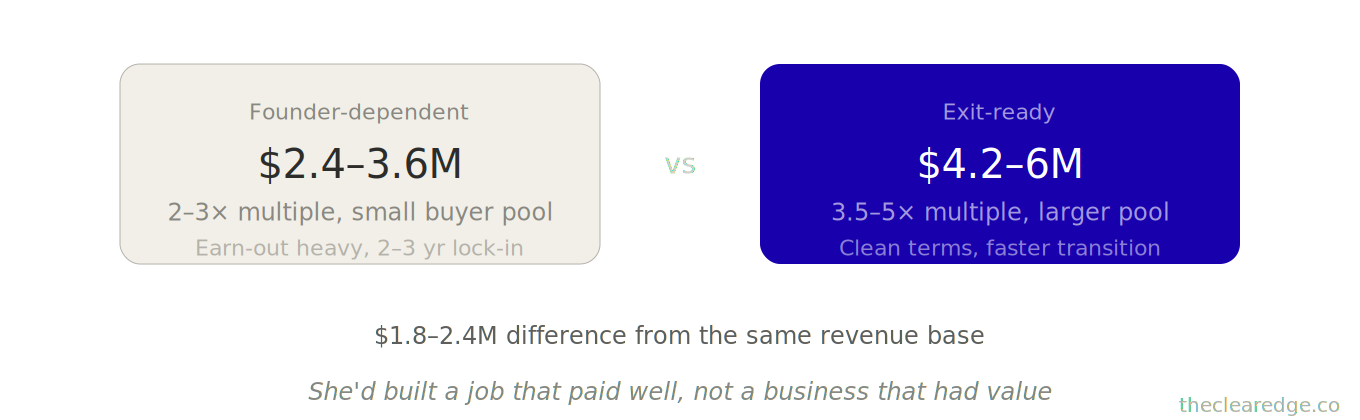
She’d built a job that paid well, not a business that had value.
The pattern: At $100K/month, 68% of founders are building founder-dependent businesses.
They’ll never exit.
They’ll never scale past themselves.
They’ll never have true optionality.
[Founder-Dependent $100K Month]

- Week 1  --> Clients fine, no new sales
- Week 2  --> Escalations, empty pipeline
- Week 3  --> Key client on edge
- Week 4  --> Team member quits
- Weeks 5-6 --> Revenue drops, panic

Result --> $70K-$85K quarterly hit
Exit-Ready In Real Life
Now that the founder-dependent pattern is clear, upgrade to premium to use the Exit-Ready Framework toolkit and walk your own $100K business through the same five systems and three moves.
The Exit-Ready Framework: Five Systems That Let a $100K Business Run Without You
Exit-ready doesn’t mean planning to sell; it means building a business that can run without you whether you exit, stay, or scale.
The optionality: if the business runs without you, you have four choices instead of one.
Choice 1: Exit (sell the business)
Choice 2: Step back (stay owner, remove yourself from operations)
Choice 3: Scale (grow without hitting your capacity ceiling)
Choice 4: Stay (but with freedom to take time off, pursue projects, live life)
Founder-dependent businesses give you zero choices, while exit-ready businesses give you all four.
The architecture: five systems that run independently of founder involvement
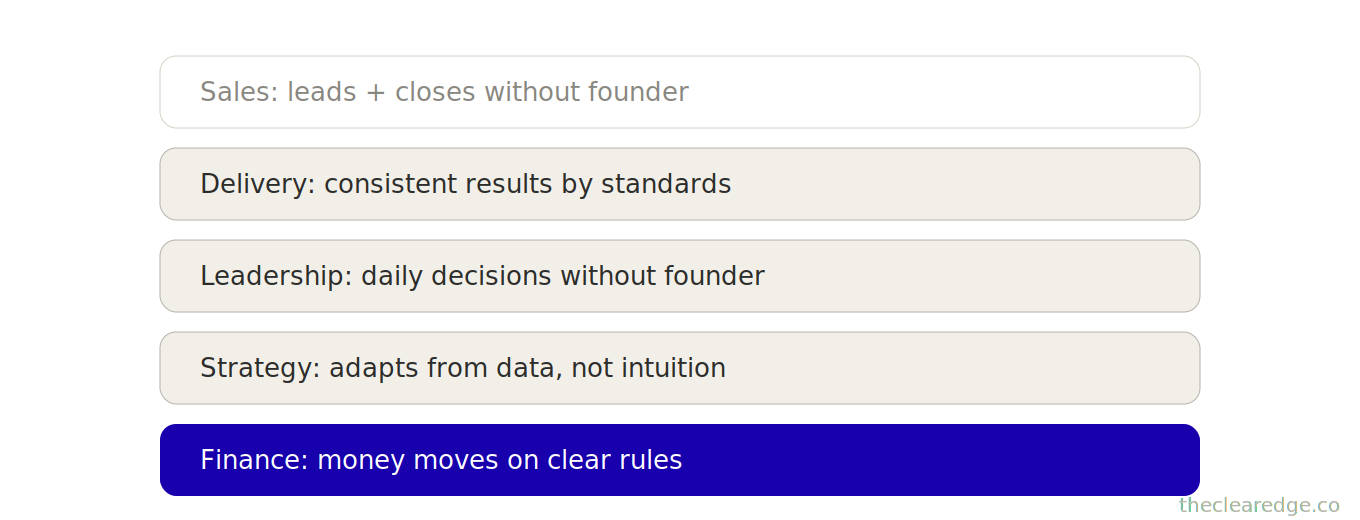
System 1: Sales (Independent Lead Generation + Conversion)
New clients come in without the founder on every call because the sales process is documented and the team handles both qualification and closing.
System 2: Delivery (Documented Service Standards)
Client outcomes don’t depend on founder touch because quality is maintained by the team following systems rather than the founder’s expertise.
System 3: Leadership (Team Operates Without Constant Direction)
Decisions get made daily without the founder’s input because the team knows the priorities, criteria, and boundaries.
System 4: Strategy (Business Adapts Without Founder Vision)
Market changes get identified and addressed by the team, and strategy evolves based on data and systems rather than founder intuition alone.
System 5: Finance (Money Moves Without Founder Approvals)
Revenue collection, expense management, and financial decisions follow clear protocols instead of relying on founder gatekeeping.
At $100K/month, building all five systems takes 18–36 months, and each one adds 20–30% to enterprise value and 10–15 hours of weekly founder freedom.
[Exit-Ready Framework - 5 Systems]

- Sales    --> Leads + closes without founder
- Delivery --> Consistent results by standards
- Leadership --> Daily calls without founder
- Strategy --> Adapts from data, not intuition
- Finance  --> Money moves on clear rules

All 5 → Business runs without you
Move 1: How to Document Decision Protocols in a $100K Founder-Dependent Business
Before systems can run without you, your team needs to know how you make decisions and be able to replicate that logic without asking you.
Most founders think they’ve documented processes, but they’ve documented tasks like “how to onboard a client,” not decisions like “when to discount pricing” or “which projects to decline.”
The gap is that tasks are mechanical while decisions require judgment, so without decision protocols the team can execute tasks but still needs the founder for 20–40 judgment calls every week.
Decision protocol structure:
Decision Type: [What decision needs to be made]
Frequency: [How often this decision occurs]
Criteria: [Specific factors that determine the decision]
Authority: [Who makes the decision, at what threshold]
Escalation: [When to involve founder vs. decide independently]
Case — a coaching business at $109K/month documented her decision protocols:
Decision Type: Client fit assessment (should we take this client?)
Frequency: 8–12 times monthly
Criteria:
Budget: $5K+ minimum project size (auto-qualify)
Timeline: Client available 4+ weeks for engagement (requirement)
Readiness: Completed pre-work assessment with 70%+ score (requirement)
Values alignment: Passes culture fit checklist (5 questions, 4/5 must be yes)
Authority:
$5K–$15K projects: Team decides (using criteria)
$15K–$30K projects: Team lead approves
$30K+ projects: Founder reviews (strategic importance)
If the criteria are unclear or the client doesn’t fit cleanly, the team documents the case, and the founder decides within 24 hours and updates the criteria for future decisions.
Before documentation: the founder made every client fit decision.
8–12 decisions monthly × 30 minutes → 4–6 hours monthly of founder time.
After documentation: the team makes 80% of decisions independently.
The founder reviews only deals above $30K or true edge cases, which works out to just 1–2 decisions monthly and about 0.5–1 hour of founder time.
Time saved: 3.5–5 hours monthly on one decision type.
She documented 23 recurring decisions over 6 months:
Client fit assessment
Pricing flexibility (when to discount, how much)
Scope changes (approve or decline)
Team conflict resolution
Marketing budget allocation
Partnership evaluation
Content topic selection
Refund requests
Client extensions
Hiring decisions (under $75K yearly)
And 13 others
Result:
Total time saved: 23 decisions at 3–5 minutes each comes to 69–115 minutes of monthly founder decision-making delegated to the team.
That’s 17–29 hours weekly returned to the founder while decision quality stays equal or better because criteria are explicit instead of implicit founder judgment.
Founders at $100K typically make 30–50 recurring decisions every month.
If you document 15–25 of the highest-frequency decisions in the first 6 months, you shift 50–70% of the founder’s decision load to the team.
Document decisions, not just tasks.
[Decision Protocol Checklist]

1) List 30-50 decisions
2) Pick 15-25 high-frequency
3) Capture type + frequency
4) Define clear criteria
5) Assign decision authority
6) Set escalation rules
7) Train, then test with real cases
Once you’ve moved judgment into decision protocols, the next constraint isn’t documentation, it’s people who can carry those calls without you.
Move 2: How to Build Leadership Redundancy With 2–3 Mini-CEOs
Once decision protocols exist, you need team members who can execute them without you and create real leadership redundancy.
Most founders at $100K have team members who do work but can’t lead work, so if the founder disappears, execution continues for a week and then stalls when questions arise.
The fix is to build 2–3 mini-CEOs who can operate entire business functions independently.
A mini-CEO is a team member who owns an entire function, not just tasks, and makes strategic decisions within that function using documented protocols.
Functions to build redundancy:
Client Delivery (Mini-CEO of Service)
Owns all client-facing work
Makes delivery decisions
Handles quality issues
Reports outcomes, not seeking approvals
Sales/Marketing (Mini-CEO of Revenue)
Owns lead generation and conversion
Makes campaign decisions
Adjusts strategy based on data
Reports performance, not asking permission
Operations (Mini-CEO of Systems)
Owns internal efficiency
Makes process decisions
Solves bottlenecks
Reports optimizations, not requesting authority
An agency at $127K/month built leadership redundancy
Before:
9 team members, all executors
The founder made all decisions across delivery, sales, and operations
When the founder is absent, the business stalls.
After (18 months building redundancy)
Mini-CEO of Delivery (senior account manager promoted + trained):
Owns all 14 active clients
Makes scope decisions, quality calls, and team assignments
Reports: weekly client health scores, and monthly retention metrics
Founder involvement: zero unless the client threatens to leave
Mini-CEO of Revenue (marketing lead promoted + trained):
Owns pipeline from lead gen through close
Makes campaign budgets, hiring decisions (under $60K), strategy pivots
Reports: monthly lead flow, conversion, and CAC trends
Founder involvement: quarterly strategy reviews only
Mini-CEO of Operations (operations manager hired + trained):
Owns all systems, tools, processes, and team efficiency
Makes vendor decisions, tool switches, workflow changes
Reports: quarterly efficiency gains and cost optimizations
Founder involvement: zero unless major cost change (>$5K monthly)
Result: Founder took a 4-week sabbatical in month 18
Business during the founder’s absence:
Revenue: $127K → $131K (new sales continued)
Client satisfaction: 94% (unchanged)
Team escalations to founder: 3 total (2 strategic, 1 emergency)
Operations: 100% smooth
Result:
Cost of building redundancy: 180–240 hours founder time over 18 months (training, documentation, and delegation).
Return: Founder went from 60-hour weeks to 25-hour weeks, from 4 weeks off yearly to 8 weeks, and enterprise value increased 40% (reduced founder dependency premium).
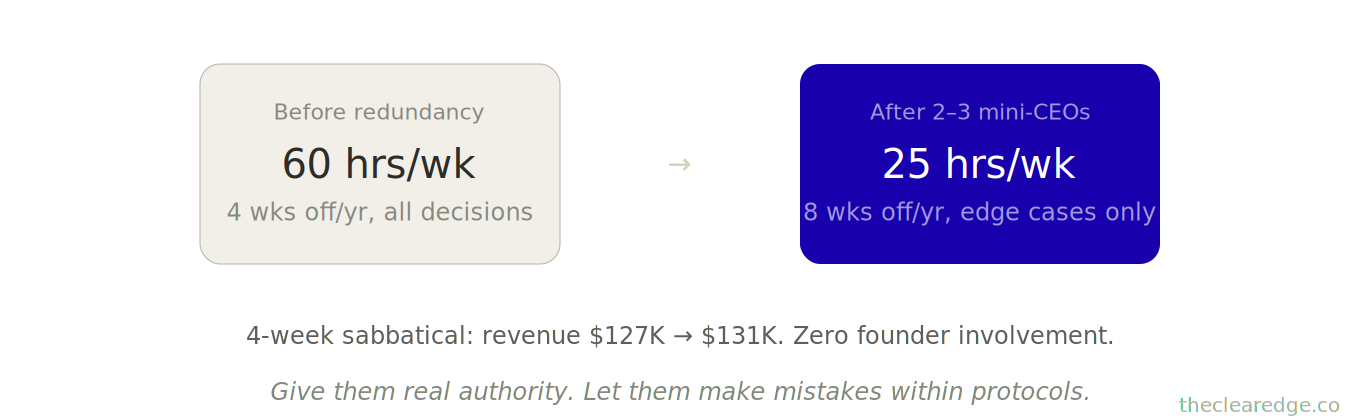
Build 2–3 mini-CEOs, give them real authority, let them make mistakes within protocols, and train them to think strategically rather than just execute tactically.
Move 3: How to Create Strategic Autopilot So Strategy Runs Without the Founder
Even with decision protocols and leadership redundancy, most founder-dependent businesses still need a founder for strategic direction—where to go next, what to build, which opportunities to pursue.
The final system: a strategic autopilot that lets the business adapt without the founder constantly steering.
Strategic autopilot components
Component 1: Data-Driven Priorities
Business decisions driven by dashboard metrics (from The Five Numbers), not founder intuition.
→ Team knows that if metric X drops >10%, we activate protocol Y.
Component 2: Annual Planning Ritual
Once a year, the team and the founder set 12-month objectives.
→ Team executes throughout the year without the founder needing to course-correct monthly.
Component 3: Quarterly Review Protocol
Every 90 days, the team reviews metrics, adjusts tactics, and updates the founder.
→ Founder approves/adjusts strategy, team executes next 90 days independently.
Component 4: Opportunity Filter
Clear criteria for what opportunities to pursue vs. decline.
→ Team evaluates against the filter, escalates only if unclear.
Case — a consultant at $119K/month built a strategic autopilot
Component 1 – Dashboard Priorities:
If conversion rate drops >5%: team activates sales training protocol
If churn increases >8%: team activates retention intervention protocol
If lead flow drops >15%: team activates marketing boost protocol
If profit margin drops >5 points: team activates cost audit protocol
Team watches the dashboard weekly, activates protocols without founder involvement, and reports monthly: “Activated X protocol because Y metric moved, results: Z.”
Component 2 – Annual Planning:
January: Founder and team set 3 major objectives for the year (e.g., “Launch group program,” “Hit $175K monthly,” “Hire 2 senior team members”).
Team builds quarterly milestones under each objective.
Team executes throughout the year, reporting progress quarterly.
Component 3 – Quarterly Reviews:
March/June/September/December: 90-minute meeting with the founder.
Team presents: metrics, objectives, progress, wins, blockers.
Founder adjusts strategy if needed (rare), approves tactics for next 90 days.
Founder time: 6 hours yearly (4 meetings × 90 minutes).
Component 4 – Opportunity Filter: Pursue opportunities that:
Align with annual objectives (score 8/10+ on alignment).
Require <40 hours of team time to test.
Could generate $10K+ monthly if successful.
Don’t require founder delivery.
Decline opportunities that:
Don’t align with objectives.
Require founder involvement.
Would distract from the core business.
Team evaluates 2–3 opportunities monthly using the filter. 90% get decided without founder input.
Result after 12 months:
Founder strategic time: 25 hours yearly (vs. 200+ hours before autopilot).
Business performance: $119K → $158K monthly (team executed strategy independently).
Founder lifestyle: 4-day workweeks, 10 weeks off yearly.
The autopilot doesn’t eliminate founder—it eliminates constant founder involvement. Business runs 90% independently, founder steers 10% strategically.
[Strategic Autopilot Flow]

- Metrics move  --> Trigger protocol
- Quarter ends  --> Run review ritual
- New idea      --> Apply opportunity filter
- Only unclear  --> Escalate to founder
- Everything else --> Team decides, executes
With the three moves in place, the question shifts from “Can this run without me?” to “What’s this business actually worth as an asset?”
The Enterprise Value Premium of Making a $100K Business Exit-Ready
Here’s what happens to business value when you build exit-ready systems:
Typical $100K/month business (founder-dependent)
Multiple: 2–3X annual revenue (heavily discounted)
Valuation: $2.4M–$3.6M
Buyer pool: small (acquirer needs founder to stay)
Sale terms: earn-out heavy (2–3 years founder commitment)
Exit-ready $100K/month business
Multiple: 3.5–5X annual revenue (premium for independence)
Valuation: $4.2M–$6M
Buyer pool: larger (business runs without a founder)
Sale terms: cleaner (minimal earn-out, faster transition)
Difference: $1.8M–$2.4M in enterprise value from the same revenue base.
But here’s what most founders miss: you don’t need to exit to capture this value.
Value of exit-ready systems (without selling)
Lifestyle value: 30–40 hours weekly time savings about 1,560–2,080 hours yearly of founder freedom
Capacity value: founder freed up to build new ventures, pursue board seats, write books, speak—$50K–$200K yearly in parallel income opportunities
Scale value: the business can grow past the founder’s capacity ceiling, so moving from $100K to $200K+ becomes possible without the founder doubling their hours.
Risk value: business survives founder illness, burnout, or life events. $100K monthly doesn’t collapse to $0 if the founder needs to step away.
Case — service business tracked value creation:
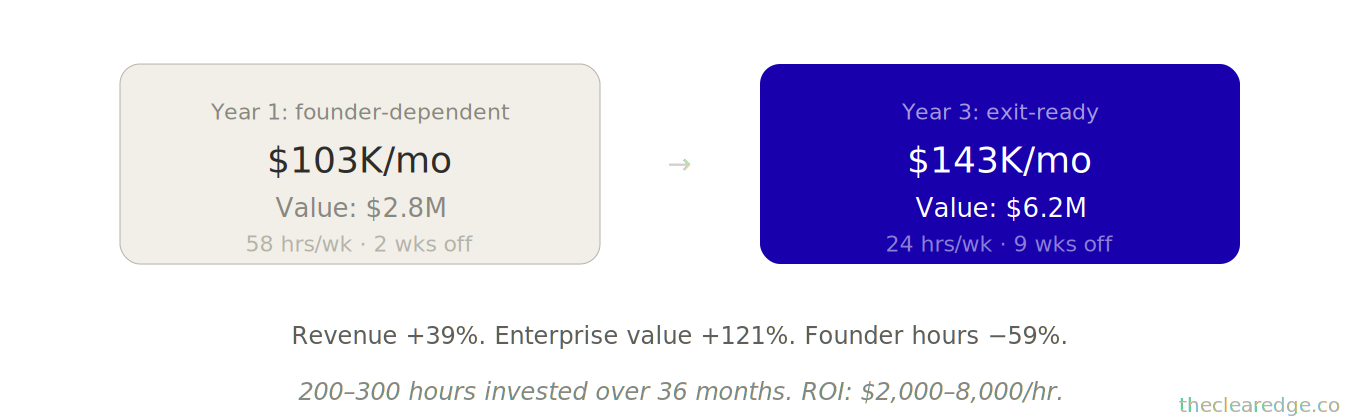
Year 1: $103K monthly, founder-dependent
Enterprise value: ~$2.8M (2.7X annual)
Founder hours: 58 weekly
Weeks off: 2 yearly
Year 3: $143K monthly, exit-ready systems built
Enterprise value: ~$6.2M (4.3X annual)
Founder hours: 24 weekly
Weeks off: 9 yearly
Revenue increased 39%. Enterprise value increased by 121%. Founder hours decreased 59%.
Those numbers only matter if the time and focus it takes to earn them are clear, so we need to make the 18–36 month investment feel concrete.
What Changes and What It Costs to Make a $100K Business Exit-Ready
Building exit-ready systems requires 18–36 months and three phases:
Phase 1: Document Decision Protocols (Months 1–6)
Identify 30–50 recurring decisions.
Document 15–25 highest-frequency.
Train the team to use protocols.
Time cost: 40–60 hours founder time over 6 months.
Phase 2: Build Leadership Redundancy (Months 7–18)
Promote or hire 2–3 mini-CEOs.
Train them to own functions.
Transfer authority gradually.
Time cost: 120–180 hours founder time over 12 months.
Phase 3: Create Strategic Autopilot (Months 19–36)
Build dashboard-driven priorities.
Establish a quarterly rhythm.
Implement opportunity filter.
Time cost: 40–60 hours founder time over 18 months.
Total investment is 200–300 hours over 36 months, which works out to an average of 5–6 hours per month.
The return:
$1.8M–$2.4M enterprise value increase
25–35 hours weekly time savings (ongoing)
6–10 weeks of additional time off yearly
$50K–$200K yearly capacity for parallel ventures
Optionality to exit, scale, step back, or stay
For a founder at $100K/month, that’s $600K–$2.4M in captured value over 3 years from 200–300 hours invested.
ROI: $2,000–$8,000 per hour invested.
One founder’s reflection at Year 3: “I built the business to make money. I built exit-ready systems to have a life.”
[18-36 Month Investment Map]

Phase 1 --> 40-60 hrs (Decisions)
Phase 2 --> 120-180 hrs (Leaders)
Phase 3 --> 40-60 hrs (Autopilot)

Total --> 200-300 hrs

Return --> $600K-$2.4M value
The Cost Of Staying Founder Dependent
If you keep a $100K/month business founder-dependent, you’re choosing to trade $1.8M–$2.4M in asset value for a well-paid job; start building the Exit-Ready version instead.
Run the Exit-Ready Decision Protocols Quick-Gate Checklist
Next time you’re about to step away for 4–6 weeks, run these before you commit.
☐ Listed your 30–50 recurring decisions and circled the 15–25 highest-frequency calls you still personally make each month.
☐ Wrote full Decision Protocols for all circled calls using type, frequency, all criteria, authority levels, and escalation rules exactly as you use them.
☐ Scored what percentage of those 15–25 decisions your team can now make independently, and logged the share that still routes back to you.
☐ Calculated monthly founder hours saved using those protocols (3–5 minutes per decision × delegated volume) and compared against your current 58-hour weeks.
☐ Logged whether at least 50–70% of your 30–50 recurring decisions now run through protocols and Mini-CEOs instead of requiring your direct judgment.
Every time you run this, you’re catching $1.8M–$2.4M in enterprise value before founder dependency discounts it into a well-paid job.
Your Turn: First 6–9 Month Steps to Reduce Founder Dependency
Start here if you want the next 6–9 months to start breaking founder dependence instead of just surviving another $100K cycle.
Audit your business for founder dependency. Which decisions only you make? Which functions collapse without you? That’s your starting point.
Document 5 decision protocols this quarter. Pick the highest-frequency decisions that consume 3–5 hours monthly of your time. Give the team criteria to decide independently.
Identify one function to build leadership redundancy around. Promote someone or hire a mini-CEO. Transfer real authority over the next 6–9 months.
The shift from founder-dependent to exit-ready typically shows measurable impact within 6–9 months: first decisions delegated, first mini-CEO operating independently, founder hours declining.
FAQ: How to Build an Exit-Ready $100K Business That Runs Without the Founder
Q: How do I know if I’m stuck with a founder-dependent $100K business instead of an exit-ready one?
A: You’re founder-dependent if you’re around $103K–$119K/month with a 6–9 person team and can’t step away for 4–6 weeks without revenue dropping, clients escalating, or key people leaving, like the $114K/month consultant whose 6-week absence caused a $17K monthly drop and a $70K–$85K quarterly hit.
Q: How does the Exit-Ready Framework turn my $100K revenue into a business that runs without me?
A: It installs five systems—independent Sales, documented Delivery, delegated Leadership, adaptive Strategy, and protocol-driven Finance—plus three moves (Decision Protocols, 2–3 Mini-CEOs, Strategic Autopilot) over 18–36 months and 200–300 hours so 50–70% of your 30–50 recurring decisions each month shift to the team.
Q: How do I use Decision Protocols to stop answering the same 20–40 questions every week?
A: You document 15–25 high-frequency decisions with type, criteria, authority, and escalation rules so the team can make about 80% of those calls alone, as in the $109K/month coach who cut one decision type from 4–6 founder hours monthly to 0.5–1 hour and saved 69–115 minutes monthly across 23 recurring decisions.
Q: How do I build 2–3 Mini-CEOs so Delivery, Revenue, and Operations keep running if I’m gone for a month?
A: You promote or hire leaders over each function, give them authority inside clear protocols, and train them over 12–18 months so they own all client work, all lead and sales decisions, and all systems, like the $127K agency whose founder took a 4‑week sabbatical while revenue rose to $131K and escalations dropped to 3 total.
Q: How does Strategic Autopilot keep the business adapting without me steering every week?
A: You wire your dashboard to trigger predefined protocols when metrics move (for example, a >10% drop in a key number), run a 12‑month planning ritual, hold four 90‑minute quarterly reviews, and use an opportunity filter so the team can adjust tactics and pursue or decline opportunities while you invest about 25 strategic hours per year.
Q: What happens to enterprise value if I stay founder-dependent at $114K/month instead of building Exit-Ready systems?
A: You’re likely looking at a discounted 2–3X multiple and $1.1M–$1.7M valuation because the business collapses when you step away, instead of the $4.1M+ implied by $114K × 36 months or the $4.2M–$6M range exit-ready businesses command at 3.5–5X revenue.
Q: How long does it take to make a $100K business exit-ready and what’s the time cost to me as founder?
A: Plan on 18–36 months and roughly 200–300 founder hours: 40–60 hours in Months 1–6 for documenting 15–25 decision protocols, 120–180 hours in Months 7–18 for building 2–3 Mini-CEOs, and 40–60 hours in Months 19–36 for Strategic Autopilot—about 5–6 hours per month on average.
Q: What changes in my weekly life once these systems are installed compared to my current 58‑hour founder grind?
A: In the case study, the founder went from a $103K, 58‑hour, 2‑weeks‑off business to a $143K, 24‑hour, 9‑weeks‑off company over three years, shifting most decisions to the team and spending their time on a small set of strategic reviews and optional projects.
Q: How much value can I realistically create over 3 years by making my $100K business exit-ready, even if I never sell?
A: The service business example increased enterprise value from about $2.8M to $6.2M (+$3.4M), cut weekly hours from 58 to 24, added 7 more weeks off per year, and created $50K–$200K of yearly capacity for new ventures—all from 200–300 hours of system-building, an effective return of $2,000–$8,000 per hour invested.
Up Next: The Designer Shift for $100K Operators
Next article covers “The Designer Shift: Free 25 Hours and Keep $100K Income for $100K–$120K Operators” I will show you how to redesign your role in the business to maximize freedom while protecting revenue.
Navigate The Clear Edge OS Systems for Scaling From $5K to $150K
Start here: The Complete Clear Edge OS — Your roadmap from $5K to $150K with a 60-second constraint diagnostic.
Use daily: The Clear Edge Daily OS — Daily checklists, actions, and habits for all 26 systems.
LAYER 1: SIGNAL (What to Optimize)
The Signal Grid • The Bottleneck Audit • The Five Numbers
LAYER 2: EXECUTION (How to Optimize)
The Momentum Formula • The One-Build System • The Revenue Multiplier • The Repeatable Sale • Delivery That Sells • The 3% Lever • The Offer Stack • The Next Ceiling
LAYER 3: CAPACITY (Who Optimizes)
The Delegation Map • The Quality Transfer • The 30-Hour Week • The Exit-Ready Business • The Designer Shift
LAYER 4: TIME (When to Optimize)
Focus That Pays • The Time Fence
LAYER 5: ENERGY (How to Sustain)
The Founder Fuel System • $100K Without Burnout
INTEGRATION & MASTERY
The Founder’s OS • The Quarterly Wealth Reset
AMPLIFICATION (AI & Automation)
The Automation Audit • The Automation Stack
⚑ Found a Mistake or Broken Flow?
Use this form to flag issues in articles (math, logic, clarity) or problems with the site (broken links, downloads, access). This helps me keep everything accurate and usable. Report a problem →
› More to Explore: Quick Navigation · The Clear Edge OS
➜ Help Another Founder, Earn a Free Month
If this system helped you avoid losing $1.8M–$2.4M in enterprise value by staying founder-dependent at $100K months, share it with one founder who needs that relief.
When you refer 2 people using your personal link, you’ll automatically get 1 free month of premium as a thank-you.
Get your personal referral link and see your progress here: Referrals
Get the Exit-Ready Business Toolkit for $100K Operators
You’ve read the system. Now implement it.
Premium gives you:
Ready-to-use PDF toolkit—every template, diagnostic, and formula pre-filled, zero setup, immediate use
Plug-and-play AI diagnosis sessions—drop into Claude, Gemini or ChatGPT, answer a few questions, save hours of guessing, get your exact next move
Audio key points—concentrated frameworks you can absorb in minutes, implement while you move
Unrestricted access to the complete library—every system, every update
What this prevents: Leaving $1.8M–$2.4M in enterprise value on the table by keeping your $100K business founder-dependent.
What this costs: $49/month.
Download everything today. Implement this week. Cancel anytime, keep the downloads.
Already upgraded? Scroll down to download the PDF, audio, and your AI session.
