


The Executive Summary
$50K–$70K/month founders risk locking nearly $1M of capacity behind their calendars by treating time problems as productivity issues; building a 30-hour week system creates independence while maintaining $50K+ revenue.
Who this is for: $50K–$70K/month founders like the $67K/month consultant with 7 team members who work 60–64 hours, can’t take a calm week off, and feel everything collapses without them.
The founder-dependency problem: Even with 17 SOPs, 8 templates, 4 dashboards, and 2 tools, founders stay at 60+ hours because execution systems replace tasks, not decisions—locking up to $996,000 of capacity in 12 months at a $500/hour rate.
What you’ll learn: The 30-Hour Week Framework—Layer 1: Self-Managing Operations, Layer 2: Decision Distribution, Layer 3: Strategic Focus—plus systems like project ownership with authority, status dashboards, escalation rules, decision trees, and role redesign.
What changes if you apply it: Over 6 months, founders go from 64-hour firefighting weeks to 30-hour schedules where project leads run operations, teams handle 71–80% of decisions, and founders spend 80% of time on non-delegable leverage.
Time to implement: Expect 31–40 hours over 6 months to build all three layers, returning 30 hours weekly (1,560 hours yearly) and preventing roughly $2.34M of lost founder capacity over 3 years.
Written by Nour Boustani for $50K–$70K/month founders and operators who want 30-hour weeks with $50K+ revenue—without burning out, micromanaging, or watching everything break when they step away.
If you’re in the $50K–$70K band and your business collapses when you step back, upgrade to premium and build the 30-Hour Week engine that runs without you.
› Library Navigation: Quick Navigation · The Clear Edge OS
Why Your $50K–$75K Business Still Needs You 60 Hours Weekly
Twice in a row, a $67,000/month founder with 7 team members and 64-hour weeks tried a simple 5-day break—and each time came back to stacked decisions, client issues, and festering conflict.
That’s the shape of being stuck at 60 hours—the business depends on you for everything, not on better time management.
When a 5-Day Break Exposes the Dependency
First attempt
Founder left the business for 5 days while the team ran operations without him.
Team handled all client work and deliverables without missing anything.
3 strategic decisions piled up, 2 client issues escalated, and 1 team conflict festered while he was away.
He spent 12 hours after returning to clean up decisions, client problems, and the team conflict.
Net result: the “vacation” created more stress for the founder than if he had stayed and worked.
Second attempt
Founder prepared more thoroughly before leaving—documented decisions and set clear protocols for the team.
The break still failed to work; he came back to the same kind of stress and cleanup.
The issue wasn’t documentation; no one owned the business when he wasn’t there to make calls.
The team executed tasks correctly but didn’t manage priorities, trade-offs, or problems at the business level.
5-Day Break Outcome
Revenue during his absence: $67K for the week, fully maintained.
Founder stress level: catastrophic, defeating the entire point of taking time off.
Operational damage: medium; nothing visibly broke, but growth and momentum stalled while he was away.
“I can’t leave without everything falling apart,” he said.
I asked to see his systems.
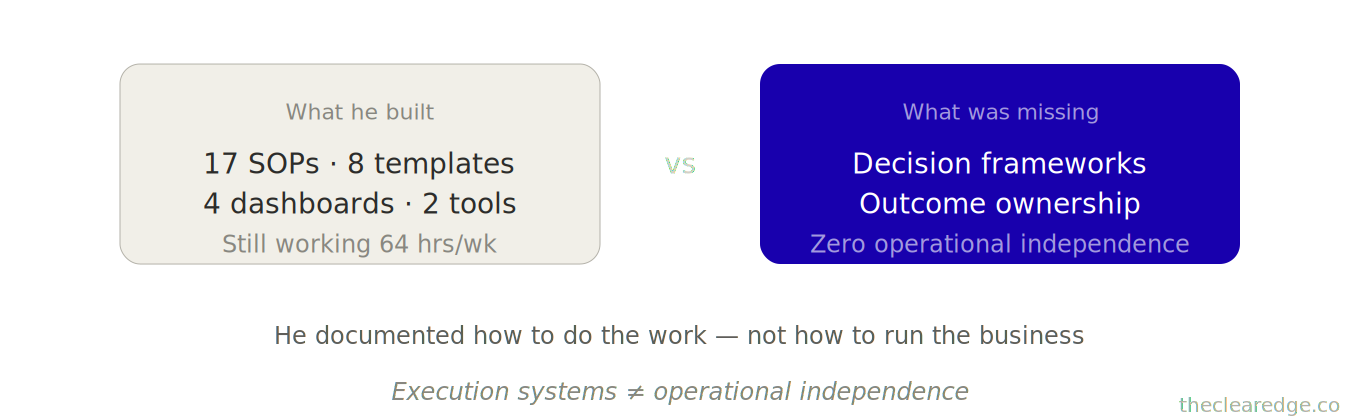
17 SOPs for client delivery
8 templates for common tasks
4 dashboards tracking metrics
2 project management tools with workflows
Good execution systems. Zero operational independence.
The gap
He’d documented how to do the work but not how to run the business, so his team could execute when he directed but couldn’t operate when he didn’t.
The math on founder dependency
64 working hours every week
277 working hours every month
40% of those hours are truly strategic work only you can do (generous assumption)
The remaining 166 hours each month are tasks that should be systematized
At a $500/hour founder rate, those 166 hours represent $83,000 in monthly opportunity cost
Over 12 months: $996,000 in capacity locked behind founder dependency.
But here’s the deeper cost: he couldn’t pursue partnerships, build new products, or scale marketing because he was trapped in operations.
Revenue ceiling was $70K–$75K, where his capacity maxed out; to reach $100K+ he needed operational independence first.
His real problem wasn’t time management. It was system architecture—his business was designed around his presence, not designed to run without it.
We rebuilt around one principle—your business needs systems that make decisions, not just execute tasks.
[5-Day “Vacation” Outcome]

[Revenue]

- $67K → looks fine

---

[Under The Surface]

- 3 strategic decisions piled up
- 2 client issues escalated
- 1 team conflict festered
- 12 hours cleanup on return

[Net Effect]

- Stress ↑
- Progress ↓
- Independence = 0
The Founder-Dependency Pattern In $50K–$70K Businesses
This is the pattern across 71 businesses I’ve audited at $50K–$70K: founders build execution systems but not decision systems.
The founder document workflows, create templates, hire people—but remain the central processor for every judgment call.
Team waits for founder input on priorities, exceptions, and trade-offs instead of using clear decision frameworks.
[What Most Founders Build]

Execution Systems -->
- SOPs
- Templates
- Dashboards
- Tools

---

[What They Still Lack]

Decision Systems -->
- Clear owners
- Rules for judgment
- Escalation criteria
- Outcome accountability

Result: Founder = default decision engine
Pattern 1: Execution Systems Without Decision Authority At $50K–$70K
One agency at $62,000/month had 5 employees running client projects, and the founder had documented everything—project phases, deliverable checklists, communication templates, and review processes.
Yet she still worked 58 hours every week.
Why?
Tracked her time for 7 days:
19 hours spent answering questions:
“Client wants to add this feature—should we?”
“We’re behind schedule—what should we prioritize?”
“Designer is sick—should we move the deadline?”
“Client feedback conflicts with our recommendation—what do we do?”
Every question was within her team’s capability to answer, but they lacked decision frameworks—the rules for making calls without her.
Example decision: scope change mid-project
Example question: “Client wants scope change mid-project—approve or push to next phase?”
Her answer depended on 5 factors:
Is the client within the first 90 days? (relationship building phase)
Is a change under 8 hours work?
Does it align with project goals?
Do we have capacity this week?
Will it delay other deliverables?
Those 5 factors created a simple decision tree:
If 4+ yes: approve and adjust timeline
If 3 or fewer: offer as a paid add-on or next-phase item
We documented the framework and gave the team authority to decide using it, and she got zero scope change questions for the next 30 days.
That one decision framework saved:
2–3 hours weekly
8–13 hours monthly
$4,000–$6,500 in recaptured capacity
We did this for 12 common decision types:
Her question load dropped 71%.
Hours dropped from 58 to 41 weekly.
Revenue maintained at $62K.
Pattern 2: Systems That Enable Execution But Block Team Autonomy
A $69,000/month consultant had built impressive systems—CRM automation, proposal templates, onboarding workflows, and reporting dashboards.
But his team couldn’t run the business for one week without him. They could execute client work, but they couldn’t manage business operations like the sales pipeline, hiring decisions, cash flow, and growth strategy.
I asked his COO: “What stops you from running this business for two weeks while he’s gone?”
“I don’t know which decisions are mine to make,” she said. “And when problems come up, I don’t know his priorities.”
That’s the gap. Systems tell people what to do; autonomy requires decision rights, priority frameworks, and outcome ownership.
We mapped 3 operational domains:
Client delivery (COO owns, full authority)
Business development (founder owns, COO has input)
Strategic direction (founder owns, COO executes)
Within each domain, we defined decision authority based on dollar thresholds and risk levels. COO could:
Approve expenses under $3,000
Hire contractors under $2,500/month
Adjust project timelines up to 2 weeks
Handle client issues unless legal/strategic
We gave her weekly outcome targets instead of task lists:
Maintain $69K+ monthly recurring
Keep client satisfaction above 90%
Deliver all projects within SLA
Hit 3 new sales monthly
How she achieved them: her call.
The founder left for 10 days. The business ran without him, with no emergencies, and revenue for the month was $71,200 from one extra sale the COO closed.
He checked Slack twice during the trip and nothing required his intervention.
The mechanism is simple: true independence requires transferring ownership of outcomes, not just task execution. When someone owns outcomes, they develop the judgment to handle unknowns.
Pattern 3: Founder As Bottleneck For Growth Decisions And Experiments
A $58,000/month course creator had systematized delivery perfectly. Students got automated onboarding, templates, recorded training, and community access, and the team handled support while revenue stayed steady.
But the business couldn’t grow past $58K.
Why?
I reviewed her 90-day backlog—14 growth opportunities she hadn’t pursued:
3 partnership proposals sitting unopened
2 course expansions outlined but not started
4 marketing campaigns discussed but not launched
5 automation improvements identified but not implemented
“I don’t have time,” she said.
Wrong diagnosis.
She had 28 hours weekly available after delegation. The constraint wasn’t time—it was permission.
Her team waited for her to green-light everything. She’d successfully delegated execution but kept all initiation authority, so nothing started without her explicit approval.
Shifting initiation authority
We changed the model and gave her marketing lead a $2,000/month experiment budget with full authority to test campaigns, measure results, and scale winners.
The only rule was to report results monthly and get approval before scaling beyond $5K/month in spend.
First 60 days: Marketing lead tested 3 campaigns.
1 failed
1 broke even
1 generated 18 qualified leads and 4 sales → $9,600 new monthly recurring for $1,400 in spend
That initiative wouldn’t have happened if the founder needed to approve every test. The marketing lead had the space to experiment, fail, and iterate.
Revenue: $58K → $67.6K over 90 days from removing herself as growth bottleneck.
The pattern: Operational independence isn’t about documenting everything—it’s about distributing decision authority so business progresses without founder involvement.
Knowing The 30-Hour Week Framework vs Actually Running It
You now understand the 30-Hour Week Framework; the toolkit is how you turn it into real calendars, authority lines, and dashboards in your business. Upgrade to premium when you’re ready to implement
You’ve seen how execution and decision gaps trap founders at 60-hour weeks; the next step is a concrete 30-Hour Week Framework that rebuilds the business around true independence.
The 30-Hour Week Framework: Three System Layers For $50K–$75K Operators
Most founders try to get to 30-hour weeks by optimizing their time—using better tools, faster processes, and smarter delegation—but that’s the wrong model.
30-hour workweeks come from system architecture where the business operates autonomously while you focus only on the work that truly requires you.
The 30-Hour Week Framework:
Layer 1: Self-Managing Operations — Daily business runs without founder input
Layer 2: Decision Distribution — Team handles 80% of decisions using frameworks
Layer 3: Strategic Focus — Founder works only on non-delegable leverage
Each layer removes one dependency.
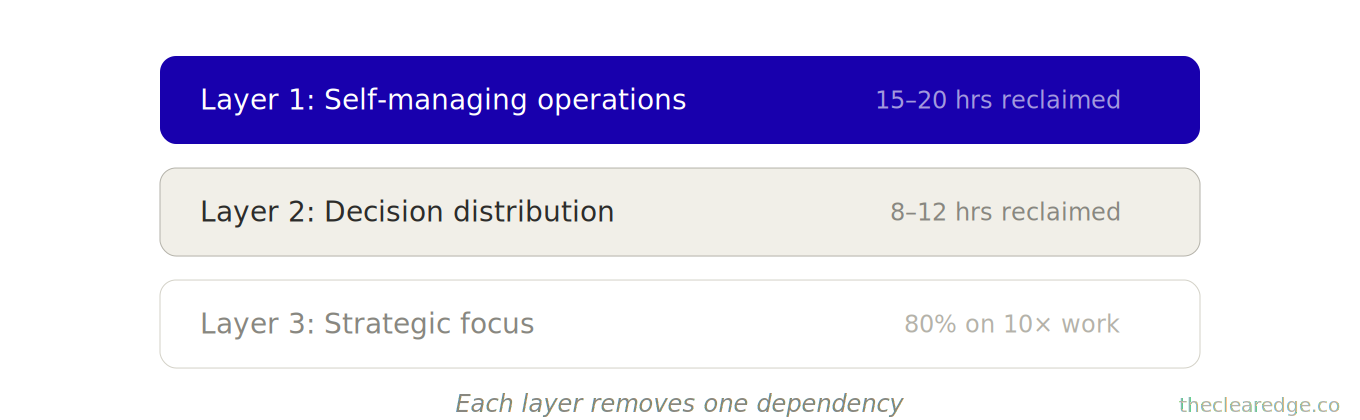
Together, they create operational independence.
Layer 1: Self-Managing Operations To Run Daily Business Without The Founder
Most operations need founder involvement because they’re not designed to run without oversight.
A $64,000/month agency had 9 employees.
Founder’s daily involvement:
Morning standup (30 min)
Project status reviews (90 min)
Client communication review (45 min)
Team questions throughout the day (60 min)
End-of-day planning (30 min)
Total: 4.25 hours daily just keeping operations running, which adds up to 21 hours weekly.
“If I don’t do this, projects slip,” she said.
Her involvement wasn’t adding value—it was compensating for missing systems.
The team needed her because:
No clear project ownership (everyone checked with her on priorities)
No automated status tracking (she manually compiled updates)
No escalation protocols (all issues came to her)
No planning systems (she created daily priorities for the team)
The fix: Self-managing operational systems
System 1: Project Ownership And Authority For Client Delivery
Assigned a lead to each project with full authority to:
Set daily priorities for the project team
Adjust timelines within ±20% of the original estimate
Approve design/content decisions
Communicate directly with the client (following tone guidelines)
Escalate only: budget issues, scope changes over 10 hours, client dissatisfaction
Project leads reported outcomes (on track, blocked, at risk) in the shared dashboard, not process details.
Founder involvement: zero daily, reviewed dashboard 15 min daily for exceptions only
Time saved: ~2 hours daily → ~10 hours weekly
System 2: Automated Status Tracking Instead Of Manual Reviews
Replaced manual status reviews with a dashboard pulling from the project management tool:
Green: on schedule, no issues
Yellow: slight delay or minor blocker
Red: significant delay or major issue
The founder only reviewed the yellow and red projects, and 70% of projects stayed green so they needed no attention at all.
Time saved: ~45 min daily → ~4 hours weekly
System 3: Team Communication Protocols That Reduce Founder Interruptions
Replaced “ask whenever” culture with structured communication:
Slack: urgent only (defined as “client leaving” or “deadline today”)
Async updates: project leads post daily summary by 5 pm
Weekly sync: 60 min meeting for blockers/decisions
Exception escalation: form with 4 questions (what’s the issue, what you tried, what you recommend, what you need)
The team learned to resolve 80% of issues on their own, and only the remaining 20% required founder input.
Time saved: ~45 min daily → ~4 hours weekly
Result: Hours Reclaimed And Revenue Maintained
Before systems:
Daily operational involvement: 4.25 hours
Weekly operational load: 21 hours
Available for strategic work: minimal
After systems:
Daily operational involvement: 45 minutes (dashboard review + exception handling)
Weekly operational load: 5 hours (dashboard + weekly sync + exceptions)
Available for strategic work: 16 hours weekly reclaimed
Revenue impact:
Maintained $64K with 76% less operational involvement.
Used freed time to close 2 new clients → $12,800 in new monthly revenue.
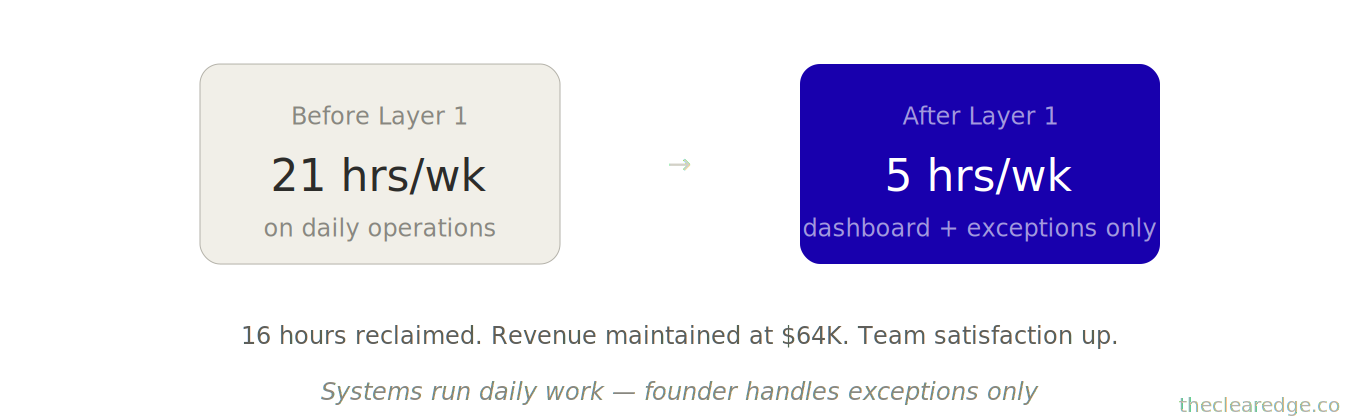
The pattern: Self-managing operations don’t eliminate founder involvement—they concentrate it on exceptions and strategic decisions rather than daily execution oversight.
What to Systematize First for Operational Independence
Daily operations:
Client communication (templates + tone guides + team authority)
Project status updates (automated dashboards, not manual reports)
Priority setting (leads own projects, founder sets weekly themes only)
Resource allocation (defined budget authority, escalation thresholds)
Exception handling:
Clear escalation criteria (when to involve the founder vs. handle internally)
First-response protocols (what team tries before escalating)
Decision frameworks (how to evaluate options without asking)
Information flow:
Dashboards replace status meetings
Async updates replace real-time check-ins
Exception reports replace general updates
Implementation: 60-Day Plan To Install Layer 1
That $67,000/month founder we started with implemented Layer 1 over 60 days:
Week 1–2: Assigned project owners, defined authority levels.
Week 3–4: Built automated dashboards, eliminated manual reporting.
Week 5–6: Established communication protocols, trained team on escalation.
Week 7–8: Monitored the system, adjusted based on what broke.
Result after 60 days:
Hours: 64 → 47 weekly
Operational involvement: 32 hours → 11 hours weekly
Time saved: 21 hours reclaimed
Revenue: $67K maintained
Team satisfaction: improved (more ownership, less waiting)
Time investment: 12–15 hours to build systems
Payback: 2 weeks
Ongoing return:
21 hours weekly → $10,500 weekly
$546,000 annually in recaptured founder capacity
Layer 1 freed a huge block of hours by fixing daily operations; Layer 2 targets the remaining decision bottleneck so you’re not dragged back in every time judgment is required.
Layer 2: Decision Distribution So Your Team Decides Without You
Once operations run autonomously, the next constraint is the decision bottleneck—founder still required for judgment calls.
A $71,000/month consultant had excellent operational systems, and the team executed independently. But 47 decisions every week still required her input.
Pricing adjustments
Scope negotiations
Hiring choices
Marketing spend
Partnership opportunities
Quality exceptions
Schedule conflicts
Average 15 minutes per decision meant 12 hours every week and 52 hours every month spent deciding things her team could have handled with proper frameworks.
The fix: Decision frameworks + distributed authority
Framework 1: Pricing Decision Rules Your Team Can Use
Previously: All pricing decisions came to her.
New framework:
Standard services: Team quotes directly from the price sheet
Custom projects: Team quotes within $3K–$8K using formula (hours × rate + complexity factor)
Discounts: Team can offer up to 10% off for 3+ project commitments
Escalate: Anything over $8K, non-standard scope, or discount over 10%
Authority: Account managers own pricing within the framework.
Result: 87% of pricing decisions were handled without her, and only 13%—the high-value or unusual projects—were escalated.
Time saved: 3 hours weekly
Framework 2: Scope Change Protocol With Clear Escalation
Previously: Every scope change request came to her.
New framework:
Under 4 hours: Approve if within project buffer, communicate to client
4–8 hours: Offer as paid add-on or next phase, use pricing framework
Over 8 hours: Escalate to the founder
Alignment check: Only approve if the change serves the original project goals
Authority: Project leads decide, document in project notes.
Result: 73% of scope changes were handled at the project lead level, and client satisfaction stayed high because responses were faster.
Time saved: 2 hours weekly
Framework 3: Hiring Decision Framework By Role And Salary Band
Previously: She interviewed every candidate, made every hiring call.
New framework:
Roles under $50K/year: COO screens, interviews, makes offer (founder meet-and-greet only)
Roles $50K–$80K/year: COO narrows to 2 finalists, founder interviews both, joint decision
Roles over $80K/year: Founder involved throughout
Quality bar: Must pass 3-interview process (phone screen, skills test, culture fit)
Authority: COO owns hiring under $50K, shared decision above.
Result: 2 junior hires were made without any founder time investment, and she interviewed 0 candidates for roles under $50K, saving 8–10 hours per hire.
Time saved: Intermittent but significant (16–20 hours eliminated every 2–3 months)
Framework 4: Marketing Experiment Approval By Budget And ROI
Previously: Every campaign idea needed her approval before testing.
New framework:
Budget under $500: Marketing lead decides, tests, measures
Budget $500–$2,000: Marketing lead proposes with projected ROI, auto-approved if ROI model is reasonable
Budget over $2,000: Founder approval required
Performance threshold: Campaign must hit 3:1 ROI within 60 days or get paused
Authority: Marketing lead owns all testing under $2,000/month.
Result: 3 campaigns were tested every month (up from 1 every 3 months previously), and 1 winner generated $14,400 in new annual revenue for $800 spent.
Time saved: 4 hours monthly + growth acceleration
Total across all frameworks
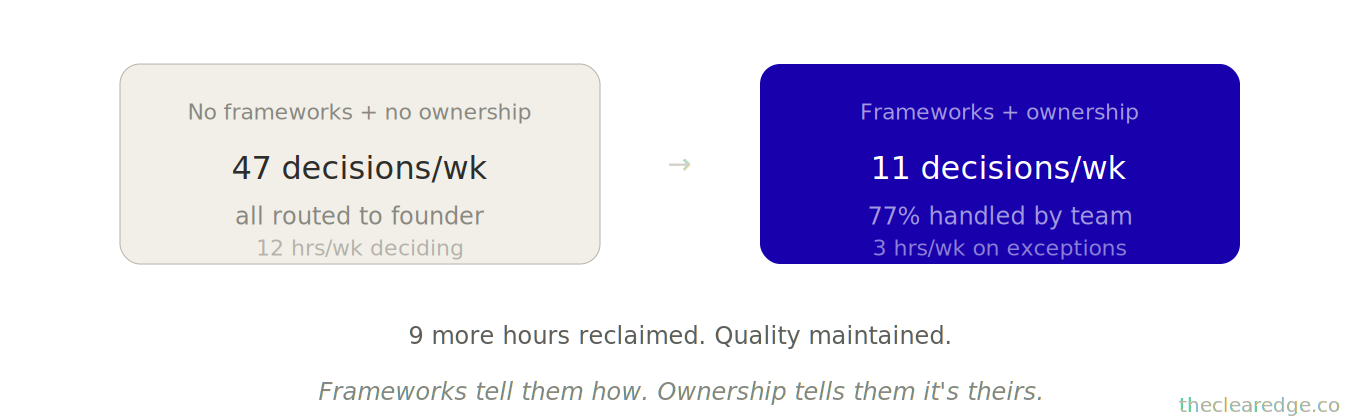
Decision load: 47 weekly → 11 weekly (77% reduction)
Time saved: 12 hours weekly → 52 hours monthly → $26,000 monthly in recaptured capacity
Quality maintained: Frameworks included clear thresholds, outcomes were tracked, and issues were rare
The pattern: Two elements every Decision Distribution system needs
Foundations
Clear frameworks (rules for making decisions without the founder)
Outcome ownership (decision-maker accountable for results)
Outcomes
Without frameworks: team asks everything (founder bottleneck).
Without ownership: team follows rules mindlessly (no judgment or development)
With both: team makes good decisions independently (operational maturity)
Which Decisions To Distribute First In A $50K–$70K Business
Tier 1 (distribute immediately):
Operational decisions with clear criteria (scheduling, resource allocation, standard pricing)
Client communication for routine situations
Quality checks using documented standards
Small budget approvals (under $500–$1,000)
Tier 2 (distribute after frameworks built):
Pricing for standard services (with formulas)
Scope changes within bounds
Hiring for junior roles
Marketing tests under threshold
Partnership opportunities below the revenue impact level
Tier 3 (keep with founder, for now):
Strategic direction
Major client acquisition
Brand positioning
Product development
High-value partnerships
Senior hiring
Implementation
The $67,000/month consultant (mentioned earlier) implemented Layer 2 after Layer 1 stabilized:
Month 3: Documented 5 most frequent decision types, built frameworks.
Month 4: Trained the team, assigned decision owners, established escalation rules.
Month 5: Monitored outcomes, refined frameworks based on what broke.
Result after Layer 1 + Layer 2:
Hours: 47 → 29 weekly
Decision involvement: 12 hours → 3 hours weekly
9 more hours reclaimed
Revenue: $67K → $72.5K (used freed time for partnerships)
Cumulative impact:
30 hours weekly reclaimed from operational + decision delegation
$15,000 monthly → $180,000 annually in capacity
Business runs 4–5 days without founder involvement
Layer 1 and 2 reclaim roughly 30 hours weekly, but where those hours go decides whether you stall or compound; Layer 3 channels them into focused strategic leverage.
Layer 3: Strategic Focus On Non-Delegatable Founder Leverage
Once operations and decisions run autonomously, the founder’s time can shift to strategic leverage—work only they can do that multiplies business value.
Most founders at this stage still default to execution mode even when operations don’t need them, checking Slack habitually, joining meetings unnecessarily, and reviewing work that doesn’t require their review.
An agency earning $73,000/month had achieved operational independence: the team ran the daily business, decisions were distributed, and the founder worked 38 hours weekly but still felt unproductive.
I audited his typical week:
8 hours: Strategic work (partnerships, product development, positioning)
12 hours: Execution work his team could handle (reviewing designs, joining client calls, answering questions)
10 hours: Management theater (status meetings, check-ins that added no value)
8 hours: Email/Slack/busy work
Only 8 of his 38 hours each week—21% of his time—created 10x or greater value, and the rest was 1x value or less, the kind of work anyone on the team could do.
The Fix: Defining the Founder’s Strategic Role
We defined his non-delegable work—things only the founder could do that generated disproportionate returns.
[Founder Time Reallocation]

Current (38 hours):

- 8h Strategic (10x)
- 12h Execution (1x)
- 10h Management theater
- 8h Busywork

---

Target (30 hours):

- 20h Strategic (10x)
- 5h Leader development
- 3h Exceptions
- 2h Essential communication
Strategic work (only the founder can do)
Partner development: Building relationships with potential partners/acquisition targets
Product strategy: Deciding what to build next, market positioning
Key client relationships: Maintaining top 10 client relationships (75% of revenue)
Team development: Coaching senior leads, developing next-level capabilities
Brand thought leadership: Content that positions the agency uniquely
Capital strategy: Managing cash flow, funding decisions, growth investments
Delegable work (team can handle)
Standard client delivery: Even high-value clients, the team can execute
Operational decisions: Distributed via frameworks
Status updates: Automated dashboards
Routine management: Team leads handle
Pure waste (eliminate)
Status meetings with no decisions
Email/Slack for non-urgent items
Reviewing work that passed quality checks
Attending meetings where he doesn’t speak
New time allocation:
20 hours: Strategic work only
5 hours: Team development (1:1s with senior leads)
3 hours: Exception handling (only real issues)
2 hours: Communication (weekly team sync, monthly all-hands)
Total: 30 hours weekly
Protection mechanisms
Calendar blocking:
Monday–Wednesday AM: Deep strategic work (no meetings, Slack off)
Wednesday PM: Team sync + exception handling
Thursday: Partner/client relationship work
Friday: Content creation + admin
No meetings before 1 pm (protects strategic time)
Communication boundaries:
Slack: Check twice daily (11 am, 4 pm), 15 min each
Email: Batch process once daily, 30 min max
“Do Not Disturb” during strategic blocks unless actual emergency (defined as “client leaving today” or “legal issue”)
Result after 90 days
Time distribution:
Total hours: 38 → 30 weekly
Strategic work: 8 → 20 hours weekly (2.5x increase)
Execution/management: 30 → 10 hours weekly (67% decrease)
Business outcomes:
2 strategic partnerships closed (would have taken 6+ months at previous pace)
1 new service line launched, generating $8,200 monthly
Revenue: $73K → $81.2K over 90 days
The mechanism: When the founder concentrates on non-delegable leverage, the business grows faster with fewer founder hours.
Strategic work multiplies outcomes. Execution work adds linearly.
What Qualifies as Strategic Founder Work vs Delegable Execution
Yes (non-delegable):
Building competitive moats (IP, positioning, unique capabilities)
Developing strategic relationships that shift the business trajectory
Making direction decisions with 5+ year implications
Coaching that develops leaders who multiply your impact
Creating thought leadership that attracts ideal clients organically
No (delegable):
Delivering client work (even for VIPs—train team to deliver)
Making operational decisions (build frameworks, distribute authority)
Managing day-to-day team performance (team leads handle)
Executing marketing campaigns (marketing team handles)
Reviewing work that passed quality systems
The test: If the work doesn’t require your unique insights/relationships/expertise, it’s delegable. If someone else can do it at 80% of your quality, delegate it.
Once the calendar reflects mostly strategic work, the constraint shifts from systems to identity; the next section digs into why founders cling to execution even after they’ve earned 30-hour weeks.
The Hidden Problem: Founder Identity Attached To Execution Work
The biggest barrier to 30-hour weeks isn’t systems—it’s founder identity tied to being “in the work.”
A $68,000/month consultant had perfect systems; operations ran independently, decisions were distributed, and yet he still worked 52 hours every week.
Time audit:
I tracked his time. Found 19 hours weekly spent on work his team could handle:
Joining client calls where his presence added zero value
Reviewing proposals his team wrote (they were already excellent)
Answering Slack questions his COO could answer
Attending project kickoffs (team ran them fine without him)
“Why are you doing this?” I asked.
Long pause.
“If I’m not in client calls, am I still a consultant?” he said. “If I’m not reviewing work, how do I know it’s good? If I’m not answering questions, am I even needed?”
That’s the real issue: he’d built a business that didn’t need him for operations, and it triggered an identity crisis.
The Reframe: From Doing the Work to Designing the Business
Your job isn’t to do the work. Your job is to build a business that does the work without you.
Every hour spent on execution is an hour not spent on strategic leverage—every client call you join is a call where you’re not developing partnerships, and every proposal you review is a proposal where you’re not creating thought leadership.
Execution feels productive because it’s concrete and immediate, while strategic work feels uncertain because results take time.
But the math is clear:
1 hour executing: Creates $500 in value (your effective rate)
1 hour strategic: Creates $2,000–$5,000+ in value (partnerships, positioning, product strategy)
When you work 20 hours on execution, you create $10,000 in value but miss $40,000–$100,000 in strategic value.
The fix: Redefine your role explicitly.
We documented his new identity: “I build systems and relationships that multiply business value. I don’t execute—I architect.”
New Daily Practice to Keep the Founder in Strategic Work
Morning: Review strategic priorities (10 min)
Ask: “Is this strategic work or execution?” before doing anything
Rule: If the team can do it at 75%+ quality, don’t do it
Weekly review: “How much strategic work did I complete this week?” (target: 80% of hours)
Result over 90 days:
Hours: 52 → 31 weekly
Strategic work percentage: 38% → 81%
3 major initiatives completed that had been languishing for months
Revenue: $68K → $76.4K from strategic work outcomes
The pattern: 30-hour weeks require a psychological shift from “I must do everything well,” to “I must ensure everything runs well without me.”
The inner shift explains why you haven’t left 60-hour mode; the next step quantifies what staying there actually costs in hours and capacity over the next 6–36 months.
What Changes With The 30-Hour Week System And The Cost Of Avoiding It
Implementation Timeline: 6-Month 30-Hour Week Rollout
Month 1–2: Build Layer 1 (self-managing operations)
Document workflows, assign owners, build dashboards
Time investment: 15–20 hours
Result: Operational independence, 15–20 hours weekly reclaimed
Month 3–4: Build Layer 2 (decision distribution)
Create decision frameworks, train the team, establish escalation protocols
Time investment: 10–12 hours
Result: Decision autonomy, 8–12 hours weekly reclaimed
Month 5–6: Implement Layer 3 (strategic focus)
Define non-delegable work, protect strategic time, establish boundaries
Time investment: 6–8 hours
Result: Focus on work that accelerates business growth
Total implementation: 31–40 hours over 6 months
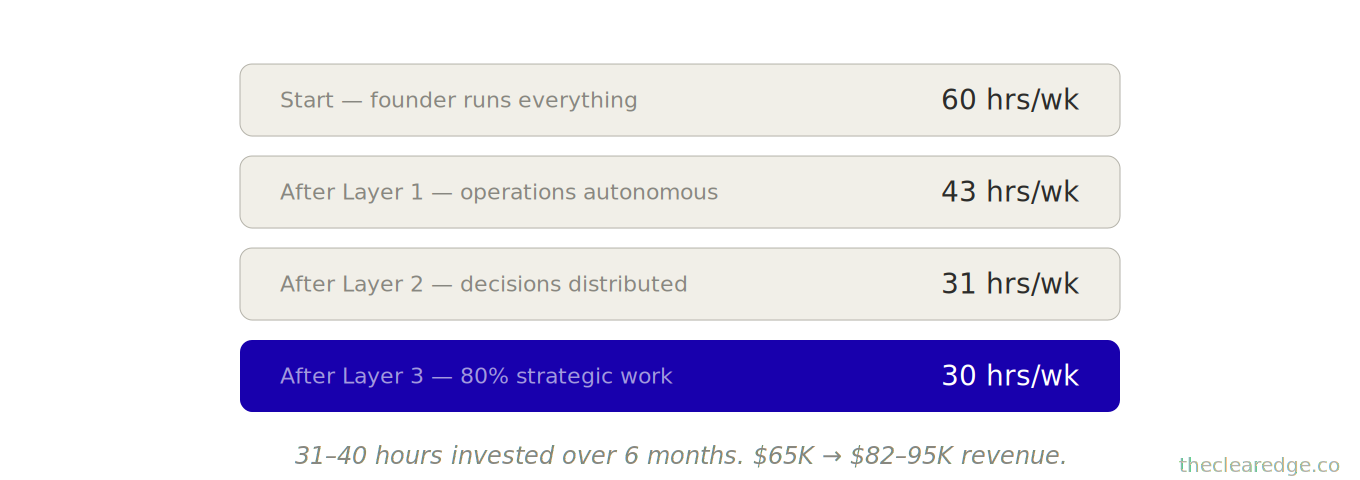
What you get at each layer of the 30-Hour Week framework
At $65,000/month with 60-hour weeks:
After Layer 1:
Hours: 60 → 43 weekly (17 hours reclaimed)
Focus: Operations autonomous
After Layer 2:
Hours: 43 → 31 weekly (12 more hours reclaimed)
Focus: Team decides, founder approves exceptions only
After Layer 3:
Hours: 31 → 30 weekly (time protected for strategic work)
Focus: 80% of time on 10x leverage work
Revenue impact of shifting from 60 to 30 hours weekly
Strategic time creates 2–4x ROI vs. execution time
Typical pattern: $65K → $82–95K over 12 months when the founder works primarily on the business instead of in it
Cost of staying in 60-hour execution mode
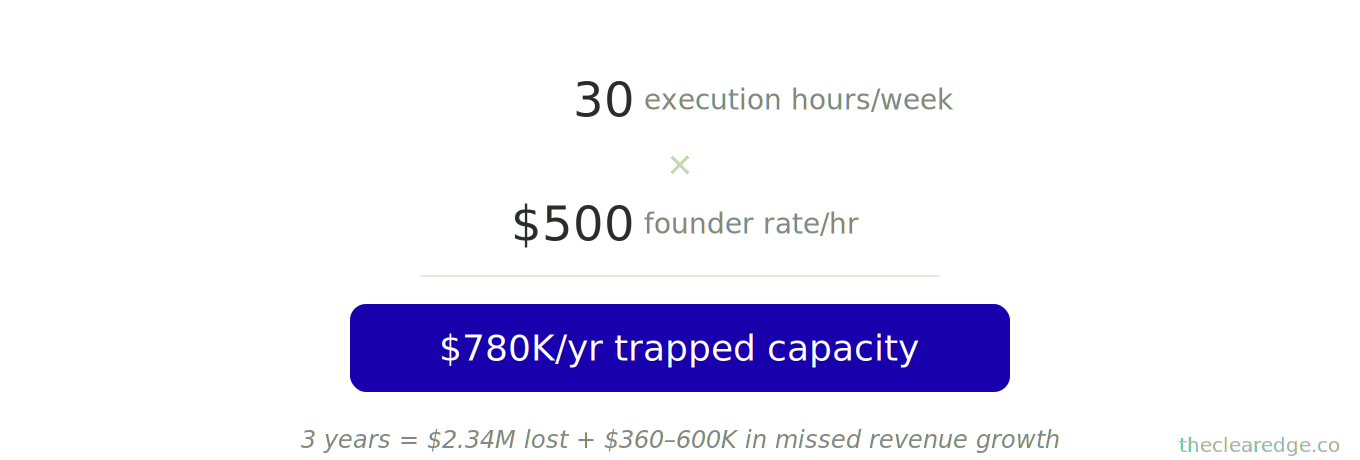
Staying in 60-hour execution mode means:
30 hours weekly spent on 1x value work others could do → 1,560 hours yearly.
At $500/hour, opportunity cost → $780,000 annually
Plus: Burnout risk, revenue ceiling at founder capacity ($70–80K max), inability to scale, and exit value minimal
Over 3 years: $2.34 million in lost capacity + $360K–600K in lost revenue growth from staying founder-dependent.
You now have the full 30-Hour Week architecture and the math on what inaction costs; the final step is turning this into a concrete dependency audit inside your own $50K–$70K business.
Founder Hours Are A Design Choice
If you keep a $50K–$70K business architected around your presence, you’re choosing 60-hour weeks and leaving $2.34M of capacity trapped; start redesigning the system, not yourself.
Run The 30-Hour Week Dependency Field Test Checklist
Next time you consider stepping away for a week or more, run these before you commit.
☐ Logged how many hours you’re currently at weekly and how many hours operations still require direct founder involvement to stay stable.
☐ Listed every decision, fire, and slowdown that would hit during a 2-week no-phone window and tagged each to Layer 1, 2, or 3 gaps.
☐ Scored what percentage of daily execution and decisions your team can currently handle without you, then marked the gap from the 71–80% target.
☐ Marked which projects, clients, or revenue streams would stall or crash if you were unreachable for 2 weeks, then tagged each as a rebuild priority.
☐ Logged whether this dependency review stayed inside a 10-minute pass instead of turning into a full system redesign session.
Every time you run this, you’re catching 60-hour dependency drag before it quietly compounds into $2.34M of trapped founder capacity.
Where to Go From Here: Install The 30-Hour Week Framework And Stop Donating $2.34M Of Founder Capacity
If you’re at $50K–$75K/month and still working 60-hour weeks, the 30-Hour Week Framework is the line between a stable business and a controlled crash. Stay founder-dependent and you quietly donate up to $2.34M of capacity over 3 years while the business stalls every time you step away.
From here, run the sequence once:
Track dependency during a 2-week “no-phone” window and map every decision, fire, and slowdown to the missing layer that would have prevented it.
Translate those failure points into concrete builds—project ownership, decision trees, escalation rules, and dashboards—so 71–80% of execution and decisions run without you.
Reallocate the 30 hours you reclaim into non-delegable strategic work—partnerships, offer strategy, and top-client leverage—so revenue climbs without increasing your weekly hours.
This is not a one-off sprint; installing the 30-Hour Week Framework is the permanent shift from a business built on your presence to one that compounds without you.
Your Turn: Run a 2-Week Dependency Audit on Your Business
If you took a 2-week vacation tomorrow with zero phone access, what would break in your business?
That’s your dependency audit: everything that would break is everything you need to systematize.
List the top 3 things that would fail; those are your Layer 1 priorities.
Drop your answer below. I read every reply.
And if your answer is “everything would break,” just say “I need a full system rebuild”—that awareness puts you ahead of most founders.
FAQ: Implementing The 30-Hour Week System In A $50K–$75K Business
Q: How do I know if the 30-Hour Week System is right for my $50K–$70K business?
A: It’s for founders around $50K–$70K/month, like the $67K/month consultant with 7 team members working 60–64 hours weekly, who can’t take even a stress-free 5-day break without decisions piling up, conflicts festering, and growth stalling.
Q: How does the 30-Hour Week Framework free 30 hours while keeping $50K+ revenue?
A: It installs three layers—Self-Managing Operations, Decision Distribution, and Strategic Focus—so operations run through project leads, the team handles 71–80% of decisions via frameworks, and you spend 80% of your 30-hour week on non-delegable leverage, enabling paths like $65K → $82–95K in 12 months without adding hours.
Q: How do I use Self-Managing Operations to cut my daily operational involvement from 4+ hours to under 1?
A: You assign project leads with authority, replace status meetings with a red/yellow/green dashboard, and enforce communication and escalation protocols so daily operational time falls from 4.25 hours to about 45 minutes, reclaiming roughly 16 hours weekly while holding $64K revenue steady.
Q: How do decision frameworks reduce the 47 weekly decisions my team still brings to me?
A: You document 10–12 common calls—pricing ranges, scope change rules, hiring thresholds, marketing experiment budgets—then assign ownership so 73–87% of decisions stay with leads, which cuts founder decision time from 12 hours to about 3 hours weekly and recaptures roughly $26K in monthly capacity at a $500/hour rate.
Q: What happens when I fully implement Decision Distribution with authority thresholds and escalation rules?
A: In the $67K/month example, spreading decisions across account managers, project leads, and a COO reduced founder decision involvement by 77%, freed 9 more hours weekly on top of operational savings, and nudged revenue from $67K to $72.5K by redirecting time into partnerships.
Q: How do I define my non-delegable work so I stop slipping back into execution and management?
A: You list the few activities that create 10x value—like partner development, product strategy, top-10 client stewardship, senior-team coaching, thought leadership, and capital strategy—then design a 30-hour schedule where 20 hours go to these, 5 to leader 1:1s, and 5 to exceptions and communication.
Q: What does a typical 30-hour founder week look like once all three layers are in place?
A: It’s five 6-hour days with Monday–Wednesday mornings reserved for deep strategic work, one weekly team sync plus exception handling, a relationship day for partners and key clients, and a light Friday for content and admin, with no status meetings, no routine client delivery, and Slack/email batched into brief windows.
Q: How long does it take to implement the 30-Hour Week Framework and what’s the time cost?
A: Over 6 months you invest 15–20 hours into self-managing operations, 10–12 hours into decision distribution, and 6–8 hours into strategic focus—31–40 hours total—which pays back in about 2 weeks once running and returns 30 hours every week thereafter.
Q: How much capacity and dollar value does a 30-hour reclaim represent at a $500/hour founder rate?
A: Freeing 30 hours weekly gives you 130 hours monthly and 1,560 hours yearly, worth $780,000 per year in capacity; over 3 years, staying at 60 hours instead of shifting to 30 quietly locks up about $2.34M of founder capacity plus $360K–$600K in lost growth.
Q: What’s the real risk of staying in 60-hour execution mode even with good SOPs and dashboards?
A: You remain the central processor for 30–50 recurring weekly decisions, cap revenue around $70K–$80K where your time maxes out, and create a business that collapses if you take a 2-week, no-phone vacation—trading $996K of 12-month capacity and long-term exit value for short-term control.
Up Next: The Founder Fuel System For Sustaining $100K Months
Next article covers “The Founder Fuel System: Cut 5 Drains and Scale to $100K for $75K–$90K Operators,” I’ll show you the energy architecture that sustains high performance—the specific drains that collapse output, the fuel sources that compound capacity, and why most “self-care” advice misses the operational reality of founder energy management.
Navigate The Clear Edge OS Systems for Scaling From $5K to $150K
Start here: The Complete Clear Edge OS — Your roadmap from $5K to $150K with a 60-second constraint diagnostic.
Use daily: The Clear Edge Daily OS — Daily checklists, actions, and habits for all 26 systems.
LAYER 1: SIGNAL (What to Optimize)
The Signal Grid • The Bottleneck Audit • The Five Numbers
LAYER 2: EXECUTION (How to Optimize)
The Momentum Formula • The One-Build System • The Revenue Multiplier • The Repeatable Sale • Delivery That Sells • The 3% Lever • The Offer Stack • The Next Ceiling
LAYER 3: CAPACITY (Who Optimizes)
The Delegation Map • The Quality Transfer • The 30-Hour Week • The Exit-Ready Business • The Designer Shift
LAYER 4: TIME (When to Optimize)
Focus That Pays • The Time Fence
LAYER 5: ENERGY (How to Sustain)
The Founder Fuel System • $100K Without Burnout
INTEGRATION & MASTERY
The Founder’s OS • The Quarterly Wealth Reset
AMPLIFICATION (AI & Automation)
The Automation Audit • The Automation Stack
⚑ Found a Mistake or Broken Flow?
Use this form to flag issues in articles (math, logic, clarity) or problems with the site (broken links, downloads, access). This helps me keep everything accurate and usable. Report a problem →
› More to Explore: Quick Navigation · The Clear Edge OS
➜ Help Another Founder, Earn a Free Month
If this system just saved you from locking $2.34M of capacity inside 60-hour weeks over the next 3 years, share it with one founder who needs that relief.
When you refer 2 people using your personal link, you’ll automatically get 1 free month of premium as a thank-you.
Get your personal referral link and see your progress here: Referrals
Get The 30-Hour Week System Toolkit For Serious Operators
You’ve read the system. Now implement it.
Premium gives you:
Ready-to-use PDF toolkit—every template, diagnostic, and formula pre-filled, zero setup, immediate use
Plug-and-play AI diagnosis sessions—drop into Claude, Gemini or ChatGPT, answer a few questions, save hours of guessing, get your exact next move
Audio key points—concentrated frameworks you can absorb in minutes, implement while you move
Unrestricted access to the complete library—every system, every update
What this prevents: Spending 60–64 hours weekly at $50K–$70K while 1,560 hours a year of founder capacity sits trapped in operations.
What this costs: $49/month.
Download everything today. Implement this week. Cancel anytime, keep the downloads.
Already upgraded? Scroll down to download the PDF, audio, and your AI session.
