


Read time: 13 minutes
› Library Navigation: Quick Navigation · The Weekly Protocol
The Executive Summary
On a sales call, your buyer says the project is worth $100K a year. A $6,000 hourly quote now undersells you, and a $20,000 share stalls with their CFO (chief financial officer). Ask six questions, keep the value their own staff can deliver, and price 15% of that value. Nina signed $9,000 instead of $6,000 for 40 hours.
Who this is for: consultants, agencies and solo creators at $5K-$150K a month. You now lose $3,000 a project by quoting hours after the buyer names $100K.
The problem: quote hours after a $100K claim and you bill $6,000 for work worth $9,000. A $20,000 share of the claim stalls on value their team can’t deliver.
The fix: 5 steps:
Say one line that asks how they got the number, and name no price.
Ask six questions about the value, word for word.
Keep the yearly value their team controls.
Quote three options, with 15% of that value in the middle.
Hold the fixed price when finance asks for an hourly rate.
Time to first result: 15 minutes on the call to know whether the number holds.
Written by Nour Boustani for consultants who want paid for results, at prices finance signs.
Try this now (under 2 minutes):
Open your last proposal where the buyer named a dollar value.
Write that value, then write how they got it.
If you can’t write the second line, you priced off a guess.
Why the Buyer’s $100K Is a Forecast
The common value-pricing advice is to ask what the result is worth to the buyer. Salesforce’s guide tells you to learn “the financial or operational outcomes they are seeking to achieve.” So you ask, and the buyer gives you a number.
That number comes from the person who wants the project approved, and a bigger value helps them. Nobody on the call has checked it.
Forecasts of value run high, even at companies with finance teams checking them:
McKinsey and the University of Oxford studied 5,400+ IT (information technology) projects. Those with budgets over $15 million delivered 56% less value than predicted.
In McKinsey’s 2021 survey, executives whose company-wide changes succeeded estimated they captured 67% of the possible financial benefit. Executives at every other company estimated 37% of it.
Treat the buyer’s number as a hope until you know how they built it.
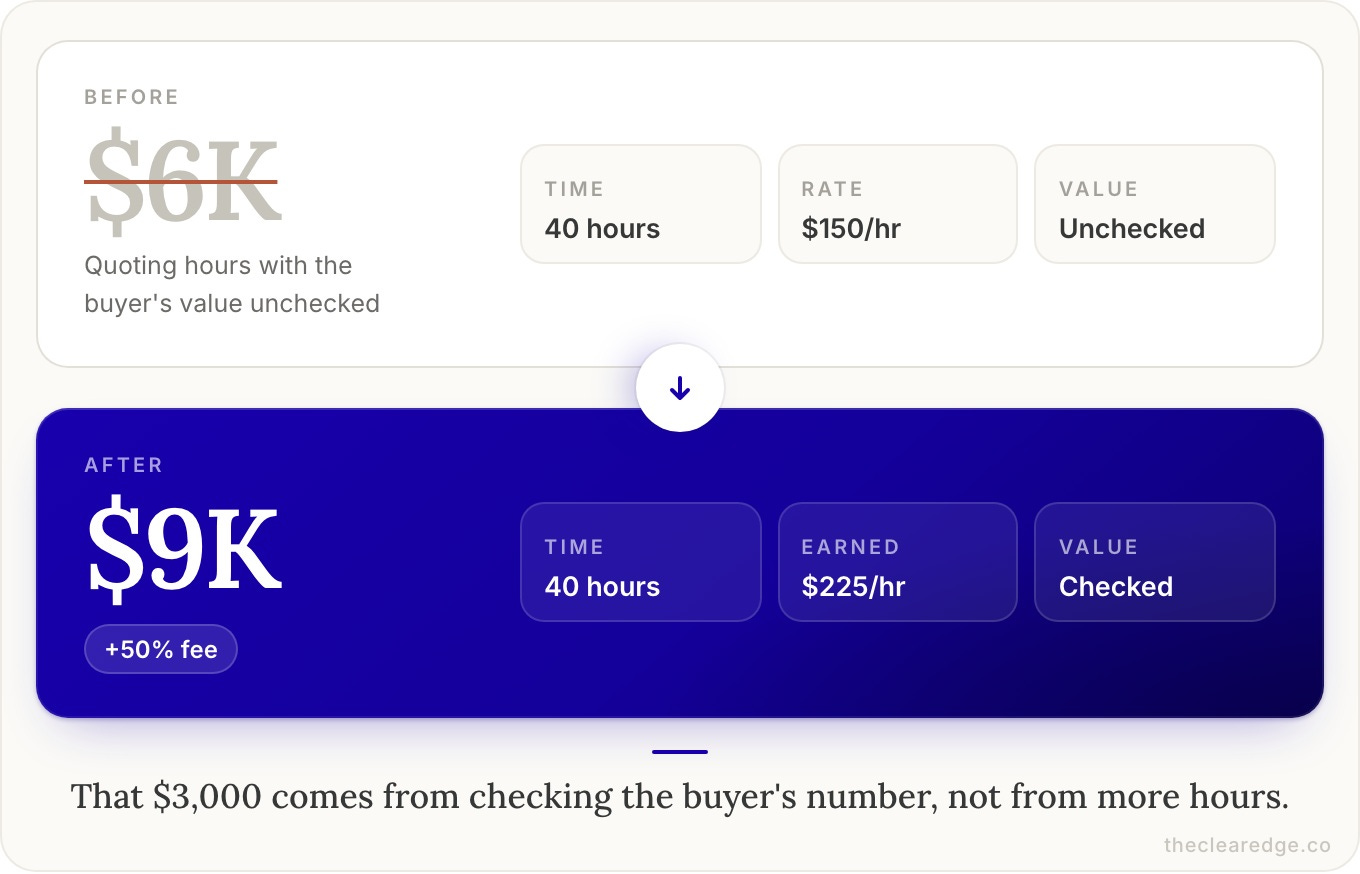
On the same 40 hours, the checked quote earns $225 an hour against $150.
Why Hours Look Cheap Next to $100K
The first number said on a call becomes the reference point for the numbers after it. The Federal Reserve Bank of St. Louis calls this the anchoring effect: people “rely heavily on the first piece of information they receive.”
The buyer’s $100K is now that first number. Say “40 hours at $150” next, and $6,000 sits beside $100,000. You’ve priced yourself as labor on a project worth nearly 17 times that.
Why I never answer the number with my rate:
I ask where the number came from before I say any rate. The answer names pieces I can check, like hires × weeks × overtime.
My rate said first gives the buyer $6,000 to hold against $100K. After the answer, I price on the value their team controls: $9,000 here.
Why a Share of the Headline Stalls the Deal
The other common mistake is a share of the buyer’s figure. One freelance guide’s simple example: a project that nets a client $100K, “You charge 20% of that”. That’s a $20,000 fee built on a round figure nobody checked.
Then the buyer’s CFO asks where $100K came from. Say 40% of the value waits on software their IT team replaces next year. Your fee then rests on a promise nobody on their side can keep, and the deal stalls or shrinks.
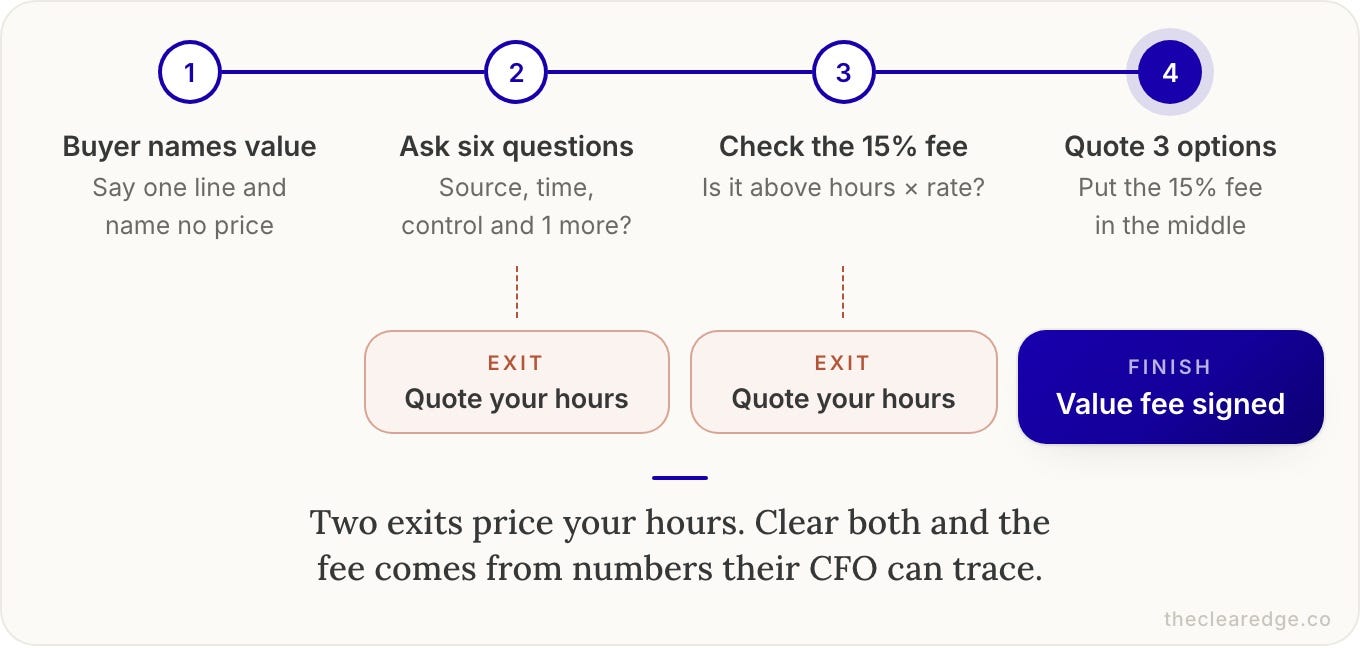
Run these checks after every call where a buyer names a value, before you write any fee down.
Ask Where the Number Came From
Two answers do most of the work. The buyer tells you what builds the number, and whether it covers 12 months or 5 years. Write both on one line during the call:
[value] over [months], built from [count] × [weeks] × [cost a week]
A buyer who names the figures behind it, like hires times weeks times pay, gives you a number to check. A round guess over five years gives you nothing to show their CFO.
The time answer changes the figure too. $100K over 5 years is $20,000 in the next 12 months, and the 60% their team controls is $12,000. Take 15% of that and you get $1,800. That falls under a $6,000 hourly quote, so you’d quote hours.
How Nina Heard $100K on a Discovery Call
Nina is a solo operations consultant. She bills about $15,000 a month at $150 an hour, across 4-5 clients.
On Tuesday 6 October 2026, she had a discovery call with Owen, COO (chief operating officer) of a home-care company. The company has 600 caregivers and a 60-person office. New office hires were slow to work alone.
At minute 20, Owen told her, “Honestly, fixing onboarding is worth $100K a year to this company.” Nina had been about to say “about 40 hours at $150.” Instead she said one line and no price. Eight days later, Owen signed $9,000 for the 40 hours she’d have quoted at $6,000.
