


Read time: 14 minutes
› Library Navigation: Quick Navigation · Weekly Newsletter
The Executive Summary
Stop sending reminders when a client won’t pay and your contractor’s invoice is due Friday. Call the person who signed the contract at 10am Wednesday. Omar bills $25,000 a month, and a client owed him $15,000 at 35 days late. A 10am call and a 3:30pm text got $7,500 in by Friday morning.
Who this is for: freelancers and consultants at $5K-$150K a month, one contractor to pay, one late invoice.
The problem: $15K is 35 days late, $9K is due Friday and the bank holds $2K. Two polite reminders got one reply: “the invoice is in the payment system.”
The fix: 4 yes-or-no checks on the signer, the work, the sign-off and your client’s cash decide the ask:
All 4 yes: ask for the full $15,000 by noon Thursday.
Your client is short on cash: ask for half by then and half 14 days after the call.
Nothing lands by the Thursday cutoff: cover payroll with the cheapest backup and keep collecting.
Time to first result: 5 minutes of checks, one call at 10am Wednesday, and cash within 48 hours.
Written by Nour Boustani for consultants who want the money in before Friday, not an apology after it.
Try this now (under 2 minutes):
Open the late invoice and find who signed the contract.
Look at the To and CC lines of your two reminders.
No signer’s address on either means the person who can pay hasn’t heard.
Why Your Third Polite Reminder Won’t Get the Invoice Paid
It’s Tuesday night, and a client owes you $15,000 for finished work. The invoice is 35 days late. Your designer’s $9,000 invoice is due Friday, and the business account holds $2,000.
In this issue, payroll means the $9,000 you owe your designer. If you run US W-2 payroll, your provider pulls the money before payday, so every deadline here comes earlier.
Your two polite reminders got one reply, “it’s in the system.” So you’re drafting a third one with a softer subject line. It will get the same reply, only slower.
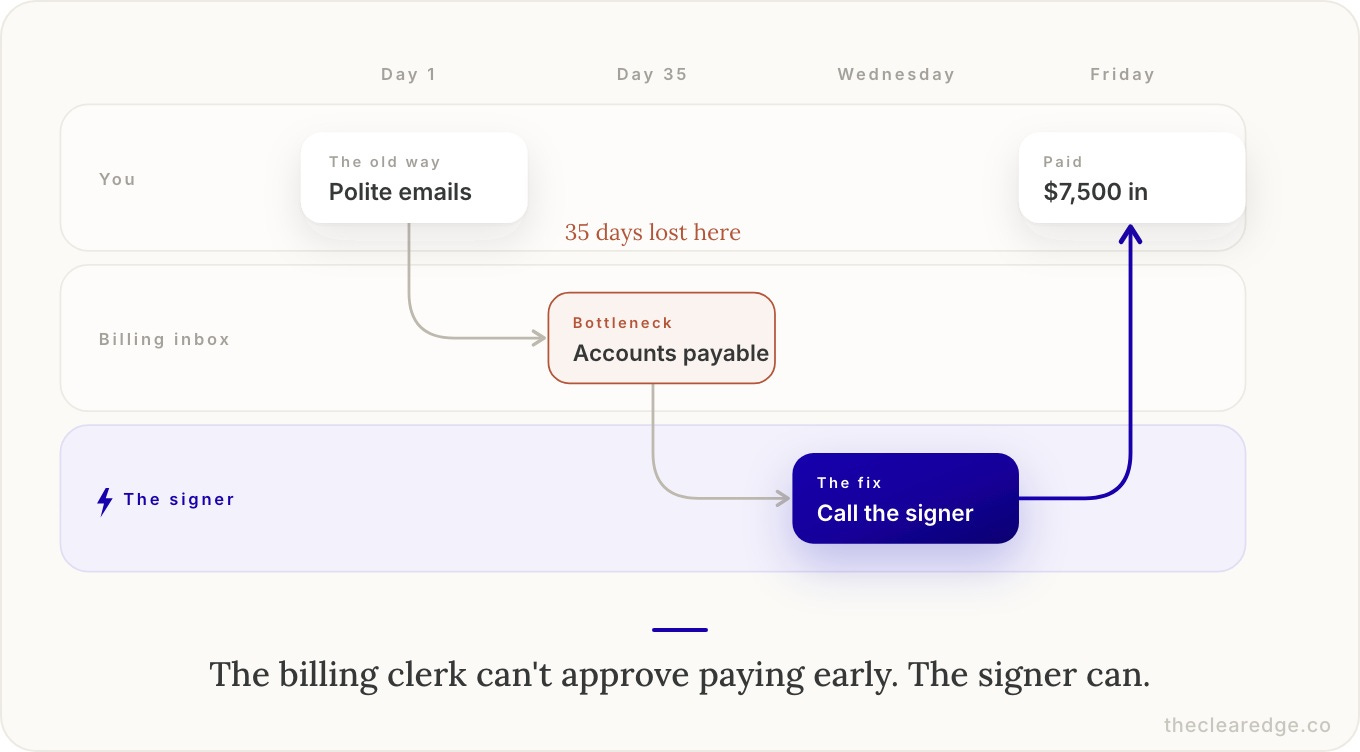
Both reminders went to the accounts-payable inbox. The clerk who reads it can’t approve paying early, and waiting costs them nothing. The person who signed can say yes, and never saw them.
Bonsai, a freelance invoicing software company, studied 3 years of invoices from its 100,000+ freelancers. It found 9 in 10 late invoices were paid within a month. At 35 days late, yours is in the 1 in 10 that wasn’t.
QuickBooks, which sells invoicing and payments software, surveyed 1,305 US small-business owners in December 2025. Of those, 59% had invoices 30 or more days overdue. And 39% said one late payment made payroll or bills hard to cover.
Stop Waiting One More Week for the $15,000
Waiting “one more week” feels polite and safe. But that week lands on your contractor, who did nothing wrong.
So change what the next message asks for, not its tone, and give it three things the reminders never had:
The exact amount you need, such as $7,500.
A date and time for it to land, such as Thursday at midday.
What happens if it misses that time.
Then you say it by phone to the signer at 10am Wednesday. Two emails to the billing team already got you nothing.
Economists at the National Bureau of Economic Research studied collection calls at a consumer lender in China.
Borrowers called by a person were 21 percentage points likelier to promise to repay than bot-called ones. They were 18 points more likely to pay that same day. The authors suggest people feel more bound by a promise made to a person.
The Wednesday call ends in one of three results:
Your client pays the full $15,000 by the Thursday cutoff.
Your client pays half by then and the rest on a fixed date, in writing.
The money misses the cutoff, and your backup covers payroll while you keep collecting.
How Omar Covered Payroll and Collected $7,500 by Friday
Omar, a consultant, bills about $25,000 a month. He pays one senior freelance designer $9,000 a month. A client owed him $15,000 for a finished brand project, 35 days past due.
His four checks on Tuesday night showed a cash problem, not a work problem. Priya, who owns his client’s company, had signed the contract and approved the files by email. But on their last call she’d mentioned a “tight quarter.” So he asked for half now instead of the full amount.
At 10am Wednesday he called Priya. She’d never seen his reminders, which sat in the accounts-payable queue awaiting her approval. She wouldn’t commit on the call. At 3:30pm she texted back: half Thursday, half in two weeks.
He emailed the dates, and Priya replied “Approved.” Her billing team sent the first $7,500 by standard transfer Thursday afternoon, not the wire he’d asked for.
Nothing had landed by the cutoff, so he moved $7,000 from his card to his business checking. Priya’s $7,500 landed Friday at 9:10am, and he paid $7,000 back to the card that morning.
The situation, Tuesday night

- Owed: $15,000
- Days late: 35
- Payroll due Friday: $9,000
- In the bank: $2,000
- Gap: $9,000 - $2,000 = $7,000

Thursday noon, nothing in

- Cash advance drawn: $7,000

Friday morning

- Cash at 9am: $2,000 + $7,000 = $9,000
- Priya's payment at 9:10am: $7,500
- Cash after it: $16,500
- Payroll out: $9,000
- Paid back to the card: $7,000
- Left in the bank: $500

What the backup cost

- Fee: 5% of $7,000 = $350
- Interest for 1 day: $5.75
- Still on the card: $355.75
His designer got paid Friday, and the backup cost $355.75 instead of a missed payroll. The second $7,500 was due 14 days after the call and came a day late.
A yes on Wednesday doesn’t put money in your account on Thursday. Ask how they’ll send it, not only when.
