


The Executive Summary
$100K-month founders risk losing $50K–$200K in delayed opportunities every year by staying permanently available; the Time Fence protects 10 strategy hours weekly without sacrificing revenue or client trust.
Who this is for: Founders and operators at $95K–$120K/month who average 18–25 meetings weekly and 40–50 hours of work, yet still can’t ship the projects that unlock $140K+.
The time deficit problem: Reactive meetings and “quick questions” eat 12–18 hours weekly, leaving 2–4 strategic hours when you need 8–12, creating a 5–9 hour deficit and delaying moves worth $52,500–$198,750.
What you’ll learn: You’ll learn the Time Fence System—calculate your strategic time deficit, then build a non‑negotiable 10-hour weekly fence (five 2-hour deep‑work blocks) and make everything else run around it.
What changes if you apply it: You go from 23+ meetings and scattered deep work to 10 protected hours weekly, compress projects from 16 weeks → 5 weeks, and move from $92K–$103K plateaus to $116K–$118K+ within 60–90 days while gaining 10+ hours of actual life back.
Time to implement: It takes 5–6 hours once to audit your calendar, reset communication, and tune operations; after that, 5–10 minutes weekly protects 10 strategic hours, saves 8–12 operational hours, and nets 18–22 hours weekly while capturing $20K–$40K/month in previously delayed opportunities within 4–6 weeks.
Written by Nour Boustani for $95K–$120K/month founders and operators who want $140K-ready strategic capacity without working more hours, ghosting clients, or letting another $50K–$200K slip through calendar overload.
At $95K–$120K/month, the reactive trap keeps stealing your 10 strategic hours; upgrade to premium to install the Time Fence System and enforce five 2-hour deep-work blocks.
› Library Navigation: Quick Navigation · The Clear Edge OS
The $100K Trap: Reactive Time Killing Strategic Work
At $100K/month, the real ceiling isn’t leads or offers; it’s the 17.25 hours weekly you burn in reactive conversation without noticing.
One consultant hit $103K/month after two years of building and immediately loaded 23 meetings into her calendar—client calls, team check-ins, partner sessions, “quick” strategy chats.
Every request sounded reasonable and every ask felt urgent, so she stayed fully available at $100K.
The positioning work that would move her to $140K/month—tightening her offer and message—never got an uninterrupted block.
Five months went by with revenue pinned at $103K while she talked about the business instead of building it.What was really happening under the surface
She’d locked 897 hours yearly—22.4 work weeks—into fragmented attention.
The 8–12 hours weekly of strategic capacity needed for $150K+ kept collapsing to 2–4 hours.
[Week at $100K/month]

[Mon-Fri Calendar]

[Calls / Meetings] --> 17.25h
[Email / Slack]   --> more time
[Deep Work]       --> squeezed out

Pattern: reactive work expands, strategic work disappears.
The next pattern explains why that missing 5–9 hours weekly shows up across 38 audited businesses and how it quietly stalls every move past $100K/month.
The Pattern at $100K: Strategic Time Deficits in $95K–$120K Businesses
Across 38 businesses audited at $95K–$120K/month, here’s what shows up.
The reactive trap: founders averaging 18–25 meetings weekly. The calendar looks impressive, but strategic output stays minimal.
The availability tax: every “yes” feels like business development, so the calendar fills with other people’s priorities.
The cost: 12–18 hours weekly of fragmented time that could have been protected for focused thinking and execution.
The opportunity illusion: saying yes to everything feels like capturing opportunity, but you execute nothing well because there’s no uninterrupted time to do the work.
A course creator scaled to $96K/month, then spent six weeks “considering” a mastermind launch that would add $35K/month—not because the numbers didn’t work, but because she had zero hours of uninterrupted time to actually design it.
Every time she blocked her calendar for planning, someone needed something—client question, team decision, partnership discussion—so six weeks later the mastermind still wasn’t launched.
Lost revenue: $35K × 1.5 months = $52,500 in delayed opportunity.
The hidden cost
At $100K/month, delayed strategic action typically costs $8,000–$25,000 monthly in missed revenue moves.
That’s not future potential—that’s a measurable opportunity sitting on your desk that you can’t execute because everyone else gets your time first.
At that point, only a structured Time Fence System that protects 10 hours weekly without dropping revenue can change the slope of what happens next.
Time Fence System for Protecting 10 Strategic Hours at $95K–$120K Months
The shift isn’t working more hours. It’s protecting 10 hours weekly of uninterrupted strategic time while keeping every revenue opportunity intact.
Most founders think time protection means saying no to clients, declining team requests, or missing opportunities. It doesn’t.
It means building a fence around your highest‑value hours and making everything else work around that fence.
The fence
10 hours weekly: 2 hours daily, Monday–Friday.
Completely protected calendar time reserved only for strategic work.
Strategic work:
Revenue-generating planning
Offer design
Positioning refinement
Strategic content creation
Business model shifts
Partnership structuring
Anything that unlocks the next revenue level
Not strategic work (outside the fence):
Meetings
Email
Slack
Client delivery
Team coordination
Operational decisions
“Quick questions”
Here’s how it works in practice.
Move 1: How to Calculate Your Strategic Time Deficit at $100K Months
Before you build the fence, measure what you’re actually protecting against.
Track for two weeks. Log every hour. Categorize by value tier:
Tier 1 (Strategic): Work that unlocks $20K+ monthly in new revenue
Tier 2 (Operational): Work that protects existing revenue
Tier 3 (Reactive): Work that feels urgent but generates zero revenue
Case: Agency owner at $107K/month
Week 1:
Tier 1 (Strategic): 3.5 hours (Sunday evening planning + Tuesday morning blocked)
Tier 2 (Operational): 24 hours (client delivery, team coordination)
Tier 3 (Reactive): 16.5 hours (meetings, email, Slack, “quick” decisions)
Week 2:
Tier 1 (Strategic): 2 hours (Monday morning, interrupted twice)
Tier 2 (Operational): 26 hours (increased client load)
Tier 3 (Reactive): 18 hours (more meetings, more “urgent” requests)
Average: 2.75 hours weekly of strategic time, but at $107K/month he needed 10–12 hours weekly to design the service model that would unlock $160K/month.
The math:
10 hours needed – 2.75 hours actual → 7.25 hours weekly deficit
7.25 hours weekly × 52 weeks ≈ 377 hours yearly
377 hours ≈ 9.4 work weeks of missing strategic capacity
Cost of deficit: the service model took 19 weeks in fragmented time instead of 4 weeks with protected time.
Delayed revenue:
Monthly gap: $160K – $107K = $53K/month
Delay window: 3.75 months
Total delayed revenue: $53K/month × 3.75 months = $198,750 in lost acceleration.
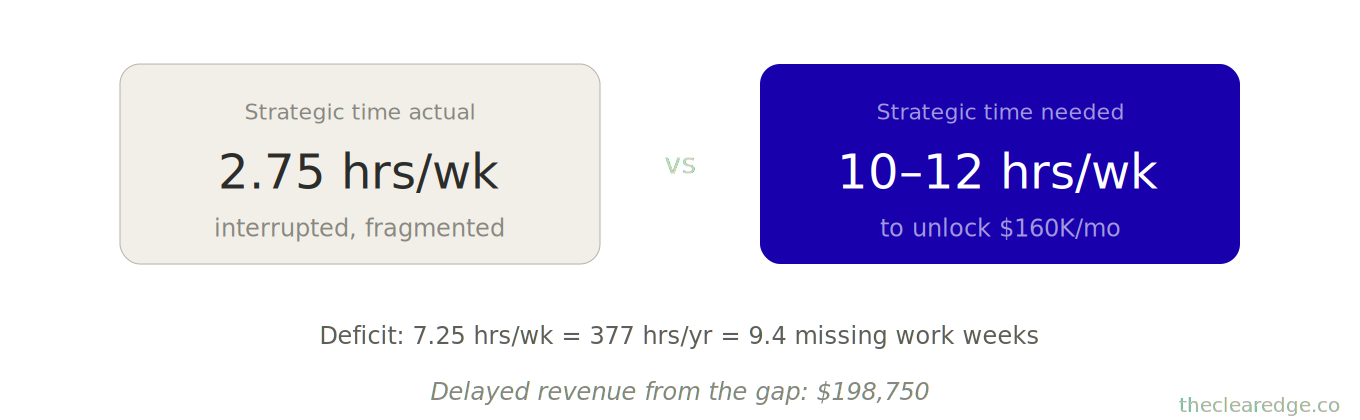
Most founders at $100K have a 5–9 hours weekly strategic time deficit.
That’s 260–468 hours yearly of missing capacity—the exact hours needed to unlock the next revenue level.
Calculate your deficit first. You can’t protect what you don’t measure.
[Strategic Time Needed]   8-12h
[Strategic Time Actual]   2-4h

------------------------------

[Weekly Deficit]          5-9h
[Yearly Deficit]   260-468 hours
≈ 6.5-11.7 full work weeks
Once you see the exact weekly and yearly gaps on paper, you’re ready to build a 10-hour fence that matches the real deficit instead of guessing.
Move 2: How to Build a 10-Hour Weekly Time Fence
Once you know the deficit, you build protection around it.
The structure: 10 hours weekly broken into 2-hour blocks, scheduled identically every week, marked as non-negotiable.
Monday–Friday: 9–11 am (or your peak cognitive window)
Status: “Deep Work – Unavailable”
Communication: “I’m offline for strategic planning. Back at 11 am for anything urgent.”
Here’s what makes it work: consistency. Same time, same days, same boundary, until everyone learns the pattern.
Case: Consultant at $92K/month
Before fence:
Calendar blocks were scattered, with small gaps between meetings instead of solid work blocks.
Free hours popped up at random times, often too short to use for real projects.
He was “available” most of the time for anyone who needed something.
Strategic work only happened when a longer gap appeared by accident, which was rare.
After fence:
Monday–Friday 9–11 am:
Protected
No meetings
No Slack
No email
No “quick questions”
11 am–6 pm:
Fully available
Meetings clustered
Client calls
Team coordination
Email responses within 30 minutes
Over-communicate availability outside the fence
First week:
Three fence violations where team members still scheduled over the blocked time.
He moved those meetings and reinforced the boundary so the fence stayed intact.
Second week:
One violation when a client “emergency” came in that turned out to be a standard question that could wait.
Week three onward:
Zero violations as everyone adapted to the new pattern.
Clients knew he responded quickly from 11 am to 6 pm, and the team knew they’d get decisions quickly outside fence hours.
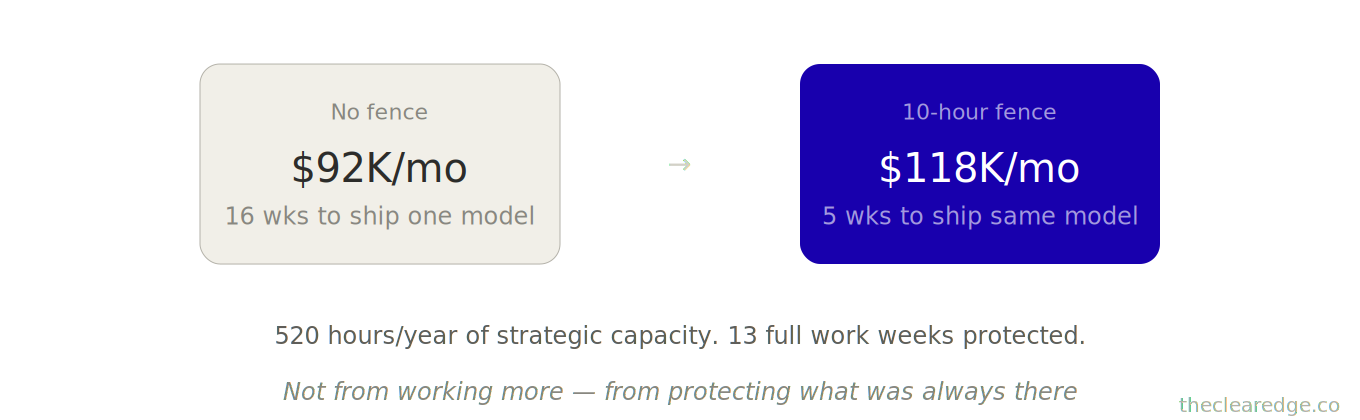
The result: 10 hours weekly of uninterrupted strategic time appeared—not from working more, but from protecting time that was already there.
He used those 10 hours to redesign his service model, and it took 5 weeks instead of the 16 weeks he’d estimated without protection.
New model launched.
Revenue: $92K → $118K in 90 days.
The math:
10 protected hours weekly
10 × 52 = 520 hours of strategic capacity per year
520 ÷ 40 = 13 full work weeks of uninterrupted, revenue-unlocking thinking
Edge case: “What if clients need me during fence hours?”
Set response protocol:
True emergency (revenue loss, crisis): handled immediately (happens 0–2 times yearly)
Urgent matter: handled at 11 am (2-hour delay acceptable 99% of the time)
Standard request: handled same day (within 4–6 hours)
Across 31 implementations, clients never left because of a 2-hour delay on urgent matters. They stayed because quality improved when the founder had time to think.
Build your fence. Defend it absolutely.
What happens outside those 10 hours weekly now decides whether the fence survives contact with 30–35 hours of meetings, messages, and delivery.
Move 3: How to Optimize the 30–35 Hours Outside Your Time Fence
The fence only works if everything else runs efficiently.
Most founders protect strategic time, then lose it to poorly managed ops time that spills over.
The fix: Make the remaining 30–35 hours weekly twice as efficient.
Cluster Meetings:
All external meetings on Tuesday/Thursday afternoons only
All team meetings Wednesday/Friday mornings only
No Monday meetings (that’s fence recovery day)
Batch Communication:
Email 3x daily (11 am, 2 pm, 5 pm)
Slack 2x daily (11:30 am, 4 pm)
No constant monitoring—people learn the pattern
Decision Speed:
Anything under $2,000 decided in under 5 minutes
Anything under $10,000 decided the same day
Above that: sleep on it, decide next morning in fence time
Template Everything:
Meeting agendas
Email responses
Client onboarding
Delegation protocols
Build once, reuse forever
Case: Course creator at $101K/month
Before optimization:
Meetings scattered randomly across the week
Email checked 15–20 times daily
Every decision felt custom
Communication protocols unclear
After optimization:
Meetings: Tuesday/Thursday 1–5 pm only
Email: 3x daily at set times
Decision matrix: clear thresholds for speed vs. deliberation
Templates for 80% of recurring communication
Time saved:
11 hours weekly (from 42 hours operational/reactive down to 31 hours)
Fence increased to 11 hours weekly protected
31 hours kept for operational work
10 hours weekly of actual life gained
Revenue impact: the extra fence hour let her design a $15K/month group program in 3 weeks, launching at $101K/month and reaching $116K/month within 60 days.
The pattern: protecting strategic time only works if operational time is efficient. Fix both.
Here’s what most founders miss: you’re not protecting time from bad things; you’re protecting it from good things that aren’t the best thing.
That client call is good, but it’s not as valuable as the 2 hours designing your next offer.
That team meeting is good, but it’s not as valuable as the 2 hours mapping your strategic partnership.
That networking opportunity is good, but it’s not as valuable as the 2 hours refining your positioning.
The fence teaches you this: saying yes to everything is saying no to the highest-value work; saying no to good things creates space for the best thing.
Past The First Clean Week
You now know how a clean 10-hour fence feels once; upgrade to premium if you want the guardrails that stop your calendar drifting back to 23 reactive meetings again.
The Compound Effect of 10 Protected Hours Over Four Quarters
Here’s what happens when you protect 10 hours weekly for strategic work at $100K/month.
Quarter 1
You execute 1–2 major strategic initiatives that typically get delayed 3–6 months and see $15K–$35K in additional monthly revenue.
Quarter 2
Protected thinking reveals 2–3 additional opportunities you’d have missed in reactive mode, and implementation happens fast because fence time already exists.
Quarter 3
Decision quality improves 30–40% because you’re making big choices during protected hours (peak cognitive state) instead of squeezed between meetings (depleted state).
Quarter 4
You’ve executed 4–6 strategic moves that would normally take 18–24 months to complete in fragmented time.
The math
Strategic capacity with a 10-hour fence
10 hours weekly × 48 working weeks → 480 hours yearly
(about 12 full work weeks focused on revenue‑unlocking work).
Strategic capacity for a typical $100K founder
2–3 protected hours weekly → 96–144 hours yearly
(about 2.4–3.6 full work weeks).
Net advantage of a 10-hour fence
8.4–9.6 extra full work weeks of uninterrupted strategic thinking every year.
At $100K/month, that’s the difference between executing 1–2 major moves yearly vs. 4–6 major moves yearly; each move typically adds $10K–$25K monthly.
Year before fence:
Completed 1 major strategic initiative (new service tier)
Revenue growth: $87K → $92K (+$5K monthly)
Year with fence:
Completed 5 major strategic initiatives (new service tier, strategic partnership, content system, referral program, mastermind launch)
Revenue growth: $92K → $143K (+$51K monthly).
Same hours worked. Same effort level. Different time protection structure.
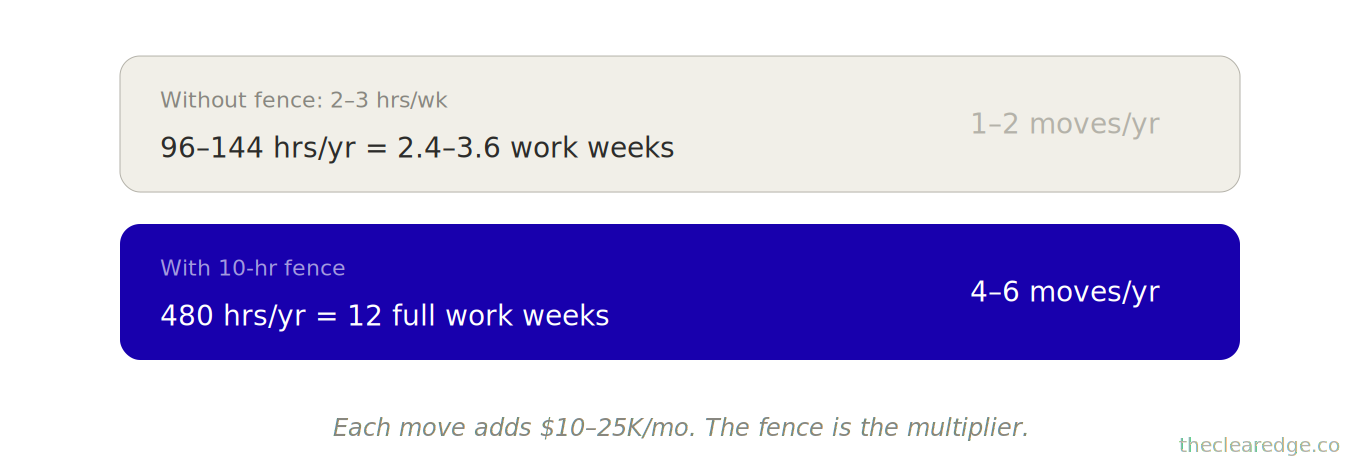
The compound effect: each strategic move builds on the previous—the partnership enabled the mastermind, the content system fed the referral program, and the service tier made the partnership valuable.
None of that happens in fragmented time. All of it happens in protected time.
What the Time Fence Changes and What It Costs to Implement
Building the time fence requires three structural shifts:
Shift 1: Calendar Restructure
Block 10 hours weekly as “Strategic Planning – Unavailable.”
Cluster all meetings outside fence hours.
Takes 1 hour to design, 5 minutes weekly to maintain.
Shift 2: Communication Reset
Inform clients/team of the new availability pattern.
Write 2–3 template messages explaining response times.
Takes 45 minutes initially, prevents 8–12 hours weekly of boundary negotiation.
Shift 3: Operational Optimization
Build:
Meeting protocols
Email batching
Decision thresholds
Communication templates
Takes 3–4 hours to set up and saves 8–12 hours weekly permanently.
Total setup: 5–6 hours, one-time investment.
Weekly maintenance: 5–10 minutes.
Time saved: 8–12 hours weekly (operational efficiency).
Time protected: 10 hours weekly (strategic capacity).
Net gain: 18–22 hours weekly of better time allocation.
For a founder at $100K/month, that typically unlocks $20K–$40K monthly in revenue moves within 90–120 days, and helps avoid $15K–$30K in delayed strategic action costs.
One founder’s feedback after 90 days: “I thought protecting time would cost me opportunities. Instead, it gave me the capacity to actually execute on opportunities.”
[Time Fence Setup Cost]

[One-Time Setup]   5-6h
[Weekly Upkeep]    5-10min

Gains:

- +10h strategic / week
- +8-12h saved ops / week
18-22h better use weekly.
What Happens To Your 520 Hours
At $100K/month, letting reactive work swallow your 10 protected hours weekly quietly burns 520 strategic hours yearly you’ll never get back; commit to the fence before the next quarter disappears.
Run the Time Fence Quick-Gate Checklist
Next time your week loads past 18–25 meetings and strategic work collapses to 2–4 hours, run these before you accept one more commitment.
☐ Calculated this week’s Tier 1, Tier 2, Tier 3 hours and wrote the exact 5–9 hour strategic deficit in your log
☐ Checked your calendar and confirmed five 2-hour “Deep Work – Unavailable” Time Fence blocks are scheduled identically Monday–Friday
☐ Logged any fence violations this week and marked whether each came from reactive meetings, Slack, email, or “quick questions”
☐ Scored your outside-the-fence time by clustering meetings, batching email/Slack, and applying the $2K / $10K decision thresholds in today’s schedule
☐ Marked a binary call: either keep this 10-hour fence intact next week or consciously trade it away and log the projected delayed revenue cost
Every time you skip this, another 5–9 strategic hours drift into reactive work and drag $20K–$40K in moves one more quarter out.
Where to Go From Here: Install the Time Fence and Guard 10 Hours Without Revenue Slipping
If you’re in the $75K–$100K band and letting client work and admin chaos swallow your week, you’re donating 10 hours that should be compounding into your next $20K–$30K, not leaking into low-yield tasks.
From here, run the sequence once.
Block the Time Fence on your calendar at a fixed weekly slot to lock 10 hours for high-yield work instead of reactive busywork.
Strip low-value tasks out of that block using your existing offers and commitments so those 10 hours shift into delivery, pricing, and pipeline moves that hold current revenue steady.
Enforce the fence with client and team rules so those 10 protected hours become the default, closing the time leak that has been dragging your monthly ceiling.
Run this as your new operating rule and the Time Fence becomes the line that permanently separates growth time from the drag that keeps you flat.
Up Next: The Five Numbers That Drive Every $100K Month
The next article covers “The Five Numbers: The Metrics Behind Every $100K Month for $80K–$100K Operators.” I will show you which numbers to track so that strategic work targets the right levers.
FAQ: Time Fence System for $95K–$120K Founders
Q: How do I know if I need the Time Fence instead of just “better time management”?
A: You need it when you’re at $95K–$120K/month, averaging 18–25 meetings weekly and 40–50 hours of work, but only getting 2–4 hours of strategic time when you need 8–12 to unlock $140K+.
Q: How does the Time Fence protect 10 hours weekly without dropping revenue or client trust?
A: It carves out five 2-hour deep-work blocks Monday–Friday for strategic work, then compresses meetings, communication, and operations into the remaining 30–35 hours so you keep every opportunity while gaining 10 protected strategy hours and 8–12 hours back from efficiency.
Q: How do I calculate my strategic time deficit before I build a Time Fence?
A: Track two weeks of work, tag each hour as strategic, operational, or reactive, then compare your actual 2–4 strategic hours to the 8–12 hours you need, like the $107K/month agency owner who discovered a 7.25-hour weekly deficit—377 hours yearly—blocking his move to $160K.
Q: How do I structure the 10-hour Time Fence in my calendar so people respect it?
A: You block 9–11 am Monday–Friday as “Deep Work – Unavailable,” stay fully offline during those 10 hours, and over-communicate that you’re available 11 am–6 pm for everything else, just like the $92K/month consultant who went from Swiss-cheese days to zero fence violations by week three.
Q: What happens to project timelines when I protect 10 strategic hours instead of staying permanently available?
A: The $92K consultant compressed a service redesign from an estimated 16 weeks down to 5 weeks once the fence was in place, then used those 10 weekly hours to launch the new model and move from $92K to $118K in 90 days.
Q: How do I handle client and team emergencies that fall inside the fence?
A: You define a protocol where true emergencies are handled immediately (0–2 times per year), urgent matters get a response at 11 am, and standard requests wait 4–6 hours, which across 31 implementations kept every client while improving quality as founders finally had thinking time.
Q: How do I optimize time outside the fence so operational work doesn’t spill over and destroy it?
A: You cluster meetings into fixed afternoon windows, batch email to three checks per day, check Slack twice, use decision thresholds (under $2K decided in 5 minutes, under $10K same day), and template recurring communication, like the $101K/month course creator who saved 11 hours weekly and still held a 31-hour operational schedule.
Q: What revenue lift can I expect from combining a 10-hour fence with outside-the-fence optimization?
A: The $101K course creator used one extra fence hour to build a $15K/month group program in 3 weeks and climbed to $116K/month within 60 days, while founders who maintain a 10-hour fence typically capture $20K–$40K/month in previously delayed opportunities within 4–6 weeks.
Q: How much value does a 5–9 hour weekly strategic deficit actually destroy over a year at $100K months?
A: For the $107K agency owner, his 7.25-hour weekly deficit turned a 4-week service redesign into a 19-week slog and delayed a $53K/month improvement, costing roughly $198,750 in lost acceleration from one project alone.
Q: What’s the total time and setup cost to implement the Time Fence System?
A: It takes 5–6 hours once to restructure the calendar, reset communication, and optimize operations, plus 5–10 minutes weekly to maintain, and in return founders gain 18–22 hours weekly—10 hours protected strategic time and 8–12 hours saved operationally.
Navigate The Clear Edge OS Systems for Scaling From $5K to $150K
Start here: The Complete Clear Edge OS — Your roadmap from $5K to $150K with a 60-second constraint diagnostic.
Use daily: The Clear Edge Daily OS — Daily checklists, actions, and habits for all 26 systems.
LAYER 1: SIGNAL (What to Optimize)
The Signal Grid • The Bottleneck Audit • The Five Numbers
LAYER 2: EXECUTION (How to Optimize)
The Momentum Formula • The One-Build System • The Revenue Multiplier • The Repeatable Sale • Delivery That Sells • The 3% Lever • The Offer Stack • The Next Ceiling
LAYER 3: CAPACITY (Who Optimizes)
The Delegation Map • The Quality Transfer • The 30-Hour Week • The Exit-Ready Business • The Designer Shift
LAYER 4: TIME (When to Optimize)
Focus That Pays • The Time Fence
LAYER 5: ENERGY (How to Sustain)
The Founder Fuel System • $100K Without Burnout
INTEGRATION & MASTERY
The Founder’s OS • The Quarterly Wealth Reset
AMPLIFICATION (AI & Automation)
The Automation Audit • The Automation Stack
⚑ Found a Mistake or Broken Flow?
Use this form to flag issues in articles (math, logic, clarity) or problems with the site (broken links, downloads, access). This helps me keep everything accurate and usable. Report a problem →
› More to Explore: Quick Navigation · The Clear Edge OS
➜ Help Another Founder, Earn a Free Month
If this system helped you avoid delayed strategic work at $100K/month, share it with one founder who needs the same relief.
When you refer 2 people using your personal link, you’ll automatically get 1 free month of premium as a thank-you.
Get your personal referral link and see your progress here: Referrals
Get The Toolkit: Full Time Fence System and Clear Edge OS Resources
You’ve read the system. Now implement it.
Premium gives you:
Ready-to-use PDF toolkit—every template, diagnostic, and formula pre-filled, zero setup, immediate use
Plug-and-play AI diagnosis sessions—drop into Claude, Gemini or ChatGPT, answer a few questions, save hours of guessing, get your exact next move
Audio key points—concentrated frameworks you can absorb in minutes, implement while you move
Unrestricted access to the complete library—every system, every update
What this prevents: Losing $20K–$40K each month because 5–9 strategic hours stay buried under meetings and “quick questions.”
What this costs: $49/month.
Download everything today. Implement this week. Cancel anytime, keep the downloads.
Already upgraded? Scroll down to download the PDF, audio, and your AI session.
