


The Executive Summary
Founders at $20K–$30K/month quietly lose $486,000 and 936 hours by trying to add their way to $50K instead of rebuilding the revenue architecture that makes $50K months structurally sane.
Who this is for: Consultants, coaches, and agency founders at $20K–$30K/month working 50–60 hours with 8–15 clients who feel capped because every extra dollar still needs more hours and more clients.
The Architecture Problem: Linear, hour-for-dollar models cap around $30K, forcing 80–100 hour ceilings, burning 936+ hours, and leaving $360,000–$486,000 in upside on the table over 18–24 months.
What you’ll learn: A three-move Direction → Protection → Multiplication architecture that upgrades positioning, installs hard client filters, and redesigns delivery so each hour earns 2–4x more.
What changes if you apply it: Revenue moves from $22K–$28K → $50K–$92K+, effective rates climb from $106–$135/hour → $285–$800/hour, hours drop from 48–58 → 18–38, and $50K months become the structural default.
Time to implement: Spend 30 minutes today to calculate your ceiling, then 8–12 hours this week to rebuild positioning, filters, and leverage, with visible lift in 90–150 days and six-figure upside in 12–18 months.
Written by Nour Boustani for $20K–$50K/month founders who want $50K+ architecture without 80-hour weeks, margin collapse, or wasting another 18 months in a model that can’t scale.
When the constraint is architecture, not willpower, upgrading to premium is how you install and run the Direction → Protection → Multiplication system with real numbers.
› Library Navigation: Quick Navigation · The Clear Edge OS
Why $20K–$30K Months Reveal a Structural Revenue Ceiling for Service Founders
At $25,000, effort isn’t the ceiling — the business model is. It wasn’t built to hold $50,000, so it keeps snapping you back down.
Last month, I talked to a consultant making $23,000/month who’d been there for 11 months straight, working 54 hours per week and taking every client who said “yes,” but still stuck at the same revenue.
I asked to see his numbers.
Client load and revenue: 8 clients × $2,875 per month = $23,000/month
Delivery hours: 54 hours per week delivery → 216 hours per month
Effective rate: $23,000 ÷ 216 = $106/hour
“I need more clients,” he said. “If I get to 12 clients at this rate, I’ll hit $34,000 per month.”
Wrong math.
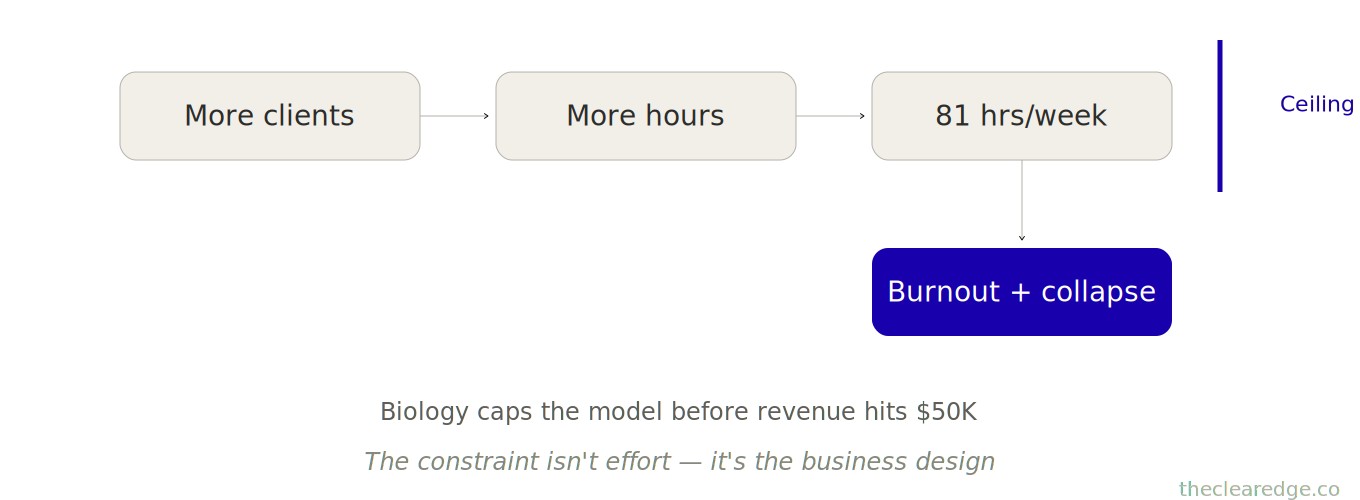
Capacity required: 12 clients × 54 hours ÷ 8 clients = 81 hours per week
That’s unsustainable. You can’t deliver quality at 81 hours per week, so clients churn, you burn out, and revenue collapses.
His real problem wasn’t volume; it was his business model.
He was stuck in a linear growth model.
More revenue → more hours — the opposite of the Direction → Protection → Multiplication architecture you need for structurally sane $50K months.
That model caps at $30,000 because there’s a biological limit to hours per week.
The constraint wasn’t effort. It was the business design itself.
We rebuilt three things:
Pricing structure
Raised rate from $2,875 to $6,200 per month for new clients.
Kept the same scope but improved positioning.
Framed the offer as “We only work with 6 companies at a time, so each gets executive-level attention.”
Delivery model
Shifted from all 1:1 calls to group workshops (3 clients per session) plus async support.
Cut delivery hours from 54 to 38 per week.
Improved client results through peer learning.
Client filter
Stopped taking every yes.
Started qualifying for budget ($6,000+ per month comfortable spend), decision speed (can commit in 2 calls max), and values alignment (respects boundaries).
Timeline:
Month 1:
Transitioned 2 existing clients to new model ($12,400)
Closed 1 new client at $6,200 → $18,600 (temporary dip)
Month 2: Closed 2 more new clients → $31,000
Month 3: Closed 1 more → $37,200
Month 4: Added final client → $43,400
Hours per week: 54 → 38
Effective rate: $106/hour → $285/hour
Revenue: $23,000 → $43,400 in 120 days
Growth didn’t come from more clients. It came from a rebuilt revenue architecture.
This is the pattern I see constantly at $20,000–30,000: founders hit a ceiling not because they lack effort, but because their business model mathematically can’t scale past their current level.
Across 67 businesses I’ve audited at this stage, 81% were capped by delivery model, not market demand.
The Revenue Architecture Pattern Keeping $20K–$30K Founders Stuck Below $50K
At $20,000/month, there’s a predictable constraint pattern:
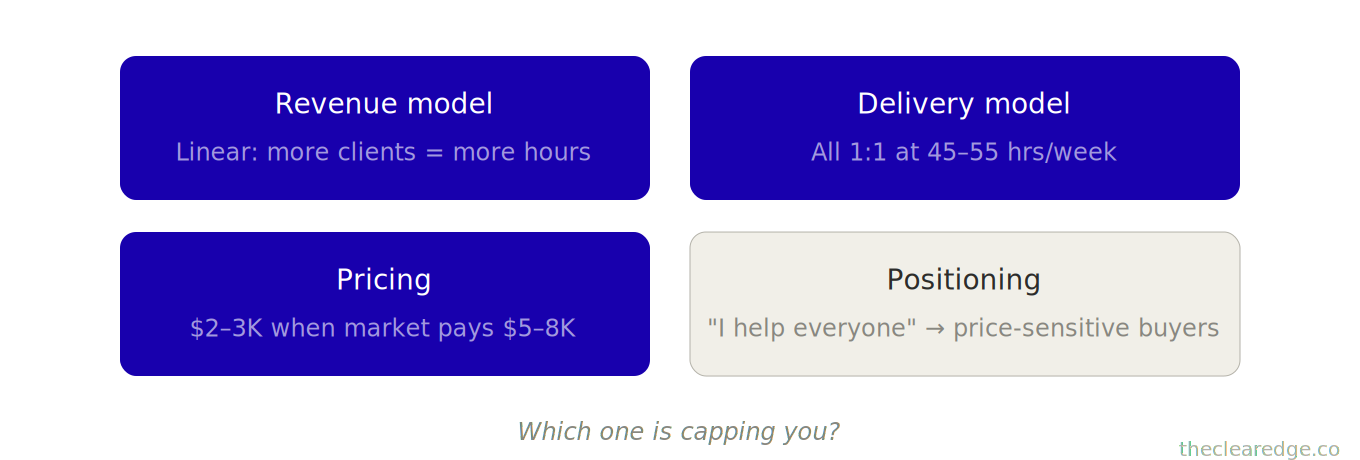
Revenue Model Constraint:
10 clients × $2,000 = linear growth model that requires 15+ clients for $50,000 (delivery collapse)
Delivery Constraint:
All 1:1 delivery at 45–55 hours per week (biological capacity maxed)
Pricing Constraint:
$2,000–3,000 per month retainers when the market will pay $5,000–8,000 for the same outcome in $1M+ companies (leaving $30,000+ yearly on the table)
Positioning Constraint:
“I help everyone” positioning that attracts price-sensitive buyers instead of premium clients
The business model you used to reach $20,000 won’t get you to $50,000. What got you here caps you there.
An agency owner I worked with was making $27,000/month from 11 clients at $2,450 each.
Workload: Working 58 hours per week
Growth target: Needed 20+ clients to hit $50,000 at current pricing
Constraint: Mathematically impossible to deliver quality at that scale.
Her constraint wasn’t sales ability. It was her business model.
[Current $20K Model]

- Pricing: $2K–$3K/month
- Delivery: All 1:1, 45–55 hrs
- Positioning: Generic, broad

=> To reach $50K:

More clients + more hours

Result: Ceiling at $30K
Current model:
11 clients × $2,450 = $27,000 per month
58 hours per week ÷ 11 clients = 5.3 hours per client per week
To reach $50,000, he’d need 20 clients, which would demand 106 hours per week — an unsustainable load.
We rebuilt her model.
Changed positioning from “social media management for small businesses” to “brand system design for $1M+ service companies.”
Pricing went from $2,450 to $7,500 per month.
Delivery shifted from doing everything to strategic direction plus team oversight.
New model:
7 clients × $7,500 = $52,500 per month
42 hours per week ÷ 7 clients = 6 hours per client per week
Margin improved, stress dropped, and clients got better results.
Timeline: $27,000 → $52,000 in 150 days.
But here’s what made it work: she didn’t just raise prices; she changed who she served, what she promised, and how she delivered, which is structural change, not a simple price adjustment.
Another consultant was stuck at $19,000/month for 9 months.
Client load: Had 13 clients at $1,465 each
Workload: Working 51 hours per week
Sales: Close rate was solid at 47%
Pipeline: Lead flow was consistent at 18 qualified leads per month.
“I need better marketing,” he said.
Wrong diagnosis.
His constraint was revenue per client, not client volume. Market rate for his expertise in $2M+ companies was $4,000–6,000 per month, and he was charging $1,465.
Gap per client: $2,535–$4,535
With 13 clients, that’s $32,955–$58,955 left on the table every month
We didn’t touch marketing. We rebuilt his offer structure:
Before: “Monthly consulting retainer — I’ll help with whatever you need.”
After: “90-day revenue acceleration intensive — I diagnose your constraint, build the fix, implement with your team”
Before: $1,465 per month ongoing
After: $12,500 for 90 days ($4,167 per month equivalent)
Before: Scope creep, endless requests, no clear outcomes
After: Defined diagnostic → implementation → handoff process
Result:
Transitioned 4 existing clients to the new model over 90 days = $16,668 per month
Closed 3 new clients at new rate → $12,500 additional per month
Revenue: $19,000 → $29,000 in 90 days, on track to $50,000+ within 6 months
Hours per week: 51 → 39 (better boundaries, clearer scope)
The difference? He stopped selling time and started selling outcomes with structure.
You’ve probably felt this ceiling too — working maximum hours, taking every client, and still capped at $20,000–$30,000. The answer isn’t more hustle; it’s better revenue architecture.
The Three-Move $50K Revenue Architecture Framework for $20K–$30K Operators
Here’s where founders get stuck. You can’t fix a structural problem with tactical effort; you need design changes that make $50,000 inevitable instead of impossible.
Most $20,000 founders try to add their way to $50,000 with more clients, more services, and more hours, which builds horizontally on a foundation that can’t support the weight. The answer is to rebuild the foundation so it can support higher revenue density.
The three moves:
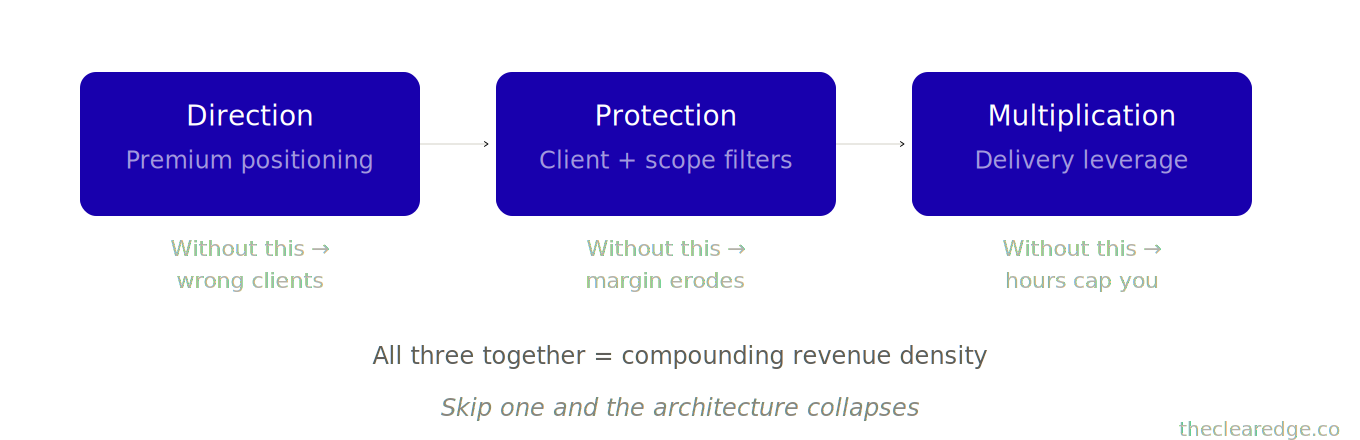
Move 1: Direction — Position for premium pricing and clients who value outcomes over hours
Move 2: Protection — Filter clients and scope to protect margin and capacity
Move 3: Multiplication — Build delivery leverage so revenue grows without linear hour increases
Why this sequence matters
Direction without protection: you attract premium clients, but scope creep quietly erases your margins.
Protection without multiplication: you have boundaries, but you’re still trading hours for dollars.
Multiplication without direction: you build leverage and systems, but for the wrong business model.
All three together create compounding revenue density so each hour and client produces more dollars instead of just more work.
Here’s what this looks like when executed properly.
A coach was earning $22,000/month from 18 clients, each paying $1,220. Working 48 hours per week, doing 1:1 calls.
To hit $50,000 at the current model, she would have needed 41 clients and 107 hours per week, which is impossible.
We ran all three moves in sequence.
Move 1 (Direction):
Repositioned from “life coach for busy professionals” to “executive performance architect for $200K+ operators.”
Changed promise from “better work-life balance” to “reclaim 15+ hours per week while increasing output 40%.”
The new offer justified $4,200 per month instead of $1,175.
Move 2 (Protection):
Built a client filter requiring $200,000+ income (proves ability to pay)
Decision-maker authority (no “I need to ask my spouse”)
90-day minimum commitment (protects from churn)
Declined 11 of 18 leads that didn’t fit
Close rate on qualified leads jumped from 34% to 72%.
Move 3 (Multiplication):
Shifted delivery from all 1:1 (48 hours per week) to a group intensive model with 12 clients per cohort, two group sessions per week, and async support for the rest.
Each cohort ran for 90 days, and she could run 2 cohorts simultaneously.
Revenue model:
12 clients × $4,200 = $50,400 per cohort
2 cohorts running = $100,800 total managed revenue
Delivery: 8 hours per week group sessions + 10 hours async → 18 hours per week (was 48)
Timeline:
Month 1–2: Closed first cohort of 8 at new rate = $33,600
Month 3: Filled cohort to 12, started second cohort with 6 = $75,600 total
Month 4: Second cohort at 10 = $92,400 total
Result: $22,000 → $92,000+ in 120 days.
Hours per week: 48 → 18.
The transformation didn’t come from extra effort. It came from a structural change to the business model. She rebuilt the business model to support the revenue level she wanted instead of staying trapped in the model that got her to $20,000.
Knowing The Framework Isn’t Running It
You’ve seen how Direction, Protection, and Multiplication break the $30K ceiling; upgrading to premium gets you the toolkit that sequences, documents, and tests this structure in your own numbers.
Move 1: Direction — Position $20K–$30K Operators for Premium Revenue
Most founders at $20,000 are underpriced by $2,000–4,000 per client because their positioning doesn’t justify premium pricing.
You can’t charge $6,000 per month with “I help businesses grow” positioning. That’s vague. Premium pricing requires specific, defensible positioning that makes you the obvious choice for a narrow market.
Here’s how this works in practice:
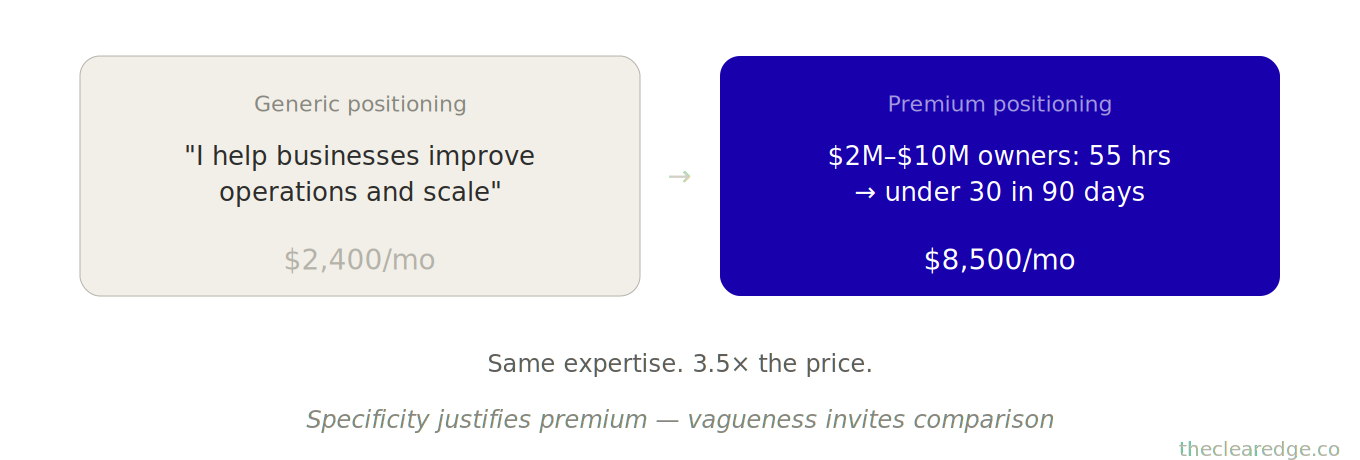
A consultant was making $24,000/month from 10 clients at $2,400 each.
Working 52 hours per week.
Market rate for his expertise (operations systems for $2M+ service companies): $7,500–10,000 per month.
But his positioning was:
“I help businesses improve their operations and scale efficiently.”
Generic. Forgettable. Not worth $7,500.
Layer 1: Define a Specific Market That Can Afford $5K–$10K Monthly Fees
Before: “businesses”
After: “$2M–10M service companies with 10–30 person teams.”
Why this matters:
$2M+ companies have $7,500 per month budgets and urgency to fix operations.
Sub-$1M companies don’t.
Specificity filters for the ability to pay.
Layer 2: Define Concrete Outcomes That Justify Premium $5K–$10K Monthly Pricing
Before: “improve operations and scale efficiently.”
After: “reduce owner involvement from 55+ hours to under 30 while maintaining or growing revenue.”
Why this matters:
Outcome is measurable and valuable.
Owner time is worth $200–400/hour at this level.
Reclaiming 25 hours per week → $5,000–10,000 per week in freed capacity
$5,000–10,000 per week in freed capacity → $20,000–40,000 per month
Service pays for itself.
Layer 3: Define a Unique Mechanism That Makes Your $50K Architecture Defensible
Before: unstated
After: “The Operator Exit Protocol — 90-day diagnostic → delegation structure → leadership transition system”
Why this matters:
Named methodology signals proprietary expertise.
A named mechanism prompts an “I need THAT specific thing” response instead of “maybe I’ll shop around.”
New positioning:
“I help $2M–10M service company owners reduce their involvement from 55+ hours to under 30 in 90 days using The Operator Exit Protocol — without revenue dropping.”
This is straight out of Eliyahu Goldratt’s Theory of Constraints: in most $2M companies, the owner is the bottleneck, and when you remove that bottleneck, the whole system’s throughput jumps.
This positioning justified $8,500 per month (was $2,400).
Math:
10 clients × $8,500 = $85,000 per month
Only needed 6 clients to hit $51,000
Closed 7 in first 120 days = $59,500 per month
Revenue: $24,000 → $59,500 in 120 days
Hours per week: 52 → 34 (better clients, clearer scope)
The positioning change didn’t just raise prices. It attracted different buyers — operators with real budgets who valued the outcome, not price-sensitive small businesses comparing quotes.
Another agency owner was stuck at $28,000/month from 9 clients at $3,100 each.
Positioning:
“We do Facebook ads for e-commerce brands.”
Commodity positioning. Competing on price. Clients saw her as a vendor, not a partner.
We repositioned:
Before: “Facebook ads for e-commerce.”
After: “Customer acquisition design for $5M–20M DTC brands — we own your CAC while you own LTV.”
Added two elements:
Risk reversal: “We guarantee CAC under $X or you don’t pay the overage.”
Profit sharing: Base $6,500 + 3% of attributed revenue over baseline
This positioning shifted the conversation from “how much?” to “can you actually do this?”
Result:
Base fee alone: $6,500 × 9 clients = $58,500
Plus profit sharing: $8,000–15,000 per month across clients
Total: $66,500–73,500 per month (was $28,000)
Timeline: 150 days to transition existing clients, plus close two new ones under the new model.
Apply the Direction Layer Now With the Three-Step Positioning Exercise
Rewrite your positioning using the three-layer model:
Who: specific enough that 95% of the market is excluded
What: outcome valuable enough to justify premium pricing
How: named mechanism that differentiates you
If your positioning doesn’t make $5,000+ per month obvious, your ceiling is $30,000.
Direction sets up premium pricing; Protection decides which clients and scopes you’ll actually let into that new structure.
Move 2: Protection — Filter Clients and Guard Margin at $20K–$30K Months
Once you have premium positioning, most founders destroy it by taking on the wrong-fit clients, who erode margins through scope creep and support burden.
I see this constantly: consultants take positions for $6,000 clients, then accept $3,000 clients “just to fill capacity.”
That $3,000 client requires the same delivery hours as the $6,000 client but pays half. Margin collapses.
Protection means ruthless client filtering.
An agency owner repositioned for premium pricing ($7,500 per month, from $2,800). First month closed four clients. Sounds great.
Problems emerged by month 2
Client A:
Paying $7,500
Weekly strategy calls (4 hours per month)
Unlimited revisions (8 hours per month)
Total: 12 hours per month delivery
Client B:
Paying $7,500
Respects boundaries, async communication
Total: 6 hours per month deliverySame price. Double the delivery cost for Client A. Margin destroyed.
We built a client filter with hard requirements:
Budget qualification: Must have $7,500+ per month comfortable spend (not “we can stretch to afford you”)
Decision speed: Can commit in 2 calls maximum (proves authority and decisiveness)
Respect for scope: Agrees to defined deliverables + change order process for additions
Communication style: Prefers async + scheduled calls over “quick question” interruptions
90-day minimum: No monthly contracts (prevents churn, allows proper implementation)
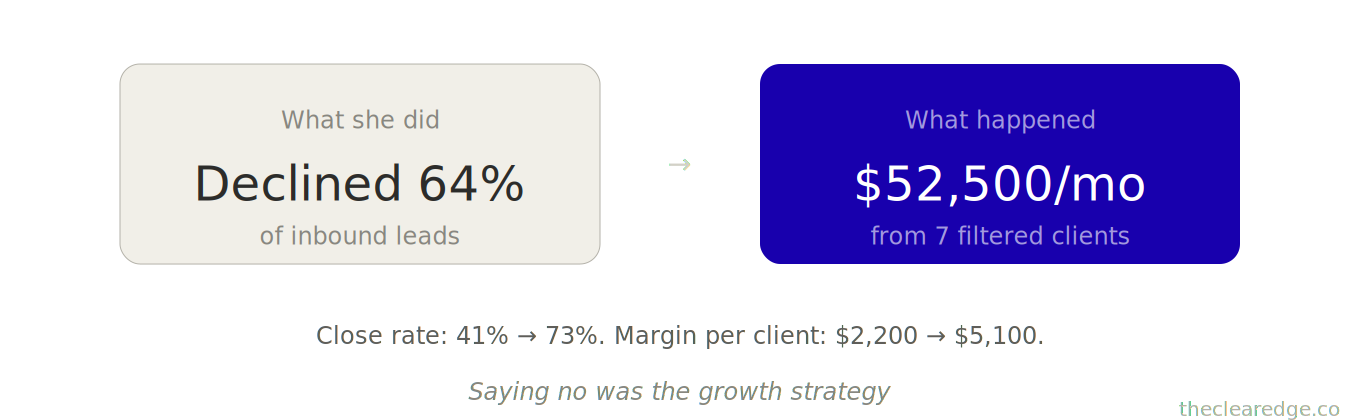
She started declining leads that didn’t fit. Declined 14 of the next 22 inbound leads (64% rejection rate).
Scary? Yes. Necessary? Absolutely.
Result:
Close rate on qualified leads: 73% (was 41% when taking everyone)
Average delivery hours per client: 6.5 (was 10.2)
Margin per client: $5,100 (was $2,200)
Client satisfaction: 9.1/10 (was 7.4/10)
Revenue: $30,000 → $52,500 in 90 days from 7 filtered clients
Better clients. Less stress. Higher margin. This is protection working.
Edge case: Founders with strong personal brands can sometimes maintain revenue with looser client filters — but they pay in margin erosion and energy drain. Brand covers for poor filtering temporarily, but can’t sustain it long-term.
Another consultant couldn’t say no to scope expansion. The client would ask for “one quick thing” mid-project, week after week, and he always said yes.
Original scope: 8 hours per month delivery at $4,500
Actual delivery: 14 hours per month (75% scope creep)
Effective rate: $4,500 ÷ 14 = $321/hour (should be $562/hour)
Lost margin: $241/hour × 6 hours × 12 months = $17,352 yearly per client
Across 8 clients: $138,816 yearly in margin erosion from scope creep.
We built scope protection into his model.
Defined deliverables—90-day engagement includes:
Initial diagnostic (week 1–2)
Implementation plan (week 3–4)
Execution support (week 5–12)
Handoff documentation (week 13)
Additional requests require a change order.
Change order process:
Any request outside scope triggers a quote provided within 24 hours.
The client approves the quote before any additional work starts.
Work outside scope is billed separately from the main engagement.
Communication boundaries:
Async communication via project management tool
Scheduled calls only (no “quick calls”)
48-hour response time on non-urgent items
Felt uncomfortable at first. “Won’t clients hate this?”
The opposite happened: professional clients respected the structure, and tire-kickers self-selected out.
Result:
Scope creep: 75% → 12%
Effective rate: $321/hour → $518/hour
Client retention: 67% → 89% (better clients stay longer)
Additional margin reclaimed: $120,000+ yearly
The lesson: Premium pricing without scope protection is charity work at high rates. You need both.
Apply the protection layer now with a non-negotiable client filter
Build your client filter:
What’s the minimum budget to be worth your time?
What communication style preserves your capacity?
What scope boundaries protect your margin?
What commitment length ensures ROI for both sides?
Then decline leads that don’t fit.
The lost revenue from saying no is smaller than the destroyed margin from saying yes to the wrong clients.
Move 3: Multiplication — Build Leverage So Revenue Grows Faster Than Delivery Hours
Direction positions you for premium pricing, protection guards your margin, and multiplication breaks the hour-for-dollar ceiling.
Most $20,000 founders hit $30,000 and then can’t scale further because delivery is purely linear: more revenue means more hours, you’re maxed at 50–60 hours per week, and you can’t grow without breaking.
The solution: delivery models that serve multiple clients simultaneously or create revenue without ongoing delivery.
A consultant was making $26,000/month from 8 clients at $3,250 each
Delivery was 48 hours per week, or 6 hours per client.
To reach $50,000 at this model, he would have needed 15 clients and 90 hours per week, which is impossible.
Linear delivery model caps revenue.
We rebuilt for leverage:
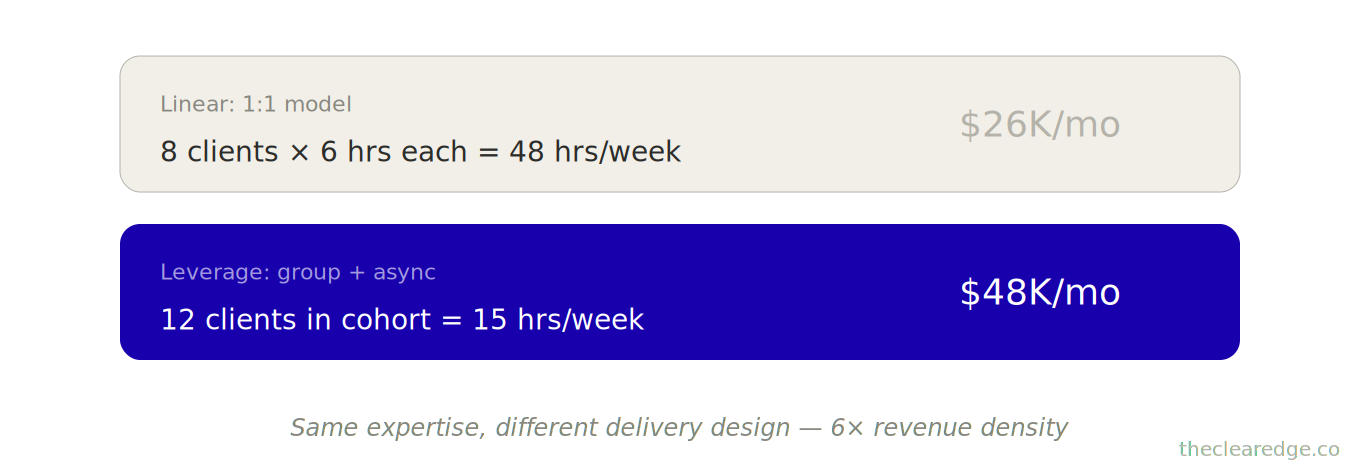
Before (1:1 model):
8 clients × 6 hours each = 48 hours per week
Revenue: $26,000 per month
Revenue per hour: $135
After (Group + Async model):
12 clients in a cohort.
2 group sessions per week (3 hours total).
Async support of 12 hours per week.
Total delivery time of 15 hours per week.
Revenue: $48,000 per month (12 × $4,000)
Revenue per hour: $800
Same expertise. Different delivery design. 6x revenue density.
The mechanism:
Group delivery creates peer learning effects that improve outcomes while reducing delivery cost per client.
Clients get accountability from the cohort, not just the consultant.
Async support batches questions, reducing context switching that kills productivity.
How the model worked:
Clients joined a 90-day cohort starting every quarter.
Each cohort had 10–12 members.
Delivery structure:
Week 1: Individual diagnostic (1 hour per client, done once)
Weeks 2–12: Two 90-minute group sessions per week (strategy + implementation)
Ongoing: Async support via Slack (client posts question, response within 24 hours)
Week 13: Individual wrap + handoff (1 hour per client)
Time breakdown:
Group sessions: 6 hours per week
Async support: 8–12 hours per week
Individual sessions: 24 hours per quarter (front and back loaded)
Total per week average: 16–20 hours to serve 12 clients, generating $48,000 per month.
Added benefit: clients got peer learning, accountability, and network effects, which led to better results than the 1:1 model.
Timeline:
Month 1: Launched first cohort with 8 clients (transitioned 5 existing + 3 new) → $32,000
Month 2: Filled to 11 clients → $44,000
Month 3: Started second cohort with 7 clients → $72,000 total across both cohorts
Month 4: Both cohorts full (12 + 11) → $92,000 per month
Result:
$26,000 → $92,000 in 120 days.
Hours per week: 48 → 28.
The design change created 3.5x revenue on half the hours. That’s multiplication.
We built asset leverage:
Before (custom model):
40 hours per project.
$4,500 per project.
$112 per hour effective rate.
Needed 11 projects per month to reach $50,000.
After: Productized website system with 3-tier options:
Foundation: $3,500 (template + 6 hours customization)
Professional: $6,500 (template + 12 hours customization + strategy)
Premium: $11,500 (template + 20 hours customization + strategy + optimization)
Built 5 core templates (60 hours investment). Each template is used 15–30 times.
New economics:
Foundation tier: 6 hours delivery = $583/hour
Professional tier: 12 hours delivery = $541/hour
Premium tier: 20 hours delivery = $575/hour
Result:
Average project value: $7,100 (was $4,500)
Average delivery hours: 12.6 (was 40)
Projects needed for $50,000: 7 per month (was 11)
Profit margin: 71% (was 34%)
Revenue: $28,000 → $49,700 in 90 days
Delivery hours: 174 per month → 88 per month
The templates (60-hour upfront investment) paid back within the first month and continued generating margin for 2+ years.
The pattern:
Linear models cap at $30,000 because hours don’t scale.
Leverage models reach $50,000–100,000+ because delivery costs don’t increase proportionally with revenue.
Apply the multiplication layer now by mapping your leverage opportunities
Map your current delivery model:
How many hours to serve one client per month?
What’s your capacity ceiling (hours × clients)?
What’s preventing leverage? (Every deliverable custom? All 1:1? No systems?)
Then ask yourself:
What could I build that serves multiple clients?
What could I systematize to cut delivery time per client by 40%?
That is your multiplication opportunity.
Even with Direction, Protection, and Multiplication in place, there’s a second layer of failure modes that quietly drags $20K–$30K operators back toward their old ceiling.
Hidden Problems That Break the Three-Move $50K Revenue Architecture
Even with direction, protection, and multiplication in place, founders hit predictable obstacles:
1. Transition Fear That Stops You Rebuilding Your Revenue Architecture
You know your current model caps at $30,000.
You know you need to rebuild that model.
Changing the model while keeping revenue stable terrifies you, so you stay stuck where you are.
One consultant spent 9 months “planning to transition” to the group model. Never pulled the trigger. Stayed at $22,000 the entire time. Lost $162,000 in opportunity cost.
The answer: Parallel implementation.
Don’t shut down the current model.
Build a new model alongside.
Transition 2–3 clients as pilot.
Test. Refine. Scale.
2. Underpricing Your New Premium Model and Attracting the Wrong Clients
You build premium positioning and group delivery but charge $3,500 when the market will pay $7,000.
The gap between $3,500 and $7,000 exists because of fear, not market reality.
One coach built a perfect group model, charged $2,400 (should’ve been $5,500).
Filled the cohort with wrong-fit clients who couldn’t afford even that.
High churn. Had to rebuild.
The answer: Price for the target client’s budget reality, not your comfort level.
If you’re serving $250,000+ earners, $6,000 is reasonable.
If you’re serving $60,000 earners, it’s not.
3. Weak Boundaries That Destroy Leverage in Group and Productized Models
You build a group model but let clients DM you for “quick questions” at all hours.
Those “quick questions” turn async into sync, and your leverage disappears.
One agency owner’s Slack notifications:
40–60 client messages daily
Expected response time: under 1 hour
Asynchronous communication has become more demanding than scheduled calls.
In practice, the fix is simple: set communication boundaries in the contract.
Async responses within 24 business hours.
Urgent items via emergency contact (rare).
No expectation of immediate reply.
4. Serving Everyone Instead of Protecting a Focused $50K Client Profile
You position for premium but say yes to a $2,000 client because “I have capacity.”
That $2,000 client demands the same attention as the $7,000 client, so your margin erodes.
The answer—decline anything under your minimum.
The capacity you protect is more valuable than the revenue you accept from the wrong clients.
[Client Protection Checklist]

1) Budget: $6K–$7.5K+ monthly?
2) Decision: Commit in 2 calls?
3) Scope: Respects defined work?
4) Communication: Async-first?
5) Commitment: 90-day minimum?

If “no” on any -> Decline
Once margin and capacity stay clean, Multiplication is what turns that protected space into actual scalable revenue instead of just a nicer-feeling $30K plateau.
What Changes When You Run Direction, Protection, and Multiplication Together for 120 Days
Here’s what happens when founders execute all three moves properly:
Revenue density increases 2–4x because the same expertise generates more revenue per delivery hour.
One consultant: $135/hour → $575/hour in 120 days.
Client quality improves dramatically because positioning and filtering attract buyers who value outcomes over price.
One agency: average client LTV $8,400 → $31,500.
Delivery hours drop 30–50% because leverage models replace linear hour-for-dollar trading.
One coach: 48 hours per week → 18 hours per week at higher revenue.
Margin expands 20–40 points because scope protection prevents erosion, and delivery leverage reduces cost per client.
One consultant: 34% margin → 71% margin.
Stress decreases substantially because working with right-fit clients at a sustainable pace is fundamentally different from grinding with wrong-fit clients.
One founder: “I used to wake up dreading client calls. Now I look forward to them.”
$50,000 becomes inevitable because the structure supports it instead of fighting it. Revenue growth becomes a matter of filling cohorts or closing clients, not reinventing delivery each time.
The underlying math:
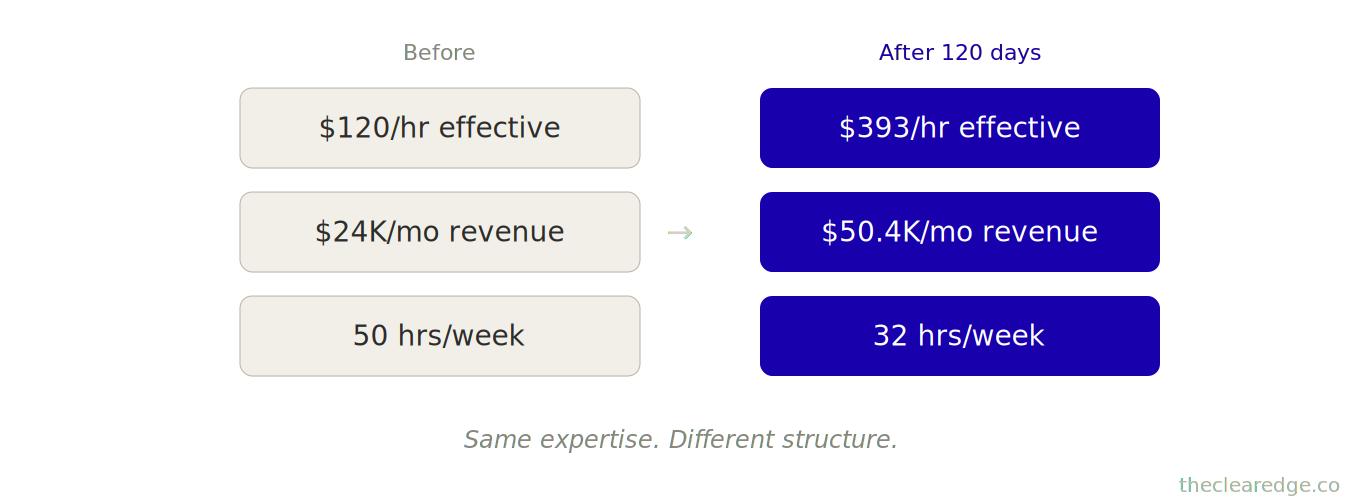
At $24,000/month with a linear model:
10 clients × $2,400 = $24,000
50 hours per week of delivery
Effective rate: $120/hour
Ceiling: $30,000 (maxed capacity)
After structure rebuild:
7 clients × $7,200 = $50,400
32 hours per week delivery
Effective rate: $393/hour
Ceiling: $100,000+ (leverage model scales)
Same expertise, different structure — that’s the gap between being stuck at $25,000 and scaling to $50,000+.
The Real Revenue and Time Cost of Keeping the Wrong Revenue Architecture
One consultant stayed in a linear model for 18 months at $23,000/month.
In that same 18 months, if he’d rebuilt the structure to support $50,000 per month:
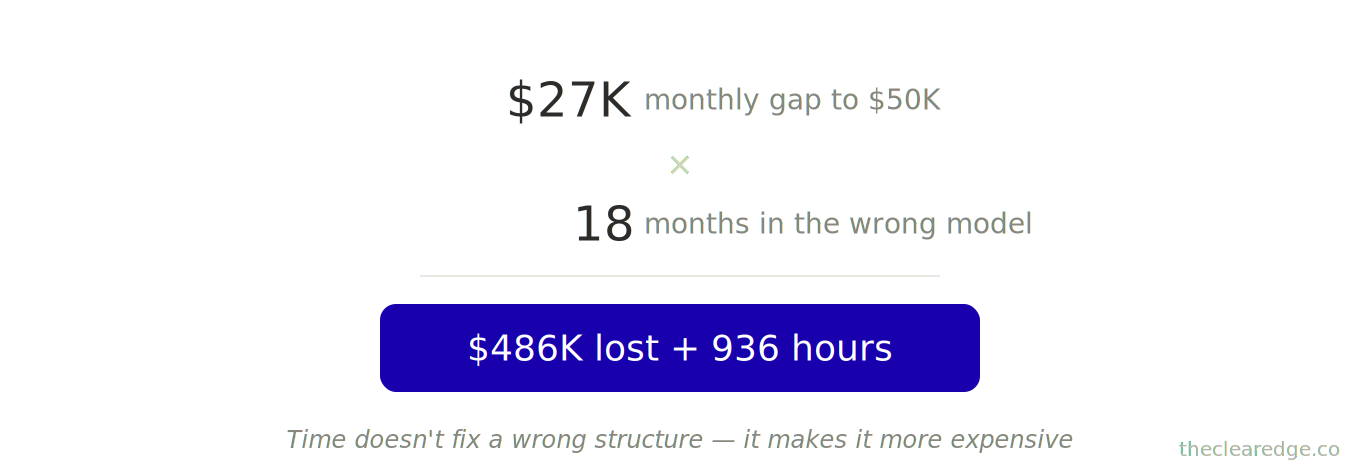
Lost revenue: $486,000 ($27,000 monthly gap × 18 months)
Lost margin improvement: $175,000 (estimate)
Lost client quality: Immeasurable (wrong-fit clients drain energy)
Lost time: 936 hours (18 months × 52 weeks × 10 hours of unnecessary delivery per week)
Think about that!
$486,000 and 936 hours because he didn’t rebuild the structure.
Another agency owner spent 2 years trying to “add her way” from $28,000 to $50,000, hiring 3 people, adding services, and taking more clients.
Result:
$32,000 revenue
$19,000 payroll
$13,000 net (was $28,000)
Working 67 hours per week, managing chaos
Finally rebuilt structure: repositioned for premium, filtered clients ruthlessly, built delivery leverage.
6 months later:
$54,000 revenue
$8,000 payroll
$46,000 net
38 hours per week
The 2 years of adding cost her $360,000+ in opportunity cost.
The lesson: adding more clients into a capped model just deepens the hole; only rebuilding the foundation changes your ceiling.
Time doesn’t fix a wrong structure; it just makes it more expensive.
When Your $20K–$30K Model Becomes the Ceiling
Staying in a $20K–$30K linear model for 18–24 months quietly burns hundreds of thousands and 936 hours you never get back; rebuild the architecture, not your tolerance for grind.
Run the Three Moves to $50K Reality Check Checklist
Next time you’re between $20K and $30K and telling yourself you “just need more clients,” pull this before you change a single offer.
☐ Calculated your 50-hour ceiling and wrote the maximum client count and ceiling revenue to see if your current model can ever hit $50,000.
☐ Named your primary constraint (pricing, delivery model, positioning, or client filter) using today’s effective hourly rate and client-count math.
☐ Rewrote your premium positioning across Who, What, and How so it defensibly supports $5,000–$10,000 monthly fees for $2M–$10M companies or $200K+ earners.
☐ Listed your non‑negotiable client filters and marked at least one current or pending client as keep or decline using the $6K–$7.5K+ budget standard.
☐ Mapped one leverage shift in delivery (group, productized, or asset-based) and wrote the first 2-hour build block you’ll ship in the next 7 days.
This is how you stop burning $486,000 and 936 hours keeping a $20K–$30K architecture that can’t ever carry $50K months.
Your Move: Start Rebuilding Your $50K Revenue Architecture Before Tomorrow
Today (30 minutes)
Calculate your current ceiling:
(Current clients × hours per client) ÷ 50 (maximum sustainable hours) = maximum client capacity.
Maximum clients × current price = ceiling revenue.
Is it above $50,000/month?
If not, your model is capping you.
Identify your constraint:
Is it pricing (charging $2,000 when the market pays $6,000)
Delivery model (all 1:1)?
Positioning (too generic)?
Client filter (taking wrong-fit clients)?
Write your premium positioning:
Who (specific market), What (measurable outcome), How (named methodology).
Test it: Does this justify $5,000+ per month?
If not, refine.
Tomorrow (2 hours)
Build your client filter:
Define your minimum budget, decision speed, scope boundaries,
communication style, and commitment length.
What’s non-negotiable? Write it down.
Design your leverage opportunity:
What could you deliver to 10 clients in the same time it takes to serve
Group sessions? Productized system? Async model?
This Week (8 hours)
Test new positioning:
Reach out to 5 ideal-fit prospects using your premium positioning.
Price objections = positioning unclear.
Budget questions = positioning working.
Pilot your group or leverage model:
Invite 3–5 current clients to test the new format or productized delivery.
Get feedback. Refine it.
Decline one wrong-fit lead:
Practice saying no.
Feel the capacity return immediately.
Your turn: name your revenue ceiling and the structural change to break it.
What’s your current revenue ceiling based on your delivery model — and what structural change would break through it?
Drop your answer below. I read every reply.
If this helped you see your ceiling differently, bookmark it — you’ll use it again.
FAQ: Using the Three Moves to $50K Architecture to Replace Linear $20K–$30K Models
Q: How do the Direction, Protection, Multiplication moves make $50,000 months structurally possible instead of biologically impossible?
A: They rebuild your revenue architecture so each client pays $5,000–$10,000, delivery hours drop from 50–60 to 18–38 per week, and revenue density rises enough that $50,000–$92,000 months fit inside sustainable capacity; that’s exactly what the Direction → Protection → Multiplication system is built to do.
Q: How do I calculate whether my current business model can ever reach $50,000 months?
A: Multiply your current clients by hours per client, divide by a 50-hour weekly ceiling to find maximum client capacity, then multiply that by your current price to see if the resulting ceiling revenue sits above or below $50,000 per month.
Q: How do I use the Three Moves to $50K framework with its Direction step before changing any prices?
A: First, rewrite positioning across Who, What, and How so your offer targets $2M–$10M companies or $200,000+ earners, promises measurable outcomes like reclaiming 25 hours weekly, and names a clear mechanism such as The Operator Exit Protocol to justify $5,000–$10,000 per month.
Q: How do I know if “adding my way” to $50,000 is silently costing me $486,000 and 936 hours?
A: If you’ve sat between $20,000–$30,000 for 12–24 months while working 50–60 hours weekly, a simple gap calculation between your current revenue and a structurally achievable $50,000 shows losses like $27,000 per month for 18 months, totaling $486,000 and 936 wasted delivery hours.
Q: What happens if I keep relying on a linear hour-for-dollar model at $20,000–$30,000 instead of rebuilding architecture?
A: You hit a hard ceiling where reaching $50,000 would require 80–106 hour weeks, 15–20+ clients, collapsing margins, and mounting burnout, which is why many founders spend 18–24 months stuck at $23,000–$28,000 despite constant effort.
Q: How do I apply Protection so client filters actually raise margin instead of just shrinking my pipeline?
A: Define non-negotiables like $6,000–$7,500+ comfortable monthly budget, two-call decision speed, respect for scope, async-first communication, and 90-day minimums, then decline 60%+ of unqualified leads so your remaining 6–9 clients each preserve $5,000+ in monthly margin and cut scope creep from 75% to around 12%.
Q: How much time does it take to rebuild my revenue architecture using Direction, Protection, and Multiplication?
A: Expect about 30 minutes today to calculate your ceiling, 8–12 focused hours this week to restructure positioning, client filters, and leverage, and then 90–150 days for transitions, cohort launches, and pricing changes to lift revenue into the $50,000–$92,000+ range.
Q: How do I use the Multiplication move to shift from 1:1 delivery to leveraged delivery without crashing revenue?
A: Run a parallel pilot where you transition 3–5 existing clients into 90-day group or productized models that serve 10–12 buyers at once, letting you move from $26,000 with 48 weekly hours to models like $48,000–$92,000 with 18–28 weekly hours while your original offers taper down.
Q: What happens if I upgrade positioning but don’t enforce scope protection with change orders and boundaries?
A: High-paying $6,000–$7,500 clients quietly expand from 8 scoped hours to 14+ hours per month, dragging effective rates down from $562/hour toward $321/hour and eroding over $17,000 in yearly margin per client—or more than $120,000 annually across a full roster.
Q: When should I refuse a $2,000–$3,000 client even if I feel like I “have capacity”?
A: Anytime saying yes would block you from serving $6,000–$8,500 clients who fit your new positioning, because each wrong-fit client can steal 5–10 hours per week and contribute to multi-year opportunity costs like $360,000–$486,000 in lost upside.
Up Next: Focus That Pays — Guard 20 Hours Weekly to Maintain $50K Architecture
In “Focus That Pays: Guard 20 Hours Weekly and Hit $50K Months for $35K–$50K Operators,” I will unpack how $50,000 founders protect their capacity from the noise that kills momentum at scale.
Navigate The Clear Edge OS Systems for Scaling From $5K to $150K
Start here: The Complete Clear Edge OS — Your roadmap from $5K to $150K with a 60-second constraint diagnostic.
Use daily: The Clear Edge Daily OS — Daily checklists, actions, and habits for all 26 systems.
LAYER 1: SIGNAL (What to Optimize)
The Signal Grid • The Bottleneck Audit • The Five Numbers
LAYER 2: EXECUTION (How to Optimize)
The Momentum Formula • The One-Build System • The Revenue Multiplier • The Repeatable Sale • Delivery That Sells • The 3% Lever • The Offer Stack • The Next Ceiling
LAYER 3: CAPACITY (Who Optimizes)
The Delegation Map • The Quality Transfer • The 30-Hour Week • The Exit-Ready Business • The Designer Shift
LAYER 4: TIME (When to Optimize)
Focus That Pays • The Time Fence
LAYER 5: ENERGY (How to Sustain)
The Founder Fuel System • $100K Without Burnout
INTEGRATION & MASTERY
The Founder’s OS • The Quarterly Wealth Reset
AMPLIFICATION (AI & Automation)
The Automation Audit • The Automation Stack
⚑ Found a Mistake or Broken Flow?
Use this form to flag issues in articles (math, logic, clarity) or problems with the site (broken links, downloads, access). This helps me keep everything accurate and usable. Report a problem →
› More to Explore: Quick Navigation · The Clear Edge OS
➜ Help Another Founder, Earn a Free Month
If this system just saved you from burning 936 hours and $486,000 trying to add your way past $30,000 months, share it with one founder who needs that relief.
When you refer 2 people using your personal link, you’ll automatically get 1 free month of premium as a thank-you.
Get your personal referral link and see your progress here: Referrals
Get the Three Moves to $50K Toolkit for Rebuilding Your Revenue Architecture Over the Next 90–150 Days
You’ve read the system. Now implement it.
Premium gives you:
Ready-to-use PDF toolkit—every template, diagnostic, and formula pre-filled, zero setup, immediate use
Plug-and-play AI diagnosis sessions—drop into Claude, Gemini or ChatGPT, answer a few questions, save hours of guessing, get your exact next move
Audio key points—concentrated frameworks you can absorb in minutes, implement while you move
Unrestricted access to the complete library—every system, every update
What this prevents: Losing hundreds of thousands and 936 hours by staying in a $20K–$30K linear model that can’t structurally support $50K months.
What this costs: $49/month.
Download everything today. Implement this week. Cancel anytime, keep the downloads.
Already upgraded? Scroll down to download the PDF, audio, and your AI session.
