


The Executive Summary
Founders at $10K–$30K/month quietly burn up to $129,600 and 23 work weeks a year treating every task as equal; a simple Signal Grid cuts the noise so the right 20% of work drives your next $30K month.
Who this is for: Coaches, consultants, and agency founders at $10K–$30K/month working 47–60 hours a week who are scattered across dashboards, content, and calls while revenue work keeps getting pushed aside.
The Signal Problem: Unfiltered inputs and “do everything” priorities eat 18–24 hours weekly, wasting up to 936 hours and $96,000–$129,600 while revenue stalls at $9K–$18K instead of breaking to $22K–$30K+.
What you’ll learn: A Signal Grid that scores every input 1–5, kills low-value noise for 30 days, and isolates the one constraint where each hour actually compounds into more revenue.
What changes if you apply it: Slack channels drop from 47 → 6, meetings from 17 → 4, and focused effort turns $9K → $17K, $11K → $22K, or $13K → $27K+ in 60–90 days without adding more tactics.
Time to implement: Spend 10 minutes today to score and cut inputs, 5 minutes tomorrow to pick your primary constraint, and 30 minutes this week to shrink one big task into a 30-minute move that starts paying you in 30–90 days.
Written by Nour Boustani for $10K–$30K/month founders who want $22K–$30K clarity-fueled growth without 60-hour weeks, 63 open tabs, or leaking six figures a year to noise disguised as work.
If this $96,000–$129,600 leak looks familiar, upgrade to premium and use the Signal Grid to redirect those hours into revenue.
› Library Navigation: Quick Navigation · The Clear Edge OS
Why $9K–$30K Founders Stall at 55–60 Hours Despite Working Hard
You’re working hard enough; the real problem is you’re fixing the wrong thing.
At $12K/month you can get away with working on everything, and at $30K/month that’s exactly what holds you back.
Case: Consultant Stuck at $9K Working 55 Hours
A consultant earning $9K/month, stuck there for eight months at 55 hours a week, constantly in motion but going nowhere.
She tracked ten different metrics:
Traffic
Engagement
Email opens
Social followers
Revenue
Expenses
Pipeline value
Close rate
Average deal size
Monthly growth rate
Daily reality:
Ten dashboards.
Ten numbers screaming for attention every morning.
The question that exposed the problem
I asked her one question: “Which number, if doubled, would change everything?”
Silence for 20 seconds.
“I... don’t know. Maybe all of them?”
That’s the problem: she didn’t know what to ignore.
That’s exactly why she was stuck at $9K working 55 hours weekly.
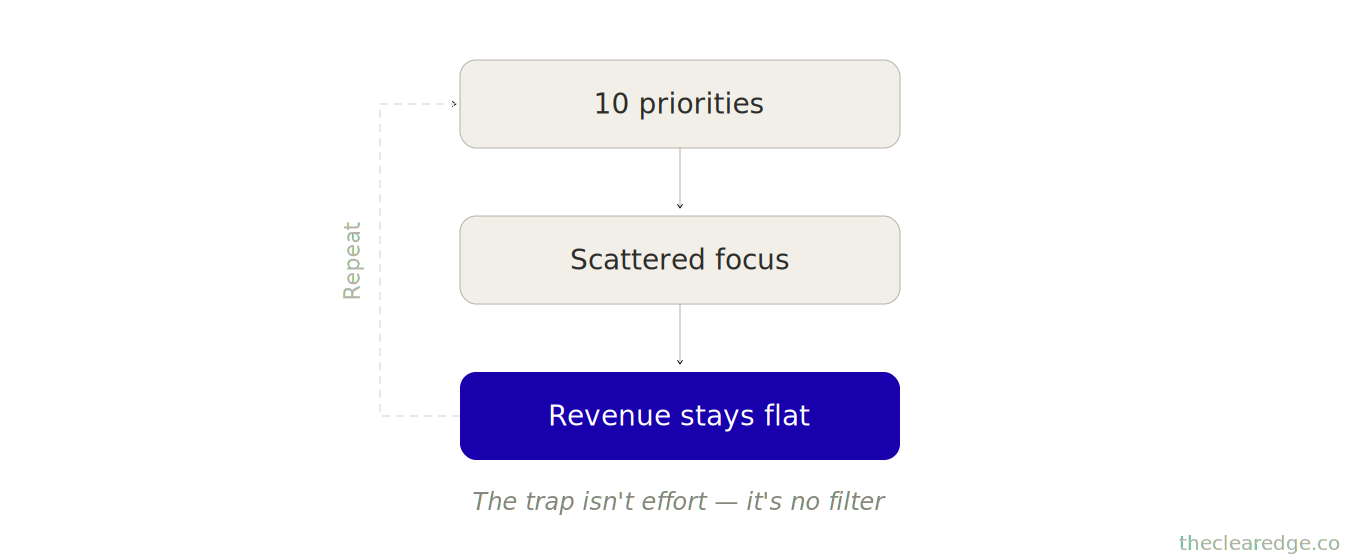
You’ve probably had that same moment — staring at ten priorities, unable to pick one.
Here’s the real gap: it isn’t effort; it’s knowing what to ignore.
In 73% of stalled businesses I’ve audited, founders waste 18–24 hours weekly on work that never touches revenue. That’s not a guess; it’s the reality you’re already living.
Eighty percent of what fills your day doesn’t move the one number that matters this week. The real mistake isn’t working too little—it’s working too much on the wrong stuff.
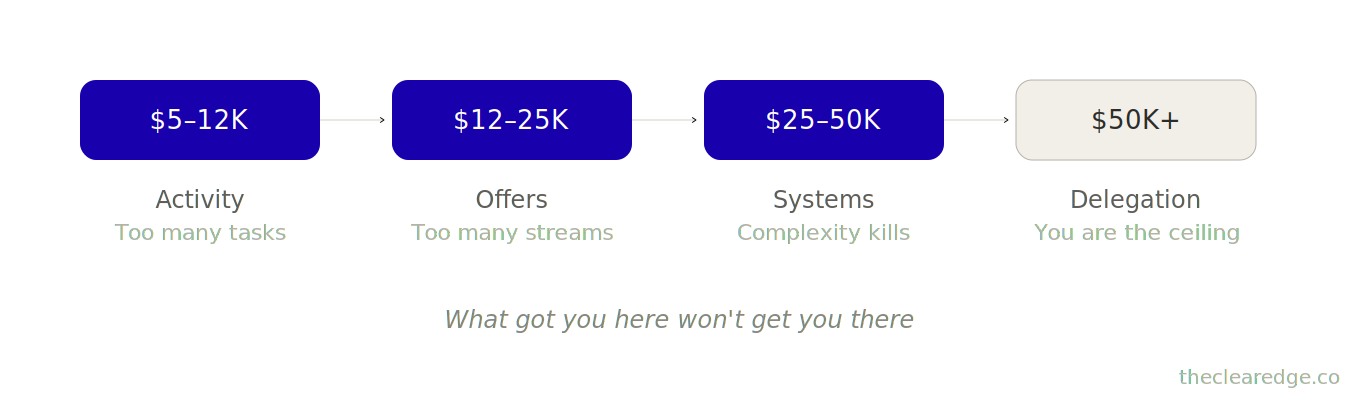
Revenue-Stalling Patterns at $5K, $12K, $25K, and $50K for Coaches and Consultants
Now that you’ve seen how one wrong fix stalls growth, here’s where that mistake usually hides at each level.
At every revenue stage, there’s a predictable pattern:
At $5–12K/month: Working on too many low-value activities
At $12–25K/month: Running too many offers or underpricing
At $25–50K/month: Complexity without systems or unclear positioning
At $50K+/month: Lack of delegation (covered in future articles)
The bottleneck you had at $8K won’t be the bottleneck at $18K. What got you here won’t get you there.
Case 1: Coach Reacting to Every Comment
A coach spends 15 hours weekly responding to every social media comment. It feels like engagement and it feels productive.
The math:
15 hours weekly on low-ROI work.
15 × 52 = 780 hours per year.
780 hours ÷ 40 = 19.5 full work weeks.
All of that time is spent on work that generates zero revenue.
Meanwhile, her email list—which generates 80% of her clients—gets 2 hours weekly. That’s backwards.
Case 2: Consultant Stuck in Slack Alignment
A consultant spends 10 hours weekly in Slack “staying aligned with team.” It’s a two-person team, and most messages don’t need to be real-time.
The cost:
10 hours weekly of fragmented attention.
10 × 52 = 520 hours per year.
520 hours ÷ 40 = 13 full work weeks lost to context switching.
His deep work gets squeezed into whatever’s left, and revenue stays stuck at $11K for 9 months.
Case 3: Agency Owner Living on Networking Calls
An agency owner attends 5 networking calls weekly. It feels like business development.
The result:
5 hours weekly
5 × 52 = 260 hours yearly
260 hours = 6.5 work weeks
Zero clients from networking in 12 months.
His outreach (which closes ~40% of qualified leads) gets 1 hour weekly. He’s starving what works to feed what doesn’t.
Stage Shift: At $15–30K/month, the Pattern Changes
At $15–30K/month, the pattern shifts.
A course creator spends 15 hours weekly creating content that gets thousands of views. Zero sales.
When we audited her funnel:
50K monthly views
0.1% email capture (50 people)
0% sales (no sales emails, just “value”)
15 hours weekly on content → 780 hours yearly
780 hours yearly → zero revenue contribution
Her only sales came from a short quarterly promo sequence — it converted at 8% and brought in $24K each time (≈$8K/month averaged).
We killed the view-chasing content and built a weekly email sequence designed to convert.
Before: View-chasing content, zero sales
After: Weekly email sequence designed to convert
$8K/month → $22K/month in six weeks. Same effort. Different filter.
Stage Shift: At $30–50K/month, Complexity Without Systems
At $30–50K/month, the problem isn’t lack of effort; it’s complexity without systems.
One consultant was running:
4 different service packages
3 pricing tiers per service
2 delivery models
Custom proposals for everything
Result: Every client required custom thinking, so nothing could scale.
She was working 60 hours weekly to maintain $32K/month and stayed stuck there for 7 months.
We cut to:
2 service packages
1 price point each
1 delivery model
Templated proposals
$32K/month → $48K/month within 90 days, working 40 hours weekly.
Why? Efficiency compounds. Complexity kills it.
Single Bottleneck, Not Ten Priorities
You’ve probably diagnosed your own business the same way.
Think you need more traffic? Focus on better conversion first.
Think you need a new offer? Finish the one you started.
Think you need a hire? Document one system first.
Every business has one bottleneck. Fix it and everything flows; ignore it and nothing moves.
This isn’t theory. This is how revenue moves when you stop treating every task as equally important.
Most founders can see the revenue pattern now; the next step is installing a repeatable filter instead of reacting to every fire.
The Signal Grid: 3-Step Focus Filter System for $5K–$50K Founders
This is what I walk every overwhelmed founder through. Three steps that take 10 minutes to run the first time and then change how you work.
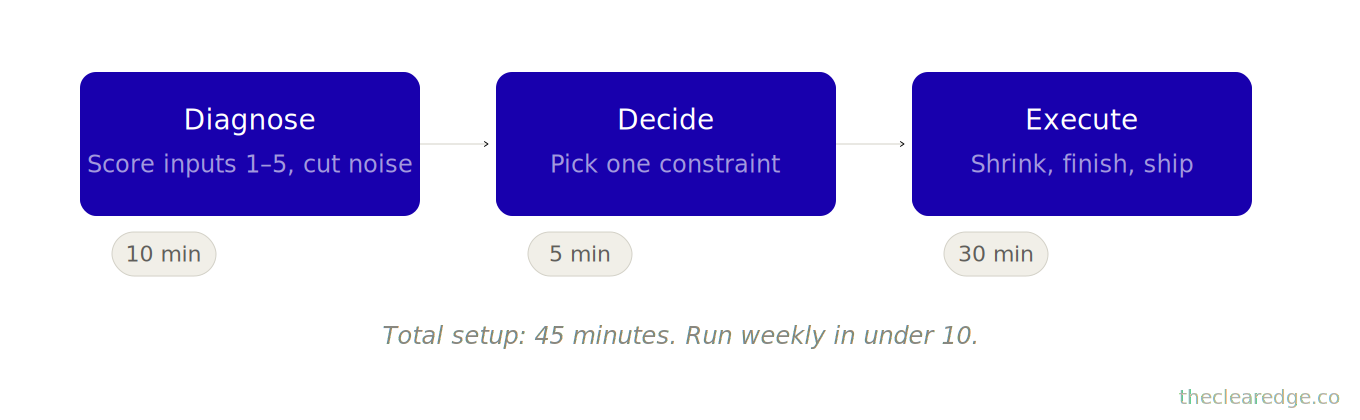
Move 1: Diagnose What’s Stealing Focus in Your 47–60 Hour Founder Week
Most founders don’t realize how much noise they’re carrying until they see it mapped.
One coach felt “scattered” but couldn’t explain why, joking that his browser had fewer tabs than his to-do list.
So we did a seven-day audit.
Information Inputs (7-Day Audit)
47 Slack channels (actively checked: 6)
23 newsletter subscriptions (read: 2)
8 podcasts queued (listened: 0)
12 group chats (valuable: 1)
6 recurring meetings (necessary: 2)
5 dashboards (used: 1)
Time Breakdown From Noise
Context switching between tools: 8 hours weekly
Reading/processing low-value info: 6 hours weekly
Attending low-ROI meetings: 4 hours weekly
Total waste: 18 hours weekly
18 hours weekly → 936 hours yearly
936 hours yearly → 23 work weeks
He was losing nearly half a year to noise.
We applied a simple scoring system.
Score each input 1–5:
5 = Directly generates revenue or saves significant time
4 = Supports revenue generation or efficiency
3 = Helpful but not critical
2 = Low value, mostly FOMO
1 = Pure noise
[List Inputs]

Slack / Newsletters / Meetings /
Dashboards / Chats / Feeds

      |
      v
[Score 1–5]

1 = Noise      5 = Revenue

      |
      v

[Under 3] --> Kill 30 days

[3–4]    --> Keep with rules

[5]      --> Protect in calendar
The Rule:
Under 3: Kill it for 30 days and see what breaks. (Spoiler: nothing does.)
3–4: Keep, but make it intentional and set clear boundaries.
5: Protect and prioritize.
His Cuts:
Slack: 47 → 6 channels (killed 41)
Newsletters: 23 → 2 (unsubscribed from 21)
Podcasts: 8 → 0 (deleted all)
Group chats: 12 → 1 (muted 11)
Meetings: 6 → 2 (declined 4 recurring)
Dashboards: 5 → 1 (closed 4 tabs permanently)
Noise cut. Focus returned. Capacity unlocked.
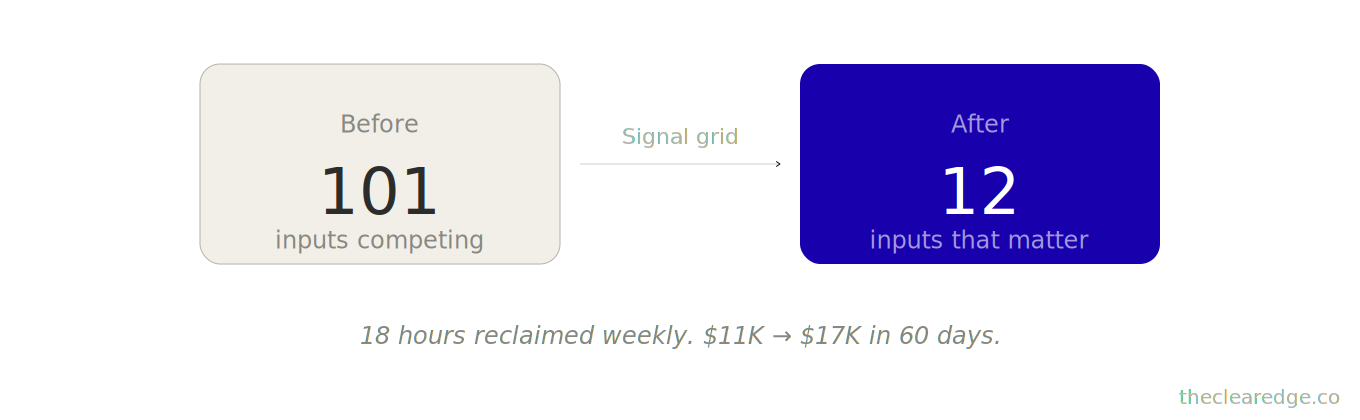
He got 18 hours back weekly, used 12 hours for client delivery and strategy, and took on 3 more clients at $2K each.
$11K/month → $17K/month in 60 days, while working fewer hours.
Case: “Staying Informed” Noise
Starting point: Another agency owner was “staying informed” with 31 newsletters, 8 podcasts, 5 YouTube channels, and 12 Twitter lists.
Why it felt necessary:
“Staying informed” sounded like professional due diligence.
Each input felt small on its own, easy to justify.
Actual behavior:
She read maybe 10% of it.
The other 90% created guilt (“I should catch up”), mental clutter, and decision fatigue.
Zero business value.
The cut:
We cut 80%.
Kept 6 highest-value sources.
Result:
Mental clarity came back in 3 days.
Decisions got faster.
She closed 2 deals she’d been “thinking about” for weeks.
Conclusion:
Noise cut. Capacity unlocked. Revenue followed.
The Math You Need to See
At $30K/month, her time was worth approximately $150/hour (200 working hours monthly).
18 wasted hours weekly → 72 hours monthly
$10,800 in opportunity cost
Over a year: $129,600 in lost potential.
Cutting noise isn’t about working cleaner — it’s about reclaiming the $129,600 in capacity you’re currently feeding into low-ROI work.
Do This Today
List every information input (Slack channels, newsletters, meetings, dashboards, group chats, social feeds).
Score each 1–5 based on revenue impact or necessity.
Kill everything under 3 for 30 days. Track what breaks (hint: nothing will).
Across 41 founder audits, I’ve seen this pattern: 60% of their “staying informed” activities produce zero business value.
Why You Need the Signal Grid Toolkit to Run This Weekly
You’ve got the Signal Grid and you can see your real constraint now; the premium toolkit gives you a simple way to run it every week so you’re not rebuilding the system from scratch every Monday.
Move 2: Decide on the One Revenue Constraint Blocking Your Next Stage
At every revenue stage, there’s one primary constraint blocking the next level.
Most founders work on ten things. Smart ones find the one.
One coach was running a group program ($2K), 1-on-1 coaching ($1.5K), mini-course ($297), and membership ($47/month).
Four revenue streams, all competing for attention and all underperforming.
[Current Revenue Band]
       |
       v
[Ask: What blocks next stage?]
       |
       +--> [Too many offers?]
       |
       +--> [Underpricing?]
       |
       +--> [Positioning / complexity?]

Pick ONE box --> Focus all changes there
Offer Split (Starting Point)
Group: $4K/month (2 members), 12 hours delivery
1-on-1: $6K/month (4 clients), 16 hours delivery
Course: $891/month (3 sales), 4 hours marketing
Membership: $141/month (3 members), 8 hours management
The Analysis:
1-on-1: $6,000 / 16 hrs (≈$375/hr) — low scalability
Group: $4,000 / 12 hrs (≈$333/hr) — high leverage
Course: $891 / 4 hrs (≈$223/hr) — scalable, underfed
Membership: $141 / 8 hrs (≈$18/hr) — poor margins
The membership was generating $18/hour while eating 8 hours monthly. Terrible margins.
The course at $223/hour and the group at $333/hour had potential but were starved for attention.
The Fix:
We killed two: membership and course.
Why? Membership was a time drain with terrible margins, and the course required completely different marketing than her core offers.
New focus: 1-on-1 and group only.
Reallocated 12 hours to 6 hours of sales and marketing and 6 hours improving group program delivery.
Result:
Group: 2 → 7 members = $14K/month
1-on-1: 4 → 5 clients = $7.5K/month (raised price to $1.5K)
$11K/month → $21.5K/month working 38 hours weekly.
Revenue nearly doubled by doing less, not more.
Pricing Constraint Case
Another consultant’s problem wasn’t offers; it was pricing.
He was charging $1,500 for projects taking 40 hours, an effective rate of $37.50/hour.
The market rate for his expertise was $150–200/hour minimum.
The constraint was simple: underpricing forced him to chase volume, volume left no time for marketing, and no marketing kept him stuck at capacity.
We raised pricing to $4,500 for the same deliverable.
Fears vs Reality
Fears: “I’ll lose all my clients.”
Reality:
Lost 2 price-sensitive clients
Kept 4 clients (happily paid new rate)
New clients: 2 at new rate (closed easier because price signaled premium)
Old: 6 clients × $1,500 = $9K/month, 240 hours
New: 6 clients × $4,500 = $27K/month, 240 hours
Phase 2: He used higher margins to work less. With 5 clients the next month, systems cut delivery to about 28 hours per project (≈140 hours total).
$9K/month → $22.5K/month at ~35 hours weekly.
Offer Clarity Case
An agency owner’s problem: offer clarity.
Website pitch: “We help businesses grow through digital marketing, social media management, content creation, SEO, email marketing, and strategic consulting.”
Translation: “We do everything and nothing.”
Conversion rate: 1.2% (website visitors to booked calls).
We rewrote to:
“We get local service businesses 30+ qualified leads monthly through Google Ads. Guaranteed or you don’t pay.”
One service. One outcome. One guarantee. One audience.
Conversion rate: 1.2% → 4.8%
The Math
Traffic: 1,000 monthly visitors (unchanged)
Old: 12 calls booked, 3 closed = $9K
New: 48 calls booked, 12 closed = $36K
Same traffic. 4x revenue. Just clarity.
The Pattern Across All Stages
$5–15K: Usually working on too many low-value activities
$15–30K: Usually running too many offers or underpricing
$30–50K: Usually complexity or unclear positioning
The Question
Before you touch anything tomorrow, ask:
“Does this move my primary constraint, or does it just keep me busy?”
If it’s the second one, it’s noise.
You’ve named the primary constraint; the game now is shrinking it into concrete moves you can actually ship this week.
Move 3: Execute by Shrinking Revenue Tasks Small Enough to Finish Today
Big goals create paralysis. Small completions create momentum.
One consultant decided to “rebuild my entire client experience,” and revenue stayed flat at $8K the entire time.
Six months later it still wasn’t done, she was paralyzed by scope, and she’d made zero progress.
Why it failed was simple: the goal was huge, vague, and had no clear completion point.
Shrink The Goal Into Shippable Pieces
We broke it into eight pieces:
Week 1: New welcome email (2 hours)
Week 2: Onboarding checklist (3 hours)
Week 3: First session template (2 hours)
Week 4: Mid-program check-in template (2 hours)
Week 5: Resource library (3 hours)
Week 6: Completion certificate (1 hour)
Week 7: Referral request sequence (2 hours)
Week 8: Testimonial collection system (2 hours)
Each piece was finished and implemented within 7 days.
By week 8, the entire client experience was rebuilt.
Email rebuilt. Onboarding rebuilt. Delivery rebuilt.
Clients noticed immediately. Perceived quality jumped, and referrals went from 1 every 3 months to 2 per month.
$8K/month → $14K/month within 120 days. The difference was the speed of progress.
[Big Vague Goal]

"Rebuild my client experience"
           |
           v
[Break Into 8 Pieces]

Welcome email / Checklist /
Templates / Check-ins / etc.
           |
           v
[One Tiny Task This Week]

e.g. "Write welcome email"
           |
           v
[Finish + Ship]
           |
           v
[Next Tiny Task]

Repeat weekly --> Full system built
Case: The “6 Rule” For 32 Priorities
One coach had 32 tasks on her list, all marked “priority,” and when everything’s a priority, nothing is. She felt overwhelmed and accomplished nothing for two weeks.
The 6 Rule: From 32 tasks, pick the six that move revenue this week and move everything else to the “Later” list.
Her 6:
Send proposal to warm lead
Follow up with 3 past proposals
Record week 3 module for group program
Email list with offer
Post LinkedIn content with CTA
Client strategy session prep
What happened:
She finished all 6 in one day.
Energy came back. Confidence returned. Momentum built.
Next 30 days:
Next week: Picked 6 more from the remaining 26. Finished 5.
Within 30 days: Original 32 tasks became 14 completed + 4 still relevant + 14 realized they never mattered.
Case: “Create Content Strategy” → One Post
Another consultant had “create content strategy” on her list for 6 weeks and never touched it.
The task was too vague, too big, and had no clear completion.
We changed it to “Write one post.”
She finished it in 90 minutes, posted on LinkedIn, got traction, and landed a $3K client.
One post per week for 12 weeks built a content engine that generated 4 clients → $12K.
The Pattern
Vague goals create avoidance:
“Improve my sales process” (when? how? what counts as done?)
“Build a content strategy” (too abstract)
“Scale my business” (meaningless)
Concrete tasks create completion:
“Rewrite my discovery call script by Friday”
“Write one LinkedIn post by Wednesday 10am”
“Send 20 outreach emails by end of today”
Why it works: Each has a clear finish line. Your brain loves finish lines.
Case: Saying Yes To Everything
Setup:
One agency owner said yes to everything: speaking gigs, podcast interviews, coffee chats, “collaboration” calls, and networking events.
Calendar: full.
Revenue: flat at $16K/month for 5 months.
Time audit:
Speaking/podcasts: 8 hours monthly, generated 0 clients in 6 months
Coffee chats: 6 hours monthly, generated 1 client in 6 months
Networking: 8 hours monthly, generated 0 clients in 6 months
“Collaboration” calls: 4 hours monthly, generated 0 partnerships
Total: 26 hours monthly → 312 hours yearly
Nearly 8 work weeks on activities with near-zero ROI.
Meanwhile, his highest-signal channel—direct outreach via email and LinkedIn—converted at 12% and took just 4 hours monthly.
The Fix:
Said no to everything external for 30 days.
Focused only on client work plus direct outreach.
Outreach time went from 4 hours to 16 hours monthly.
Result:
Outreach volume: 40 → 160 messages monthly
Responses: 5 → 19 (12% hold)
Calls booked: 3 → 12
Closed: 1 → 4 at $3K each
Revenue shift: $16K/month → $28K/month.
Opportunity cost of low-ROI yeses: $12K/month → $144K yearly.
You’ve seen how small, finished actions compound; now here’s what happens to clarity, time, and revenue once the filter is actually running.
Edge case: founders with strong inbound can survive scattered focus longer, but they still bleed months of progress and tens of thousands in quiet opportunity cost before growth stalls.
The rule: every yes to something creates ten hidden nos to something else—and most founders forget that part.
What Changes When $10K–$30K Founders Install a Signal Grid on a 47–60 Hour Week
Here’s the pattern I see when founders implement this system.
Clarity & decisions
Mental clarity returns within days.
One coach: “I realized 80% of my to-do list was just making me feel busy. It wasn’t moving anything forward.”
Decision speed increases.
One consultant: “I used to agonize over what to work on each morning. Now it’s obvious.”
Task lists shrink dramatically.
From 40+ items to under 10 that matter.
Everything else was noise pretending to be work.
Within 30 days, more gets shipped.
One consultant shipped three complete offers in 30 days after being stuck for 4 months.
Why? Focus stopped scattering.
Time & revenue
Revenue increases.
One agency owner went from $13K/month → $27K/month in 90 days by cutting non-revenue work from 30 hours weekly to 5 hours.
Time frees up.
One coach went from 17 weekly meetings → 4 weekly meetings and reclaimed 13 hours, which she used for deep work.
Revenue plus emotional state.
$9K/month → $18K/month in 90 days. In that same window, the drowning feeling disappears and is replaced by control and direction.
Daily experience shift.
One consultant: “I used to wake up stressed about ‘everything I had to do.’ Now I wake up clear on the one thing that matters today.”
Momentum & stages
Momentum becomes predictable.
One founder: 63 open tabs + 18 active projects → 8 tabs + 3 projects.
Shipping returns.
Shipped two products in 30 days.
Made $11K from those 2.
First time in a year he’d finished anything.
Revenue stages break through.
Stuck at $8–12K → breaks to $18–25K
Stuck at $15–20K → breaks to $30–40K
Stuck at $25–35K → breaks to $50–60K
Why it happens:
Because the constraint wasn’t effort. It was focus.
The Underlying Math
At $20K/month working 50 hours weekly:
Effective rate: $100/hour
200 hours monthly
If 40% of the time is noise:
20 hours weekly → 80 hours monthly
$8,000 monthly in wasted capacity
Over a year:
$96,000 in lost opportunity
Cutting noise isn’t about “working less.” It’s about reclaiming $96K in annual capacity for revenue-generating work.
You’ve seen the upside of a working filter; now look at what running without one really costs over months and years.
The Real Revenue and Time Cost of Operating Without a Signal Grid Filter
Case 1: Six Months Building the Wrong Thing
One consultant spent six months building a course nobody asked for.
Why: Building felt productive, like real progress, and safer than selling.
Results:
Revenue: flat at $7K the entire time
Launch: made $800 total
Six months of nights and weekends → $800. Think about that. Six months.
Hidden cost:
Meanwhile, his consulting (which he ignored while building) could’ve generated an additional $30K in that period if he’d just done sales outreach.
Opportunity cost: $30,000.
Case 2: A Year of Engagement, Zero Clients
One coach spent a year creating content that got engagement but zero conversions.
42 posts
Thousands of likes
Hundreds of comments
Zero clients.
Ignored asset:
Her email list (5,000 subscribers, no sales emails sent) sat dormant.
Single leveraged action:
When we finally sent one sales email: 8 clients in 2 weeks → $12K.
That email took 45 minutes to write. 45 minutes she’d avoided for a year.
Real cost:
The cost of focusing on likes instead of revenue: 12 months, potentially $100K+ in lost clients.
Case 3: Hiring Before Systems Destroys Net
An agency owner hired three people before documenting any process.
“I need help!”
Team grew. Chaos grew faster.
Numbers:
Revenue: $18K → $21K (+$3K)
Payroll: $0 → $15K (+$15K)
Net: $18K → $6K (-$12K)
He was making less money working more hours managing a team that had no systems to follow.
Six months later:
Let go of 2 people. Kept 1. Finally, built systems first.
Result:
Revenue: $28K
Payroll: $5K
Net: $23K
The lesson: Systems before scale. Filter before the team.
The Pattern: Every week you work without a filter costs you months of actual progress.
The founder who’s clear on what matters moves at 3–5x the speed of the founder who’s busy with everything.
This isn’t motivational — it’s the Signal Grid translated into business math you can’t argue with.
The Price Of Treating Everything As Equal
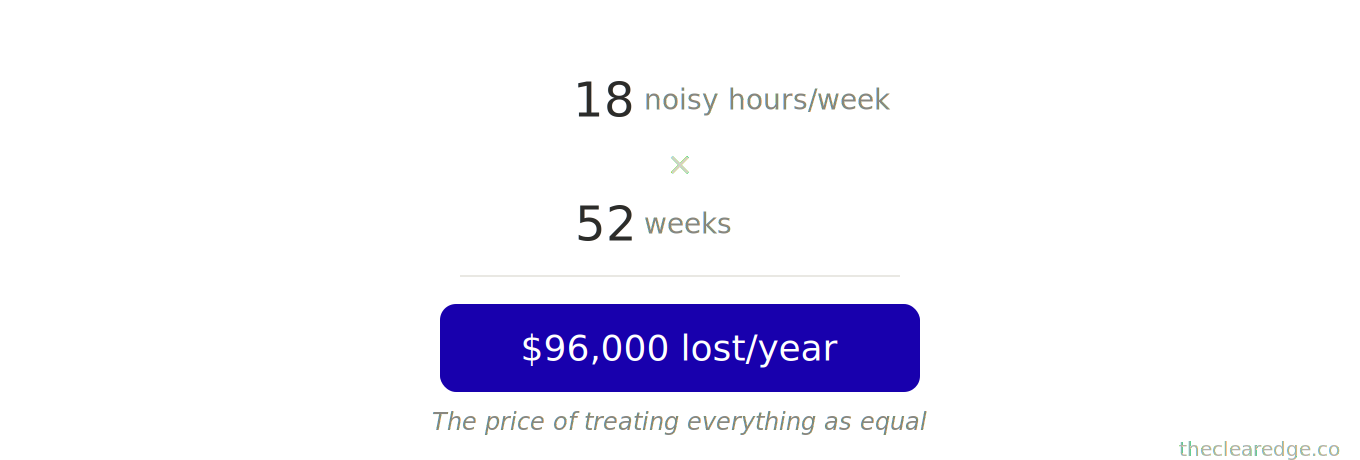
Every week you let 18–24 noisy hours bury your real work, you quietly trade $96,000+ a year for feeling busy instead of installing a filter that fixes it.
Run Your Signal Grid Field Test Checklist
Next time your week feels full but revenue’s flat, run these before you touch your inbox.
☐ Scored every live input 1–5 on the Signal Grid and wrote which channels, newsletters, meetings, chats, and dashboards sit under 3 for 30 days.
☐ Listed all 3–5 revenue patterns for your current band and circled one primary constraint to treat as the only target for this week’s moves.
☐ Wrote one 30-minute shippable task that directly moves that primary constraint and blocked it first in your 47–60 hour calendar.
☐ Compared today’s calendar against all 4–5 Signal Grid inputs and deleted or rescheduled anything that doesn’t touch those protected blocks.
☐ Logged whether this pass stayed inside the 10-minute, 5-minute, and 30-minute Signal Grid timing so you’re not rebuilding the system again tomorrow.
Five minutes here keeps another 18–24 noisy hours from quietly trading $96,000–$129,600 of capacity for feeling busy instead of paid.
How to Run the Signal Grid Before Tomorrow in 10, 5, and 30 Minutes
Before you check your inbox tomorrow morning, do this.
Today (10 minutes):
List everything competing for your attention: Every Slack channel, newsletter, meeting, dashboard, group chat, social feed
Score each 1–5 based on revenue impact or necessity (5 = Directly generates revenue or saves major time, 1 = Pure noise)
Cut everything under 3 for 30 days: Unsubscribe, mute, decline, delete. Track what breaks (hint: nothing)
Tomorrow (5 minutes):
Pick your one primary constraint: What’s the single thing blocking your next revenue stage? More offers? Better pricing? Clearer message? More focus?
Ask before every task: “Does this move my constraint or just keep me busy?” If it’s busy work, skip it
This Week (30 minutes):
Shrink your biggest task until it fits in 30 minutes or less: “Rebuild everything” → “Rewrite welcome email.” “Create strategy” → “Write one post.”
Finish one complete thing before starting anything new: Completion creates momentum. Starting creates clutter
Say no to one thing you’d normally say yes to: Track the time saved. Reallocate to your constraint
[TODAY - 10 min]

[ ] List all inputs
[ ] Score 1–5
[ ] Cut under 3 for 30 days

[TOMORROW - 5 min]

[ ] Pick ONE primary constraint
[ ] Ask: Does this move it?

[THIS WEEK - 30 min]

[ ] Shrink one big task to 30 min
[ ] Finish it before starting new
[ ] Say no once, track saved time
You’ve got the actions to run this week; the rest of this is fast answers to the questions serious operators usually ask next.
Identify One Non-Revenue Task You Know Isn’t Working But Still Do
What’s one thing you’re doing that you know — deep down — isn’t working, but you’re still doing it anyway?
Drop your answer below. I read every reply.
Be honest. We all have at least one.
FAQ: Using the Signal Grid Focus Filter to Cut Busywork and Grow Revenue
Q: How does the Signal Grid help me cut 80% of busywork and reach $22K–$30K months?
A: It scores every input 1–5, kills everything under 3 for 30 days, and re-routes 18–24 wasted hours weekly into a few moves that can turn $9K → $17K, $11K → $22K, or $13K → $27K+ in 60–90 days.
Q: How do I use the Signal Grid with its 1–5 scoring rule before I plan next week?
A: List all inputs (Slack, newsletters, meetings, dashboards, group chats, social feeds), score each 1–5 for revenue impact or necessity, kill everything under 3 for 30 days, then protect 4–5s in your calendar so they get first claim on your 47–60 weekly hours.
Q: How do I know if my real problem is noise, offers, or positioning at my current revenue stage?
A: At $5–12K/month it’s usually too many low-value activities, at $12–25K it’s too many offers or underpricing, and at $25–50K it’s complexity or unclear positioning, so you match your stage to these patterns instead of guessing which of ten priorities matters.
Q: What happens if I keep treating every task as equally important without a filter?
A: You repeat patterns like 15 hours weekly on comments, 10 hours in Slack, and 5 hours networking that together burn 260–780 hours yearly and quietly cap you at $9K–$18K while starving the few activities—like email or outreach—that actually move revenue.
Q: How much money does unfiltered noise really cost a $20K/month founder over a year?
A: With a rough $100/hour effective rate at 50 hours weekly, wasting 20 hours weekly on low-ROI work means 80 hours monthly and about $96,000 in lost annual capacity that could have gone into revenue-generating actions.
Q: How do I run the Signal Grid today if I’m drowning in Slack, newsletters, and meetings?
A: Audit one week of inputs, then cut Slack from counts like 47 → 6 channels, newsletters from 23 → 2, meetings from 6 → 2, and dashboards from 5 → 1 so you reclaim around 18 hours weekly—936 hours or 23 work weeks a year—for delivery, strategy, and sales.
Q: What happens when I apply the Signal Grid and then focus on my primary constraint instead of ten priorities?
A: Founders who do this typically shrink from 9–18 active projects to 3, ship key assets like offers and emails within 30 days, and see jumps such as $8K → $22K, $11K → $21.5K, or $13K → $27K in 60–90 days without adding new tactics or hours.
Q: How do I use the Signal Grid to decide which offers to kill so revenue actually grows?
A: You compare each offer’s revenue per hour—like $18/hour memberships vs $223/hour courses vs $333/hour groups—then kill low-margin offers, reallocate 8–12 weekly hours into the highest-leverage ones, and make moves like $11K → $21.5K while dropping from 40 to 38 hours.
Q: What happens if I scale hires and projects before installing a Signal Grid filter?
A: You risk scenarios where revenue creeps from $18K → $21K while payroll jumps from $0 → $15K, net drops to $6K, and 26+ monthly hours disappear into low-ROI speaking, networking, and “collaborations” instead of the direct outreach or systems that could have taken you to $28K.
Q: How much time should I budget to keep the Signal Grid running each week without overcomplicating it?
A: Use 10 minutes today to score and cut inputs, 5 minutes tomorrow to choose your primary constraint, and about 30 minutes each week to shrink one big task into a 30-minute shippable action so you keep compounding progress for 30–90 days.
You’ve seen how the Signal Grid runs; the next piece is how to keep momentum compounding instead of stalling at the next ceiling.
Up Next: The Momentum Formula for Removing Daily Leaks at $12K–$30K Months
In “The Momentum Formula: Stop the Revenue Leaks Stalling $10K–$20K Operators at $12K,” we unpack why businesses rarely stall from big failures—but from the quiet energy drains that pile up every day.
Navigate The Clear Edge OS From $5K To $150K Months
Start here: The Complete Clear Edge OS — Your roadmap from $5K to $150K with a 60-second constraint diagnostic.
Use daily: The Clear Edge Daily OS — Daily checklists, actions, and habits for all 26 systems.
LAYER 1: SIGNAL (What to Optimize)
The Signal Grid • The Bottleneck Audit • The Five Numbers
LAYER 2: EXECUTION (How to Optimize)
The Momentum Formula • The One-Build System • The Revenue Multiplier • The Repeatable Sale • Delivery That Sells • The 3% Lever • The Offer Stack • The Next Ceiling
LAYER 3: CAPACITY (Who Optimizes)
The Delegation Map • The Quality Transfer • The 30-Hour Week • The Exit-Ready Business • The Designer Shift
LAYER 4: TIME (When to Optimize)
Focus That Pays • The Time Fence
LAYER 5: ENERGY (How to Sustain)
The Founder Fuel System • $100K Without Burnout
INTEGRATION & MASTERY
The Founder’s OS • The Quarterly Wealth Reset
AMPLIFICATION (AI & Automation)
The Automation Audit • The Automation Stack
⚑ Found a Mistake or Broken Flow?
Use this form to flag issues in articles (math, logic, clarity) or problems with the site (broken links, downloads, access). This helps me keep everything accurate and usable. Report a problem →
› More to Explore: Quick Navigation · The Clear Edge OS
➜ Help Another Founder, Earn a Free Month
If this system just saved you from leaking $96,000 in noisy, zero-revenue work while staying stuck at $9K–$20K, share it with one founder who needs that relief.
When you refer 2 people using your personal link, you’ll automatically get 1 free month of premium as a thank-you.
Get your personal referral link and see your progress here: Referrals
Get the Signal Grid Toolkit to Cut 80% of Busywork and Surface $96K–$129K in Hidden Capacity
You’ve seen the system. Now run it.
Premium gives you:
Ready-to-use PDF toolkit—every template, diagnostic, and formula pre-filled, zero setup, immediate use
Plug-and-play AI diagnosis sessions—drop into Claude, Gemini or ChatGPT, answer a few questions, save hours of guessing, get your exact next move
Audio key points—concentrated frameworks you can absorb in minutes, implement while you move
Unrestricted access to the complete library—every system, every update
What this prevents: Losing up to $129,600 a year by letting 18–24 noisy hours weekly bury the work that pays.
What this costs: $49/month.
Download everything today. Implement this week. Cancel anytime, keep the downloads.
Already upgraded? Scroll down to download the PDF, audio, and your AI session.