


Read time: 12 minutes
› Library Navigation: Quick Navigation · Weekly Newsletter
The Executive Summary
When a prospect says “just send a proposal,” don’t write it yet, and ask who signs first. Dana runs a 3-person agency at $45K a month. She asked who signs on 12 sales calls in one quarter. She signed the same 4 deals and cut proposal work from 66 hours to 19.
Who this is for: agency owners and freelancers at $5K-$150K a month. You write 4+ custom proposals a month, each taking hours, and about 1 in 3 gets signed.
The problem: you write 12 proposals a quarter at 5 hours each, and 8 don’t sign. That’s 40 hours of writing and $72,000 unsigned, at $9,000 a project.
The fix: ask who signs while the buyer is still on the call. The answer puts every buyer on 1 of 3 paths, and none needs a five-hour proposal:
The buyer signs alone.
Someone else signs.
Nobody can say who signs.
Time to first result: 15 minutes. Send a short recap to every unanswered proposal by Wednesday, then count replies Friday.
Written by Nour Boustani for agency owners who want deals decided on the call, not in the inbox.
Try this now (under 2 minutes):
Open the last 3 proposals you sent that got no reply.
Next to each one, write the name of the person who signs.
No name next to a proposal means it’s waiting on someone who can’t sign.
Why a Proposal Request Usually Stalls the Deal Instead of Closing It
The sales call went well, and the prospect asked what the project costs and when you could start. Near the end of the call, they said it: “Just send me a proposal.”
It feels like a yes, so you hang up and block Thursday afternoon to write it. You send six careful pages and hear nothing back, even after a follow-up on day 7.
You may have just done five hours of unpaid homework for someone who had already left.
Sometimes “send me a proposal” is a real request. Just as easily, it’s the kindest way to end a call without saying no. It costs the buyer nothing and costs you 5 hours.
Behind the request, one of three things is missing: a budget, a decision date, or the signer. In the agency case below, 5 of the 12 buyers who asked couldn’t sign alone.
A document can’t fix any of those. It just gives them something to not reply to.
It gets worse, because open proposals make next month look full. So you ease off on finding new buyers. Then none of them sign, and the month is empty.
Proposify, a proposal software company, studied 1.28 million proposals sent through its tool. It puts the industry average close rate at 20%, while its own users closed 36%. The same report shows why the signer matters: most proposals go to 1 person. When 2 or more people view it, the close rate nearly doubles.
Stop Writing Proposals for Every Buyer
The mistake is writing a custom proposal for everyone who says “send me something.” You do it to be helpful, because saying no feels rude.
Time the last proposal you wrote. If it took 5 hours, 12 a quarter is 60 hours of writing. You lose a week and a half of 40-hour weeks.
At that point you’re not running sales, you’re running a free writing service with a logo on it. The fix isn’t a better template. It’s one question, asked while the buyer is still on the call: who signs off on it?
How Dana Cut Proposal Work From 66 Hours to 19
Here’s how it worked in one agency. Dana runs a 3-person agency at $45K a month. Retainers bring in $33K, the rest comes from warm $9,000 projects, and a custom proposal takes her 5 hours.
In one quarter, 12 buyers asked for a proposal, all 12 got one, and 4 signed. The next quarter, she asked who signs on all 12 calls. Seven buyers could sign on their own, 3 needed a second signer, and 2 couldn’t say who signs.
Quarter one, a proposal for everyone who asked

- Writing: 12 x 5 hours = 60 hours
- Follow-up: 12 x 30 minutes = 6 hours
- Signed: 4 of 12, or $36,000

Quarter two, who signs first

- Extra call time: 12 x 10 minutes = 2 hours
- Signs alone:
  - 7 pages, 7 hours
  - 3.5 hours of follow-up

- Second signer:
  - 3 briefs with the contact, 45 minutes
  - 3 pages, 3 hours
  - 1 review with the signer, 30 minutes
  - 1.5 hours of follow-up

- Nobody named: 2 recaps and 2 check-ins, 42 minutes
- Total: about 19 hours
- Signed: 4 of 12, or $36,000

The difference

- Hours back: 66 - 19 = 47, about 3.6 hours a week
- Deals: the same 4, the same $36,000
Same deals and the same money, with 3.6 hours a week back that Dana spent finding new buyers. Per buyer, a recap cost her 15 minutes and a page with its follow-up 1.5 hours. A full proposal with its follow-up cost 5.5 hours.
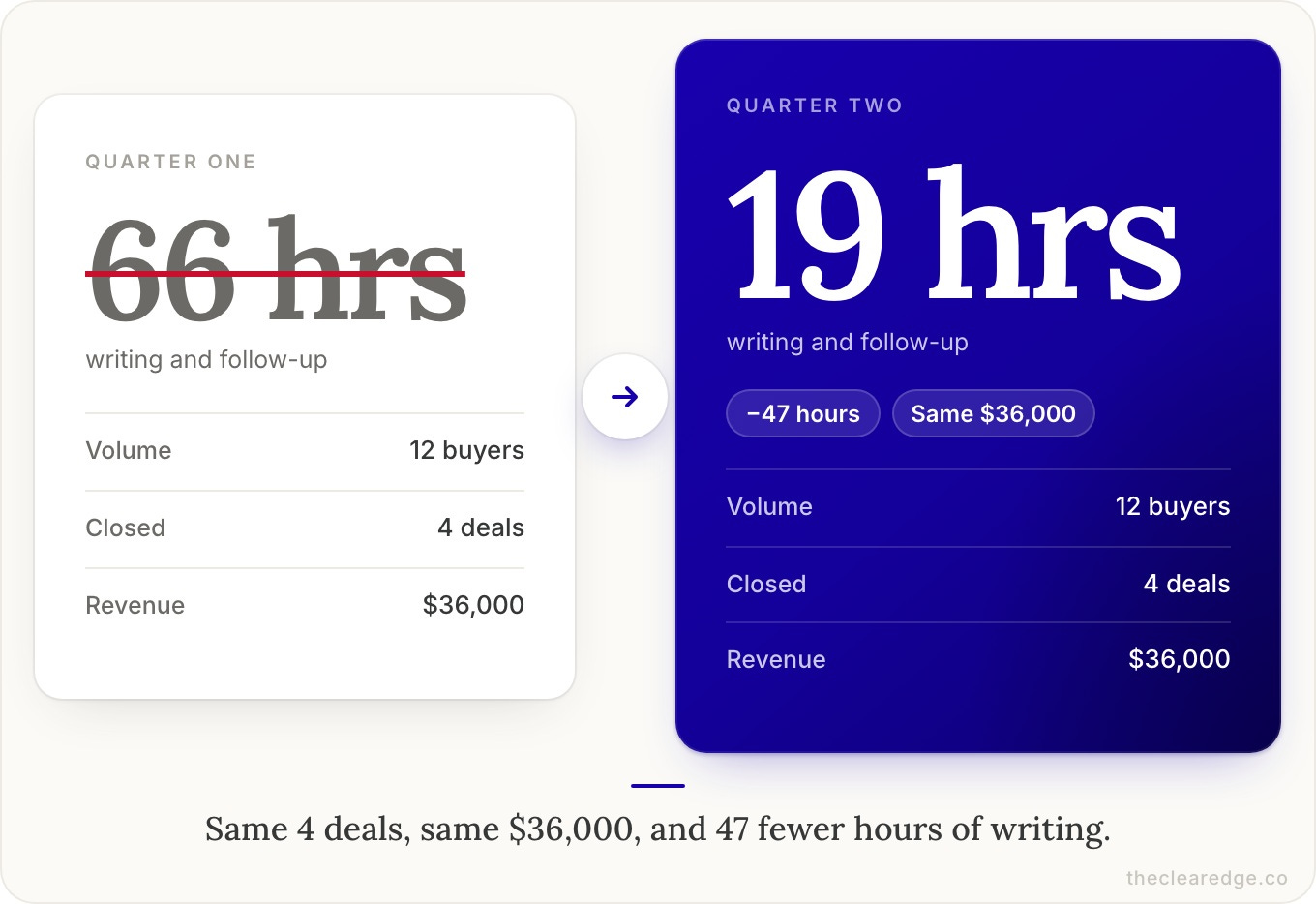
Of the 4 deals, 3 came from buyers who signed alone. The fourth had a second signer.
Pitchsite, which sells proposal software, lists win rates for warm leads by agency type. Full-service agencies win 28-48% and strategy work wins 45-65%. Dana’s 4 of 12 is 33%, in the lower half of the full-service range.
Dana didn’t win more deals. The same 4 deals took her 47 fewer hours of proposal work.
The two recaps did one more job. One buyer replied “restart” with a date, and that deal starts next quarter.
An unsigned proposal isn’t pipeline. Don’t count it until someone who can sign says yes.
