


The Executive Summary
Founders at $40K–$60K/month quietly cap out at $47K–$55K by adding more hours instead of leverage; this Revenue Multiplier roadmap turns the same 58–61 hours into $70K–$85K without burnout.
Who this is for: Service founders and operators at $40K–$60K/month working 55–61 hour weeks with 10–25 clients who feel maxed out because every new dollar still costs another hour.
The revenue multiplier problem: Linear, add-more-hours thinking traps you at $47K–$55K, burns 15–25 low-yield hours weekly on proposals, custom delivery, and reactive selling, and quietly leaves $150K–$200K+ in annual upside unused.
What you’ll learn: A focused Revenue Multiplier roadmap that shifts you from addition to multiplication by redesigning delivery, turning one-off work into reusable assets, and making past effort keep generating leads and revenue.
What changes if you apply it: Revenue moves from $47K–$55K → $70K–$85K+, high-leverage hours jump from 6 → 18+, low-leverage hours fall from 20 → 4, and you stack an extra $204,000 over 12 months without adding weekly hours.
Time to implement: Invest 15–20 hours of build over 4–6 weeks to free 10–25 hours inside 60–90 days, with full revenue multiplication visible by 90–120 days.
Written by Nour Boustani for $40K–$60K/month founders who want $70K–$85K income from the same hours without burning out, stalling at $47K plateaus, or rebuilding everything from scratch for every client.
If your 55–61 hours still deliver linear results, you’re running this framework half-built; upgrade to premium to document, test, and enforce The Revenue Multiplier properly.
› Library Navigation: Quick Navigation · The Clear Edge OS
Why Revenue Plateaus at $47K for $40K–$60K Service Founders Working 55–61 Hours
On paper, $47,000/month from 19 clients at $2,470 each and 61 hours a week looks like a healthy coaching business.
Three weeks ago, I talked to a coach at those exact numbers, whose revenue hadn’t moved in 7 months despite adding three new clients in that time.
“I’m maxed out,” she said. “Every client gets my full attention. I can’t add more hours, and I can’t compromise quality.”
But the math told a different story.
I asked her to track for 1 week which activities produced revenue and which consumed time without a proportional return.
Here’s what we found:
Discovery calls:
8 calls per week at 45 minutes each → 6 hours
Conversion rate: 38% (3 of 8 closed)
6 hours generated 3 clients → 2 hours per conversion
Proposal writing:
2.5 hours per custom proposal
8 proposals → 20 hours per week
Closed 3 → 6.7 hours per closed deal
Client onboarding:
3 hours per new client (intake, questions, expectations)
3 new clients → 9 hours that week
Weekly check-ins:
30 minutes per client on progress calls
19 clients → 9.5 hours weekly
Content creation:
12 hours writing emails, posts, and articles
Purpose: generate leads that feed the funnel
Total selling + delivery hours: 56.5 hours of her 61-hour week.
But here’s what mattered: Not all hours generated equal results.
Discovery calls: 6 hours → 3 clients → $7,410 monthly recurring = $1,235/hour
Proposals: 20 hours → 3 clients → $7,410 monthly recurring = $370/hour
Content: 12 hours → estimated 4-5 leads → 1-2 conversions = $185-370/hour
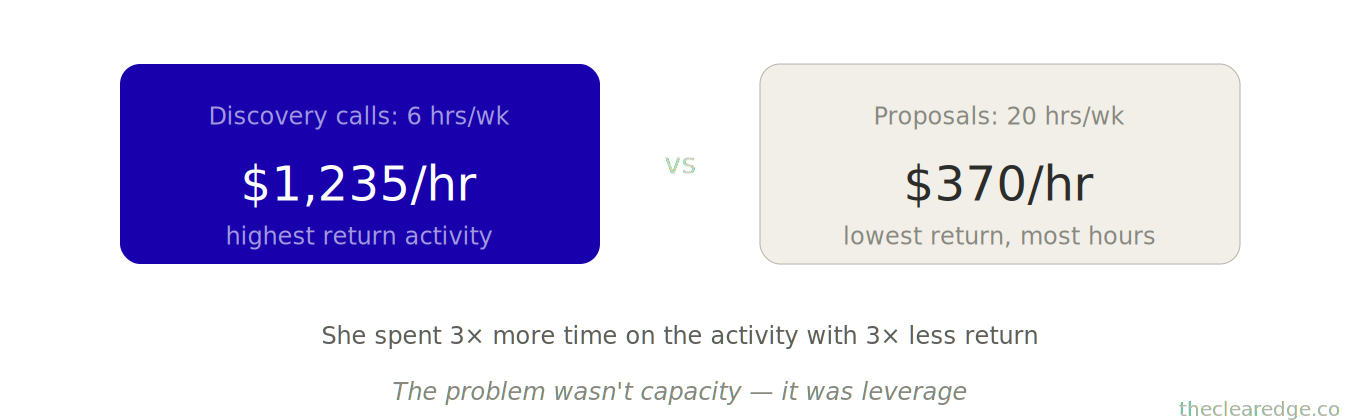
The pattern: She spent 20 hours on proposals (lowest return per hour) and 6 hours on calls (highest return per hour).
Her capacity was maxed, but her allocation was backwards.
“I thought custom proposals showed I cared,” she said. “That every lead deserved personalized attention.”
Wrong math.
Personalization doesn’t come from rebuilding the same framework eight times. It comes from applying a proven system to each person’s specific situation.
A templated proposal with three customization points beats a from-scratch custom one—because the template carries every lesson from previous wins.
Her real problem wasn’t capacity. It was leverage.
We rebuilt her business around one rule: Every hour should multiply results, not just add to them.
Changes
Proposals:
Built template with modular sections (problem diagnosis, solution framework, pricing tiers, timeline)
Customization reduced to 20 minutes per proposal (was 2.5 hours)
Conversion rate increased to 44% because template was stronger
Discovery calls:
Created pre-call questionnaire (10 questions, took leads 15 minutes to complete)
Eliminated 30% of calls from unqualified leads
Remaining calls focused on solution fit, not information gathering
Time per call: 30 minutes (was 45 minutes)
Client onboarding:
Recorded 23-minute video covering process, expectations, and first steps
Sent to every new client before the first session
Reduced live onboarding to 45 minutes (was 3 hours)
Questions answered in video, not in 1:1 time
Weekly check-ins:
Shifted 14 of 19 clients to async check-ins via voice memo + Loom update
Clients responded when ready, scheduling eliminated
Time reduced to 12 minutes per client (was 30 minutes)
Kept live calls for five high-touch clients only
Content creation:
Repurposed client session recordings (with permission) into case study content
Creation time reduced to 6 hours weekly (was 12 hours)
Content became more credible (showed real work, not theoretical frameworks)
Timeline:
Week 1: Built proposal template + pre-call questionnaire
Week 2: Recorded onboarding video, tested with 2 new clients
Week 3: Shifted 14 clients to async check-ins
Week 4: Implemented content repurposing system
Month 2: Freed 19 hours weekly, took on 6 new clients
Month 3: Revenue hit $61,850 (+$14,850 from baseline)
Result:
Hours/week: 61 → 58
High-leverage hours: 6 → 18
Low-leverage hours: 20 → 4
Clients: 19 → 25
Revenue: $47K → $61.8K (+31%)
She didn’t work anymore. She multiplied the return on every hour.
Growth didn’t come from addition. It came from multiplication.
The Revenue Plateau Pattern Capping $40K–$60K Service Businesses at $47K–$58K
Now that you’ve seen multiplication in action, here’s why most founders stay trapped in addition mode.
Every founder at $40,000–$60,000 hits the same wall: they assume every new dollar requires another hour of work, so revenue rises only as long as they can add hours and then caps when those hours max out.
Multiplication works differently: each hour generates disproportionate returns because the way the business is set up amplifies that effort instead of just adding it.
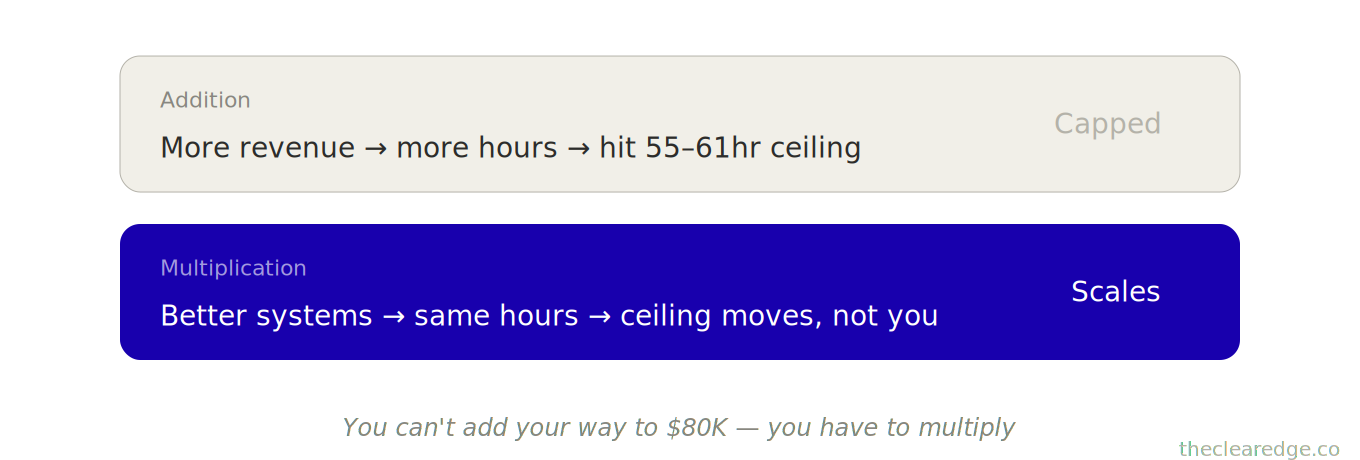
The pattern shows up in three places:
Pattern 1: Time-for-Money Delivery With No Leverage at $40K–$60K Months
You sell hours, so more revenue means more hours, and the ceiling hits when you max biological capacity at 50–60 hours per week.
One consultant was making $52,000/month from 13 clients, each paying $4,000.
Delivery: 4 hours per client per week → 52 hours weekly.
To reach $80,000: needed 20 clients → 80 hours per week (impossible).
The constraint: Linear delivery model where every client requires equal time input.
The solution: Delivery models that serve multiple clients simultaneously or reduce time per client without reducing quality.
We rebuilt for leverage
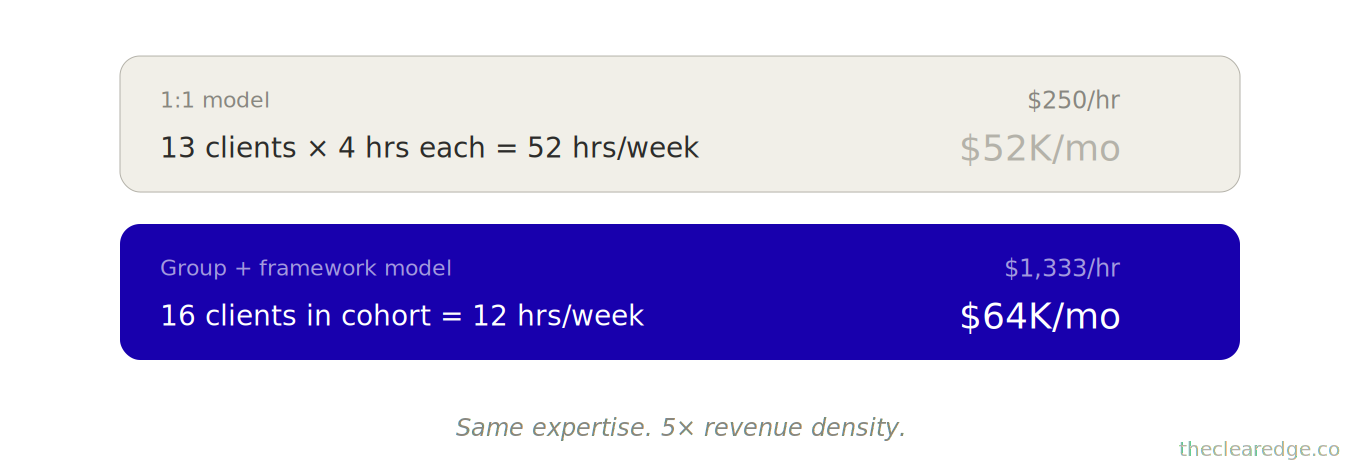
Before (1:1 model):
13 clients × 4 hours each = 52 hours per week
Revenue: $52,000 per month
Revenue per hour: $250
After (Group + Framework model):
16 clients in monthly cohort
2 group sessions per week (4 hours total)
Framework library (8 hours to maintain)
12 hours per week total
Revenue: $64,000 per month (16 × $4,000)
Revenue per hour: $1,333
Same expertise. Different delivery design. 5x revenue density.
How it worked:
Clients joined monthly cohorts of 14-18 members. Each cohort ran for 90 days with rolling enrollment.
Delivery structure:
Week 1: Individual diagnostic (45 minutes per client, done once at start)
Weeks 2-12: Two 2-hour group sessions per week (implementation + problem-solving)
Ongoing: Framework library with templates, checklists, and recordings (clients self-serve between sessions)
Week 13: Individual wrap + next steps (30 minutes per client)
Time breakdown:
Group sessions: 8 hours per week
Framework maintenance: 3 hours per week
Individual sessions: 12 hours per month (front and back loaded)
Total per week average: 12-14 hours to serve 16 clients, generating $64,000 per month
Added benefit: Clients got peer learning, accountability, and pattern recognition across the cohort. Better results than 1:1 because they saw solutions applied to multiple scenarios, not just theirs.
Timeline:
Month 1: Launched first cohort with 11 clients (transitioned 7 existing + 4 new) = $44,000
Month 2: Filled to 14 clients = $56,000
Month 3: Hit 16 clients = $64,000
Month 4: Maintained 15-17 clients = $60,000-68,000 range
Result: $52,000 → $64,000 in 90 days.
Hours per week: 52 → 14.
The design change increased revenue by 4x per hour. That’s multiplication.
Pattern 2: Custom Delivery With No Reusable Assets Blocking $80K Capacity
Every client deliverable is built from scratch.
Every solution feels unique, but the effort stays high and the multiplication stays low.
An agency owner was delivering a brand strategy for clients.
Starting economics:
Revenue: $44,000/month from 8 projects at $5,500 each
Time: 35 hours per project (research, strategy, deliverable)
To reach $80,000: needed 15 projects → 525 hours monthly (not possible at quality standard)
The constraint: Zero reusability. Every insight discovered once, never leveraged again.
The solution: Framework-based delivery where research becomes reusable and client work focuses on application, not discovery.
We rebuilt with asset leverage.
Before:
Custom research for each client = 35 hours per project
Revenue per project: $5,500
Revenue per hour: $157
After: Built brand strategy framework (60 hours upfront investment):
5 core positioning templates
Market research database (maintained quarterly, 12 hours per update)
17 common scenarios with documented solutions
Client application: 12 hours per project (diagnostic + customization)
New economics:
Framework maintenance: 3 hours per week average
Client delivery: 12 hours per project
Revenue per project: $6,200 (price increased due to proprietary methodology)
Revenue per hour: $517 (after framework investment amortized)
Result:
Average project value: $6,200 (was $5,500)
Average delivery hours: 12 (was 35)
Projects needed for $80,000: 13 per month (was 15)
Capacity: Could handle 20+ projects monthly (was 12)
Timeline:
Month 1: Built framework (60 hours), tested with 2 clients = $12,400 (temporary revenue dip during build)
Month 2: Delivered 6 projects using framework → $37,200
Month 3: Delivered 10 projects → $62,000
Month 4: Delivered 13 projects → $80,600
Hours per month: 280 → 185
Revenue: $44,000 → $80,600 in 120 days
The 60-hour framework build paid for itself in the first month and kept expanding margin on every project that followed.
Pattern 3: Reactive Selling With No Compounding Lead System at $50K–$60K
Revenue depends entirely on active selling. Stop selling and revenue stops; there’s no compounding, no multiplication.
One consultant was making $58,000/month from outbound sales, spending 18 hours weekly prospecting, pitching, and following up, and converting 4–5 clients monthly at $3,200 each.
To maintain revenue, it had to keep selling at the same pace forever.
The constraint: Time invested in selling never compounds, so the same effort is required every month regardless of past success.
The solution: Content-driven inbound that you create once and that generates leads repeatedly.
We built content multiplication
Before:
18 hours weekly outbound = 72 hours monthly
Converts to 4–5 clients = $12,800–16,000 new monthly recurring
Return per hour: $178–222
After: Built a content system:
1 detailed case study monthly (8 hours to create)
3 tactical breakdown posts weekly (6 hours total)
Email sequence for warm leads (built once, 12 hours, automated)
Webinar recorded once (4 hours), run automatically weekly
Time investment: 18 hours weekly to create + automate
Ongoing maintenance: 6 hours weekly after setup
Lead generation results:
Month 1: 12 leads (content building phase)
Month 2: 28 leads (content compounding)
Month 3: 41 leads (past content still generating)
Month 4: 53 leads (compounding effect clear)
Conversion rate: 22% (was 28% from outbound, but volume offset difference).
Revenue:
Month 1: $58,000 (baseline, no new clients from content yet)
Month 2: $64,800 (6 leads × 22% = 1.3 clients, rounded to 2 at $3,400)
Month 3: $75,600 (9 leads × 22% = 2 clients)
Month 4: $85,200 (12 leads × 22% = 2.6 clients, rounded to 3)
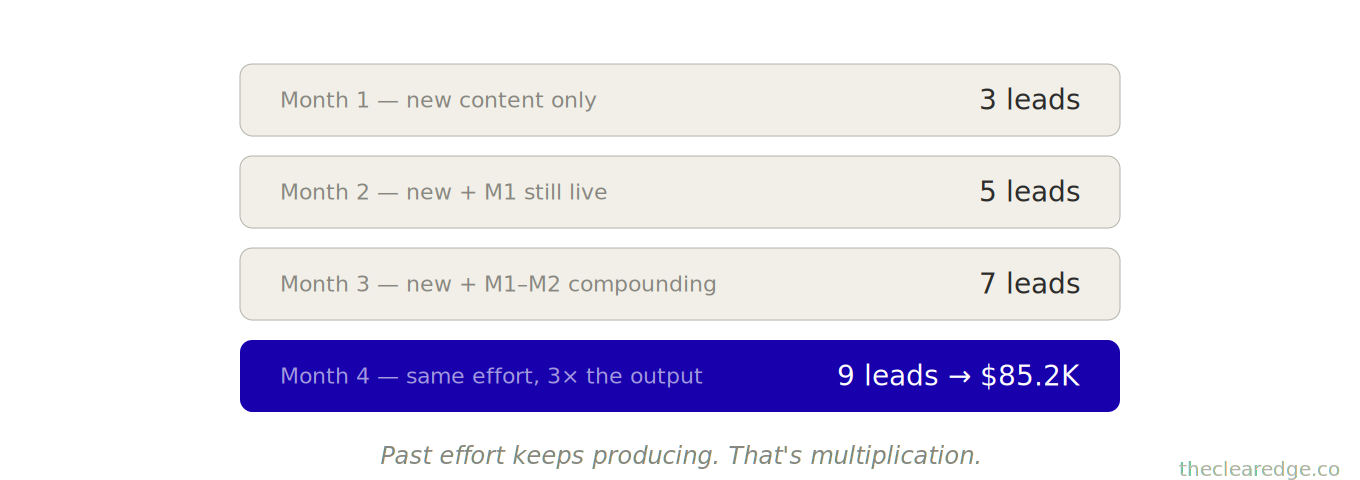
Critical difference: Month 1 content still generated leads in Month 4. Content from Month 2 generated leads in Months 3–4–5. Each piece multiplied results over time.
Timeline: $58,000 → $85,200 in 120 days.
Selling hours: 18 → 6 per week.
Past efforts continued producing results. That’s multiplication.
This is the pattern across 73 businesses I’ve worked with at $40,000→$60,000:
Founders cap revenue by thinking in addition, where more hours mean more money, instead of multiplication, where better systems create disproportionate returns from the same hours.
You can’t add your way to $80,000+—you have to run the three Revenue Multiplier moves until each hour produces outsized returns.
The Revenue Multiplier Framework in The Clear Edge OS for $40K–$60K Operators
Here’s the system that turns addition into multiplication.
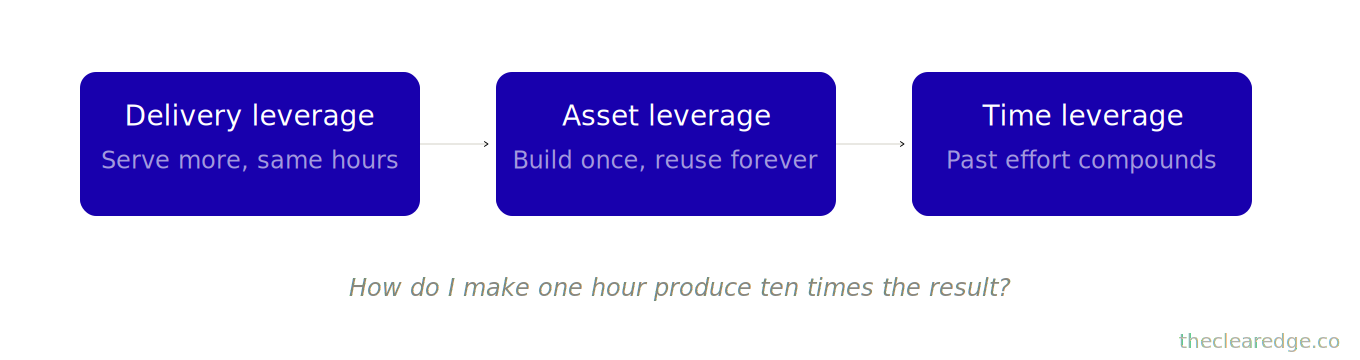
Every business has multiplication opportunities in three areas: delivery leverage, asset leverage, and time leverage. Most founders pour effort into whichever area screams loudest instead of deliberately choosing the highest-multiplication move.
The question isn’t “How do I work more efficiently?”—it’s “How do I make one hour produce ten times the result?”
Leaving $150K–$200K On The Table
If you can see 15–25 low-leverage hours in your own week, don’t wing this. Upgrade to premium and use the toolkit to systematically reallocate them into compounding work.
Move 1: Delivery Leverage to Serve More Clients Without Adding Beyond 55–61 Hours
Most delivery models scale linearly: one more client means one more unit of time.
Multiplication comes from delivery models where time input doesn’t increase in step with the number of clients you serve.
The goal: Reduce delivery time per client by 40-60% without reducing quality.
Three delivery multiplication methods to cut client hours by 40–60%:
1. Group delivery to lift revenue per hour 3–5x
Replace 1:1 sessions with group formats where multiple clients receive value simultaneously.
When to use: You deliver coaching, consulting, training, or advisory work where clients benefit from peer learning and don’t require constant 1:1 attention.
Implementation:
Identify which deliverables can be delivered in group format (most can—founders overestimate need for 1:1)
Design cohort structure: 10-15 clients, weekly or biweekly sessions, 90-day commitment
Keep diagnostic and wrap sessions 1:1 (personalization where it matters)
Price at 70-85% of 1:1 rate (clients get peer learning + network, you get leverage)
Math example:
Before: 10 clients × 3 hours each = 30 hours weekly, $40,000 monthly
After: 12 clients × 6 hours group sessions = 6 hours weekly, $45,600 monthly
Result: +$5,600 revenue, -24 hours weekly
2. Async delivery to replace standing calls with flexible check-ins
Replace synchronous time (calls, meetings) with asynchronous communication (video, voice memos, recorded responses).
When to use: Clients need direction and feedback but don’t need real-time interaction for every touchpoint.
Implementation:
Shift routine check-ins to Loom videos or voice memos
Build template responses for common questions
Use async tools (Loom, voice memo, shared docs) for 60-70% of communication
Reserve synchronous time for high-value strategic discussions only
Math example:
Before: 15 clients × 2 hours weekly calls = 30 hours
After: 15 clients × 30 minutes async review = 7.5 hours
Result: -22.5 hours weekly, same client experience
3. Framework-based delivery to replace custom work with proven systems
Replace custom solutions with proven frameworks that get customized to client situations.
When to use: You solve the same core problem repeatedly but each client feels unique.
Implementation:
Document your solution method (the steps you always follow, even if sequence varies)
Build decision trees for common variables
Create templates for each framework component
Clients get customization within a proven structure (faster, better results)
Math example:
Before: 25 hours per client to develop a custom strategy
After: 8 hours per client to apply framework + customize
Result: -17 hours per client, better outcomes (proven method)
Edge case: “What if my clients demand 1:1 and won’t accept group or async?”
Two scenarios:
Scenario 1: They demand it because you positioned it that way.
Most clients don’t care about format—they care about getting the promised results. If you position group or async as premium (”you’ll get peer insights most 1:1 clients never see”), they’ll prefer it.
Scenario 2: They genuinely need 1:1 (rare, usually only C-suite or highly sensitive work).
Charge 2–3x your group rate. True 1:1 requirement means premium pricing. If they won’t pay a premium, they don’t actually need 1:1.
Most $40K–$60K operators who fix delivery next run into the same drag: they’re still recreating proposals, onboarding, and strategy from scratch every time.
Move 2: Asset Leverage to Turn Repeated Work Into Reusable Revenue Systems
Most founders recreate the same assets over and over.
Every client gets a new proposal, every onboarding builds from scratch, and every report is recreated monthly.
The goal: Identify everything you create more than once and turn it into a reusable asset.
Four asset multiplication types that turn monthly work into compounding output:
1. Templates that cut proposals, reports, and docs by 60–80%
Any document, spreadsheet, presentation, or deliverable you create more than twice should become a template.
What to template:
Proposals (modular sections, 3-5 pricing tiers)
Onboarding documents (process, expectations, getting started)
Reports (auto-populated from data, not rebuilt each time)
Strategy frameworks (fill-in-the-blank with client specifics)
Meeting agendas (recurring meetings use the same structure)
Implementation:
Document one week of work
Identify anything created more than once
Build template for each (10-60 minutes per template)
Use template, customize only what must be unique (5-20% of content)
Math example:
8 proposals per month × 2 hours each = 16 hours
Template proposal (built once, 3 hours) + 20 minutes customization → 2.7 hours monthly
Result: -13.3 hours monthly per process
2. recorded assets that replace repeated client explanations
Anything you explain verbally more than three times should be recorded once and sent repeatedly.
What to record:
Onboarding process (20-30 minute video)
Common questions (FAQ video or doc)
How to use your tools/systems (screenshare walkthrough)
Your methodology (why you do what you do)
Implementation:
Track questions asked in client sessions for 2 weeks
Identify the 10 most common questions
Record answer to each (5-10 minutes per answer)
Send recording when a question comes up (clients prefer it—can rewatch)
Math example:
3 hours weekly answering the same questions across clients
6 hours to record answers once
Result: -3 hours weekly forever after a 2-week investment
3. Frameworks that turn your method into a named, defensible system
Your method for solving problems should be documented, named, and reusable.
What to framework:
Your diagnostic process (how you identify root problems)
Your solution method (steps you always follow)
Your decision criteria (how you choose between options)
Your implementation sequence (order of operations)
Implementation:
Document the last 5 client engagements: what did you actually do?
Find the pattern (you probably follow the same steps, even if the order varies)
Name each step + document decision points
Build a visual representation (flowchart, checklist, or matrix)
Use a framework with every client (they get a proven method, not an experimental approach)
Math example:
Before: 30 hours to develop a custom strategy per client
After: 10 hours to apply framework + customize for specifics
Result: -20 hours per client, better results (tested method)
4. Content that turns client work into ongoing lead flow
Client work should generate content, not consume time separately.
What to repurpose:
Client session insights → case study content
Common problems solved → how-to articles
Q&A from calls → FAQ content
Results achieved → social proof + testimonials
Implementation:
Record client sessions (with permission)
Extract anonymized insights for content (15 minutes per session)
Repurpose into posts, articles, or case studies (2-3 hours per piece)
Content generates leads that become clients (multiplication effect)
Math example:
Before: 12 hours weekly creating content separately
After: 4 hours weekly repurposing client work
Result: -8 hours weekly + better content (real examples, not theory)
Critical implementation rule: Build assets during downtime, not during busy periods.
When you have capacity, invest 10-20 hours building templates, recordings, and frameworks. When you’re busy, use them. Assets built during slow months pay dividends during busy months.
Once assets are doing the heavy lifting, the remaining ceiling is time—how much of your 55–61 hours keeps paying you after you’ve logged it.
Move 3: Time Leverage So Past Effort Compounds Into Future Revenue at $55–61 Hours
Most work generates returns only once. You do the work, you get paid, and it’s over.
Multiplication comes from work that keeps producing results after the initial effort.
The goal: Shift 20-40% of work to activities where effort compounds over time.
Three time-multiplication strategies to shift 20–40% of work into compounding activities:
Strategy 1: content-driven inbound that keeps producing leads for 12–36 months
Create content once, and it generates leads forever.
How it works:
Write detailed case studies showing real results (8-12 hours per piece)
Post tactical breakdowns of your process (2-4 hours per piece)
Each piece generates leads for 12-36 months after publication
Old content continues working while you create new content
Implementation:
Month 1: Create 4 detailed pieces (foundation)
Month 2: Create 4 more + promote Month 1 content
Month 3: Create 4 more + repurpose previous 8
Month 4: New content + old content both generating leads
Math example:
Month 1: 1 piece → 3 leads
Month 2: 1 new piece (3 leads) + Month 1 piece still live (2 leads) → 5 leads
Month 3: 1 new piece (3 leads) + Month 1-2 pieces (4 leads) → 7 leads
Month 4: 1 new piece (3 leads) + Month 1-3 pieces (6 leads) → 9 leads
Result: Same effort monthly, compounding returns (3 → 9 leads with same time input)
Strategy 2: Referral systems that turn closed clients into a steady deal flow
Build mechanisms where past clients generate future clients without ongoing effort.
How it works:
Design a formal referral process (not just “tell your friends”)
Create referral incentives that benefit both parties
Make referral easy (specific ask, simple process)
Track and optimize (what generates most referrals?)
Implementation:
Week 8-10 of engagement: Ask “Who else faces this problem?”
Offer value to both parties: referrer gets a bonus session, referred gets a discount.
Provide referral template (makes asking easier)
Follow up monthly: “Made any introductions this month?”
Math example:
Before: 0% systematic referrals (occasional random intros)
After: 18% of clients refer someone within 90 days
At 20 active clients × 18% = 3.6 referrals per quarter → 1.2 per month
Result: 1-2 new clients monthly without selling effort
Strategy 3: Leverage-based pricing to triple revenue per hour as systems improve
Price based on value created, not time spent.
How it works:
Shift from hourly/monthly to outcome-based or value-based pricing
As your systems improve (faster delivery via leverage), profit margin increases without price changes
Clients pay for results, don’t care if you deliver in 10 hours vs 40 hours
Implementation:
Calculate current value delivered (revenue generated or cost saved)
Price at 10-20% of value created (not based on your time)
As you get more efficient, the margin improves while the price stays stable
Math example:
Before: 30 hours × $200/hour = $6,000 per client
After (value-based): Client generates $75,000 additional revenue, you charge $9,000 (12% of value)
Your delivery time: 15 hours (via leverage)
Result: $9,000 revenue on 15 hours = $600/hour (was $200/hour)
Edge case: “What if my market won’t pay value-based pricing?”
Two responses.
Response 1: Wrong market.
If clients can’t pay based on value created, they’re not seeing enough value. Either deliver more value or find clients with bigger problems.
Response 2: Wrong positioning.
Value-based pricing requires proof. Show documented results (case studies, data, testimonials). If you can’t prove value, build proof before changing the pricing model.
Hidden Problems That Stop $40K–$60K Founders From Installing Revenue Multipliers
Even with delivery, asset, and time leverage in place, founders hit predictable obstacles.
1. Building leverage when you’re already at 55–60 hours weekly
You’re maxed at 55–60 hours weekly. Building templates, recording videos, and creating frameworks all require time, and you can’t add hours to build leverage while maintaining current delivery.
The trap is thinking, “I’ll build systems when things slow down.” Things never slow down, so systems never get built.
The solution is to make micro-investments during existing work.
Don’t carve out 20 hours to build systems. Build them incrementally:
5 minutes after each proposal: Update the proposal template with the new section learned
10 minutes after each common question: Record answer, add to FAQ
15 minutes after each client win: Document what worked, add to framework
Over 90 days:
5 minutes daily = 7.5 hours of template refinement.
10 minutes 3× weekly = 6.5 hours of recorded assets.
15 minutes weekly = 3 hours of framework documentation.
Total: 17 hours invested across 90 days (11 minutes per day average).
Return: 15–25 hours saved monthly after assets are built.
2. Handling client who resist group or async leverage models
You propose a group model or async delivery. Client says, “I need more personal attention than that.”
The trap is assuming the client knows what delivery model works best. They don’t; they know they want results, not a specific delivery method.
The solution is to position leverage as premium, not cost-cutting.
Bad framing: “To save time, I’m moving to group format.”
Good framing: “You’ll get peer insights and pattern recognition most 1:1 clients never see, plus accountability from the cohort.”
Most resistance comes from positioning, not actual client needs.
If the client genuinely requires 1:1, charge 2–3× your group rate. True 1:1 need means premium price; if they won’t pay, they don’t need it.
3. Fear that leverage will reduce quality and personalization
Templates feel generic. Frameworks feel rigid. Group delivery feels less personal.
The trap is confusing customization with quality. Clients don’t want custom work; they want results.
The reality is that leverage often improves quality because it applies proven methods consistently instead of reinventing them each time.
Template proposals convert better because they carry every lesson from past wins.
Framework delivery hits faster because it runs a tested method, not a fresh experiment.
Group sessions often outperform 1:1 because clients get peer learning and built‑in accountability.
Test it by building one leverage asset and comparing results with the old method. Leverage usually wins.
What The Revenue Multiplier Changes in 90–120 Days and What It Costs to Install
Here’s what actually happens when you implement multiplication.
Month 1: Foundation build
15-20 hours building core leverage assets (templates, recordings, framework)
Revenue flat or slight dip (time invested in building, not delivering)
Discomfort as you shift from custom to systematic
Month 2: Implementation
Use leverage assets with new clients
Measure time saved per client
Refine based on what works
Revenue returns to baseline or a slight increase
Month 3: Multiplication visible
Clear time savings (10-25 hours weekly freed)
Revenue increases as capacity freed
Client results improve (systematic beats custom)
Confidence builds in the leverage approach
What it Costs in time, attention, and short-term revenue to build leverage
Time investment: 15-20 hours spread across 4-6 weeks to build core leverage
Mental cost: Discomfort shifting from “every client is unique” to “every client gets proven system”
Short-term revenue risk: Possible 5-10% dip in Month 1 as you build (offset by Month 2-3 gains)
What you get: Hours freed, revenue gained, and capacity created after 120 days
Immediate: 10-25 hours freed weekly within 60-90 days
Near-term: 20-40% revenue increase within 90-120 days from capacity freed
Long-term: Scalable business model that doesn’t cap at biological hour limits
The math on a $55,000/month business applying the revenue multiplier
Before leverage:
$55,000 monthly on 58 hours weekly.
Revenue per hour: $237.
Capacity: Maxed.
After leverage (90 days later):
$72,000 monthly on 52 hours weekly.
Revenue per hour: $346.
Capacity: Room to grow to $90,000+ without hour increases.
Difference:
+$17,000 monthly.
–6 hours weekly.
That’s multiplication.
Addition Keeps You Capped, Not Effort
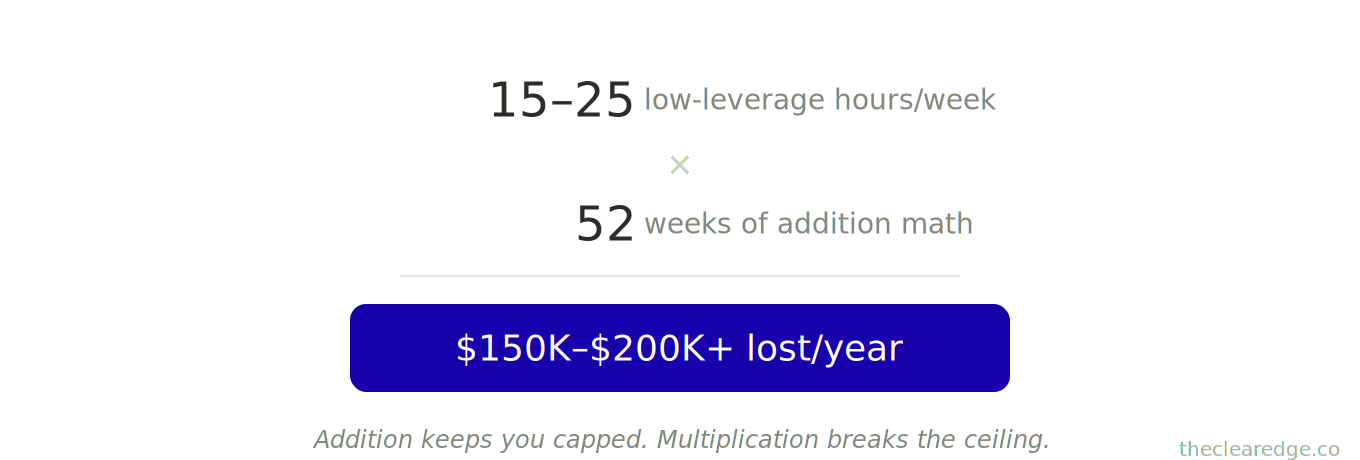
The hard truth is your $40K–$60K plateau comes from clinging to addition math that wastes 15–25 hours weekly and leaves $150K–$200K+ on the table; start rebuilding around multiplication, not another sprint.
Run the Revenue Multiplier Reality Check Checklist
Takes 5 minutes. Run it every time your revenue sits between $47K and $58K while your week is already at 55–61 hours.
☐ Listed this week’s hours as delivery, asset, or time leverage and totaled all low-leverage work above 15–25 hours
☐ Calculated current revenue per hour using this month’s revenue and actual 55–61 hour range, wrote the number next to the $237/hour benchmark
☐ Checked delivery model against group, async, and framework options and decided whether to keep or redesign it for 40–60% time cuts
☐ Logged how many repeated proposals, onboarding flows, and strategies still aren’t templates, recordings, or frameworks and chose one asset to convert next
☐ Compared today’s selling mix between outbound and content-driven inbound, wrote whether selling time still dominates or compounding systems are taking over
This is how you stop a $47K–$58K plateau from quietly donating $150K–$200K+ in upside to addition math every single year.
Where to Go From Here: Install The Revenue Multiplier and Lift $55K to $70K–$85K
If you’re in the $40K–$60K/month band, stuck at $47K–$55K on 55–61 hours, you’re donating $150K–$200K+ a year to low-leverage delivery, assets, and selling. That drag doesn’t fix itself—you have to rebuild how each hour works.
From here, run the sequence once:
Map your week and tag every hour as delivery, asset, or time leverage so you surface the 15–25 low-leverage hours capping you at $47K–$55K.
Convert repeated proposals, onboarding, and strategy into templates, recordings, and frameworks so projects drop from 25–35 hours to 8–12 hours and monthly revenue can move toward $62K–$80.6K.
Shift 20–40% of effort into compounding work—content-driven inbound, referral systems, and value-based pricing—so past effort keeps producing leads and lifts revenue from $55K to $72K–$85.2K in 90–120 days.
The Revenue Multiplier becomes the permanent fix that stops your $150K–$200K upside from leaking into addition math and lets every 58-hour week compound instead of crash into the same ceiling.
Your Turn: Identify Your Primary Leverage Bottleneck and One Multiplier to Build This Week
What’s your current bottleneck: delivery time, asset creation, or lead generation? Pick one multiplication opportunity and commit to building it this week.
Drop your answer below. I read every reply, and the patterns that show up often shape what I write next.
And if you’re not sure which leverage type to build first, just say “I need to map my multiplication opportunities”—that awareness alone puts you ahead of most founders.
Up Next: The Repeatable Sale to Turn One Yes Into Ten Without More Selling Hours
Next article covers “The Repeatable Sale: Turn One Yes Into Ten Without More Pitching for $45K–$65K Operators,”—the systematic selling model that turns closed deals into referral engines at $60,000-$80,000 monthly revenue.
You’ll learn the referral timing system that generates 2-4 referrals per closed client, the specific language that makes asking easy, and the incentive structures that benefit both parties without feeling like MLM tactics.
FAQ: Using The Revenue Multiplier Framework to Break $47K–$58K Plateaus at 55–61 Hours
Q: How does The Revenue Multiplier turn a $40K–$60K/month plateau into $70K–$85K without more hours?
A: It reallocates 15–25 low-leverage hours into high-leverage delivery, assets, and time systems so the same 55–61 hour weeks produce $70K–$85K+ and stack an extra $204,000 over 12 months.
Q: Why does revenue keep capping around $47K–$58K even when I add more clients and work 55–61 hours?
A: Because you’re using linear, add-more-hours math—spending 20+ hours on low-return work like custom proposals and reactive selling—so biological limits hit before leverage, quietly leaving $150K–$200K+ in annual upside on the table.
Q: How do I use The Revenue Multiplier with its three moves before I try to grind harder or raise prices again?
A: First, map where hours are going, then apply Move 1 (delivery leverage), Move 2 (asset leverage), and Move 3 (time leverage).
So you cut delivery time per client by 40–60%, turn 60-hour months of work into frameworks, and shift 20–40% of effort into compounding activities that unlock $17,000+ in extra monthly revenue within 90–120 days.
Q: What happens if I keep selling time-for-money with no delivery leverage at $52K/month?
A: You stay stuck serving 13 clients for 52 hours weekly and need an impossible 80 hours to reach $80K, instead of shifting into a group-and-framework model that serves 16 clients in 12–14 hours and lifts revenue to $64,000 in 90 days.
Q: How do I redesign delivery so I serve more clients without working beyond 55–60 hours per week?
A: Combine group delivery, async check-ins, and framework-based work—like moving 14–18 clients into 90-day cohorts, shifting 60–70% of communication to Loom and voice memos, and applying named frameworks—so high-leverage hours jump from 6 to 18+, low-leverage hours drop from 20 to 4, and you can grow from $47K–$55K to $70K–$85K+ without adding hours.
Q: What happens if I keep rebuilding proposals, onboarding, and strategies from scratch for every client?
A: Custom delivery with no reusability locks you into 25–35 hours per project, which caps you at 8–12 projects and $44,000–$55,000/month, instead of using templates, recorded assets, and frameworks that cut projects to 8–12 hours, support 13–20+ projects, and push revenue to $62,000–$80,600 within 120 days.
Q: How do I build leverage assets when I’m already working 55–60 hours and feel like I have no spare time?
A: You make micro-investments—5 minutes after each proposal updating templates, 10 minutes after common questions recording answers, 15 minutes after wins documenting frameworks—so over 90 days you invest 17 hours total (about 11 minutes per day) and then permanently save 15–25 hours every month.
Q: What happens if I keep relying on reactive outbound selling instead of building compounding lead systems?
A: You remain trapped in 18 hours a week of prospecting forever to hold $58,000/month, instead of shifting that effort into content and automation that brings in 12–53 leads per month, grows revenue to $85,200 in 120 days, and reduces selling time to 6 hours weekly.
Q: How do I know when to move from hourly or “done-for-you” pricing to leverage-based, value-driven pricing?
A: Once your frameworks reliably create measurable wins—like adding $75,000 in client revenue or saving dozens of hours—you can stop charging 30 hours at $200/hour ($6,000) and price at 10–20% of value (for example $9,000 on $75,000), effectively tripling your revenue per hour as your systems get faster.
Q: What changes over the first 90–120 days when I fully implement The Revenue Multiplier Framework?
A: In Month 1 you invest 15–20 hours into assets and may see a 5–10% temporary dip, in Month 2 you run new templates, recordings, and delivery models back through live clients, and by Month 3 you’ve freed 10–25 hours per week, increased revenue from $55,000 to roughly $72,000, and opened clear runway toward $90,000+ without touching your 58-hour capacity.
Navigate The Clear Edge OS Systems for Scaling From $5K to $150K
Start here: The Complete Clear Edge OS — Your roadmap from $5K to $150K with a 60-second constraint diagnostic.
Use daily: The Clear Edge Daily OS — Daily checklists, actions, and habits for all 26 systems.
LAYER 1: SIGNAL (What to Optimize)
The Signal Grid • The Bottleneck Audit • The Five Numbers
LAYER 2: EXECUTION (How to Optimize)
The Momentum Formula • The One-Build System • The Revenue Multiplier • The Repeatable Sale • Delivery That Sells • The 3% Lever • The Offer Stack • The Next Ceiling
LAYER 3: CAPACITY (Who Optimizes)
The Delegation Map • The Quality Transfer • The 30-Hour Week • The Exit-Ready Business • The Designer Shift
LAYER 4: TIME (When to Optimize)
Focus That Pays • The Time Fence
LAYER 5: ENERGY (How to Sustain)
The Founder Fuel System • $100K Without Burnout
INTEGRATION & MASTERY
The Founder’s OS • The Quarterly Wealth Reset
AMPLIFICATION (AI & Automation)
The Automation Audit • The Automation Stack
⚑ Found a Mistake or Broken Flow?
Use this form to flag issues in articles (math, logic, clarity) or problems with the site (broken links, downloads, access). This helps me keep everything accurate and usable. Report a problem →
› More to Explore: Quick Navigation · The Clear Edge OS
➜ Help Another Founder, Earn a Free Month
If this system just saved you from leaving $150K–$200K+ in annual upside to linear, low-leverage work, share it with one founder who needs that relief.
When you refer 2 people using your personal link, you’ll automatically get 1 free month of premium as a thank‑you.
Get your personal referral link and see your progress here: Referrals
Get The Revenue Multiplier Toolkit to Move $47K–$55K Plateaus Toward $70K–$85K Months
You’ve read the system. Now implement it.
Premium gives you:
Ready-to-use PDF toolkit—every template, diagnostic, and formula pre-filled, zero setup, immediate use
Plug-and-play AI diagnosis sessions—drop into Claude, Gemini or ChatGPT, answer a few questions, save hours of guessing, get your exact next move
Audio key points—concentrated frameworks you can absorb in minutes, implement while you move
Unrestricted access to the complete library—every system, every update
What this prevents: Leaving $204,000 over 12 months on the table by staying stuck in $47K–$55K addition mode.
What this costs: $49/month.
Download everything today. Implement this week. Cancel anytime, keep the downloads.
Already upgraded? Scroll down to download the PDF, audio, and your AI session.
