


The Executive Summary
Founders at $40K–$60K/month quietly burn $428,670 a year by treating each sale as a one-off; the Clear Edge OS Repeatable Sale framework turns closed clients into a 3-move post-sale system instead.
Who this is for: Service founders at $40K–$60K/month with 14–16 active clients and 89–92% satisfaction who are stuck flat because growth depends on constant new prospect hunts.
The repeatable sale problem: Treating sales as one-time events abandons 63+ past clients, leaves $428,670 in unrealized rehires, referrals, and retention, and keeps revenue stalled around $52K despite strong delivery.
What you’ll learn: The Clear Edge OS Repeatable Sale framework that turns every yes into a relationship asset with 30-60-90 retention check-ins, win-timed referral asks, and quarterly reactivation campaigns.
What changes if you apply it: One yes starts producing 2–4 additional sales, revenue moves from $52K → $78K+, warm deals close at 55–82%, and sales time drops while pipeline compounds from people who already trust you.
Time to implement: Budget 8–12 hours of setup and 2 hours weekly to run check-ins, referral triggers, and reactivation emails, with visible lift inside 60–90 days and meaningful upside over 12 months
Written by Nour Boustani for $40K–$60K/month founders who want compounding, warm revenue without endless cold outreach, stalled MRR, or abandoning high-value clients after the first yes.
Every abandoned client keeps you closer to $52K/month than $78K. If you’re ready to install the Clear Edge OS Repeatable Sale system properly, upgrade to premium.
› Library Navigation: Quick Navigation · The Clear Edge OS
When Revenue Flatlines At $40K–$60K From Constant Pitching
You’re at $52K with a solid close rate, but the ceiling comes from treating every sale as a one‑off instead of compounding closed clients.
Last month, I talked to an agency owner making $52,000/month from 14 active clients at an average of $3,714 each.
Great close rate: 67% on qualified calls.
Strong delivery: 92% client satisfaction.
Revenue hadn’t moved in 8 months
“I close well,” he said. “But I have to keep finding new prospects. Every month is a fresh hunt.”
The numbers showed the problem.
Lead generation:
Spent 14 hours weekly on outreach, networking, and content creation
Generated 18–22 leads monthly from cold channels
Sales process:
12–15 qualified calls per month at 60 minutes each
12–15 hours monthly selling time
Close rate:
67% close rate
8–10 new clients signed monthly
Churn and capacity:
Average client stayed 5.3 months
Lost 6–8 clients monthly to project completion or budget changes
Net growth: +8–10 new, –6–8 churned = +2 net growth monthly
Capacity maxed at 16 clients (delivery hours), so growth stalled
The constraint: every sale depended on finding new prospects instead of compounding wins from closed clients.
But here’s what he wasn’t tracking: where his closed clients went after the project ended.
I asked him to map it. 63 clients served in the past 18 months. Where were they now?
Current clients: 14 (still active)
Completed + happy: 31 (would work together again)
Completed + neutral: 12 (fine experience, no strong view)
Completed + unhappy: 6 (scope issues, misaligned expectations)
That’s 31 clients who’d happily buy again or refer—but he’d never asked. Not once.
“I didn’t want to seem pushy,” he said. “They know where to find me if they need something.”
Wrong assumption.
People don’t rehire or refer because they’re satisfied.
They rehire or refer because you make it easy and timely. Satisfaction is baseline; systems create action.
The real problem: not lead generation, but sale abandonment—treating closed deals like endpoints instead of starting points.
The new rule: Every closed client should generate 2–4 additional sales without additional pitch effort
Changes:
Post-delivery touchpoint system: Built a 3-point follow-up sequence starting 30 days after project completion.
Point 1: Results check-in (”How’s the system performing?”).
Point 2 (60 days): Expansion opportunity (”Here’s what clients typically add at this stage”).
Point 3 (90 days): Referral request with specific ask + mutual benefit structure.
Referral timing framework:
Identified optimal referral timing as 2–3 weeks after a visible client win, when they’re most excited to share.
Set up automated tracking so the referral request triggers at that moment, not at random timing.
Structured referral ask:
Stopped vague “know anyone who needs this?”
Started specific: “I’m looking for 2 clients in [industry] facing [specific problem]. Here’s what I’m offering them: [clear value]. Do you know anyone who fits?”
Included mutual benefit: successful referral gets $500 credit toward the next project.
Reactivation campaign:
Built a 6-email sequence for completed clients, sent quarterly.
Highlighted new capabilities, case studies, and expansion opportunities.
Made rehiring frictionless: “Reply with YES and I’ll send updated proposal.”
Client success content:
Started documenting client wins (with permission) and sharing with full client list monthly.
Social proof triggered “that’s exactly what I need” responses from past clients who hadn’t realized additional services existed.
Timeline:
Week 1: Mapped 63 past clients, categorized by rehire potential
Week 2: Built 3-point touchpoint system + referral framework
Week 3: Sent reactivation campaign to 31 completed-happy clients
Week 4: Implemented referral requests with 8 recent completions
Month 2: 4 rehires from reactivation ($14,856 new monthly recurring), 3 referrals booked ($11,142 new monthly recurring)
Month 3: 2 more rehires ($7,428), 5 more referrals ($18,570)
Month 4: Revenue hit $78,000 (+$26,000 from baseline)
Result:
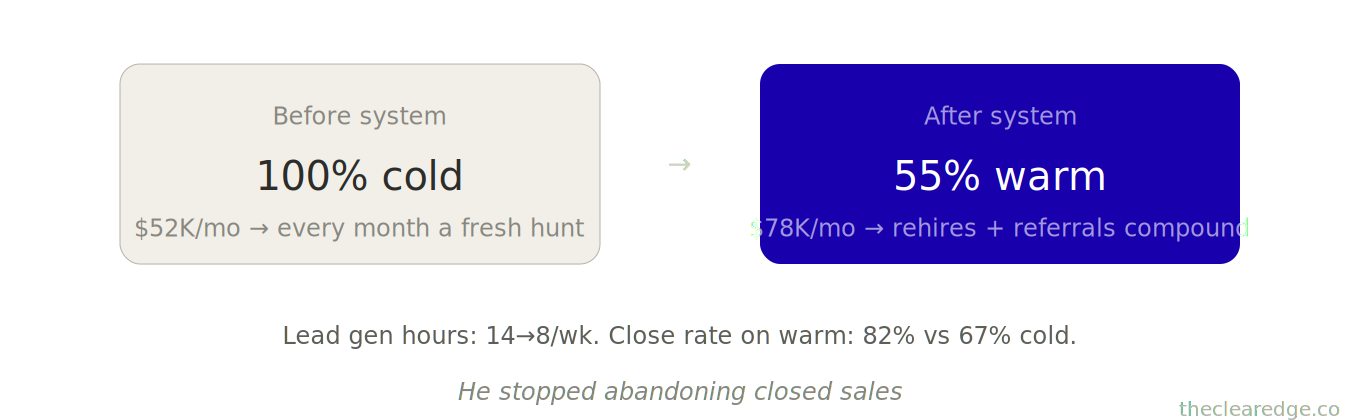
New client sources: 100% cold → 45% cold, 55% warm (rehires + referrals)
Lead generation hours: 14 → 8 weekly (less cold outreach needed)
Close rate: 67% cold, 82% warm (trust pre-established)
Sales cycle: 21 days cold, 9 days warm (less convincing required)
Revenue: $52K → $78K (+50%)
System built. Sales automated. Growth multiplied.
He didn’t get better at pitching. He stopped abandoning closed sales.
The Repeatable Sale Pattern: Treating Revenue As One-Off Transactions
This is the pattern across 89 businesses I’ve audited at $40K–$60K: founders treat sales as one-time transactions instead of relationship starting points.
What they do now:
Close a client.
Deliver the work.
Send the invoice.
Move to the next prospect.
No follow-up system. No referral timing. No reactivation strategy.
Revenue depends entirely on finding new people every month.
The constraint:
Linear sales model caps revenue at whatever you can personally pitch and close monthly.
Can’t scale without scaling pitch effort.
Pattern 1: No Post-Delivery Relationship System For $40K–$60K Service Founders
One consultant closed $43,000 monthly from 9 clients at $4,778 average.
Client satisfaction: 89%.
Referrals received: 0 in the past 6 months.
Rehires: 1 in the past 12 months.
“My clients love me,” he said. “But they don’t refer.”
Wrong diagnosis.
I asked him to show me his post-delivery process. There wasn’t one.
Project ended, the client got the final deliverable, and the relationship stopped—no check-in, no results review, no expansion conversation, no referral request.
“I assumed if they were happy, they’d naturally refer,” he said.
Satisfaction doesn’t create referrals. Timing, ease, and mutual benefit create referrals.
We built a post-delivery system:
30-day check-in: “How’s the implementation going? Any questions?”
Shows continued care, surfaces expansion opportunities.
60-day results review: “Let’s review the numbers. Here’s what changed.”
Quantifies value, builds case for expansion or referral.
90-day referral request: Specific ask with context:
“I’m looking to work with 3 more clients in [specific situation]. Do you know anyone facing [exact problem we solved for you]? If so, I’ll give you $750 credit toward your next project when they sign.”
Result after 90 days:
7 referrals generated from 9 active clients (each client referred 0.78 on average).
4 referrals booked (57% conversion).
$19,112 new monthly recurring from 4 new clients.
Revenue: $43K → $62.1K in 90 days.
The system turned satisfied clients into active referral sources—but only because he made it structured, timed, and easy.
Pattern 2: Vague Referral Requests That Don’t Generate Warm Deals
One coach asked for referrals. Got none.
“I’ve asked,” he said. “They just don’t follow through.”
I asked to see his referral ask. Here’s what he said:
“If you know anyone who could benefit from this type of work, I’d love an introduction.”
Vague. No specificity. No action trigger.
Why this fails:
People don’t refer because they forget, they’re not sure who fits, or they don’t know what to say.
You’ve probably felt this too—someone asks for a referral and you freeze, not because you don’t want to help, but because the ask is too vague.
Vague asks require the client to do too much work: figure out who qualifies, craft an introduction message, and coordinate timing.
The fix: Make referral requests impossible to misunderstand and frictionless to execute.
Bad ask: “Know anyone who needs this?”
Good ask: “I’m looking for 2 clients in [industry] struggling with [specific problem].
Ideal fit: [revenue range], [situation], [timeline].
Do you know anyone like that? If so, just intro us via email—I’ll handle everything from there.
And when they sign, you get [specific benefit].”
Difference
Specificity: Client knows exactly who qualifies (can picture 2–3 people immediately).
Ease: Just make an email intro, don’t need to pitch or explain.
Benefit: Clear value for successful referral (not just goodwill).
Urgency: “Looking for 2 clients” creates scarcity without pressure.
When he switched to structured asks, the referral rate went from 0% to 41%—meaning 41% of clients referred someone within 90 days of completing their project.
Pattern 3: No Reactivation System For 60+ Past Clients
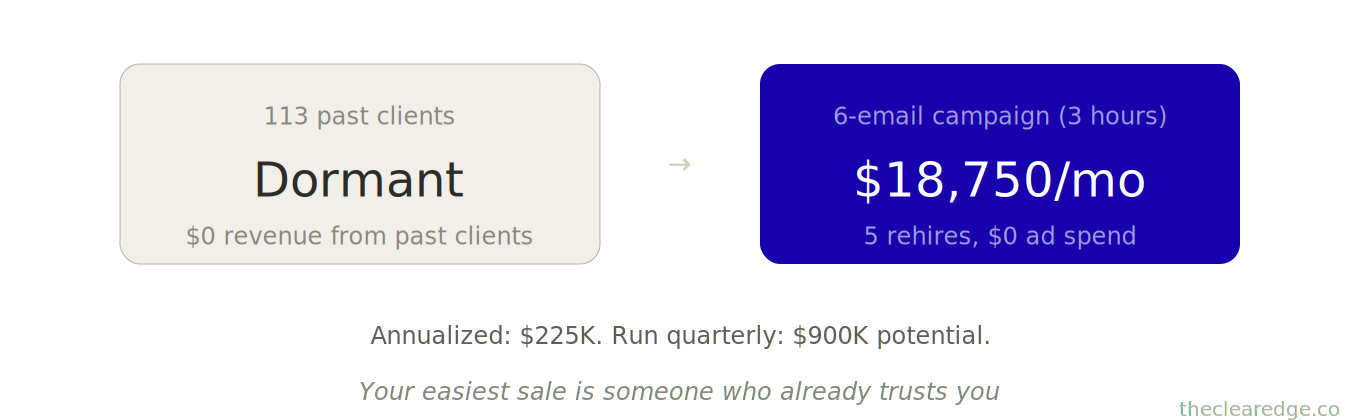
One agency had 127 past clients from the previous 3 years, with 14 currently active and the remaining 113 completely quiet.
“Most were one-time projects,” he said. “They got what they needed and moved on.”
I asked: Did you ever offer them anything else?
“No. I assumed they’d reach out if they needed more,” he said.
That assumption cost him $180,000+ in uncaptured revenue.
Here’s what we did: Built a 6-email reactivation campaign for past clients, sent quarterly. Each email highlighted:
New capability or service (expansion opportunity).
Case study from a similar client (social proof).
Specific offer (project type, timeline, pricing).
Frictionless action (“Reply YES for proposal”).
Results from first campaign (113 recipients):
Open rate: 67% (76 opens).
Reply rate: 19% (22 replies).
Booked calls: 11 (50% of replies).
Closed deals: 5 (45% of calls).
New monthly recurring: $18,750 (5 clients × $3,750 average).
Cost: 3 hours to write campaign, $0 ad spend.
Return: $225,000 annualized from 3 hours of work.
The insight is that past clients are 3–5x easier to reactivate than cold prospects because they already know your quality, have experienced results, and trust you.
You just need to give them a clear reason and a simple opportunity to buy again.
When 63 Clients Go Quiet
If you can see the $428,670 leak but haven’t built a repeatable sale layer on your 63+ past clients; upgrade to premium so the toolkit can sit beside you while you implement.
The Clear Edge OS Repeatable Sale Framework For $40K–$60K/Month Founders
Here’s the system that turns closed clients into revenue multipliers.
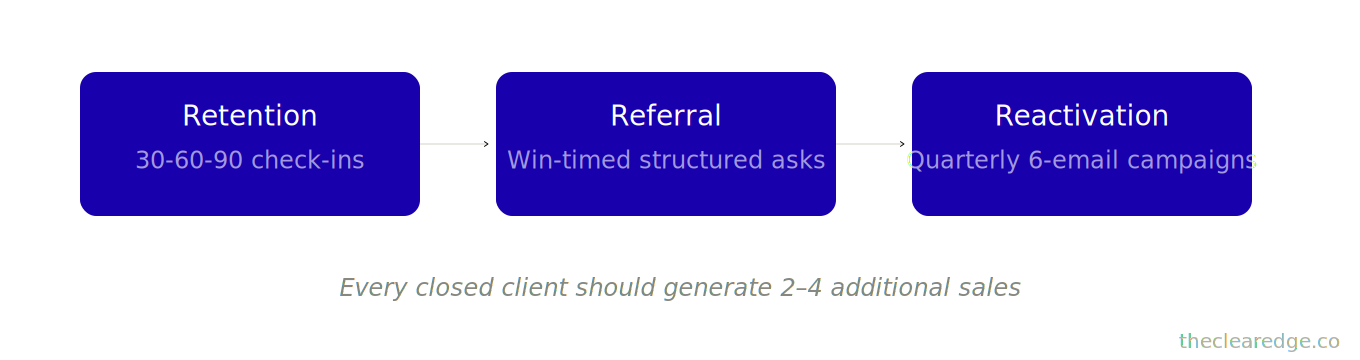
Every closed deal has three leverage points: rehire potential, referral potential, and retention potential. Most founders capture none of them.
The question isn’t “How do I get more leads?”—it’s “How do I make every closed client generate 2-4 more sales?”
Here’s how to build it.
Retention is the first place the Repeatable Sale shows up in the real world, not in theory, so you start by stretching how long each client actually stays.
Move 1: Retention Systems To Extend Client Lifetime 40–60%
Most client relationships end not because clients are unhappy, but because there’s no clear reason to continue—no expansion path, no additional value, no defined next step.
The goal: Extend average client lifetime by 40–60% through structured retention touch-points.
The 30-60-90 check-in system for retention and expansion:
Day 30: Results check-in call
Ask: “What’s working? What needs adjustment?”
Surface issues early before they become churn reasons.
Offer optimization recommendations.
Plant seed for expansion (“Most clients at this stage add [next service]”).
Day 60: Results review + expansion opportunity
Show quantified results: “Here’s what changed since we started: [specific metrics].”
Present expansion as natural next step: “Clients who see these results typically add [service] to go from [current state] to [next level]. Want to explore?”
Day 90: Referral request + long-term planning
Use success momentum: “You’ve seen great results. I’m looking for 2 more clients facing [exact situation you faced]. Know anyone?”
Then shift to retention: “What makes sense for next 90 days? Here are typical expansion paths.”
Why this works:
Regular touchpoints prevent the client from thinking “project’s done, time to move on.”
Value addition (optimization tips, results reviews) builds goodwill before asking.
Natural progression from check-in → results review → expansion makes continued relationship feel logical, not pushy.
Example:
Before:
Average client lifetime 5.3 months
14 clients
$3,714 each
$52,000 monthly revenue
After:
Average client lifetime 8.1 months (+53%)
Same 14 clients initially
Retention reduces churn from 6–8 monthly to 3–4 monthly
Result:
Can grow to 18–20 active clients before hitting capacity (was 16 max)
Revenue increases to $67–74K monthly from retention alone
Implementation:
Set up 3 calendar reminders for each client: 30, 60, 90 days post-start
Create a call agenda template for each touchpoint (what to ask, what to offer)
Track results data from day 1 so you can show quantified progress at the 60-day review
Build an expansion service catalog so you know exactly what to offer at each stage
Move 2: Referral Systems To Turn Happy Clients Into A Warm Sales Channel
Most referral systems fail because they’re passive (”Let me know if you know anyone”) or poorly timed (asking before the client sees results).
The goal: Generate 2-4 referrals per closed client through systematic, timed, low-friction requests.
The referral timing framework: Ask 2–3 weeks after visible wins
Best time to ask: 2–3 weeks after a visible client win.
Why: Client is most excited about results, most willing to share, most credible to their network.
Asking too early (before results) means there’s nothing to share.
Asking too late (6+ months) means results feel old and excitement has faded.
How to identify “visible win” timing:
Track client progress metrics weekly.
Set trigger: when client hits [specific milestone]
First $10K increase
First 50 new leads
First 5-hour time savings
Schedule referral request at that point
Don’t wait for project completion; ask when momentum is highest.
The structured referral asks (copy this):
“[Client name], you’ve seen [specific result] in [timeframe]—that’s exactly what we wanted.
I’m looking to work with [number] more clients in [industry/situation] facing [specific problem].
Ideal fit: [revenue range], [challenge], [timeline].
Do you know anyone like that?
If so, just intro us via email and I’ll take it from there.
When they sign, you’ll get [specific benefit: credit/discount/bonus service].”
Why this structure works:
Social proof first: Reminds them of their win, primes them to want to share.
Specific target: They can picture 2–3 exact people (vague asks get zero action).
Ease: Just make an intro, don’t need to sell or explain.
Mutual benefit: They get tangible value, not just goodwill.
Scarcity: “Looking for [number]” creates urgency without pressure.
Math example:
14 active clients per month.
41% referral rate (industry average when a structured ask is used).
5–6 referrals per month from existing client base.
58% close rate on referrals (higher than 67% cold because of pre-established trust).
3 new clients monthly from referrals at $3,714 each → $11,142 new monthly recurring.
Annual value: $133,704 from referrals alone.
Implementation:
1. Add “referral trigger” field to client tracking
When did they hit a visible win?
2. Write referral ask template
Blanks for [specific result], [target profile], [benefit]
3. Set up referral benefit structure
Recommend $500–750 credit or 10–15% discount on next project
4. Track referral sources
Know which clients are top referrers (reward them)
Edge case: “What if my clients don’t know others in my target market?”
Two options:
Option 1: Broaden the referral ask slightly
Instead of “other agency owners,” ask for “business owners doing $500K–$2M who complain about [specific problem].”
Most professionals know 5–10 people in that range.
Option 2: Shift to testimonial request instead
“Would you share your experience in a 2-minute video I can use on my site?”
Video testimonials convert cold prospects at a 2–3x rate of written ones, so this becomes an indirect lead generation tool.
Move 3: Reactivation Systems To Rehire 15–25% Of Past Clients
Most founders ignore their easiest sale: past clients who’ve already bought, experienced results, and trusted them once.
The goal: Reactivate 15-25% of past clients annually through systematic outreach.
The quarterly 6-email reactivation campaign for past clients
Who to target: Past clients who completed projects 3+ months ago with positive outcomes (satisfied or better).
Campaign structure (6 emails, sent over 90 days):
Email 1 (Day 1): “Checking in—how’s [project outcome] performing?”
Re-engage, show you care about long-term results, surface problems they might not have realized.
Email 2 (Day 14): “New capability: [service]”
Introduce expansion service with case study from similar client, plant seed.
Email 3 (Day 30): “Most clients at your stage do this next”
Position expansion as natural progression, not sales pitch, show what peers are doing.
Email 4 (Day 45): “Here’s what changed since we last worked together”
Update on your capabilities, new results, recent wins—builds FOMO.
Email 5 (Day 60): “Limited availability: [specific offer]”
Create urgency, make action easy: “Reply YES for proposal.”
Email 6 (Day 90): “Last call: [offer] closes [date]”
Final nudge, include testimonial from recent reactivated client, deadline clear.
What makes this work:
Value-first: First 3 emails give value (checking results, sharing case studies, positioning next steps) before asking for sale.
Progression: Moves from “how are you?” → “here’s what’s new” → “here’s your opportunity” → “decision time.”
Specificity: Each email has one clear point, one specific offer, one easy action.
Timing: 90-day sequence gives enough touches to overcome inertia without feeling spammy.
Math example:
113 past clients (completed projects 3+ months ago).
19% reply rate (22 replies).
50% book calls (11 calls).
45% close (5 new clients).
$3,750 average project value.
$18,750 new monthly recurring from 3 hours of work (campaign creation).
Annualized: $225,000 from one campaign.
Run quarterly: $900,000 annual revenue potential from reactivation alone.
Implementation:
Export all past clients from CRM, filter for 3+ months since project completion.
Remove anyone who ended on bad terms (neutral or unhappy).
Write a 6-email sequence following the structure above (takes 2–3 hours).
Set up an automated campaign in an email tool (Mailchimp, ConvertKit, ActiveCampaign).
Run quarterly—January, April, July, October.
Track reply rate, book rate, and close rate to optimize sequence.
Edge case: “Won’t past clients be annoyed if I reach out after months of silence?”
Short answer: No—if the relationship ended well, they’re happy to hear from you.
Why they’re not annoyed: Most clients appreciate the check-in because it shows you care about long-term results, not just taking their money and disappearing.
Key: Lead with value—check results and share useful insights in the first 2–3 emails—so by email 4–5 the ask feels natural because you’ve re-established the relationship.
The Hidden Problem: Referral Timing Misalignment That Kills Warm Revenue
Here’s what most founders miss: They ask for referrals at the wrong moment.
Common timing mistakes:
Too early: Ask during project (client hasn’t seen full results yet, nothing compelling to share).
Too late: Ask 6+ months after project (results feel old, excitement faded, client’s moved on mentally).
Random: Ask whenever you think of it (no strategy, low response rate).
The fix: Track client “win moments” and trigger referral requests 2–3 weeks after each visible win.
What qualifies as “visible win”:
Revenue increase client can quantify.
Time savings client can feel.
Problem solved the client complained about.
Goal achieved the client set at start.
Compliment client received from their customer/client.
How to implement win tracking:
Add “milestone tracker” to the client management system.
Set 3–5 key milestones per client at project start.
When the client hits a milestone, schedule a referral request for 2–3 weeks later.
Use a structured ask (from Move 2) at that moment.
Why this timing works:
Client is most excited about results (emotional high).
Results are fresh, specific, memorable (easy to articulate to others).
Client is actively talking about winning with their network anyway (you’re just asking them to direct that conversation toward you).
Math example:
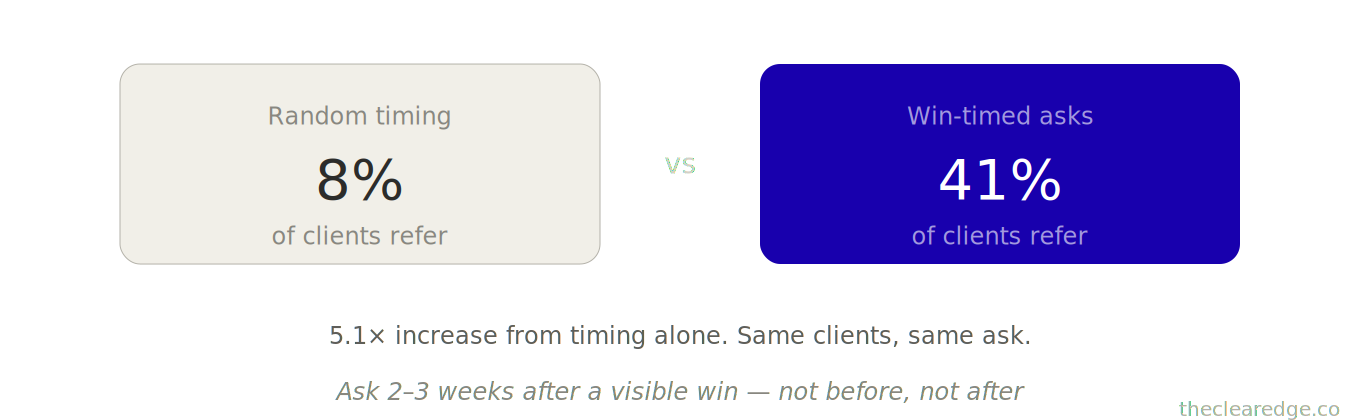
Random referral timing: 8% of clients refer.
Win-timed referral requests: 41% of clients refer.
Difference: 5.1x increase in referrals from the same client base.
Revenue impact:
Clients: 14
With win-timed asks (41%): 6 referrals monthly
With random timing (8%): 1 referral monthly
Annual difference:
Referrals: 60 vs. 12
Extra opportunities: +48
Closed (at 58%): 28
Annual revenue: +$104K
What Sale Abandonment Costs You At $52K/Month
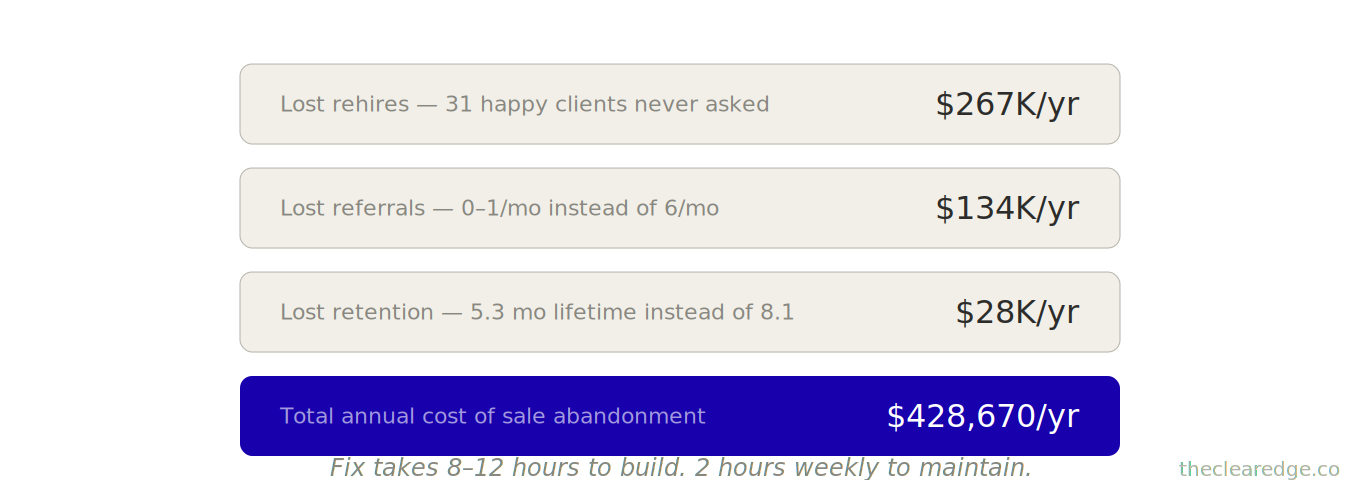
You’re burning $428,670 annually in abandoned client value.
Here’s the math if you’re at $52K/month with 14 active clients:
Lost rehire revenue:
31 past happy clients (past 18 months).
Conservatively, 20% would buy again if asked systematically → 6 rehires.
$3,714 average × 6 clients = $22,284 monthly.
Annual: $267,408.
Lost referral revenue:
14 active clients × 41% referral rate → 6 referrals monthly (you’re probably getting 0–1).
Difference: +5 referrals monthly.
58% close rate = 3 new clients monthly.
$3,714 × 3 = $11,142 new monthly recurring.
Annual: $133,704.
Lost retention revenue:
Current churn: 6–8 clients monthly → average lifetime 5.3 months.
With retention system: 3–4 clients churn monthly → average lifetime 8.1 months.
Lift: 53% longer lifetime → 53% more revenue per client before churn.
Impact: 14 clients × $3,714 × 53% ≈ $27,558 additional annual revenue per cohort.
Total annual cost: $428,670 in unrealized revenue from your existing client relationships.
You’re leaving half a million dollars on the table by treating sales as one-time events.
The fix—building the Repeatable Sale system—takes 8–12 hours to build and 2 hours weekly to maintain.
When You Treat Clients As One-Offs
Every month you stay at $52K while ignoring 63+ past clients and $428,670 in unrealized rehires, referrals, and retention is a choice, not bad luck—start building the Repeatable Sale instead of another cold campaign.
Run The Repeatable Sale Quick-Gate Checklist
Next time a client hits a visible win or a project wraps, run these before you chase new cold leads.
☐ Scored every active and past client against the 30-60-90 retention map and logged who’s due for each touchpoint this week.
☐ Checked last 2–3 weeks of client wins and scheduled structured, win-timed referral asks using the specific “2 clients in [situation]” script.
☐ Logged this quarter’s past-client list, tagged the 3+ month completions, and queued the 6-email reactivation campaign with dates locked.
☐ Compared this week’s rehire, referral, and reactivation deals to cold deals and marked where the $428,670 leak is still open.
Every pass catches sale abandonment before it quietly compounds into that $428,670 drag on your 63+ clients.
Where to Go From Here: Install The Repeatable Sale To Plug The $428,670 Leak
At $40K–$60K/month stuck around $52K with 63+ past clients, the real drag is sale abandonment that quietly leaks $428,670 a year from rehires, referrals, and retention you never trigger.
From here, run the sequence once:
Map and tag all past and current clients, then apply the 30-60-90 retention system so lifetimes stretch from 5.3 to ~8.1 months and revenue climbs toward $67K–$74K without more cold leads.
Track visible wins and send structured, win-timed referral asks so roughly 41% of your 14–16 active clients generate 5–6 warm referrals a month and stack about $11,142 in new recurring revenue.
Build the quarterly 6-email reactivation campaign so one 3-hour pass can reliably pull 5 rehires, $18,750/month, and up to $225,000–$900,000 annualized from your existing 60+ past clients.
Run The Repeatable Sale as your default operating system and that $428,670 leak turns into a compounding revenue loop instead of a permanent drag on every future month.
Apply the Repeatable Sale framework in your business
What’s your current gap: retention system, referral timing, or reactivation strategy? Pick one and commit to building it this week.
Drop your answer below. I read every reply, and the patterns shape what I write next.
And if you’re not sure which system to build first, just say “I need to map my post-sale leverage”—that awareness alone puts you ahead of most founders.
Next Week: Delivery That Sells And Generates 5–7 Referrals Per Client
Next article covers “Delivery That Sells: Turn One Client Into Five Referrals Without Pitching for $50K–$70K Operators,”—the client experience design that generates referrals automatically at $60K-$80K monthly revenue.
I will show you the client journey framework that creates 5-7 referral moments per engagement, the delivery milestones that trigger word-of-mouth, and the feedback loops that turn satisfied clients into active promoters.
FAQ: The Clear Edge OS Repeatable Sale Revenue Engine For $40K–$60K/Month
Q: How does The Repeatable Sale system turn one yes into 2–4 additional sales without more pitching?
A: It layers 30-60-90 retention check-ins, win-timed referral asks, and quarterly reactivation campaigns so each of your 14–16 clients reliably generates 2–4 extra sales from rehires, referrals, and longer lifetimes.
Q: What happens if I keep treating every sale as a one-time event at $40K–$60K/month?
A: You abandon 63+ past clients, cap out around $52K/month, and quietly burn about $428,670 each year in unrealized rehires, referrals, and retention revenue.
Q: How much time does it take to build and run The Repeatable Sale framework at my current revenue?
A: Expect 8–12 hours of one-time setup to map past clients, create 30-60-90 touchpoints, referral asks, and a 6-email reactivation campaign, then about 2 hours weekly to run check-ins, send reactivation emails, and track win-triggered referrals.
Q: How do I use The Repeatable Sale with its 30-60-90 check-ins before I add more cold lead channels?
A: Before expanding lead gen, install 30-, 60-, and 90-day touchpoints for every client to review results, present natural expansion options, and ask for 2–3 specific referrals so your existing 14–16 clients and 31 past happy clients become your warmest pipeline.
Q: When should I rely on my 67% close rate and when do I need a Repeatable Sale system instead?
A: Once you’re around $52K/month from 14 active clients, 89–92% satisfaction, and 8 months of flat revenue despite 18–22 leads and 12–15 sales calls monthly, you’ve proven sales skill and need post-sale systems to compound each win instead of more pitching volume.
Q: What happens if I keep chasing new prospects instead of reactivating my 63+ past clients?
A: You stay stuck doing 14 hours a week of cold outreach and 12–15 hours of sales calls while ignoring a 6-email, 3-hour reactivation campaign that has already shown it can turn 113 past clients into $18,750/month and $225,000 annualized with zero ad spend.
Q: How do I implement the 30-60-90 retention system so clients stay 40–60% longer?
A: For every new client, schedule a 30-day “how’s implementation going?” call, a 60-day quantified results review, and a 90-day referral plus next-90-days planning call, which consistently stretches lifetimes from 5.3 to about 8.1 months and supports $67K–$74K/month from the same base.
Q: When should I ask for referrals so I stop hearing “I’ll let you know if I think of anyone”?
A: Track visible wins—like first $10K revenue bump, 50 new leads, or 5-hour weekly time savings—and send a structured, specific referral ask 2–3 weeks after each win, which typically lifts referral rates from 8% “random” to around 41% and adds about $11,142/month or $133,704 annually.
Q: How do I stop vague referral asks from stalling and use the Repeatable Sale referral script instead?
A: Replace “know anyone who needs this?” with a concrete ask that names 2 target clients, revenue range, situation, and benefit (like $500–$750 credit), so clients can picture 2–3 people instantly and you convert roughly 41% of satisfied clients into referrers within 90 days.
Q: What happens if I never build a quarterly 6-email reactivation campaign for my past clients?
A: You keep assuming one-time projects are finished relationships and forfeit the pattern where emailing 113 past clients every quarter reliably produces 22 replies, 11 calls, 5 closes, $18,750 in new monthly recurring revenue, and up to $900,000 annual potential from reactivation alone.
Navigate The Clear Edge OS Systems for Scaling From $5K to $150K
Start here: The Complete Clear Edge OS — Your roadmap from $5K to $150K with a 60-second constraint diagnostic.
Use daily: The Clear Edge Daily OS — Daily checklists, actions, and habits for all 26 systems.
LAYER 1: SIGNAL (What to Optimize)
The Signal Grid • The Bottleneck Audit • The Five Numbers
LAYER 2: EXECUTION (How to Optimize)
The Momentum Formula • The One-Build System • The Revenue Multiplier • The Repeatable Sale • Delivery That Sells • The 3% Lever • The Offer Stack • The Next Ceiling
LAYER 3: CAPACITY (Who Optimizes)
The Delegation Map • The Quality Transfer • The 30-Hour Week • The Exit-Ready Business • The Designer Shift
LAYER 4: TIME (When to Optimize)
Focus That Pays • The Time Fence
LAYER 5: ENERGY (How to Sustain)
The Founder Fuel System • $100K Without Burnout
INTEGRATION & MASTERY
The Founder’s OS • The Quarterly Wealth Reset
AMPLIFICATION (AI & Automation)
The Automation Audit • The Automation Stack
⚑ Found a Mistake or Broken Flow?
Use this form to flag issues in articles (math, logic, clarity) or problems with the site (broken links, downloads, access). This helps me keep everything accurate and usable. Report a problem →
› More to Explore: Quick Navigation · The Clear Edge OS
➜ Help Another Founder, Earn a Free Month
If this system helped you see where $428,670 is leaking in abandoned client revenue, share it with one founder who’s running the same pattern.
When you refer 2 people using your personal link, you’ll automatically get 1 free month of premium as a thank‑you.
Get your personal referral link and see your progress here: Referrals
Get The Clear Edge OS Repeatable Sale Toolkit
You’ve read the system. Now implement it.
Premium gives you:
Ready-to-use PDF toolkit—every template, diagnostic, and formula pre-filled, zero setup, immediate use
Plug-and-play AI diagnosis sessions—drop into Claude, Gemini or ChatGPT, answer a few questions, save hours of guessing, get your exact next move
Audio key points—concentrated frameworks you can absorb in minutes, implement while you move
Unrestricted access to the complete library—every system, every update
What this prevents: Leaving $428,670 a year on the table by abandoning 63+ closed clients after the first yes.
What this costs: $49/month.
Download everything today. Implement this week. Cancel anytime, keep the downloads.
Already upgraded? Scroll down to download the PDF, audio, and your AI session.
