


The Executive Summary
$100K/month founders leave $10K–$30K/month trapped in Tier 3 delivery by staying service-only; a three-tier Offer Stack turns existing expertise into $10K–$25K in “passive” income without adding clients.
Who this is for: Service founders around $95K–$120K/month (often $100K–$118K) with coaching, consulting, or agency offers and 50–60 hours a month tied directly to delivery.
The offer stack problem: 100% of revenue depends on Tier 3 done-for-you services, so growth looks like 44% more clients or a 39% price hike while $10K–$30K/month in frameworks and templates sit unused.
What you’ll learn: The three-tier Offer Stack—Tier 1 (Self-Serve, $50–$500 or $20–$100/month), Tier 2 (Guided, $500–$3,000 or $200–$800/month), and Tier 3 (Done-For-You)—plus Asset Extraction, Tier 1 First, and Tier 2 After Validation.
What changes if you apply it: Over 5–12 months you shift from $100K in services to stacks like $119K (Tier 3) + $13.9K (Tier 2) + ~$6.5K (Tier 1) or $107K → $147K in 12 months, adding $26K–$40K/month from Tiers 1–2 on 4–6 extra hours and no new done-for-you clients.
Time to implement: Expect 35–50 hours over 5 months—8–12 hours for asset extraction, 15–20 hours to build Tier 1, 12–18 hours to launch Tier 2—then 4–6 hours monthly to run a stack that typically returns $120K–$360K/year or $2,400–$7,200 per hour invested.
Written by Nour Boustani for $95K–$120K/month founders and operators who want an extra $10K–$30K/month from their existing expertise without adding clients, overbuilding courses, or turning “passive income” into a second job.
If you’re carrying 50–60 hours of Tier 3 delivery with $10K–$30K/month in unused IP, that’s the Offer Stack failure pattern; upgrade to premium to turn those trapped frameworks into stacked revenue.
› Library Navigation: Quick Navigation · The Clear Edge OS
Service Revenue Ceiling At $100K/Month For Consultants And Agencies
At $100K/month in services, a specific pattern shows up.
Revenue grows, but the founder’s expertise value outpaces what the service model can actually sell.
Case: service ceiling at $106K/month
Revenue: $106K/month
Clients: 18 clients at $5,900/month
Team: 3 people
Target: push toward $150K/month
To get there, the founder saw two options:
More clients: 26 clients (44% more delivery load)
Higher pricing: $8,200/client (39% higher pricing)
Hidden cost of the “obvious” paths
More hiring risk and complexity
More churn risk from stretching client capacity
More dependence on a single delivery model that kept 100% of revenue tied to capacity
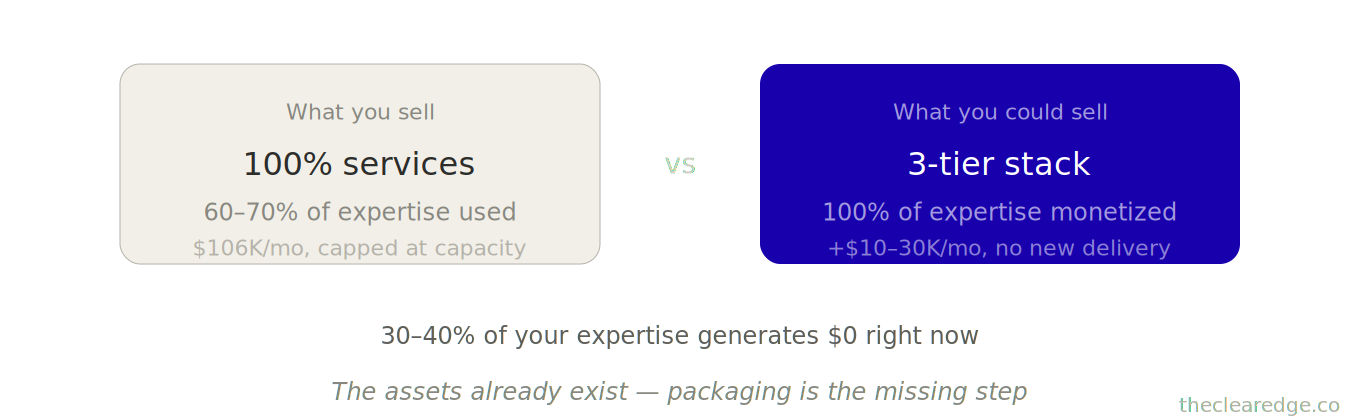
Only 60–70% of her expertise actually monetized
The remaining 30–40%—frameworks, processes, methodologies—could have thrown off $10K–$25K/month in parallel revenue instead of sitting idle
Higher pricing also meant repositioning the entire service:
3–4 months of market testing
Real risk of client churn
She spent five months considering both paths. Neither felt right.
What she missed
$106K/month from services represented 100% of her revenue but only 60–70% of her expertise value.
The other 30–40%—frameworks, processes, methodologies she used in delivery—could generate $10K–$25K/month without adding a single client.
The offer stack: build parallel revenue streams that monetize your expertise without increasing delivery load.
At $100K/month in services, you typically have $10K–$30K/month sitting in existing expertise that could be productized instead of staying buried in delivery. Most founders never extract it.
At this point you’ve seen the pattern at $100K, so the next step is to name it precisely and show how it repeats across different businesses.
Offer Stack Failure Pattern At $95K–$120K/Month Service Businesses
Across 39 service businesses audited at $95K–$120K monthly, here’s what shows up:
The capacity trap: Founder hits delivery ceiling, can’t scale without hiring, hesitates to add operational complexity. Revenue plateaus while expertise sits unused.
The pricing ceiling: Founder maxes out what the market will pay for done-for-you services, can’t justify higher rates without expanding scope (which adds complexity).
The expertise waste: Founder has frameworks, templates, processes that clients would pay to access—never packages them as standalone offers.
All three patterns share the same outcome: revenue caps below potential because the founder only monetizes through one delivery model.
Case: coaching business at $99K/month
Revenue: $99K/month
Client load: 30 one-on-one clients at $3,300/month each
State: Maxed capacity, couldn’t take more clients without sacrificing quality
Over three years, she’d developed:
Assessment framework (used in client onboarding)
12-module curriculum (delivered in coaching sessions)
Template library (50+ tools given to clients)
Decision protocols (frameworks that clients applied repeatedly)
Every client used these frameworks, and they consistently produced results, but clients were paying $3,300/month for the coaching and its application—not for the frameworks themselves.
Other founders would pay $500–$2,000 to access these frameworks without coaching.
She never packaged them, leaving $15K–$25K in monthly revenue sitting in existing intellectual property.
The cost of not building the stack is a revenue ceiling that hits while expertise value stays trapped in service delivery.
Here’s what unlocks it.
Three-Tier Offer Stack Framework For Tier 1, Tier 2, And Tier 3
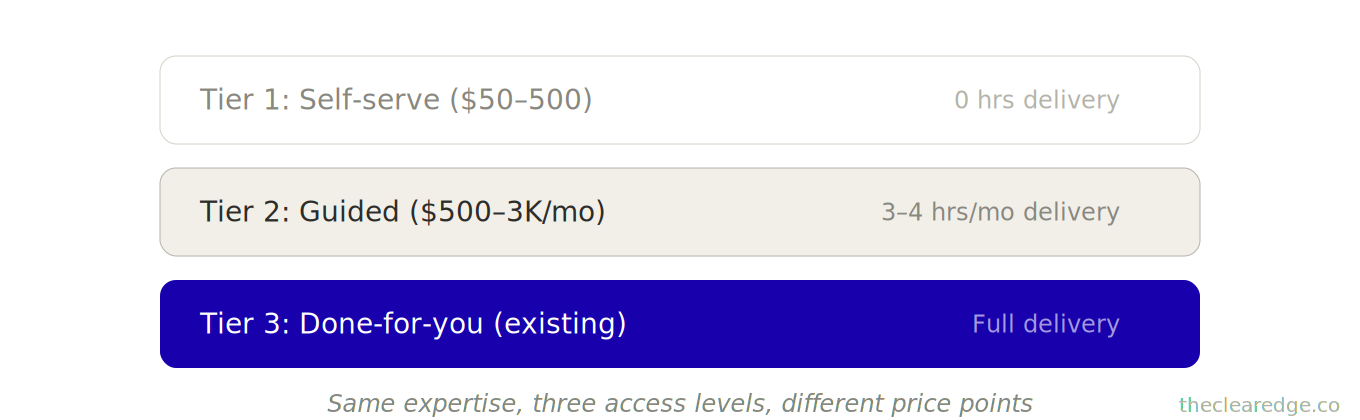
Tier 1 (Self-Serve): $50–$500 one-time or $20–$100/month
Self-serve formats include:
Digital products
Courses
Templates
Frameworks
Toolkits
The customer learns and implements alone.
Tier 2 (Guided): $500–$3,000 one-time or $200–$800/month
Guided formats include:
Group programs
Cohorts
Memberships with live components
The client gets guidance and community.
Tier 3 (Done-For-You): Your current service model
High-touch formats include:
Custom delivery
One-on-one work
Small-team implementations
The client gets implementation handled.
Delivery load by tier
Tier 1 = no delivery
Tier 2 = 3–4 hours monthly
Tier 3 = full delivery
Most founders at $100K only have Tier 3. That’s why they’re capped.
The stack works like this: same expertise, three access levels, different price points, and no additional delivery on Tiers 1–2 beyond minimal maintenance.
Case: consultant at $118K/month builds her stack
Tier 1: Template library + recorded training ($497 one-time)
Built once from existing client materials.
Takes 8–12 hours to package.
Zero ongoing delivery.
Tier 2: Monthly group program ($497/month, 40-person cap)
Two live calls monthly (2 hours each).
Reuses frameworks from Tier 3 services.
4 hours monthly delivery per cohort of 40.
Tier 3: Existing consulting ($8,500/month, 14 clients)
High-touch, custom strategy.
Done-for-you implementation.
Launch results after 6 months
Tier 1
47 sales → $23,359 from the initial launch.
Ongoing trickle: 12–15 sales monthly → $5,964–$7,455 per month.
Tier 2
28 members → $13,916 monthly (ramped over 4 months).
Tier 3
14 clients → $119K monthly (unchanged).
Result:
Total revenue: $119K + $13.9K + $6.5K (average Tier 1) = $139.4K monthly.
Revenue increase: $21.4K/month → 18% growth without adding a single done-for-you client.
Time cost:
Tier 2: 4 hours monthly for delivery.
Tier 1: 2–3 hours monthly for maintenance (email support, occasional updates).
The pattern:
Tiers 1–2 don’t replace Tier 3.
They stack underneath, monetizing the same expertise at different access levels.
[One Expertise Base]
        |
        v
[Tier 1: Self-Serve]
        |
        v
[Tier 2: Guided]
        |
        v
[Tier 3: Done-For-You]

Same IP, 3 access levels
With the stack shape clear, the next constraint isn’t ideas, it’s finding the assets you already have that can move into Tiers 1 and 2 quickly.
Move 1: Asset Extraction To Find Tier 1 And Tier 2 Offer Stack Products
Before you build the stack, identify what you already have that’s packageable.
Most founders think they need to create new content, but they already deliver 80–90% of what Tiers 1–2 need—just not packaged for self-serve or group access.
Audit your existing service for these assets
Assessment tools: How do you diagnose client problems? That’s a framework others would pay for.
Process maps: What steps do clients follow? That’s a system others would pay to copy.
Template libraries: What tools do you give clients? That’s a product others would pay to access.
Decision frameworks: How do you help clients choose between options? That’s a guide others would pay for.
Training curriculum: What do you teach clients? That’s content others would pay to learn.
Case study patterns: What transformations repeat across clients? That’s proof others would pay to see.
Case: agency at $111K/month audited their assets
Assessment tool
Client readiness scorecard (used in sales process)
Stackable as: $97 self-assessment tool
Process map
8-week project delivery timeline
Stackable as: Template included in $497 toolkit
Template library
12 project management templates
Stackable as: Core of $497 toolkit
Training curriculum
6-module internal training for junior team members
Stackable as: Group program curriculum ($697/month)
Case studies
15 detailed client transformations
Stackable as: Social proof for all tiers + lead generation content
They didn’t create anything new. They packaged what already existed.
Time investment: 18 hours to extract, organize, and package existing assets into two offers (Tier 1 product + Tier 2 group program).
Launch results
Tier 1: $497 toolkit → 22 sales in first 60 days = $10,934
Tier 2: $697/month program → 19 members by month 3 = $13,243 monthly
Additional revenue: $13,243 monthly recurring + $10,934 one-time.
Most founders at $100K have $15K–$30K in monthly stackable revenue sitting in assets they already use in service delivery but have never extracted.
Extract first. Package second. Build new content last (if ever).
[18 Hours Asset Extraction]

- Week 1: Find assets
- Week 2: Package toolkit
- Week 3: Design group offer

=> 2 offers, no new content
Once the assets are visible, the fastest way to de-risk the stack is to turn a small subset into Tier 1 and watch how real buyers behave.
Move 2: How To Build Tier 1 Self-Serve Offers From Existing Service Delivery
Once you’ve extracted your assets, start with Tier 1—the self-serve product that requires zero ongoing delivery.
Why Tier 1 first? Three reasons:
Validates demand without additional operational commitments, so if nobody buys, you learn quickly and can adjust.
Creates lead generation for Tiers 2–3 because Tier 1 customers arrive pre-qualified for higher tiers.
Builds an email list asset because every Tier 1 buyer enters your ecosystem, where 15–25% eventually upgrade to Tier 2–3.
The Tier 1 structure:
Package your best 2–3 assets
Price it between $97–$497
Deliver it as a digital product
Good Tier 1 formats:
Template library + implementation guide ($297–$497)
Assessment tool + results framework ($97–$197)
Process map + video walkthrough ($197–$397)
Case study library + application guide ($147–$297)
Bad Tier 1 formats:
Long courses (takes too long to build, too hard to sell)
Coaching lite (requires delivery, defeats the purpose)
Membership access (wrong tier—that’s Tier 2)
Case: course creator at $104K/month builds Tier 1
Asset: Her client onboarding framework (used in first 30 days with every coaching client)
Package: $297 digital toolkit with:
5-step onboarding template
12 email scripts
Client welcome video framework
First 30 days checklist
3 case studies
Build time: 11 hours (most content already existed from client work)
Launch: Soft launch to email list (2,400 subscribers), $297 price point
Results:
Week 1: 14 sales = $4,158
Month 1: 31 sales = $9,207
Month 2: 18 sales = $5,346
Month 3: 22 sales = $6,534 (settled into steady state)
Steady-state revenue: $6,534 monthly from product built once.
Additional benefit:
7 Tier 1 buyers (23%) booked Tier 3 discovery calls within 90 days.
3 became clients at $4,800/month → $14,400 monthly new Tier 3 revenue.
Total impact from Tier 1:
$6,534 direct
$14,400 Tier 3 upgrades
$20,934 monthly increase
The pattern at $100K:
Tier 1 products at this stage typically generate $5K–$15K in direct monthly revenue, plus an additional $8K–$20K each month in Tier 3 upgrades from the qualified leads they create.
Build Tier 1 first so it can fund and validate Tier 2.
[Tier 1 Build Checklist]

[ ] Pick 2-3 core assets
[ ] Choose $97-$497 price
[ ] Create simple landing page
[ ] Set delivery method
[ ] Email existing audience
When Tier 1 starts sending you buyers and data instead of guesses, you finally have enough signal to design Tier 2 as a controlled scale-up, not a blind bet.
Move 3: When To Add Tier 2 Guided Program After Tier 1 Validates Demand
Once Tier 1 sells consistently, add Tier 2—the guided group program that scales your expertise without scaling delivery proportionally.
Tier 2 structure:
Live group program
2–4 sessions monthly
Cap at 20–50 members
Priced at $297–$997/month
The leverage:
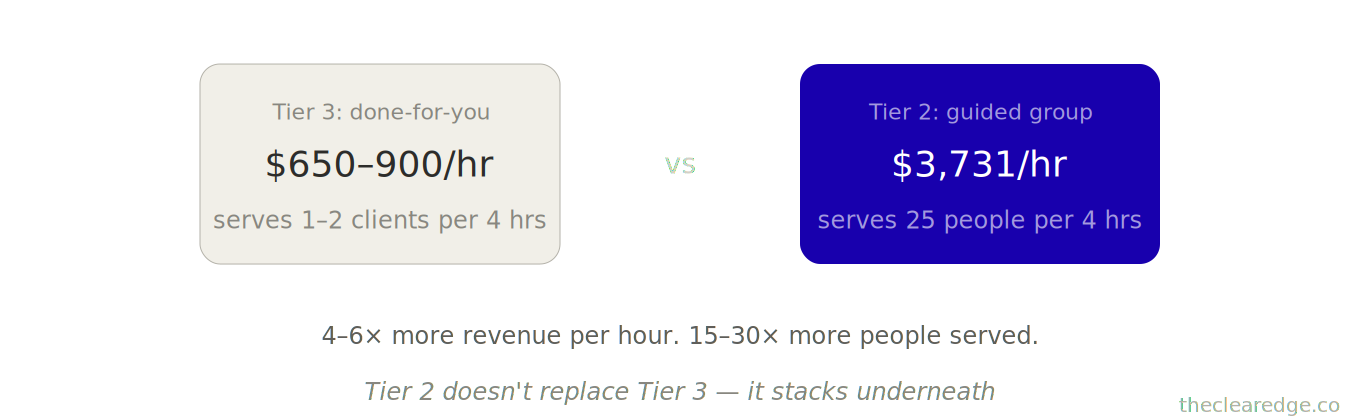
4–8 hours of Tier 2 delivery each month serves 20–50 people, versus Tier 3 where the same 4–8 hours might only serve 1–2 clients.
Tier 2 curriculum sources:
Tier 1 content (expanded with live teaching)
Tier 3 frameworks (delivered as group training)
Case studies from Tier 3 clients (anonymized)
Q&A addressing common Tier 1 buyer questions
Case: consultant at $113K/month adds Tier 2
Tier 1: $447 strategy toolkit (selling 18–22 monthly → $8,046–$9,834)
Tier 2 design:
$597/month group program
2 live calls monthly (90 minutes each)
Private community access
30-person cap
Content: Tier 1 toolkit taught live + group strategy sessions
Launch: Offered to Tier 1 buyers first (85 total at time of launch)
Results:
13 Tier 1 buyers joined immediately (15.3% conversion)
Month 2: Added 7 new members (direct signups, no Tier 1 purchase)
Month 3: Added 5 more (mix of Tier 1 upgrades + direct)
Month 4: Hit 28 active members (settled into 23–25 average after natural churn)
Revenue: 25 members × $597 = $14,925 monthly recurring.
Time cost: 4 hours total
3 hours monthly delivery (2 calls)
1 hour community management
Per-hour value: $14,925 ÷ 4 hours = $3,731/hour (vs. Tier 3 at $650–$900/hour).
The leverage multiplier:
Tier 2 generates 4–6X more revenue per hour than Tier 3 while serving 15–30X more people.
Add Tier 2 after Tier 1 proves demand, using Tier 1 buyers as your initial cohort and scaling gradually to 20–40 members.
Knowing The Offer Stack Isn’t Running It
You can map the three-tier Offer Stack from this article, but running it cleanly is different work; upgrade to premium to structure and test the first 5–12 months of your stack.
Now that Tier 2 has a clear role and capacity band, you can step back and look at the full stack economics instead of isolated wins in each tier.
Offer Stack Economics Comparing Service-Only Revenue To Three-Tier Stack
Starting state (Tier 3 only)
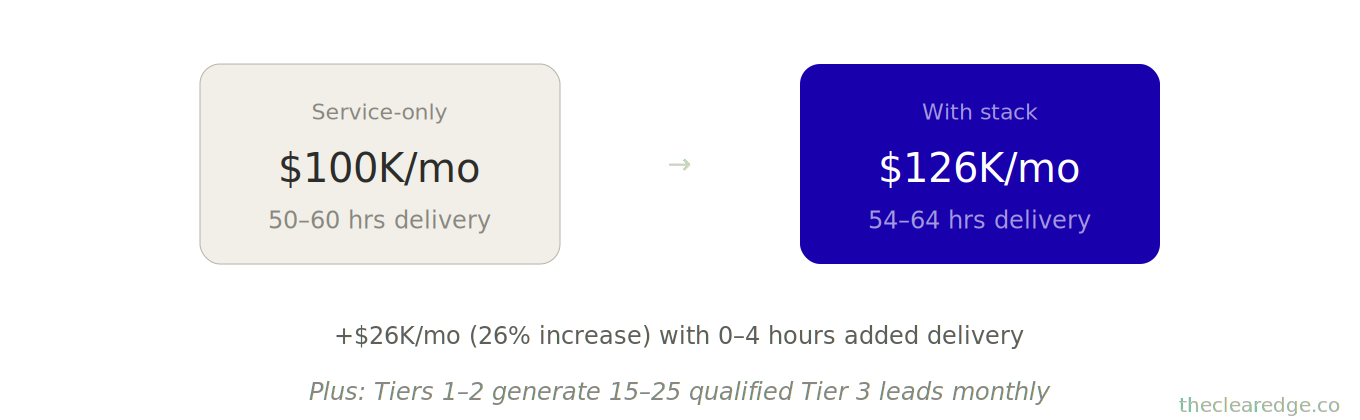
Revenue: $100K monthly
Delivery hours: 50–60 hours monthly
Per-hour value: $1,667–$2,000
Growth constraint: Delivery capacity
Stack state (all three tiers)
Tier 1: $8K monthly (0 hours ongoing delivery)
Tier 2: $18K monthly (4 hours monthly delivery)
Tier 3: $100K monthly (50–60 hours monthly delivery, unchanged)
Total revenue: $126K monthly
Total delivery hours: 54–64 hours monthly
Blended per-hour value: $1,969–$2,333
Growth unlocked: $26K monthly (26% increase) with 0–4 hours added delivery time.
Plus compounding effects
Lead generation: Tiers 1–2 generate 15–25 qualified Tier 3 leads monthly
(vs. 8–12 from previous marketing efforts alone)
Market positioning: Three-tier stack positions you as authority
(comprehensive solution vs. single-service provider)
Revenue stability: Diversified income reduces dependency on Tier 3 client retention. One Tier 3 client loss means a 5–10% revenue hit; with a stack, that drops to 3–6%.
Exit value: Businesses with stacked revenue trade at 1.5–2X higher multiples than service-only businesses (more predictable, less founder-dependent)
Case: 12-month stack impact track
Month 0: $107K (Tier 3 only)
Month 3: $119K (added Tier 1: $12K in first 90 days)
Month 6: $133K (added Tier 2: $14K monthly recurring)
Month 12: $147K (all tiers optimized)
Tier 1: $9K monthly average
Tier 2: $23K monthly
Tier 3: $115K with upgrades
Result: 37% revenue increase without adding delivery capacity, with the stack generating $40K monthly while Tier 3 also grew by $8K from stack-generated leads.
The economics: the stack adds $10K–$30K in monthly revenue in the first year and continues to compound as Tiers 1–2 audiences grow.
[Service-Only vs Stack]

- Service-Only: $100K --> 50-60 hrs
- With Stack: $126K --> 54-64 hrs

Same founder, more revenue per hour
With the numbers on the table, the remaining question is whether the time and effort to build the stack are justified by the upside you’re leaving in Tier 3-only delivery.
Offer Stack Implementation Timeline, Hours, And Operational Tradeoffs
Building the three-tier stack runs through three phases:
Phase 1: Asset Extraction (Week 1–2)
Audit existing service assets.
Identify packageable frameworks, templates, and processes.
Takes 8–12 hours across two weeks.
Phase 2: Tier 1 Build (Week 3–5)
Package 2–3 best assets into a self-serve product.
Create a landing page.
Set up a delivery system.
Takes 15–20 hours across three weeks.
Phase 3: Tier 2 Design (Month 4–5)
Build group program curriculum.
Set up a community platform.
Launch to Tier 1 buyers.
Takes 12–18 hours to launch, 4 hours monthly to deliver.
Total investment: 35–50 hours over 5 months to build a complete stack.
Revenue return: $10K–$30K/month within 6–9 months, with stack revenue compounding as Tiers 1–2 grow.
For a founder at $100K/month, that’s:
$120K–$360K in additional yearly revenue from roughly 50 hours of one-time setup, plus 4–6 hours of ongoing work each month.
ROI: $2,400–$7,200 per hour invested (based on $120K–$360K added yearly from ~50 hours setup).
One founder’s feedback after 8 months: “I thought passive income meant building a separate business. Turned out the assets were already there—packaging was the missing step.”
When $100K Services Hide $10K–$30K Gaps
Keeping 100% of revenue in Tier 3 quietly burns $10K–$30K/month in un-packaged IP; treat stack-building as a focused 90–120 day project, not background noise.
Score Your Offer Stack Reality Check Checklist
Next time a new buyer type shows up or a new offer idea hits, walk it through this stack before you say yes.
☐ Listed current Entry, Core, and Premium offers and wrote their exact prices using the 30% / 1x / 3–5x Core structure.
☐ Checked each tier against the 3x value differentiation rule and marked any tier that doesn’t clearly deliver 3x more than the one below.
☐ Calculated projected revenue by mapping this buyer or offer across all three tiers and logged whether it lifts average sale value by 40–80%.
☐ Wrote a binary decision: add this offer or buyer into the existing 3-tier stack, redesign a tier, or reject it to protect the ladder.
Run it once per decision and the yes/no on every new offer stops being a guess that quietly erodes your 3-tier economics.
How To Start Building Your Offer Stack From A $100K Service Business
If you’re already at ~$100K/month in services, you don’t need more ideas—you need a clean path to pull hidden revenue out of delivery.
What to do next
Audit your service delivery for stackable assets. What frameworks, templates, processes, or training do you use with every client?
Build Tier 1 first. Package your 2–3 best assets into a $297–$497 digital product. Launch to your existing audience.
Add Tier 2 when Tier 1 proves demand. Create a group program that expands Tier 1 content with live delivery. Cap at 20–40 members.
The shift from service-only to three-tier stack typically shows measurable impact within 90–120 days: Tier 1 launches, initial sales validate demand, Tier 2 planning begins.
FAQ: Offer Stack System For $95K–$120K/Month Service Founders
Q: How do I know if I’m ready for the Offer Stack instead of just raising my service prices again?
A: You’re ready when you’re at $95K–$120K/month (often $100K–$118K), working 50–60 hours weekly, and 100% of revenue comes from Tier 3 done-for-you services even though you have frameworks, templates, and curricula baked into delivery.
Q: How does the Offer Stack turn my existing $100K/month service business into $10K–$30K/month “passive” income?
A: It adds Tier 1 self-serve and Tier 2 guided offers around your current Tier 3 services so stacks like $119K (Tier 3) + $13.9K (Tier 2) + ~$6.5K (Tier 1) reach ~$139.4K/month in 5–12 months without adding done-for-you clients.
Q: How do I use Asset Extraction to find the Tier 1 and Tier 2 products already hiding inside my delivery?
A: You audit assessments, templates, process maps, training, decision frameworks, and case studies you already use with every client, like the $111K/month agency that turned its readiness scorecard, 8-week timeline, 12 templates, and 6-module training into a $497 toolkit and $697/month group program in 18 hours.
Q: How do I build Tier 1 first so I can validate demand without committing to more delivery?
A: You package 2–3 of those assets into a $97–$497 digital toolkit, like the $104K/month course creator who spent 11 hours turning her onboarding framework into a $297 product that settled at $6,534/month plus three new $4,800/month clients from Tier 1 buyers.
Q: How do I know when to add Tier 2 and what does a good guided offer look like at this stage?
A: Once Tier 1 sells consistently, you add a $297–$997/month group program with 2–4 calls monthly and a 20–50 person cap, as in the $113K/month consultant whose $597/month program reached 25 members and $14,925/month recurring on 4 hours of delivery.
Q: How does Tier 2 change my revenue per hour compared to staying service-only?
A: In the $113K example, Tier 2 produced $14,925/month from 4 hours of work—about $3,731/hour—versus $650–$900/hour in Tier 3 delivery, making guided leverage 4–6× more valuable per hour while serving 15–30× more people.
Q: What kind of full-stack results can I realistically expect over 12 months if I start at $100K/month?
A: Across the 12-month track example, a founder moved from $107K (Tier 3 only) to $119K (Tier 3 + Tier 1), then $133K (adding Tier 2), and finally $147K/month with Tier 1 at $9K, Tier 2 at $23K, and Tier 3 at $115K, a 37% lift without adding delivery capacity.
Q: How much time does it actually take to build the Offer Stack, and how is that time distributed?
A: Expect 35–50 hours over 5 months: 8–12 hours for asset extraction, 15–20 hours to build Tier 1, and 12–18 hours to design and launch Tier 2, plus 4–6 hours monthly to run the stack that typically returns $120K–$360K/year.
Q: What’s the real cost of staying service-only at $100K/month instead of building the three-tier stack?
A: You leave $10K–$30K/month ($120K–$360K/year) trapped in un-packaged IP, keep your revenue capped by delivery capacity, and forfeit $2,400–$7,200 of return for every hour you could have invested in stack-building.
If that’s the gap you’re staring at, the next move is simple: decide whether you’ll run the Offer Stack yourself or tap into a system that already does the heavy lifting.
Next In The Clear Edge OS: The 10-Year Play Strategy
Next article covers: “The 10-Year Play: Compound Small and Build $1M Revenue for $100K–$125K Operators,” I’ll show you a long-term strategy founders use to take $100K businesses toward $1M+ over a 10-year window.
Navigate The Clear Edge OS Systems for Scaling From $5K to $150K
Start here: The Complete Clear Edge OS — Your roadmap from $5K to $150K with a 60-second constraint diagnostic.
Use daily: The Clear Edge Daily OS — Daily checklists, actions, and habits for all 26 systems.
LAYER 1: SIGNAL (What to Optimize)
The Signal Grid • The Bottleneck Audit • The Five Numbers
LAYER 2: EXECUTION (How to Optimize)
The Momentum Formula • The One-Build System • The Revenue Multiplier • The Repeatable Sale • Delivery That Sells • The 3% Lever • The Offer Stack • The Next Ceiling
LAYER 3: CAPACITY (Who Optimizes)
The Delegation Map • The Quality Transfer • The 30-Hour Week • The Exit-Ready Business • The Designer Shift
LAYER 4: TIME (When to Optimize)
Focus That Pays • The Time Fence
LAYER 5: ENERGY (How to Sustain)
The Founder Fuel System • $100K Without Burnout
INTEGRATION & MASTERY
The Founder’s OS • The Quarterly Wealth Reset
AMPLIFICATION (AI & Automation)
The Automation Audit • The Automation Stack
⚑ Found a Mistake or Broken Flow?
Use this form to flag issues in articles (math, logic, clarity) or problems with the site (broken links, downloads, access). This helps me keep everything accurate and usable. Report a problem →
› More to Explore: Quick Navigation · The Clear Edge OS
➜ Help Another Founder, Earn a Free Month
If this system just saved you from leaving $120K–$360K a year trapped in un-packaged expertise, share it with one founder who needs that relief.
When you refer 2 people using your personal link, you’ll automatically get 1 free month of premium as a thank-you.
Get your personal referral link and see your progress here: Referrals
Get The Offer Stack Toolkit PDF, Audio, And Full Library Access
You’ve read the system. Now implement it.
Premium gives you:
Ready-to-use PDF toolkit—every template, diagnostic, and formula pre-filled, zero setup, immediate use
Plug-and-play AI diagnosis sessions—drop into Claude, Gemini or ChatGPT, answer a few questions, save hours of guessing, get your exact next move
Audio key points—concentrated frameworks you can absorb in minutes, implement while you move
Unrestricted access to the complete library—every system, every update
What this prevents: Letting $10K–$30K/month sit locked in Tier 3 delivery instead of stacking Tier 1 and Tier 2 income.
What this costs: $49/month.
Download everything today. Implement this week. Cancel anytime, keep the downloads.
Already upgraded? Scroll down to download the PDF, audio, and your AI session.
