


Read time: 14 minutes
› Library Navigation: Quick Navigation · The Weekly Protocol
The Executive Summary
Your new client’s vendor form says “net 60”. You pay the account’s team every other Friday until their first payment, about 90 days in. Add up those salaries in dollars and set them against your cash, then offer a trade. Kai, who runs a 6-person agency, took a $20K monthly retainer and kept his $30K reserve above $10,092.
Who this is for: agencies, consultants and solo creators at $20K-$150K a month. You now carry 90 days of payroll costs before a net-60 client pays.
The problem: you fund about 3 months of salaries for the account before its first payment. A $12,000-a-month team makes that $36,000. A $30,000 reserve can’t cover it.
The fix: 5 steps:
Get the first payment date from procurement.
Multiply the account’s monthly cost by the months until then.
Compare that total with your cash reserve, and pick one of 3 bands.
Offer a kickoff deposit, a 3% price line or billing on the 1st.
Get the PO (purchase order) before kickoff, and chase each invoice on day 45.
Time to first result: 10 minutes to get the dollar figure and know your answer.
Written by Nour Boustani for agencies who want the enterprise client and a covered payroll.
Try this now (under 2 minutes):
Pick your client on the longest payment terms.
Write down that account’s monthly cost in people and tools.
Multiply that cost by the months until your first payment, 3 for most retainers.
Set the result next to your business account’s cash.
Why Net-60 Pays You Around Day 90
Net-60 is normal for agencies with enterprise clients. The ANA (Association of National Advertisers) surveyed 109 of its member brands. Its 2020 report found brands gave themselves 58.1 days to pay agency fees in 2019. In 2013, they gave themselves 45.7 days.
1 in 10 of those brands set terms of 90 days or more. Their main reason was “to improve marketers’ cash flow.” Finance and procurement set those terms, so the person who hired you can’t change them.
Your 60 days also start later than the contract says. Four rules on your client’s side add weeks:
Vendor setup comes first. The University of Oregon’s payables office allows “5-7 business days” for its own setup. Ask your client for theirs.
Each invoice needs a PO number. At Clemson University, an invoice without one “will be rejected and returned to the supplier.”
A client who signs off each month’s work before paying accepts your September invoice only on 1 October. The 60 days start then.
The payment then waits for your client’s next payment run. BCG (Boston Consulting Group), a consultancy that advises buyers, gives one example: paying on “the first Tuesday of each month”.
Say your retainer starts on 1 September. You invoice September’s work on 1 October. Add 60 days and it falls due on 30 November, day 90 of the work. A slow setup, a rejected invoice or a monthly run adds up to 30 days.
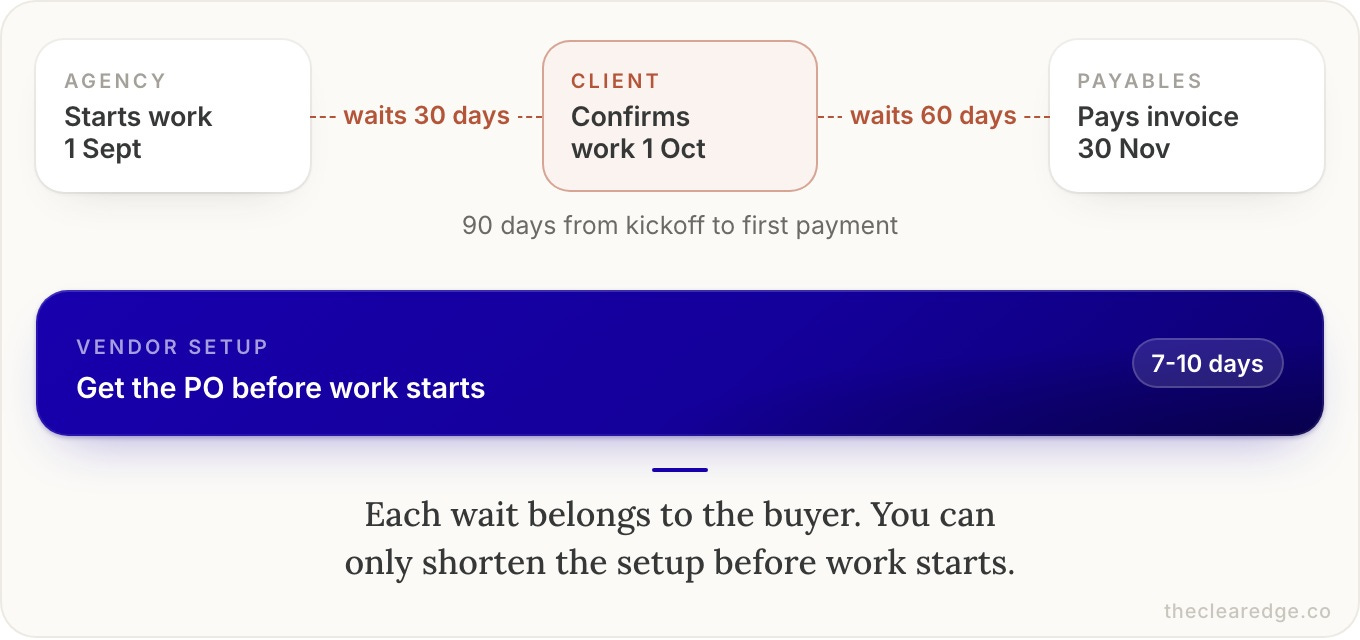
Each wait in that chain belongs to the buyer. You can shorten two: the setup, before work starts, and the month-end invoice, if they accept billing on the 1st.
Price the 90 Days and Pick Your Answer
Salaries, contractors and tools for the account start in week 1. So take the account’s monthly cost and multiply it by the months until the first payment.
Count new hires in full, plus your current team’s share of hours on the account. Solo, count your own pay and tools. That money leaves your bank from week 1, and the fee arrives in month 3. So a team costing $12,000 a month means $36,000 out before any fee comes in.
You stay about 3 months behind for the whole contract. A second net-60 client adds its own 3 months.
In 2016, the JPMorgan Chase Institute, a bank’s research arm, measured cash buffers. The median small business held 27 days of cash.
Your other clients pay late too. QuickBooks, which sells invoicing software, published a 2026 late payments report. In it, 39% of small businesses said one late payment in 2025 made payroll hard to cover.
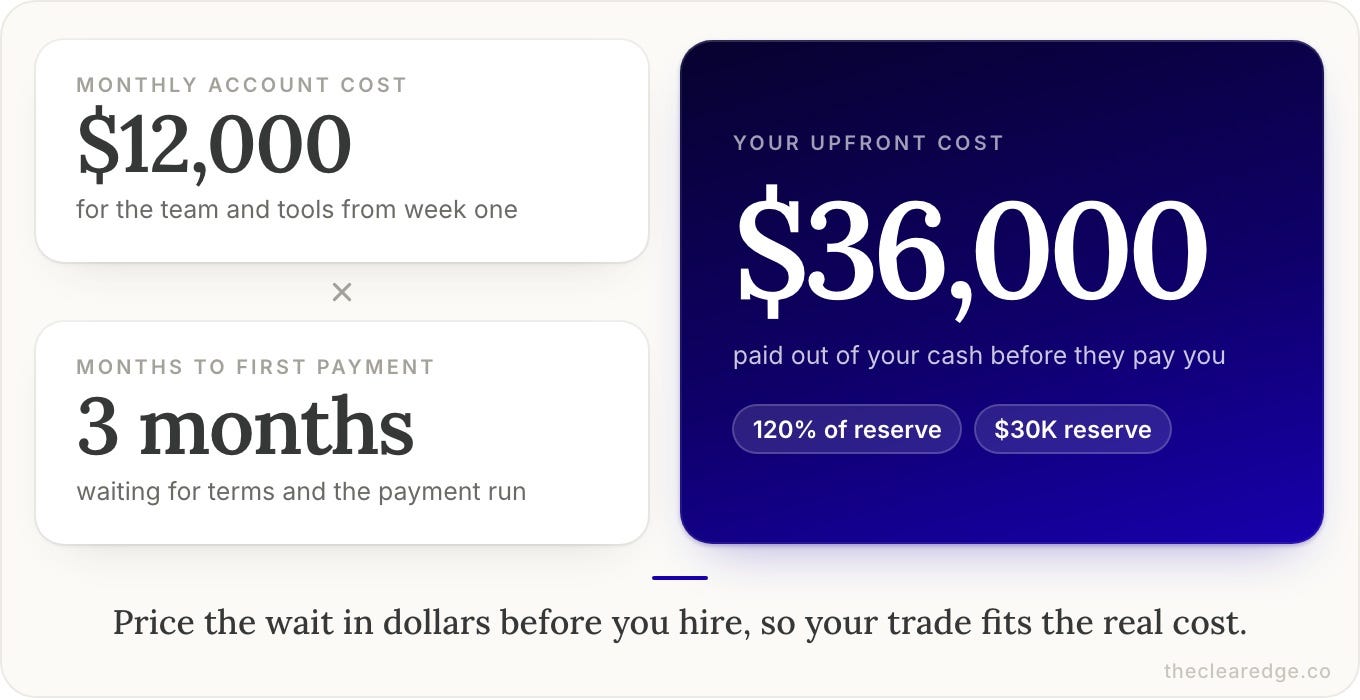
Put your own two numbers into that sum before you reply to the vendor form.
Set That Cost Against Your Reserve
Divide that cost by your cash reserve. The result puts you in one of three bands:
Under 50%: accept net-60, and ask to bill on the 1st of each month.
50% to 100%: accept only with a kickoff deposit or billing on the 1st. Add the 3% price line on top, never alone.
Over 100%: ask for the deposit. If they refuse every trade, turn the contract down and offer 30-day terms instead.
I set 50% so the cash left still covers your largest unpaid invoice from another client. Over 100%, one late invoice elsewhere means a loan or a missed payroll.
Why the sum comes before my reply:
I price the 90 days before I reply, because a yes without a trade can empty a $30,000 reserve.
I answer with the number in front of me, so my trade fits the dollars I pay out.
Once you sign, procurement has no reason to reopen the terms.
Open With the Trade
A flat no goes to a procurement team that has never met you and holds other agencies on file. So open with one sentence that keeps their terms:
“I can do net-60 on these terms.”
Then list the trades your band allows. The 60 days stay, and they pick one.
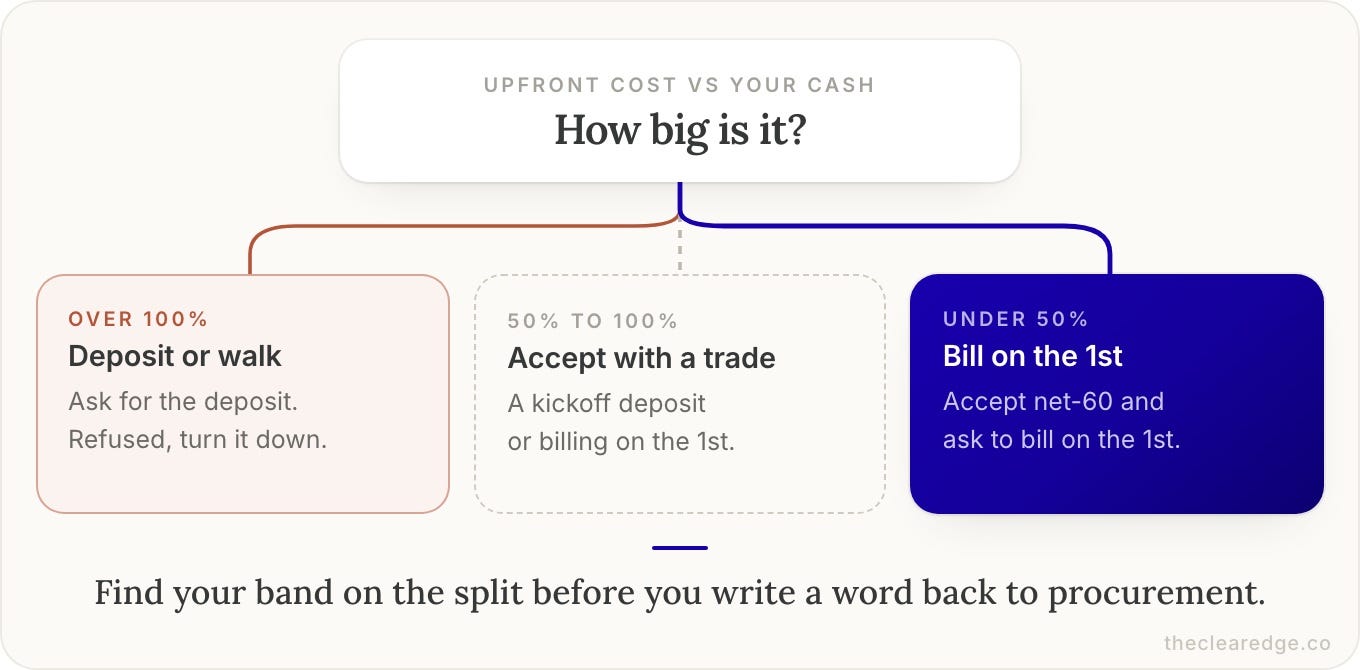
Find your band on that split before you write a word back to procurement.
How Kai Priced the Wait Before Hiring
Kai runs a 6-person content and SEO agency. He bills $60,000 a month to 9 clients, all on 30-day terms. The business account held a $30,000 reserve, and payroll runs every other Friday.
On Monday 10 August 2026, a software company agreed a 12-month retainer. The fee was $20,000 a month, starting Tuesday 1 September. Maren, their head of content, sent the vendor form. It said: “Payment terms: net 60 from receipt of a valid invoice.”
The account needed 2 more writers. Their US salaries plus payroll taxes came to $12,000 a month. Kai’s current team covered strategy inside its existing hours. Kai held the job offers and emailed procurement at 3pm that Monday:
“Before I sign, 4 questions: When does the 60-day clock start? What dates do your payment runs go out? What does vendor setup need, and how long does it take? Do you offer shorter terms to small suppliers?”
Procurement’s vendor lead answered on Tuesday 11 August. The clock starts when payables receives an invoice with the PO number. Maren confirms each month’s work, and then Kai invoices it.
Runs go out on the 15th and the last business day. Setup takes 7-10 business days, and services get no shorter terms.
So the September invoice would go in on 1 October. 60 days later is Monday 30 November, a run day. Kai would pay out $36,000 first, or 120% of the $30,000 reserve. That put Kai over the 100% line.
