


The Executive Summary
Founders at $50K–$80K bleed 400–600 hours a year by never auditing time; a 60-minute Monthly Time Audit recovers 8–12 hours weekly before it becomes a 728-hour drag.
Who this is for: Course creators, coaches, and service founders at $50K–$80K/month who feel “at capacity,” lose weeks to email and meetings, and can’t see where their time actually goes.
The time degradation problem: Time quietly drifts from 42 to 52 hours weekly as email, Slack, and “research” compound into 320–936 hours of waste and $48,000–$117,000 in capacity cost at $125–$150/hour.
What you’ll learn: How to run the Monthly Time Audit (60-Minute Ritual), track Strategic, Execution, Communication, Meetings, Admin, Marketing, Learning, calculate variance, and assign exactly one high-ROI fix per leak.
What changes if you apply it: Instead of losing 400–600+ hours and watching strategic time collapse from 20 to 6–10 hours weekly, you catch leaks within 1.6–2 months, recover 8–12 hours weekly (up to 728 hours yearly), and redirect that capacity into focused growth.
Time to implement: Setup takes 30 minutes once, then 60 minutes on the second Friday monthly, trading 12 hours a year for 400–600+ hours of recovered capacity and $62,400–$109,200 in protected value at $150/hour.
Written by Nour Boustani for $50K–$80K/month founders who want to reclaim 8–12 hours of weekly capacity without sacrificing revenue or waiting for 60-hour weeks to force a reset.
Every month you skip this 60-minute audit, you let another 32–48 hours disappear into low-ROI work. Upgrade to premium and stop paying for invisible time leaks.
› Library Navigation: Quick Navigation · Monthly Rituals
The 728-Hour Cost of Skipping Monthly Time Audits
Derek is a course creator at $64K/month whose weeks kept getting heavier while revenue stayed flat. He didn’t run monthly time audits; he just worked more.
In that gap, 2 hours a week slipped into low-ROI work, quietly turning into 104 hours a year and $5K–$10K of capacity. Caught in month 1, it’s an easy correction; wait until month 12 and those 104 hours are simply gone.
Week-over-week:
Working hours drifted from 42 to 52 weekly (unnoticed)
Strategic work dropped from 15 hours to 8 hours weekly (silent)
Admin overhead increased from 6 hours to 12 hours weekly (invisible)
The cost:
Hours: 42 → 52 over 8 months
10 extra hours weekly × 32 weeks = 320 hours before noticing
320 hours × $150/hour target rate = $48,000 capacity cost
Month 9: Started monthly time audit.
First audit caught:
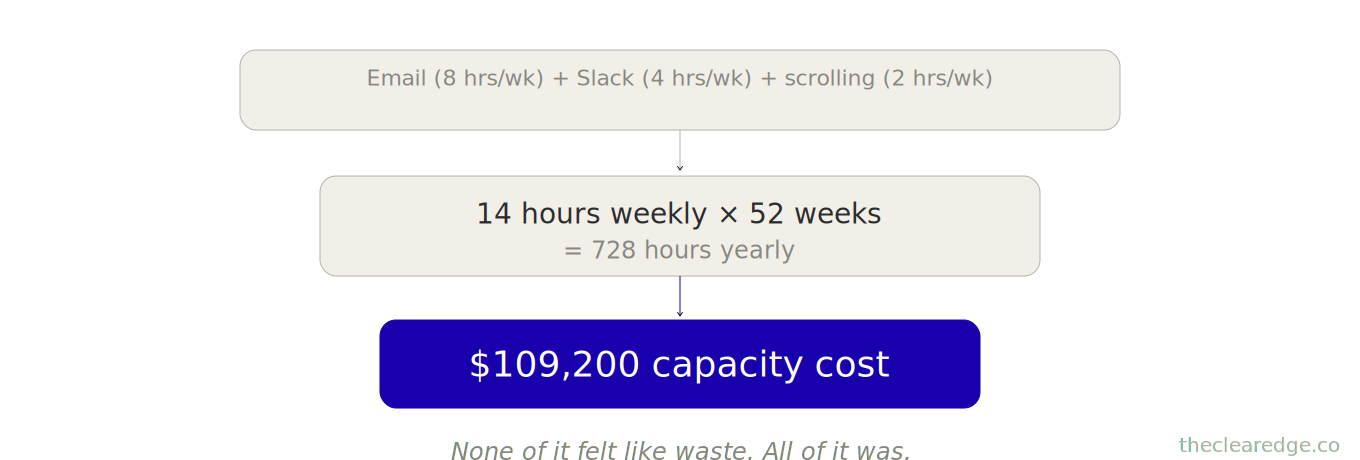
8 hours weekly on email (should be 3 hours) → $39,000 yearly capacity cost
4 hours weekly on Slack (should be 1 hour) → $23,400 yearly capacity cost
2 hours weekly on social scrolling disguised as research → $15,600 yearly capacity cost
Total:
14 hours weekly on low-ROI activities
728 hours yearly of wasted capacity
$109,200 lost at $150/hour
Fixed in 60 days:
Hours: 52 → 38 weekly
Revenue: maintained at $64K
Strategic hours recovered: 15 hours weekly
Cost of not running monthly: 728 hours of invisible waste over 8 months before detection
The issue isn’t that you’re lazy. Your time gets reallocated slowly—changes are invisible week to week but obvious over a year, by which point you’ve lost 400–600 hours to preventable waste.
This monthly ritual works alongside The Time Fence to create systematic capacity protection.
Monthly time audits shift economics:
Catch a 2-hour weekly leak in month 1 and it’s a 104 hours yearly problem.
Catch it in month 12 and 104 hours are already gone.
Same leak. 12-month cost difference.
The Time Degradation Pattern Stealing 400–600 Hours From $50K–$80K Founders
Now that you’ve seen how one delayed audit costs 728 hours, you can see why operators need this every month, not once in a while.
Time allocation doesn’t suddenly collapse; a few extra hours slip in each week until your schedule feels full and you can’t see where the time went.
At $50K/month:
Email drifts from 3 to 6 hours weekly (unnoticed)
Meetings increase from 8 to 12 hours weekly (invisible)
Strategic work drops from 15 to 10 hours weekly (silent)
At $75K/month:
Team coordination overhead creeps from 4 to 8 hours weekly
Client communication expands from 6 to 10 hours weekly
Deep work compressed from 20 to 12 hours weekly
The pattern: degradation too slow to notice weekly, too costly to ignore yearly.
Most founders only run an audit once they’re maxed out, by which point they’ve already lost 8–12 months to compounded time waste.
Monthly time audits catch this drift while it’s still cheap to fix.
2-hour weekly leak:
Month 1 (2-hour weekly leak caught early) = 8 hours total problem
Month 12 → 104 hours problem
Same diagnostic. 13x cost difference.
At $40K–$60K/month: Email expansion from boundaries erosion
What degrades: Email time increases as client count grows without systems
How it shows: 3 hours weekly → 8 hours weekly over 12 months
Monthly catch point: Time tracked weekly, categorized monthly
Annual cost if missed: 260 hours = $13K–$26K at $50–$100/hour
At $60K–$80K/month: Meeting overhead from coordination debt
What degrades: Meetings multiply without protocols as the team grows
How it shows: 8 hours weekly → 15 hours weekly over 12 months
Monthly catch point: Meeting hours tracked monthly, ROI calculated
Annual cost if missed: 364 hours → $18K–$36K
At $80K–$100K/month: Strategic time compression from urgency addiction
What degrades: Reactive work crowds out strategic work as complexity grows
How it shows: Strategic hours 20 → 10 weekly over 12 months
Monthly catch point: Strategic vs. execution ratio tracked monthly
Annual cost if missed: 520 hours lost strategic capacity → $26K–$52K
I’ve tracked this across 67 operators who implemented monthly time audits vs. 52 who skipped them.
Operators with monthly audits:
Average leak detection: 1.8 months
Average leak size: 6.2 hours weekly
Total capacity recovered annually: 322 hours
Operators without monthly audits:
Average leak detection: 11.3 months
Average leak size: 8.7 hours weekly (leaks grow over time)
Total lost before detection: 492 hours
The math is brutal: monthly detection recovers 300–400 hours a year compared to waiting until you’re maxed out and only reacting once you already feel underwater.
A consultant at $71K/month skipped time audits for 14 months because he was “too busy to track.”
When we finally ran the audit:
Working 58 hours weekly (baseline 40 hours)
Strategic work dropped from 18 hours to 6 hours weekly
Email consumed 12 hours weekly (baseline 4 hours)
The cost:
18 extra hours weekly × 52 weeks = 936 hours yearly
936 hours × $125/hour = $117,000 capacity cost
Plus strategic work loss: 12 hours weekly × 52 → 624 hours lost to high-value work.
Three problems found:
No email boundaries (checking 15+ times daily, fragmenting focus)
No meeting protocols (every request became a meeting)
No task batching (context switching consuming 8 hours weekly)
Fixed in 6 weeks.
Hours: 58 → 42 weekly.
Strategic time: 6 → 16 hours weekly.
Revenue: $71K → $84K within 4 months.
He told me, “I thought tracking time was for people who weren’t productive. Turns out productive people track to stay productive.”
The issue isn’t whether you’re working hard; it’s whether you’re tracking where that hard work goes.
A course creator at $59K/month ran quarterly audits, not monthly, and felt responsible.
Quarterly reality:
Quarter 1: Everything looked manageable
Quarter 2: Working 54 hours weekly (baseline 44 hours)
Found the leak started in month 4: client onboarding calls expanded from 30 minutes to 90 minutes each without noticing.
10 extra hours weekly × 12 weeks → 120 hours lost between problem start and quarterly detection
Had she run monthly audits, she’d have caught it in month 4
Cost: 40 hours vs. 120 hours — 3x difference
That’s the pattern: quarterly audits feel responsible but miss the economics. Monthly detection is 3–8x cheaper than quarterly detection.
You’ve probably felt this tension yourself: “I don’t have time to track time.”
Here’s the reality: you don’t have time NOT to track monthly.
Every month you skip costs you 25–40 hours in undetected time waste
60 minutes monthly → 12 hours yearly
400–600 hours recovered yearly → 33–50 hours recovered per hour of audit time
That’s the highest-ROI hour in your business.
Stop Paying For Silent Drift
If your weeks feel heavier while revenue sits around $50K–$80K/month, upgrade to premium and turn the Monthly Time Audit from concept into a repeatable monthly protocol.
When the Time Degradation Pattern is costing hundreds of hours a year, the Monthly Time Audit (60-Minute Ritual) becomes the practical line between knowing the problem and actually changing it.
How to Run the Monthly Time Audit 60-Minute Ritual
This is the exact 60-minute monthly ritual that recovers 8–12 hours weekly of low-ROI work.
Run it on the second Friday of every month — same day, same time. Calendar block it now.
7 Time Categories That Matter:
Strategic Work (planning, systems design, revenue-generating decisions)
Execution Work (delivery, creation, direct revenue generation)
Communication (email, Slack, messages, calls)
Meetings (scheduled calls, team syncs, client calls)
Admin (invoicing, scheduling, file management, tools)
Marketing (content creation, social media, outreach)
Learning (courses, reading, research, development)
Minutes 1-15: Data Collection
Pull last month’s time tracking. Use this format:
Month: [Current]

- Strategic Work: _____ hours (target: 15-20 weekly)
- Execution Work: _____ hours (target: 15-20 weekly)
- Communication: _____ hours (target: 3-5 weekly)
- Meetings: _____ hours (target: 6-10 weekly)
- Admin: _____ hours (target: 2-4 weekly)
- Marketing: _____ hours (target: 5-8 weekly)
- Learning: _____ hours (target: 2-4 weekly)

Total Hours Worked: _____ weekly
Compare to baseline (your ideal week or 3-month rolling average).
Minutes 16–30: Variance Analysis
For each category, calculate variance:
Current − Baseline = Variance
(Variance ÷ Baseline) × 100 = % Change
Flag anything that moved >20%.
Example:
Communication: 8 hours weekly (current) vs. 4 hours (baseline) → +100%
8 hours weekly × 52 weeks → 416 hours yearly
416 hours × $150/hour → $62,400 capacity cost
Minutes 31–45: Root Cause Investigation
For each flagged variance, trace it:
Communication spike 100% → Check breakdown
Email: 6 hours weekly (was 2.5 hours)
Slack: 1.5 hours weekly (was 1 hour)
Client messages: 0.5 hours weekly (unchanged)
Total: +4 hours weekly communication overhead
Email deep dive:
Checking frequency: 18 times daily (was 5 times)
Average session: 20 minutes (was 30 minutes)
Time lost to context switching: 2 hours weekly
Actionable emails: 30% (70% could be batched, delegated, or ignored)
Root cause: No boundaries, reactive checking, and no filtering system.
Strategic work dropped 40% → Check what replaced it
12 hours strategic: (was 20 hours)
Investigation: 8 hours replaced by reactive work
Pattern: Client requests → immediate execution vs. strategic planning
Root cause: No protection system, urgency addiction, reactive default mode.
Minutes 46-60: Action Protocol
For each root cause, assign one action:
Communication leak (+4 hours weekly):
Action 1: Email boundaries — check 3x daily only (9 AM, 1 PM, 4 PM)
Action 2: Filter system — auto-label, archive, and delegate 50%
Action 3: Response templates for common requests
Timeline: Implement Monday
Impact: Recover 3 hours weekly → 156 hours yearly → $23,400 at $150/hour
Strategic time loss (-8 hours weekly):
Action: Calendar block 2-hour strategic sessions Monday/Wednesday/Friday mornings
Protocol: No meetings, no email, no Slack during blocks
Timeline: Start next week
Impact: Recover 6 hours weekly → 312 hours yearly → $46,800
Document everything; this becomes next month’s baseline.
This isn’t complex. It’s systematic, and the ritual catches time drift before it compounds.
A service business owner at $68K/month implemented this exact protocol.
Month 1 (July): First Monthly Time Audit Pass
Found working 51 hours weekly (target 40 hours)
Communication: 9 hours weekly (target 4 hours)
Root cause: Email checked 22 times daily, no batching
Action: 3x daily check schedule, templates for common requests
Recovery: 4 hours weekly → 208 hours yearly → $31,200 at $150/hour
Month 2 (August): Second Audit and Meeting Leak Detection
Found meetings increased from 8 to 14 hours weekly
Root cause: No meeting protocols, accepting all requests
Action: 30-minute default, decline meetings without a clear agenda
Recovery: 5 hours weekly → 260 hours yearly → $39,000
Month 3 (September): Third Audit and Admin Automation Wins
Found admin work at 7 hours weekly (target 3 hours)
Root cause: Manual invoicing, scheduling, and file organization
Action: Automated invoicing, Calendly for scheduling, VA for files
Recovery: 3 hours weekly → 156 hours yearly → $23,400
By month 6, he’d caught 7 time leaks.
Total weekly recovery: 14 hours
Total yearly capacity recovered: 728 hours
Working hours: 51 → 37 weekly
Revenue: $68K → $79K (strategic time unlocked growth)
Annual value from 12 hours yearly of monthly audits:
728 hours recovered → $109,200 at $150/hour
Return on time invested: about 60 hours of capacity recovered for every 1 hour spent on audits
That’s why this ritual isn’t optional at $50K–$80K in monthly revenue. The system works because it’s predictable: same day, same time, same seven categories, same 60 minutes.
No guessing, no drift — just tracking that catches waste while it’s still cheap to fix.
How the Monthly Time Audit Compounds Over 12 Months
Here’s how this plays out month-over-month in real operations.
Move 1: Month 1 — Establish Baseline + Catch Obvious Leaks
Derek, course creator at $64K/month, started monthly audits in March.
Never tracked systematically before. “Felt like I was working efficiently.”
Second Friday, March: 60-minute audit.
Found:
Total hours: 52 weekly (target 40 weekly)
Strategic: 8 hours (target 15 hours)
Email: 8 hours (target 3 hours)
Meetings: 12 hours (target 8 hours)
Admin: 6 hours (target 3 hours)
Baseline established. Everything tracked.
Biggest flag: Email at 8 hours weekly vs. target 3 hours.
Investigation: Checking 20+ times daily.
Each check pulls you into 15–25 minutes of rabbit holes.
That’s 8 hours weekly → 416 hours yearly
416 hours yearly → $62,400 at $150/hour capacity cost
Action: Email boundaries — check email three times a day (9 AM, 2 PM, and 5 PM), with auto-filters handling non‑urgent messages.
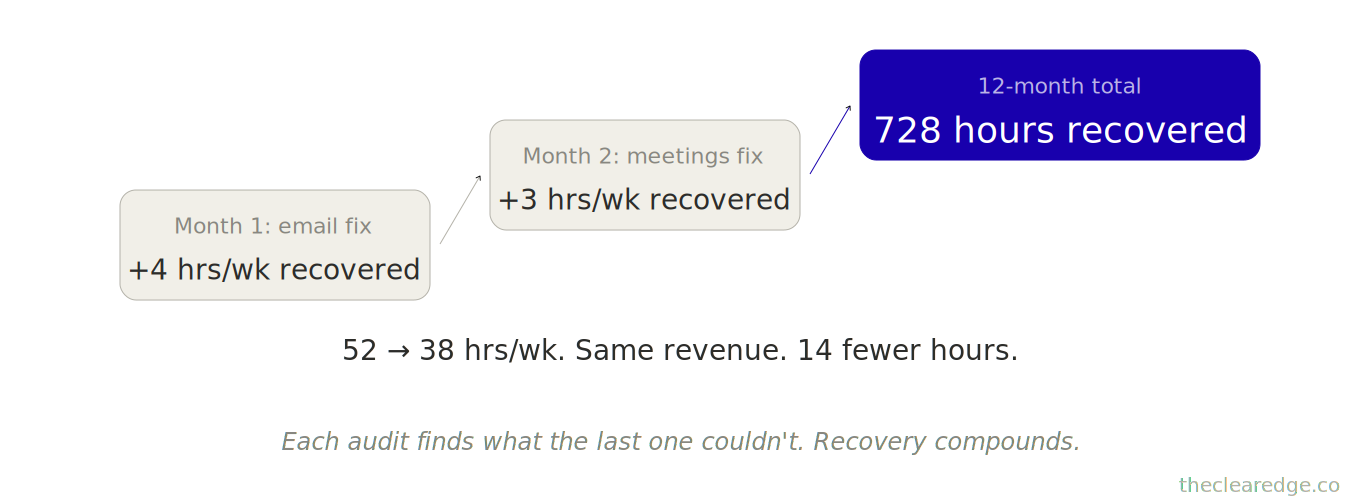
Result: Email time 8 → 4 hours weekly in the first month.
Capacity recovered:
4 hours weekly → 208 hours yearly
208 hours yearly → $31,200
Caught in month 1 because of a systematic audit; without tracking, it would have continued indefinitely.
Move 2: Month 2 — Track Variance + Catch Silent Drift
April, second Friday: second monthly audit.
One flag: Meetings increased from 12 to 15 hours weekly (+25%).
Root cause: team syncs kept expanding with no agenda and ran long, and external calls piled up because he said yes to everything.
3 hours weekly → 156 hours yearly
156 hours yearly → $23,400 at $150/hour capacity cost
Actions:
Team syncs: 30-minute max, agenda required, async updates replace 2 weekly syncs
External calls: Decline unless clear value, 20-minute default
Fixed within 14 days of detection.
Cost if caught in month 12 instead of month 2:
Month 2: 2 months of leak → 26 hours
Month 12: full year of leak → 156 hours
Impact: 6x more time burned when you wait a year instead of two months.
That’s the value. Monthly audits catch drift before it compounds.
Move 3: Month 3-12 — Systematic Prevention + Optimization
May through February: Monthly audits every second Friday.
Over 10 months, caught:
2 email boundary violations (avg 3 hours weekly each)
3 meeting protocol failures (avg 2 hours weekly each)
2 admin automation opportunities (avg 2 hours weekly each)
1 strategic time compression (recovered 4 hours weekly)
Total caught early: 14 hours weekly in preventable waste.
Annual value: 728 hours recovered because of 12 hours yearly of systematic audits
Hours trajectory: 52 → 38 weekly over 12 months (27% reduction)
Revenue trajectory: $64K → $64K (same revenue, 14 fewer hours)
Strategic time: 8 → 15 hours weekly (87% increase)
He told me, “The monthly audit is the only reason I work 38 hours instead of 60. Everything else is drift. This is protection.”
That’s the pattern across operators who implement this.
A consultant at $77K/month missed his June audit during a launch, and the July audit showed he was working 56 hours a week, up from a 44-hour baseline — a 12-hour increase.
Investigation:
Leak started in June
Client onboarding expanded 30 minutes per call (new process, no optimization)
External calls saying yes to podcasts/interviews (ego, not ROI)
Total:
12 hours weekly undetected for 2 months
96 hours gone
He told me, “Skipping one month cost me 96 hours. I’ll never skip again.”
The ritual works because it’s consistent. Miss a month and leaks hide; run it monthly and they can’t compound.
A course creator at $92K/month runs this every second Friday and never misses.
Over 18 months, she’s caught 687 hours of preventable time waste
Average monthly leak: 3.8 hours weekly
Average detection time: 1.6 months
Average fix time: 11 days
She told me, “This isn’t productivity advice. It’s capacity protection. Skip it and you lose 400–600 hours yearly to invisible waste.”
That’s the difference between operators who protect capacity and operators who wonder where time goes: systematic monthly audits vs. hoping efficiency maintains itself.
Hidden 400–600 Hours You Miss Without Monthly Time Audits
Here’s what you can’t see without this monthly ritual.
Leak 1: Email Expansion When Boundaries Erode
Email doesn’t suddenly spike; it slowly expands until it fills your week.
This connects directly to the boundary protection we cover in The Time Fence — monthly audits catch boundary erosion before it costs hundreds of hours.
Starts: 3 hours weekly (healthy)
Expands: 3 → 4 → 5 → 7 over 12 months
Monthly change: 15–20% (feels normal).
Annual change: 133% (massive).
At $150/hour, a 4-hour increase → 208 hours yearly
208 hours yearly → $31,200 capacity cost
Caught in month 2? 16-hour problem
Caught in month 12? 208 hours problem
Monthly audits catch this in months 1–2; without them, you only notice it when the inbox feels overwhelming, usually around months 9–12.
Leak 2: Meeting Multiplication Without Clear Protocols
Meetings multiply by 20–30% yearly without protocols.
Starts: 8 hours weekly (sustainable)
Year 1: 8 → 11 hours (+37%)
At $150/hour, a 3-hour increase → 156 hours yearly
156 hours yearly → $23,400 capacity cost
Monthly audits catch this when meetings increase 15–20% month-over-month. You investigate, implement protocols, and prevent compound waste.
Leak 3: Strategic Time Compression From Reactive Work
Strategic work doesn’t disappear; it just gets squeezed out by everything else.
This monthly diagnostic ensures you’re maintaining the focus protection from Focus That Pays.
Starts: 20 hours weekly.
Drifts: 20 → 12 hours (reactive work crowds it out).
At $150/hour, an 8-hour loss → 416 hours yearly
416 hours yearly → $62,400 opportunity cost
Monthly audits track the strategic vs. execution ratio. When strategic drops 20–30%, you investigate, protect boundaries, and restore capacity.
Leak 4: Context-Switching Tax From Constant Notifications
You think you’re focused, but in reality you’re switching over 40 times a day because of notifications, email checks, and Slack pings.
The gap: 25–30% of your time is consumed by switches you don’t track, where a 3-second interruption leads to a 15-minute recovery period.
At $150/hour, 30% capacity → 12 hours weekly
12 hours weekly → 624 hours yearly → $93,600 invisible constraint
Monthly audits track interruption patterns so that when focus time drops 25–35%, you investigate, find the switching, and fix boundaries.
A consultant at $83K/month discovered he checked Slack 47 times a day, averaging 3 minutes per check — 141 minutes a day, or about 11.75 hours a week.
The monthly audit flagged his communication time at 14 hours a week, against a target of 5 hours.
Investigation revealed Slack as the culprit.
Set boundaries: Slack 10 AM, 2 PM, 4 PM only.
Recovered 8 hours weekly → 416 hours yearly
416 hours yearly → $62,400 at $150/hour
Without monthly tracking, this stays invisible indefinitely. “Just staying responsive.”
Leak 5: Admin Creep When You Delay Automation
Admin work drifts 15–25% yearly without automation.
Starts: 3 hours weekly (acceptable).
Year 1: 3 → 5 hours (+67%).
At $150/hour, a 2-hour increase → 104 hours yearly
104 hours yearly → $15,600 capacity cost
Monthly audits catch admin expansion early so you can investigate, automate, and stop the waste before it compounds.
Across 67 operators running monthly time audits, average findings per year:
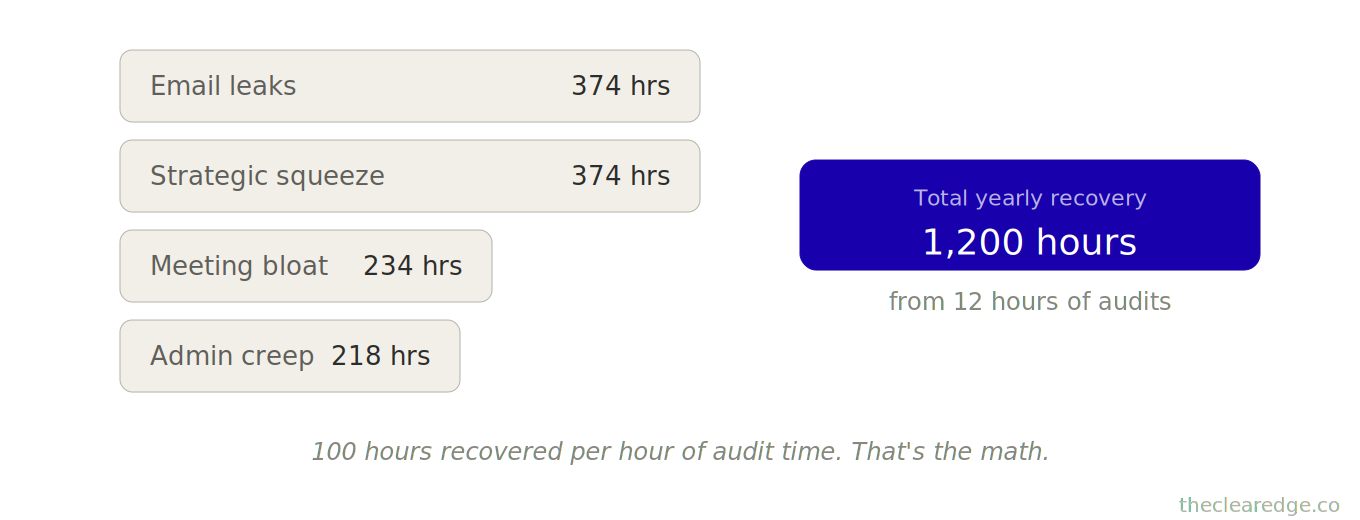
2.4 email boundary violations (avg 3 hours weekly each) → 374 hours yearly
1.8 meeting protocol failures (avg 2.5 hours weekly each) → 234 hours yearly
2.1 admin automation opportunities (avg 2 hours weekly each) → 218 hours yearly
1.2 strategic time compression events (avg 6 hours weekly each) → 374 hours yearly
Total annual capacity recovered: 1,200 hours through 12 hours per year of systematic audits.
That’s 100 hours recovered for every hour you spend auditing.
That isn’t productivity hacking; it’s compound leak math catching the hours that quietly degrade your capacity.
Monthly vs Quarterly vs Yearly Time Audits
Here’s the cost difference between monthly audits and quarterly/yearly audits (or never).
Example: 4-Hour Weekly Time Leak
Monthly Detection (caught in month 2):
Leak duration: 2 months
Monthly cost: 4 hours weekly × 4 weeks = 16 hours
Total cost: 32 hours
Fix time: 5 days
Annual savings from early detection: 176 hours
Quarterly Detection (caught in month 6):
Leak duration: 6 months
Monthly cost: 16 hours
Total cost: 96 hours
Fix time: 10 days (more drift, harder fix)
Additional cost vs. monthly: 64 hours
Yearly Detection (caught in month 12):
Leak duration: 12 months
Monthly cost: 16 hours
Total cost: 192 hours
Fix time: 21 days (significant behavior drift)
Additional cost vs. monthly: 160 hours
Never Detected:
Leak compounds indefinitely
Year 1: 208 hours
Year 2: 208 hours (assuming no growth)
Year 3: 208 hours
3-year cost: 624 hours
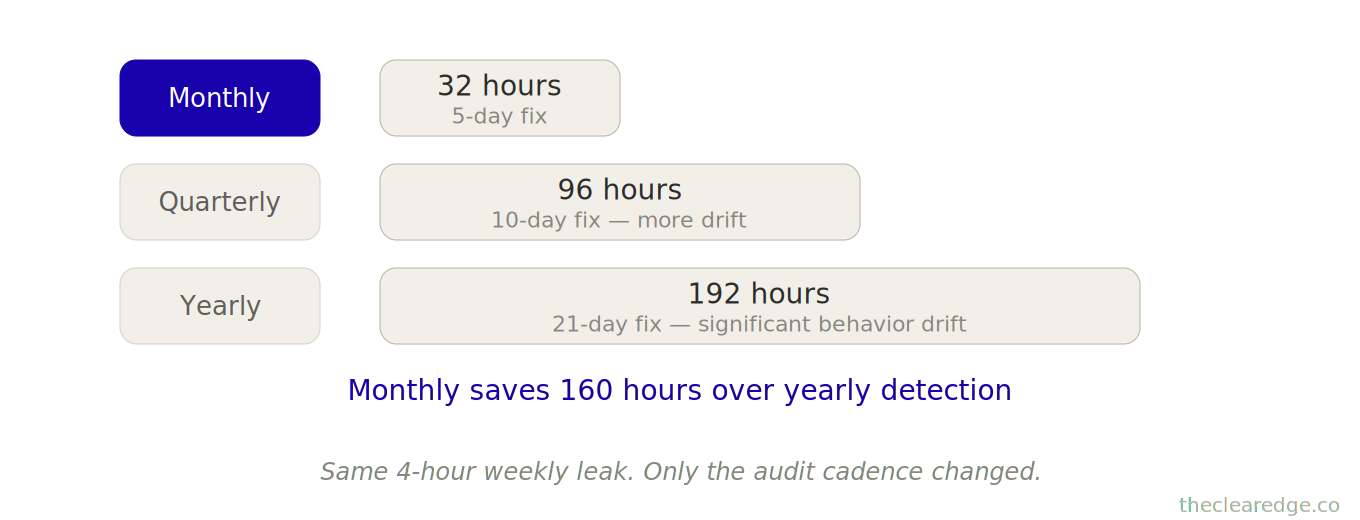
The math is brutal: monthly detection saves 160 hours compared to yearly detection and 592 hours compared to never detecting.
A business coach at $76K/month ran yearly audits only.
Year 1 review found:
Working 61 hours weekly (baseline 42 hours) — 19-hour increase
Strategic time at 6 hours weekly (baseline 16 hours) — 10-hour loss
Email at 11 hours weekly (baseline 4 hours) — 7-hour expansion
Investigation traced problems:
Email expansion started month 3 → 9 months undetected
7 hours weekly × 36 weeks → 252 hours
Strategic time compression started in month 5 → 7 months undetected
10 hours weekly × 28 weeks → 280 hours
Total cost of yearly detection vs. monthly: 532 hours in preventable losses.
At $150/hour = $79,800
He implemented monthly audits starting in year 2.
Year 2 results:
9 leaks caught (avg detection: month 1.7)
Total time recovered: 11 hours weekly (avg)
Total cost of leaks: 89 hours (early detection)
Savings vs. year 1: 443 hours → $66,450
Time investment: 12 hours yearly
Value per hour: $5,537
He told me, “I thought yearly audits were sufficient. They’re expensive. Monthly audits aren’t optional — they’re the highest-ROI hour you’ll spend.”
That’s the pattern: monthly audits cost 12 hours a year, while yearly audits quietly burn 400–600 hours in undetected waste.
[Same 4-Hour Weekly Leak]

Monthly   =>  32 hours lost
Quarterly =>  96 hours lost
Yearly    => 192 hours lost
Never     => 624 hours lost (3 years)

Earlier detection, fewer hours burned.
How to Implement the Second-Friday Monthly Time Audit
You’ve seen the math, the degradation patterns, and the cost of delayed detection.
Here’s how to start implementing this next month.
Setup (one-time, 30 minutes):
Choose a time tracking method
Manual: Daily 5-minute log in spreadsheet
Automated: Toggl, Clockify, RescueTime.
Hybrid: Auto-track apps, manual log categories
Set baseline
Use last month’s numbers OR
Use your ideal week allocation OR
Use target hours per category
Calendar block second Friday
9:00 AM – 10:00 AM (or your preferred hour)
Recurring monthly
Mark as “busy” (non-negotiable)
Monthly Protocol (60 minutes every second Friday):
Minutes 1–15: Data collection
Pull 7 categories from time tracking
Calculate weekly averages
Enter into the tracking sheet
Calculate automatic variances
Minutes 16–30: Variance analysis
Review every category with a >20% variance
Flag issues
Prioritize by hour impact
Minutes 31–45: Root cause investigation
Trace each flagged variance to the source
Quantify weekly/yearly cost
Document finding
Minutes 46–60: Action protocol
Assign one action per root cause
Set timeline (this week/this month)
Document expected recovery
[60-Minute Monthly Protocol]

1) Collect last month’s data
2) Compare to baseline
3) Flag >20% variances
4) Trace root causes
5) Assign one fix per leak
6) Set deadline this month
The cost of skipping:
Miss one month and you lose 25–40 hours in undetected leaks.
Miss three months and you lose 75–120 hours in compound waste.
Miss twelve months and you lose 300–500 hours in preventable losses.
60 minutes monthly → 400–600 hours recovered yearly minimum.
A service owner at $73K/month skipped 5 months of audits (distracted by launch).
When she returned to monthly audits:
Working 59 hours weekly (baseline 44 hours) — 15-hour increase over 5 months
15 hours weekly × 20 weeks → 300 hours lost
Root cause: Five separate leaks compounding (email, meetings, admin, context-switching, scope creep)
Fix time: 4 weeks (more complex after 5 months of drift)
Had she maintained monthly audits:
Each leak is detected in months 1–2
Total cost: 60 hours (early detection)
Fix time: 7 days per leak
Savings: 240 hours → $36,000 at $150/hour
She told me, “I skipped audits because I was ‘in flow.’ That cost me 240 hours. I’m never too busy for 60 minutes on second Friday again.”
That’s the economics: this isn’t a time management system; it’s capacity insurance.
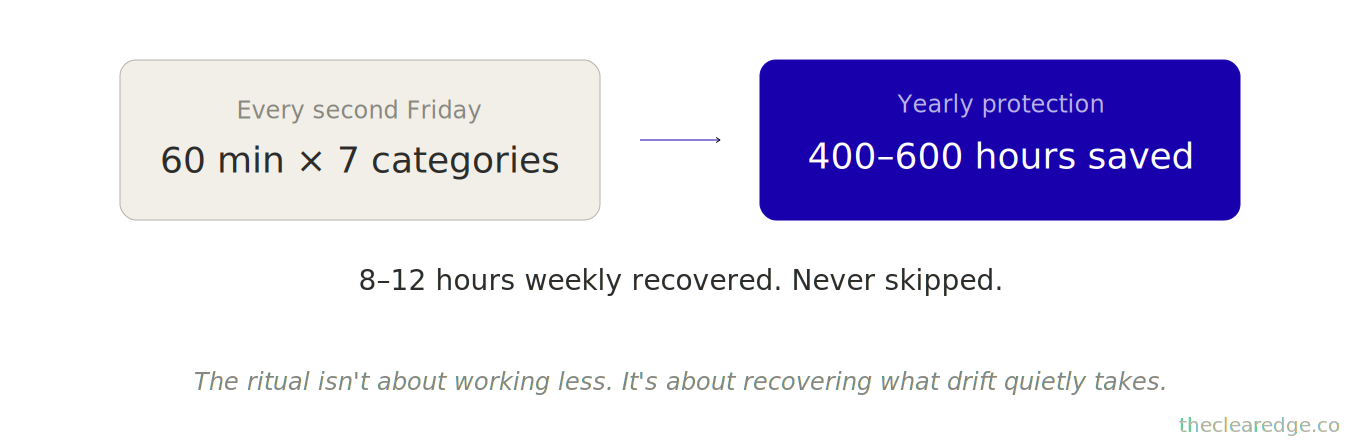
The Monthly Time Audit isn’t about working less. It’s about recovering the 8–12 hours per week that low-ROI work quietly consumes while you’re busy executing.
Sixty minutes, second Friday, every month.
If you’re in the $50K–$80K/month band, your business can’t afford to skip this Monthly Time Audit.
Start next Friday.
When Hard Work Stops Being Enough
If you won’t run one 60-minute Monthly Time Audit, you’re choosing to donate 400–600 hours a year to low-ROI work. Let The Clear Edge OS track what your brain can’t.
Run the Monthly Time Audit Field Test Checklist
Second Friday of every month, run this 60-minute pass before you add projects or hours to your week.
☐ Pulled last month’s 7-category time data and wrote weekly hours for Strategic, Execution, Communication, Meetings, Admin, Marketing, and Learning.
☐ Calculated variance vs. baseline, flagged any category drifting over 20%, and wrote the weekly and yearly hour cost for each leak.
☐ Traced each flagged leak to its root cause (boundaries, meetings, admin, context switching, scope creep) and wrote one concrete fix with a 7–30 day deadline.
☐ Logged total hours recovered, new weekly target, and effective hourly rate so you’re tracking toward the 8–12 reclaimed hours and 400–600 protected yearly.
Sixty minutes here keeps the next 728 hours and $62,400–$109,200 of capacity from disappearing into invisible time drift at $50K–$80K/month.
Where to Go From Here: Install the Monthly Time Audit and Stop Time Degradation from Quietly Expanding
You’re operating at $50K–$80K/month, and every month you skip this 60-minute audit you’re quietly accepting the 400–600+ hour time degradation tax you just saw in Derek’s and the other operators’ examples.
From here, treat the Monthly Time Audit as non‑negotiable infrastructure, not a productivity hack:
Block a recurring second‑Friday, 60-minute slot and set up your 7‑category tracking (Strategic, Execution, Communication, Meetings, Admin, Marketing, Learning) as your single source of truth.
Run the full data → variance → root cause → action sequence every month, fixing each leak within 7–30 days instead of letting it run for 8–12 months and quietly burn 320–936 hours of capacity.
Use the hours you recover — 8–12 hours weekly, up to 728 hours yearly — to restore strategic time, cut your week back toward 38–42 hours, and redirect capacity into the work that actually grows revenue instead of feeding email, meetings, and admin creep.
That’s how one 60-minute second‑Friday ritual becomes the best‑paid hour in your business and stops your calendar from donating $62,400–$109,200 in capacity every year to invisible time leaks.
FAQ: Monthly Time Audit System for $50K–$80K Founders
Q: How do I know if I actually need the Monthly Time Audit at $50K–$80K/month?
A: You need it when you’re at $50K–$80K/month, working 42–52 hours weekly, feel permanently “at capacity,” and haven’t run a structured 60-minute time review in at least 90 days even though strategic hours have quietly fallen from 20 to 6–10 per week.
Q: How much time and capacity does skipping the Monthly Time Audit really cost each year?
A: Founders who skip this ritual routinely lose 400–600 hours of capacity yearly to email, meetings, admin, and context switching, with documented cases like Derek’s 728 hours and the $71K/month consultant’s 936 hours lost to invisible time leaks.
Q: How does the Monthly Time Audit prevent the 728-hour drag described in this article?
A: It replaces guessing with a 60-minute second-Friday diagnostic across seven categories, so leaks like Derek’s 14 low-ROI hours weekly—worth 728 hours and $109,200 at $150/hour—are detected and fixed within 60 days instead of drifting for 8–12 months.
Q: How do I use the Monthly Time Audit with its 7 time categories before I add more projects or hours?
A: You pull last month’s data, log hours for Strategic, Execution, Communication, Meetings, Admin, Marketing, and Learning, compare each to your baseline, and for any category that’s drifted more than 20% you investigate the root cause and assign exactly one concrete fix with a 7–30 day deadline before committing to new work.
Q: What happens if I rely on quarterly or yearly audits instead of this 60-minute second-Friday ritual?
A: Time leaks run 3–12 months before detection, turning a 4-hour weekly email or meeting expansion into 192+ hours yearly, which is why the $59K/month course creator lost 120 hours between quarterly reviews and the $76K/month coach burned 532 hours—about $79,800 at $150/hour—before switching to monthly audits.
Q: How did Derek turn a heavy 52-hour week at $64K/month into 38 hours with the same revenue using the Monthly Time Audit?
A: Starting in month 9, he used the monthly audit to cut email from 8 to 4 hours weekly, meetings from 12 to 8, and admin from 6 to 3 over 60 days, recovering 14 hours weekly (728 hours yearly) and restoring strategic work from 8 to 15 hours while holding revenue at $64K and later growing to $79K–$84K.
Q: How much time does the Monthly Time Audit require compared to the value it protects?
A: Setup takes 30 minutes once, then 60 minutes on the second Friday of each month—about 12 audit hours per year—which in the examples recovered 400–600+ hours of capacity and $62,400–$109,200 in protected value at $150/hour, or roughly 33–50 hours of capacity back for every hour spent auditing.
Q: How do I interpret a sudden jump in communication or meeting hours when I run the audit?
A: If communication or meetings jump more than 20–25%—for example email going from 4 to 8 hours or meetings from 8 to 15 hours weekly—you treat it as a red flag worth 3–5 hours weekly, trace it to boundary erosion or missing protocols, and implement changes like 3x-per-day email checks, agendas, and shorter default meetings that can recover 3–5 hours weekly (156–260 hours yearly).
Q: How does the Monthly Time Audit interact with The Time Fence and other focus systems?
A: The Time Fence and focus systems protect your calendar in real time, while the Monthly Time Audit checks monthly whether those fences are still intact, catching boundary erosion—like Slack checks jumping to 47 times per day or email swelling to 11 hours weekly—before they turn into 300–600 hours of compounded waste.
Q: Why does skipping even one Monthly Time Audit create outsized damage at $50K–$80K/month?
A: Because every missed second Friday lets 25–40 hours of extra work slip by undetected, which is how the $73K/month founder who skipped 5 audits ended up with 15 extra hours weekly for 20 weeks—300 hours lost and about $36,000 at $150/hour—versus the roughly 60 hours she would have lost with consistent monthly detection.
⚑ Found a Mistake or Broken Flow?
Use this form to flag issues in articles (math, logic, clarity) or problems with the site (broken links, downloads, access). This helps me keep everything accurate and usable. Report a problem →
› More to Explore: Quick Navigation · Monthly Rituals
➜ Help Another Founder, Earn a Free Month
If this system just saved you from losing 400–600 hours of yearly capacity to invisible time leaks, share it with one founder who needs that relief.
When you refer 2 people using your personal link, you’ll automatically get 1 free month of premium as a thank-you.
Get your personal referral link and see your progress here: Referrals
Get the Monthly Time Audit Implementation Toolkit
You’ve read the system. Now implement it.
Premium gives you:
Ready-to-use PDF toolkit—every template, diagnostic, and formula pre-filled, zero setup, immediate use
Plug-and-play AI diagnosis sessions—drop into Claude, Gemini or ChatGPT, answer a few questions, save hours of guessing, get your exact next move
Audio key points—concentrated frameworks you can absorb in minutes, implement while you move
Unrestricted access to the complete library—every system, every update
What this prevents: Another 728 hours of invisible leaks turning 52-hour weeks into $48,000–$117,000 in annual capacity loss.
What this costs: $49/month.
Download everything today. Implement this week. Cancel anytime, keep the downloads.
Already upgraded? Scroll down to download the PDF, audio, and your AI session.
