


The Executive Summary
Founders at $120K–$160K risk losing $25K–$40K per person in preventable turnover by waiting for visible issues; a 20-minute Monthly Team Calibration catches strain 1–2 months earlier, while it’s still fixable.
Who this is for: Growing agency and productized-service founders at $120K–$160K/month with 10–14 team members and rising delivery complexity who don’t yet have a structured way to catch strain before people mentally exit.
The team calibration problem: Skipping monthly calibration creates 3.4-month silent strain windows and per-person turnover costs of $35K–$42K, compounding to $89K–$95K annually at this scale.
What you’ll learn: How to run the Monthly Team Calibration (20-minute 1-on-1s) using the 6-question Calibration Framework to flag capacity, priority, decision, and support risks while they’re still recoverable.
What changes if you apply it: You move from losing 2–3 people a year and eating $89K–$101K in turnover and productivity loss to intervening within 48 hours–7 days and pushing retention toward 94%.
Time to implement: One 80–90 minute setup, then 20 minutes per team member plus 30 minutes of analysis on the last Friday monthly, with quarterly 30-minute audits to track retention.
Written by Nour Boustani for $120K–$160K/month founders who want to keep their best people and scale delegation without eating $25K–$40K per preventable turnover event.
Monthly Team Calibration is how $120K–$160K/month founders catch 3.4‑month strain windows before they become $25K–$40K exits—upgrade to premium to install the full system.
› Library Navigation: Quick Navigation · Monthly Rituals
The $40K Monthly Team Calibration Gap at $120K–$160K/Month
There’s a specific pattern where strain quietly compounds for months, and then one exit wipes $25K–$40K off your year.
Two months before someone quits, they’re already disengaged. Six weeks before delegation fails, clarity gaps already exist. One month before productivity drops, strain signals are already showing.
By the time you reach a crisis conversation, it’s too late.
Caught monthly at the first signal through a Monthly Team Calibration, the situation is still fixable.
Caught at the breakdown stage, you’re no longer solving a problem—you’re paying a bill.
Here’s what that looks like in real numbers.
Case Study: Marcus’s $37,300 Turnover Event
Marcus is an agency owner at $134K/month who wasn’t running a Monthly Team Calibration—only weekly standups.
The team seemed fine, delivery on track. Until it wasn’t.
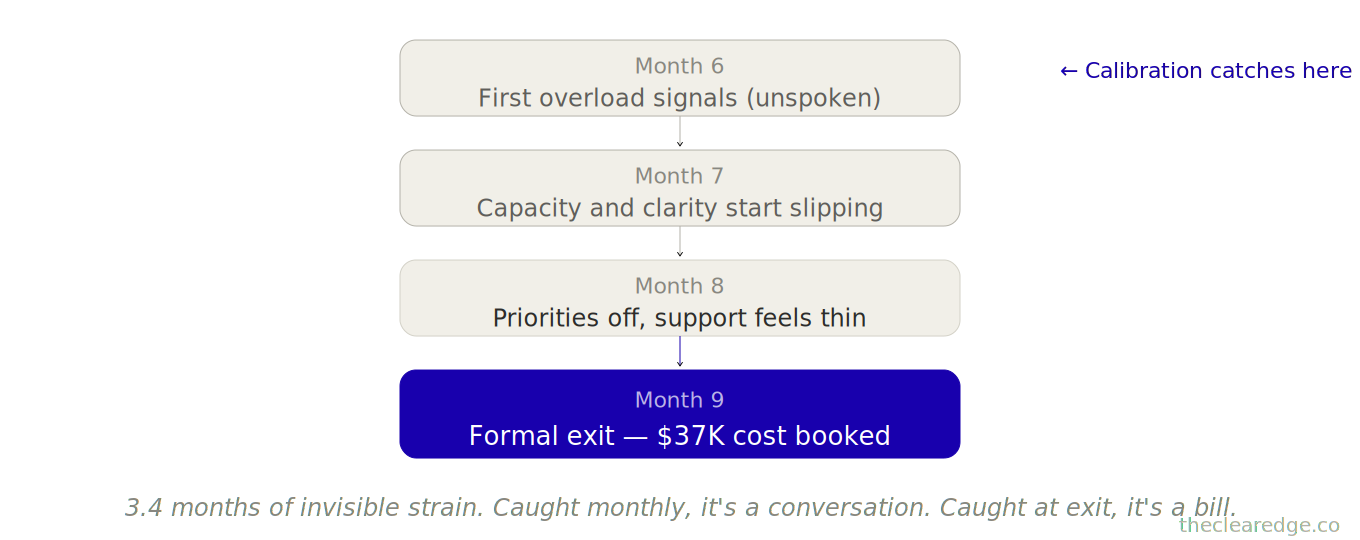
Month 9: Senior project manager quit (no warning)
Departure cost:
Recruitment: $8,500 (agency fees, interviews, onboarding)
Training replacement: 8 weeks × 20 hours = 160 hours → $9,600
Lost productivity during transition: $12,800 (projects delayed, client issues)
Knowledge loss: $6,400 (systems, relationships, institutional knowledge)
Total turnover cost: $37,300
Exit interview revealed pattern:
“Felt overwhelmed for 3 months” (started month 6)
“Workload kept increasing, never discussed capacity” (month 7–8)
“Didn’t feel supported, unclear priorities” (month 8)
“Already decided to leave by month 8” (mental exit 4 weeks before formal notice)
Average strain duration before exit: 3.4 months.
The cost:
If caught at first signal (month 6), salvageable.
Weekly standups never surfaced capacity concerns (too tactical, no space for calibration discussion).
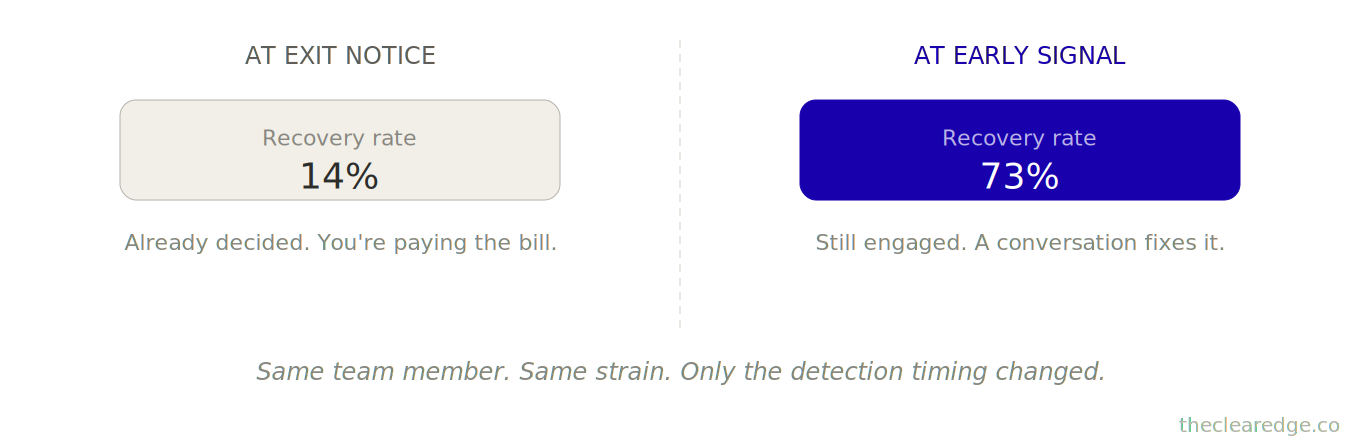
Caught at exit notice in month 9, she had already mentally checked out 4 weeks earlier.
Recovery rate at exit notice: 14%.
Recovery rate at early signal: 73%.
Month 10: Started Monthly Team Calibration
Changed approach completely.
Don’t wait for breakdowns.
Don’t rely on weekly tactical meetings.
Systematically check alignment monthly.
Catch strain signals early.
Month 10 baseline:
11 team members (4 senior, 7 mid-level)
Average fully-loaded cost: $7,200 monthly per person
Total team cost: $79,200 monthly
No structured calibration system
Month 10 first calibration (last Friday, 2 hours for the full team):
Ran structured 1-on-1 calibrations:
20 minutes each
11 people
220 minutes total
3.7 hours total
Asked 6 calibration questions:
Capacity clarity (1-10): How clear are you on your capacity limits?
Workload sustainability (1-10): Is your current workload sustainable?
Priority alignment (1-10): How aligned are we on what matters most?
Decision clarity (1-10): How clear are you on decision authority?
Support adequacy (1-10): Are you getting the support you need?
One adjustment needed
Flagged signals:
3 team members rated workload sustainability ≤5 (red flag)
2 team members rated priority alignment ≤6 (yellow flag)
1 team member rated decision clarity ≤5 (delegation breakdown risk)
Immediate action (month 10–11):
Team Member 1 (workload 4/10): “Taking on too much”
Action: Capacity audit found 58 hours weekly vs. 40 planned (45% over)
Solution: Redistributed 12 hours, extended one deadline
Follow-up: Workload rating 8/10
Result: Retained ($7,200/month × 12 = $86,400 + $9,600 avoided replacement)
Team Member 2 (workload 5/10): “Unclear priorities”
Action: Priority matrix + weekly 15‑minute sync
Follow-up: Priority rating 9/10
Result: Retained, delivery quality improved
Team Members 3–4: Similar interventions (role restructure, decision authority matrix). Both were retained with improved ratings.
Result:
Total prevention: 4 team members
Prevented cost: $256,000 (assuming 2.5 would’ve left, conservative estimate)
Why this changed the baseline:
By month 16, Marcus’s team retention rate hit 94% (vs. 78% industry average at this scale).
Monthly calibration stopped being optional and became infrastructure.
What the calibration actually does:
You’re catching strain when the capacity index is 4–6/10 (salvageable, early intervention).
You’re not waiting until 2–3/10 (they’ve already decided to leave).
Why it matters:
The issue isn’t that teams become strained.
It’s that strain compounds silently for 2–4 months before you notice.
Monthly calibration makes that invisible window visible while there’s still time to act.
$25K–$40K Delegation Breakdown
You’ve seen how the invisible delegation breakdown pattern quietly turns into $25K–$40K losses per person. The Monthly Team Calibration toolkit inside premium turns that pattern into a system.
A 20-minute Monthly Team Calibration per person is the bridge between spotting the silent delegation breakdown pattern and actually moving those 3.4-month strain windows into the recoverable zone.
The Invisible Delegation Breakdown Pattern Behind $25K–$40K Per-Person Turnover
Now that you’ve seen how early detection saved $256K in turnover costs, here’s why every operator with a team needs this monthly.
Team strain doesn’t spike overnight. It compounds gradually:
Week 1-4: Honeymoon/normal (capacity feels manageable)
Week 5-8: Early pressure (workload increasing, still handling it)
Week 9-12: Strain building (sustainability questions emerging, not voiced)
Week 13-16: Active strain (overwhelm setting in, quality/speed affected)
Week 17-20: Decision point (mental evaluation: stay or go?)
Week 21-24: Mental exit (if unaddressed, decision made to leave)
At $120K-$140K/month
10-14 team members average
Annual turnover: 18-24% without calibration (2-3 people)
Average fully-loaded cost: $6,800-$7,500 monthly per person
Per-person turnover cost: $35K-$42K (recruitment, training, productivity loss)
Annual turnover cost: 2.5 people × $38K = $95K
Team strain compounds over time:
Weeks 1–4: normal
Weeks 9–12: strain building (unvoiced)
Weeks 17–20: mental evaluation
Weeks 21–24: decision to leave
Intervention impact:
Caught at Weeks 9–12 → 73% recovery
Caught at Weeks 21–24 → 14% recovery
Most founders check alignment in weekly tactical meetings (too operational), annual reviews (too infrequent), or only when problems surface (too late).
Monthly calibration catches strain while team members are still engaged.
Common early signals:
Capacity strain: workload over 40 hours
Priority confusion: unclear what actually matters
Decision paralysis: fuzzy decision authority
Support gaps: feeling alone or stuck
Role clarity breakdown: scope creep and shifting responsibilities
Communication overhead: too many meetings and channels
How to Run the Monthly Team Calibration 20-Minute 1-on-1 Structure
This isn’t a performance review. It’s where you spot real strain in your team before it turns into a resignation.
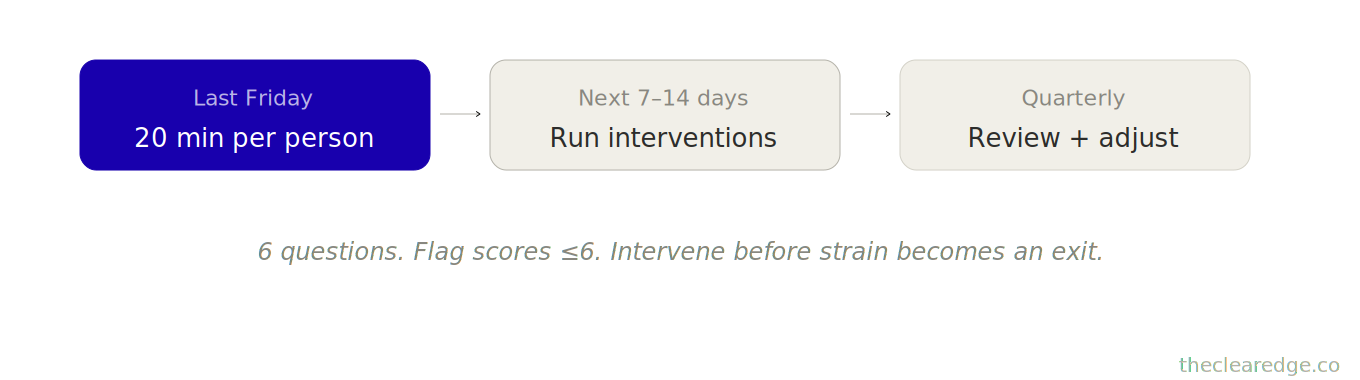
Ask 6 calibration questions.
Flag at‑risk team members.
Intervene within 7 days.
Run this on the last Friday of every month.
20 minutes per team member.
Calendar‑blocking mandatory.
Part 1: The 6-Question Calibration Framework (Ask in Every 1-on-1)
Question 1: Capacity Clarity
“On a scale of 1–10, how clear are you on your capacity limits—what’s sustainable vs. what would push you into unsustainable territory?”
1–3: Critical (no capacity awareness, likely already over)
4–6: Concerning (unclear boundaries, risk of overflow)
7–8: Clear (knows limits, managing proactively)
9–10: Crystal clear (strong capacity management)
Question 2: Workload Sustainability
“On a scale of 1–10, is your current workload sustainable for the next 30–60 days?”
1–3: Critical (already unsustainable, burning out)
4–6: Concerning (borderline, strain building)
7–8: Sustainable (manageable pace)
9–10: Optimal (productive without strain)
Question 3: Priority Alignment
“On a scale of 1–10, how aligned are we on what matters most—do you know what to focus on when things compete?”
1–3: Critical (total confusion, contradictory priorities)
4–6: Concerning (unclear priorities, frequent conflicts)
7–8: Aligned (mostly clear, occasional confusion)
9–10: Perfectly aligned (total clarity)
Question 4: Decision Clarity
“On a scale of 1–10, how clear are you on your decision authority—what you can decide vs. what needs my input?”
1–3: Critical (paralysis, unclear authority)
4–6: Concerning (frequent uncertainty, over‑escalating)
7–8: Clear (mostly knows, rare questions)
9–10: Total clarity (confident in scope)
Question 5: Support Adequacy
“On a scale of 1–10, are you getting the support you need—resources, guidance, problem‑solving help?”
1–3: Critical (feeling alone, stuck frequently)
4–6: Concerning (some gaps, wants more support)
7–8: Supported (getting what’s needed)
9–10: Fully supported (all needs met)
Question 6: One Adjustment
“What’s ONE thing I could adjust or do differently to help you be more effective?”
Open‑ended: provides specific actionable feedback
Delivery Method:
Schedule: Last Friday monthly, 20 minutes per person
Format: Private 1‑on‑1 (not group, not async)
Setting: Calm space (not during crisis, not rushed)
Approach: Listening posture (not defensive, not problem‑solving yet)
Target completion: 100% of the team (no skipping people; everyone gets calibration)
Part 2: Response Analysis (30 Minutes After All 1-on-1s Complete)
Task: Review all responses, flag at-risk team members, prioritize interventions
Step 1: Collect Responses (10 minutes)
Step 2: Calculate Risk Scores (10 minutes)
For each team member, assess risk level:
Critical Risk (Red):
Any score 1–3 on Q1–Q5
OR Q2 (Workload) score 1–4 (already unsustainable)
OR multiple scores 4–6 (systemic strain)
High Risk (Orange):
Q2 (Workload) score 5–6 (borderline sustainability)
OR any two scores 4–6 on Q1, Q3–Q5
OR concerning feedback in Q6 (systemic issue mentioned)
Moderate Risk (Yellow):
Any single score 4–6 (others 7+)
OR adjustment feedback that indicates a fixable issue
Low Risk (Green):
All scores 7+
Minor or positive feedback in Q6
Step 3: Flag Patterns (10 minutes)
Look across all responses for patterns:
Multiple people rating Priority ≤6 → system priority confusion
Multiple people rating Workload ≤6 → capacity planning failure
Multiple people rating Decision ≤6 → delegation framework unclear
Multiple people giving similar Q6 feedback → structural issue
Patterns identified:
1. Pattern: _____ (what multiple people mentioned)
2. Affected team: _____ (count)
3. Action needed: _____ (system-level fix)
Step 4: Prioritize Interventions (10 minutes)
List all flagged team members by risk level:
Critical (immediate intervention within 48 hours):
- Name: __
- Issue: __
- Role: __
- Monthly cost: $__

---

- Name: __
- Issue: __
- Role: __
- Monthly cost: $__
High (intervention within 7 days):
- Name: __
- Issue: __
- Role: __
- Monthly cost: $__

---

- Name: __
- Issue: __
- Role: __
- Monthly cost: $__
Moderate (intervention within 14 days):
- Name: __
- Issue: __
- Role: __
- Monthly cost: $__

---

- Total turnover at risk: $__ monthly = $__ annually
Part 3: Intervention Protocol (Matched to Risk Level)
For each flagged team member, execute matched intervention:
Critical Risk Intervention (Within 48 Hours)
Signal: Any 1–3 score OR Workload 1–4.
Intervention: Emergency Capacity Reset.
Schedule within 48 hours:
Subject: “Priority conversation – [Name]”
Length: 45–60 minutes
Agenda: Understand strain, reduce load immediately, create a sustainability plan
Conversation structure:
Minutes 1–15: Listen fully
“Your calibration scores showed you’re under significant strain. Tell me what’s actually happening.”
Don’t defend the current state; don’t minimize their experience
Understand: When did strain start? What triggered it? What’s the impact?
Minutes 16–30: Immediate load reduction
“Here’s what I’m going to do immediately: [specific actions].”
Options:
Redistribute 10–15 hours of work to other team members
Extend deadlines on non‑critical projects
Pause new assignments for 2–4 weeks
Add temporary support (contractor, redistribute urgent items)
Make decisions in the conversation. Don’t say “let me think about it.”
Minutes 31–45: Sustainability plan
“Going forward, here’s how we prevent this: [specific changes].”
Changes might include:
Weekly capacity check‑ins (15 minutes, track hours/load)
Hard cap on hours (for example, 42 hours max per week)
Clear project capacity (max 3 active projects at once)
Escalation protocol (when to say “I’m at capacity”)
Minutes 46–60: Commitment + follow‑up
Document everything in the shared doc
Schedule 2‑week checkpoint (on calendar before the call ends)
Send a summary email within 2 hours
Follow‑up:
Implement load reduction within 24–48 hours
Check in at 1 week (informal: “How’s the load feeling?”)
Run mini‑calibration at 2 weeks (3 questions: Capacity, Workload, Support)
Success rate: 64% retention when the intervention is initiated within 48 hours of the critical signal.
High Risk Intervention (Within 7 Days)
Signal: Workload 5-6 OR multiple 4-6 scores
Intervention: Structured Realignment
Schedule within 7 days:
Subject: “Let’s get you set up for success - [Name]”
Length: 30-45 minutes
Agenda: Address strain, adjust approach, clarify expectations
Conversation Structure:
Minutes 1-10: Validate Concern
“Your scores showed [specific dimension] at [number]. Help me understand that.”
Listen, validate experience
Clarify: Is this recent or building over time?
Minutes 11-25: Propose Adjustments
Based on their feedback, propose 2-3 specific changes:
If Capacity/Workload issue:
Reduce project load by 20% (specific projects named)
Add buffer time between projects
Institute has no meeting on Wednesdays
If Priority confusion:
Create a priority matrix together
Weekly priority sync (15 minutes Mondays)
Clear decision framework for trade-offs
If there is a Decision clarity issue:
Document decision authority matrix
Define escalation triggers
Give explicit permission to decide within scope
Minutes 26-45: Action Plan
Document all changes in the shared tracker
Set expectations: “You should feel [specific improvement] within 2 weeks”
Schedule a 30-day checkpoint
Follow-up:
Implement changes within 7 days
Check in at 30 days (scheduled follow-up)
Include in next month’s calibration
Success rate: 76% retention when the intervention is initiated within 7 days of a high-risk signal
Moderate Risk Intervention (Within 14 Days)
Signal: Single 4-6 score OR minor adjustment feedback
Intervention: Proactive Enhancement
Approach:
Email or brief conversation (15 minutes)
Address specific feedback from Q6
Implement improvement proactively
Email Template:
Subject: Re: Monthly Calibration - [Specific Adjustment]
“[Name],
Thanks for your feedback on this month’s calibration. You mentioned [specific thing from Q6].
I’m making this adjustment: [specific action you’re taking].
You’ll see this [when/how/timeline].
Let me know if this addresses what you had in mind, or if we should talk it through.
[Your name]”
Follow-up:
Implement within 14 days
Check effectiveness in the next monthly calibration
Success rate: 87% retention/productivity when proactive enhancement is applied to moderate signal
Pattern-Level System Fixes
When 3+ team members flag the same issue:
Capacity Planning Pattern
Issue: Multiple people rate Workload ≤6
System fix: Institute a capacity planning process (before assigning new work, check current load)
Tool: Shared capacity tracker (hours committed per person, visible to all)
Priority Clarity Pattern
Issue: Multiple people rate Priority ≤6
System fix: Weekly team priority communication (Monday email with top 3 company priorities)
Result: Everyone aligned on what matters this week
Decision Authority Pattern
Issue: Multiple people rate Decision ≤6
System fix: Create and share a decision authority matrix for all roles
Format: “You decide: [list]. Needs approval: [list]. Collaborate on: [list].”
Support Structure Pattern
Issue: Multiple people rate Support ≤6
System fix: Clarify support channels and response-time expectations
Result: Team knows exactly how to get help and how fast to expect it
Fixing patterns prevents future strain across the entire team, not just individuals.
Part 4: Track Intervention Results (Ongoing)
After each intervention, document:
What was the strain signal
What intervention you executed
Did it work (Y/N)
Did the team member stay/improve (Y/N)
Annual value retained: $_
This log shows:
Which interventions work (repeat successful approaches)
Success rate by risk level (calibrate urgency)
Annual turnover cost avoided (ROI of calibration system)
This is a 2–4 hour monthly system:
20 minutes per person
30 minutes of analysis
Interventions spread over 2 weeks
Last Friday. Non-negotiable.
The $89K average annual turnover cost without monthly calibration buys 593 monthly calibration sessions. The math isn’t close.
$48,100 of annual swing from Monthly Team Calibration is the point where this stops being about good management and becomes about redesigning how you run delegation altogether.
Three Implementation Moves to Install Monthly Team Calibration in Your Team
Monthly team calibrations sound simple, yet most founders still lose team members they could have kept—here’s how to make this actually work.
Move 1: Install Monthly Team Calibration Infrastructure in 90 Minutes
You can’t catch strain without asking questions, yet most founders still lean on weekly tactical meetings (the wrong forum) or hope team members will speak up on their own (they won’t).
Your task: Set up the 6‑question calibration framework and monthly calendar blocks.
Framework setup (30 minutes)
Create a calibration question list (print or digital):
Capacity clarity (1–10)
Workload sustainability (1–10)
Priority alignment (1–10)
Decision clarity (1–10)
Support adequacy (1–10)
One adjustment needed
Calendar setup (30 minutes):
Block the last Friday of every month for team calibrations:
Calculate time needed: team size × 20 minutes each
Example: 10 people × 20 minutes each = 200 minutes → 3.3 hours
Block calendar: last Friday, 1:00–4:30 PM (with buffer)
Mark as recurring monthly
Mark as “Do Not Move” (non‑negotiable)
Schedule individual 1‑on‑1s:
Send calendar invites to each team member
Subject: “Monthly Calibration – [Month]”
Location: private meeting space or video call
Recurring: monthly (last Friday, same time slot each month)
Response tracking setup (30 minutes):
Create a simple spreadsheet:
Tab for each month (Jan, Feb, Mar…)
Columns:
Name
Q1–Q5 scores
Q6 feedback
Risk level
Action taken
Why this works: infrastructure removes friction—questions prepared, calendar blocked, tracking ready—so you’ll actually run it every month.
Marcus’s example:
Month 10 setup:
Created a 6‑question framework: 15 minutes
Blocked last Friday 1:00–5:00 PM for 11 people: 20 minutes
Sent recurring calendar invites to the entire team: 25 minutes
Created tracking spreadsheet: 20 minutes
Total setup: 80 minutes
Saved $256K in turnover costs
ROI: effectively infinite.
Move 2: Run the Last-Friday Monthly Team Calibration Ritual (20 Minutes Per Person)
Lock this into the calendar: the last Friday of every month becomes dedicated time for each team member—recurring and non‑negotiable.
The 20‑Minute 1‑on‑1 Sequence:
Minutes 1–2: Frame the conversation
“This is our monthly calibration. I’m going to ask 6 questions—I want your honest answers. Nothing’s off‑limits, and this helps me support you better.”
Set tone: this isn’t a performance review, it’s an alignment check
Permission: encourage candor
Minutes 3–12: Ask the 6 questions
Go through each question
Note the 1–10 scores
For any score ≤6, ask: “Tell me more about that.”
Listen without fixing (yet)
Minutes 13–18: Discuss Q6 (One Adjustment)
“What’s the one adjustment that would help most?”
Listen fully
Ask clarifying questions
Note the specific request
Minutes 19–20: Close
“Thanks for the feedback. If anything urgent came up (scores ≤5), I’ll follow up within 48 hours. Otherwise, I’ll think through what you shared and we’ll address it.”
Don’t problem‑solve in the moment (unless critical)
Give yourself time to consider the best intervention
After All 1-on-1s Complete
Same day (30 minutes): Enter all data into tracking sheet, calculate risk scores, identify patterns
Next week: Execute interventions based on risk level (critical within 48 hours, high within 7 days, moderate within 14 days)
Marcus’s Month 11 example:
Friday 1:00–5:00 PM: Completed 11 calibrations (220 minutes actual)
Friday 5:00–5:30 PM: Entered data, flagged 4 critical/high-risk team members
Monday: Scheduled emergency capacity resets for 2 critical cases (Tuesday and Wednesday)
Tuesday–Thursday: Held all critical/high-risk interventions
Following 2 weeks: Implemented all promised changes
Result by Month 12: All 4 at-risk team members’ ratings significantly improved (workload 4/10 → 8/10 average).
Move 3: Track Monthly Team Calibration Retention ROI Quarterly
Most founders run interventions but don’t measure retention impact. Without measurement, it’s easy to push this down the list when things get busy.
Quarterly Retention Audit (30 minutes)
Run every 3 months (end of March, June, September, December).
Step 1: Calculate Turnover Rate
Last 3 months:
- Team size at start of quarter: _____
- Voluntary departures: _____
- Turnover rate: (Departures ÷ Start) × 100 = _____%
- Annualized: ____% × 4 = _____%

Target: <12% annual turnover (good retention)
Step 2: Analyze Prevented Turnover
Review intervention log from the last 3 months:
- Team members flagged as at-risk: _____
- Interventions executed: _____
- Team members retained after intervention: _____
- Success rate: (Retained ÷ Flagged) × 100 = _____%
Calculate retention value:
- Team members retained: _____
- Average fully-loaded cost: $_____ monthly

- Replacement cost per person: $_____
  (recruitment + training + productivity loss)

- Annual retention value:
  Retained team members: _____
  Average monthly cost: $_____
  Replacement cost per person: $_____
  Calculation: _____ × $_____ × 12 + _____ × $_____ = $_____
Step 3: Compare to Baseline
Before monthly calibration:
- Historical turnover rate: _____%
- Annual turnover cost: $_____
After monthly calibration:
- Current turnover rate: _____%
- Annual turnover cost: $_____
- Prevented turnover: $_____
ROI calculation:
- Time invested:
  20 min per person × team size × 3 months = _____ hours = $_____

- Value protected: $_____

- ROI: _____x
Marcus’s Quarter 1 results (Months 10-12)
Turnover rate:
Before calibration: 24% annually (baseline from prior 12 months)
After calibration: 6% annually (months 10–12 trend)
Prevented turnover:
4 team members flagged and intervened
4 team members retained (100% success rate, first quarter)
Annual value: 2.5 expected departures prevented × ($7,200 × 12 + $37,300 replacement) → $253,800
ROI:
Time: 20 min × 11 people × 3 months = 11 hours = $1,650
Value: $253,800
ROI: 154x first quarter
Refinements:
Workload sustainability (Q2) is the most predictive signal (prioritize)
Emergency capacity resets within 48 hours are critical (don’t delay)
Pattern fix: Added capacity planning process (prevented future overload)
This tracking proves the system works. Makes it non‑negotiable when you see $253K retention value quarterly.
When Marcus can point to $253,800 in protected retention from the Monthly Team Calibration, you have enough proof to treat this as infrastructure, not a nice-to-have habit.
What You Miss When You Skip Monthly Team Calibration
Running monthly calibrations reveals risks operators miss when relying on tactical meetings or hoping team members will speak up.
Silent Overload: Overloaded team members push through silently—longer hours, skipped breaks, quality drops. Founders read it as dedication; in reality, it’s unsustainable strain building.
The monthly calibration question, “On 1–10, is workload sustainable?” surfaces overload they won’t volunteer on their own.
Compounding Misalignment
Week 4: unclear priority (about 5% misalignment)
Week 12: wrong priorities become the norm (around 25%)
Week 16: frustration builds, trust erodes
Caught at weeks 4–8, it’s a simple fix. Caught at week 16, recovery becomes much harder.
Decision Paralysis
Decision paralysis happens when authority is unclear, leading to over‑escalation (slows velocity) or under‑escalation (creates problems).
The monthly calibration question surfaces decision paralysis early instead of letting it compound.
The fix for decision paralysis is a decision authority matrix you can document in about 20 minutes.
Support Gaps
Support gaps show up when team members feel stuck but don’t want to “bother” you.
Team members are missing resources but assume “this is just how it is,” so the underlying support gap never gets named or fixed.
The monthly calibration question reveals support gaps early while you can still fix them.
Monthly Team Calibration vs Reactive Management at $120K–$160K/Month
With Monthly Calibration
Monthly calibration costs $18,900 annually (time for 1‑on‑1s, analysis, interventions).
Early detection enables 71% success.
Average turnover: 9.3%.
Net cost: $52,900.
With Reactive Management
Reactive management costs $12,000 annually in crisis firefighting.
Late detection gives only 18% success.
Average turnover: 22.7%.
Turnover cost: $89,000.
Net cost: $101,000.
Annual swing: $48,100 from catching signals 1–2 months early vs. at exit notice.
When You Skip Calibration, You Pay Turnover
Letting 3.4‑month strain windows run unchecked is how you quietly book $25K–$40K per exit in preventable turnover instead of spending 90 minutes to install a repeatable calibration system—run the damn ritual.
Run the Monthly Team Calibration Reality Check Checklist
Last Friday of every month, run this before you trust weekly standups to catch delegation strain.
☐ Scored each team member 1–10 on all 5 calibration dimensions and logged Critical, High, Moderate, or Low risk using the Risk Level Classifier.
☐ Flagged every Critical and High‑risk person and wrote a 48‑hour or 7‑day intervention plan for each (capacity reset, priority fix, or authority clean‑up).
☐ Listed any pattern where 3+ people scored ≤6 on the same dimension and wrote the single system‑level fix you’ll deploy in the next 14 days.
☐ Calculated quarterly turnover rate and dollars protected from retained at‑risk team members so you can see the $48,100 annual swing in your own numbers.
Ninety focused minutes here is what keeps the next $25K–$40K delegation breakdown from quietly compounding into $89K–$101K in annual turnover.
Where to Go From Here: Install the Monthly Team Calibration and Prevent Delegation Breakdowns
You’re running at $120K–$160K/month with 10–14 team members, and every month you skip this calibration you’re quietly choosing the $25K–$40K per person delegation breakdown tax that added up to $89K–$95K in the examples you just saw.
From here, make the Monthly Team Calibration a standing part of how you run the team, not an optional “when there’s time” check-in:
Spend 80–90 minutes once to install the 6‑question Calibration Framework, block the last‑Friday calendar time, and set up your simple tracking sheet so strain signals stop living only in people’s heads.
Run 20-minute 1‑on‑1s with every team member on the last Friday each month, log scores, flag Critical/High/Moderate risk, and execute matched interventions within 48 hours–14 days instead of waiting for the 3.4‑month strain window to flip into an exit.
Use quarterly retention audits to track turnover rate, intervention success, and dollars protected so you can see the $48,100 annual swing between reactive management and a working calibration system in your own numbers.
That’s how this fixed, repeatable rhythm turns silent strain into visible signals and keeps you from funding the next $25K–$40K delegation breakdown just because it never made it onto your calendar in time.
FAQ: Monthly Team Calibration System for $120K–$160K/Month Founders
Q: How do I know if I actually need the Monthly Team Calibration at $120K–$160K/month?
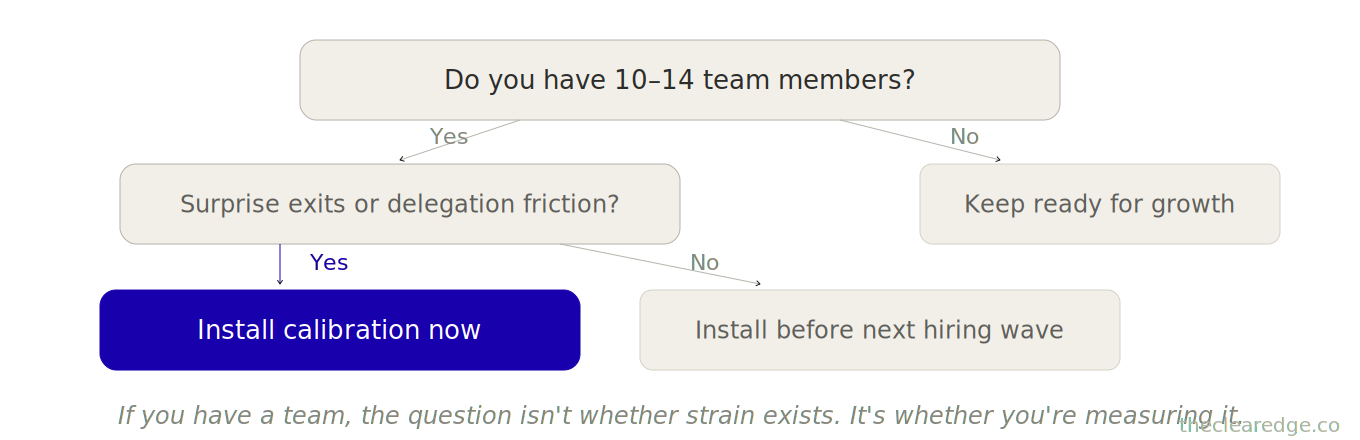
A: You need it when you’re at $120K–$160K/month with 10–14 team members, relying on weekly standups, and you’ve had surprises like a senior quitting or recurring delegation friction you can’t fully explain.
Q: How much does a single missed delegation breakdown really cost at this stage?
A: One preventable turnover event typically costs $35K–$42K per person once you add recruitment, 8 weeks of training, lost productivity, and knowledge loss, which compounds to around $89K–$95K per year when 2–3 people churn.
Q: How does the Monthly Team Calibration prevent the $25K–$40K delegation breakdown pattern described in this article?
A: By running 20-minute 1-on-1s on the last Friday each month with the six calibration questions, you catch 3.4-month strain windows at weeks 9–12 instead of weeks 21–24, where recovery drops from 73% to 14% and costs jump into the $25K–$40K range for each exit.
Q: How do I use the Monthly Team Calibration with its 6-question Calibration Framework before my next quarter of hires and delegation?
A: You install the six 1–10 questions on capacity, workload, priorities, decision clarity, support, and one adjustment, then run them in 20-minute monthly 1-on-1s, feeding the scores into a simple sheet so you can flag red (1–3) and orange (4–6) risks and intervene within 48 hours–7 days before handing out more ownership or projects.
Q: What happens if I keep relying on weekly standups and annual reviews instead of running this monthly?
A: You stay blind to unvoiced strain during the 21–24 week mental exit window, keep losing 2–3 people per year at a $35K–$42K per-person cost, and end up paying around $89K–$101K annually in turnover and productivity loss while thinking “the meetings are fine.”
Q: How did Marcus turn a $37,300 loss into a $256,000 save using the Monthly Team Calibration?
A: After losing a senior project manager and eating $37,300 in recruitment, training, lost productivity, and knowledge loss at $134K/month, he installed the monthly 20-minute calibrations, flagged four at-risk team members in Month 10, ran capacity resets and priority fixes within 48 hours–7 days, and retained an estimated 2.5 people, protecting roughly $256,000 in turnover costs.
Q: How do I interpret the Capacity Index scores and decide when to trigger an Emergency Capacity Reset?
A: Any 1–3 score on capacity, workload, priorities, decision clarity, or support—or workload at 1–4—with patterns like 58-hour weeks instead of 40 means critical risk where you cut 10–15 hours immediately, extend deadlines, and schedule a 45–60 minute Emergency Capacity Reset within 48 hours instead of waiting for formal notice.
Q: How much time does the Monthly Team Calibration actually take compared to what it saves?
A: Setup takes about 80–90 minutes one time, then 20 minutes per team member plus 30 minutes of analysis on the last Friday monthly, which for 11 people is roughly 3.7 hours per month, and in Marcus’s case that 11 hours per quarter translated into $253,800 in protected value—a 154x ROI.
Q: When should I treat a pattern as a system problem instead of just fixing one person’s workload?
A: As soon as 3 or more people rate the same dimension at 6 or below—like workload sustainability, priority alignment, or decision clarity—you implement pattern-level fixes such as a shared capacity tracker, Monday priority email, or a decision authority matrix so you’re not patching individual cases while a structural issue keeps recreating $25K–$40K risks.
Q: Why does skipping the Monthly Team Calibration keep turning normal strain into $25K–$40K delegation breakdowns each year?
A: Because strain compounds silently over 21–24 weeks—capacity over 40 hours, unclear priorities, fuzzy authority, and weak support—so by the time you notice missed deadlines or attitude shifts, the person’s recovery odds are down near 14%, making expensive exits and rushed replacements almost inevitable.
⚑ Found a Mistake or Broken Flow?
Use this form to flag issues in articles (math, logic, clarity) or problems with the site (broken links, downloads, access). This helps me keep everything accurate and usable. Report a problem →
› More to Explore: Quick Navigation · Monthly Rituals
➜ Help Another Founder, Earn a Free Month
If this system just saved you from losing $89K–$101K to preventable turnover and delegation breakdowns, share it with one founder who needs that relief.
When you refer 2 people using your personal link, you’ll automatically get 1 free month of premium as a thank-you.
Get your personal referral link and see your progress here: Referrals
Get the Monthly Team Calibration Implementation Toolkit
You’ve read the system. Now implement it.
Premium gives you:
Ready-to-use PDF toolkit—every template, diagnostic, and formula pre-filled, zero setup, immediate use
Plug-and-play AI diagnosis sessions—drop into Claude, Gemini or ChatGPT, answer a few questions, save hours of guessing, get your exact next move
Audio key points—concentrated frameworks you can absorb in minutes, implement while you move
Unrestricted access to the complete library—every system, every update
What this prevents: Another $89,000–$101,000 in annual losses from $25K–$40K delegation breakdowns and preventable turnover.
What this costs: $49/month.
Download everything today. Implement this week. Cancel anytime, keep the downloads.
Already upgraded? Scroll down to download the PDF, audio, and your AI session.
