


The Executive Summary
Founders and operators at $120K–$140K/month quietly eat $80K–$200K in burnout damage by tracking revenue instead of capacity; a 30-minute monthly energy recalibration catches depletion before it triggers recurring crash-and-recover cycles.
Who this is for: High-output founders and operators at $120K–$140K/month running 50–60 hour weeks who feel decision quality slipping and suspect they’re pushing through early burnout signals instead of managing capacity.
The Energy Recalibration Problem: Untracked energy depletion compounds 5–10% monthly, triggering $80K–$120K burnout crashes, 25–35% revenue drops, and 2–3 months of forced recovery at reduced capacity.
What you’ll learn: How to run the Monthly Energy Recalibration (30-Minute Diagnostic), use the Energy Scorecard and First-Monday capacity zones check, and target chronic over-capacity, context switching, unresolved conflict, or decision overload.
What changes if you apply it: Instead of crashing to 30–40% capacity every 8–10 months and losing $80K–$120K per cycle, you catch depletion at 65–70%, recover in 10–14 days, and stabilize around 84–88% capacity while holding $120K+ revenue.
Time to implement: The core system runs in 30 minutes on the first Monday each month, with initial boundary and batching setup in 4–6 hours in Week 1 and 3–4 weeks to see the first reversal from depletion to stable capacity.
Written by Nour Boustani for $120K–$140K/month founders who want to sustain high revenue and sharp decision-making without recurring burnout crashes and six-figure capacity losses.
Most $120K–$140K founders don’t see the Energy Depletion Pattern until it’s erased six figures. Upgrade to premium and install the Monthly Energy Recalibration before the next crash.
› Library Navigation: Quick Navigation · Monthly Rituals
The $120K–$140K Energy Depletion Pattern Explained
The Energy Depletion Pattern at $120K–$140K doesn’t arrive as a dramatic crash. It shows up as a 5–10% monthly slide while revenue holds steady and capacity quietly drains.
You don’t see it in Stripe. You notice it in how long it takes to make a decision, how short your fuse gets, how often you tell yourself, “I’ll push through this month,” even though everything already feels heavier.
Caught early with Monthly Energy Recalibration, that pattern is just a quick reset.
Ignored, it becomes 2–3 months at reduced capacity and $80K–$120K burned on a crash you could’ve avoided.
It keeps repeating because it stays invisible until it’s expensive.
Example: Tyler, consultant, running at $126K/month.
Revenue had been stable for 8 months and looked successful, but he felt increasingly depleted and kept ignoring it—“Just need to push through.”
There was no monthly energy check, only nonstop execution, so revenue stayed strong while energy ran empty.
But month-over-month degradation:
Month 1–4: Energy at 85% capacity (sustainable)
Month 5–6: Energy at 65% (starting to drain, still functional)
Month 7–8: Energy at 45% (struggling daily, quality slipping)
Month 9: Energy at 20% (barely functioning, making mistakes)
The cost is invisible until month 9:
Month 9, Week 2
Missed client deadline.
First time in 3 years.
Client is frustrated but understanding.
No immediate cost.
Month 9, Week 3
Made a strategic error on project scope.
Realized 2 weeks into work.
Had to redo $6,400 worth of work (16 hours × $400/hour).
Month 9, Week 4
Blew up at team member over a minor issue.
She quit (wasn’t actually wrong, Tyler was just depleted).
Replacement cost
Total: $8,200
Recruiting: $2,400
Training: $3,800
Productivity gap: $2,000
Month 10
Couldn’t maintain $126K pace.
Energy completely depleted.
Revenue dropped to $89K ($37K loss, 29% decline).
Month 10–11
Recovery period.
Reduced client work to rebuild capacity.
Revenue stayed at $92K–$98K (couldn’t return to $126K without rest).
Month 12
Finally back to $119K (94% of previous).
Total cost of energy crash:
Rework: $6,400
Team turnover: $8,200
Revenue loss months 10–12:
$126K − $93K average = $33K monthly gap
$33K × 3 months = $99,000
Total damage: $113,600 from burnout that compounded invisibly for 8 months
Month 13: Started monthly energy recalibration, and the first 30-minute check caught early depletion signals.
Energy Scorecard:
Sleep quality: 6/10 (baseline 8/10)
Decision energy: 5/10 (baseline 9/10)
Patience level: 4/10 (baseline 8/10)
Strategic thinking: 5/10 (baseline 9/10)
Physical energy: 6/10 (baseline 8/10)
Overall capacity: 52% (severe depletion zone).
All five signals are showing: Immediate recalibration required before a crash.
Immediate recovery block:
Took a 5-day complete break (no work, no email, full disconnection).
Returned at 74% capacity. Not perfect, but functional.
Rebuilt to 88% over 3 weeks with a lighter schedule.
Ongoing monthly checks:
Month 14: Second monthly check caught early slip (dropped to 72%).
Adjustment: Declined 2 low-value projects, freed 8 hours weekly.
Result: Back to 84% within 10 days.
Month 16: Third monthly check showed sustained 86% capacity.
Revenue $124K (stable), energy sustainable.
Cost of skipping monthly energy checks:
8 months of invisible depletion → $113,600 crash cost.
With monthly checks:
Depletion caught at 65% (month 5)
Preemptive capacity reduction cost: $4,200
Crash cost avoided: $113,600
Trade-off: $4,200 vs. $113,600
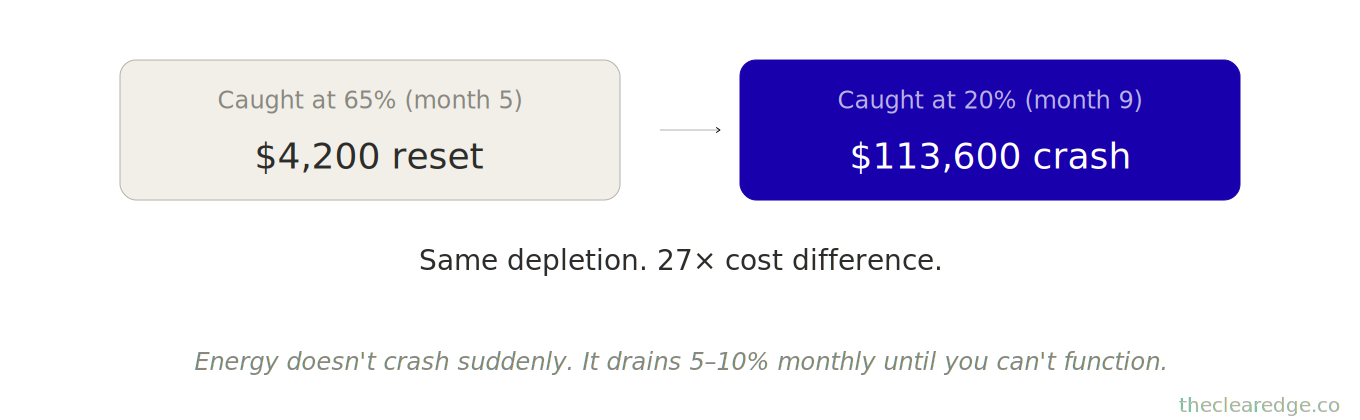
Monthly energy checks shift timing:
Catch 15% depletion in month 1 → take a 3-day break, prevent a crash.
Catch 60% depletion in month 9 → you’re already heading toward a $100K+ crash cost.
The issue isn’t that energy depletes. It’s that depletion compounds invisibly — 5–10% monthly degradation unnoticed, creating a 40–50% total gap before crash.
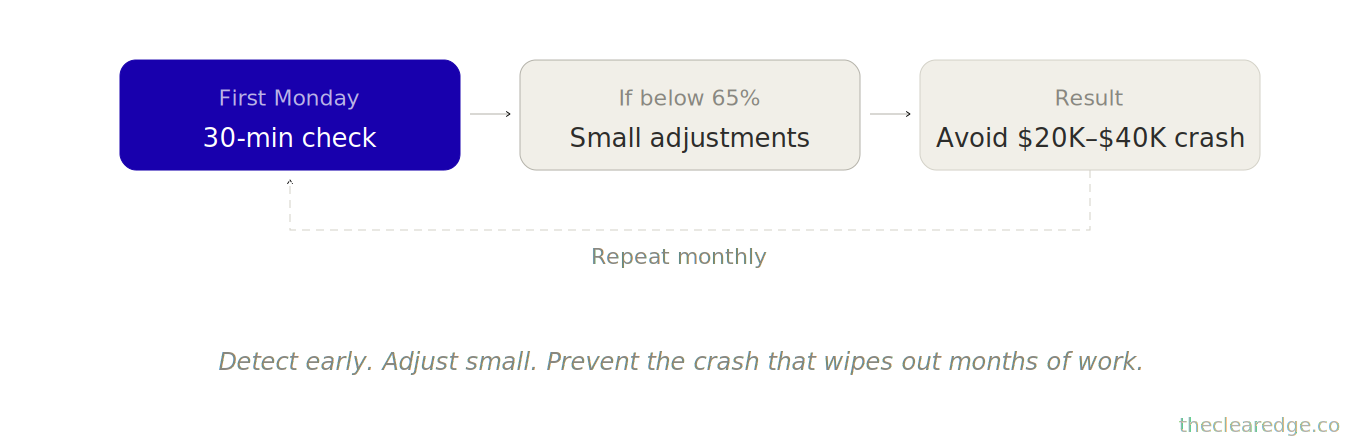
From $120K Months To Crash
Holding $120K–$140K on depleted capacity works until one invisible arc wipes out months of work; the premium toolkit turns this diagnostic into a repeatable crash-prevention habit.
How The Energy Depletion Pattern Triggers $20K–$40K Burnout Crashes
Now that you’ve seen how one undetected 8-month depletion cost $113,600 in crash damage, here’s why every operator needs this monthly.
Energy depletion doesn’t spike overnight; it slowly builds month after month until your capacity finally collapses.
At $120K-$140K/month
Average 5-8% monthly energy degradation when untracked
Typical crash point: 8-10 months of compound depletion
Standard recovery: 2-3 months at reduced capacity
Revenue impact: 25-35% drop during recovery period
The compounding problem:
Can’t think strategically when depleted
Make bad decisions
Bad decisions create more problems
More problems drain more energy
Death spiral
Without monthly energy recalibration:
Average time to detect depletion: 8.4 months
Average capacity at detection: 34% (severe burnout)
Average recovery time: 2.7 months
Average revenue impact: $87,000 (lost revenue during crash + recovery)
With monthly energy recalibration:
Average time to detect depletion: 1.2 months
Average capacity at detection: 68% (early warning)
Average recovery time: 0.4 months (12 days)
Average revenue impact: $6,800 (minor capacity reduction)
Difference: $80,200 average prevented cost from catching depletion early vs. waiting for a crash.
The key thing most founders miss is that energy isn’t unlimited; it’s a depletable resource that slips 5–10% each month when you don’t actively manage it, and without monthly checks that slide stays invisible until you can barely function.
Monthly recalibration creates an early warning system.
Catch depletion at 15–20% loss (manageable, reversible)
Before it reaches 60–80% loss (crash territory, months to recover)
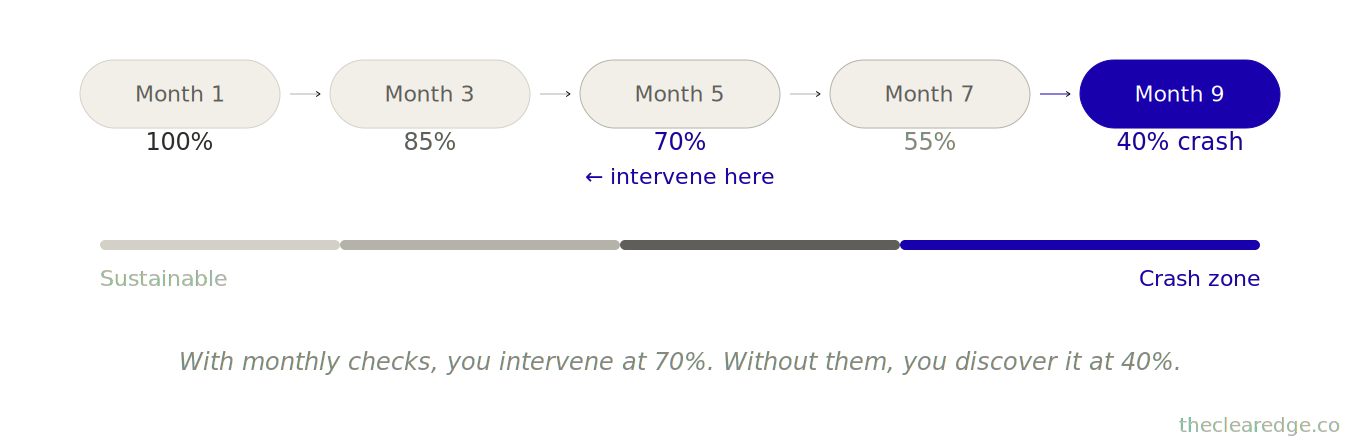
Those capacity percentages are the bridge between the abstract risk of the Energy Depletion Pattern and the concrete 30-minute protocol you’re about to run each month.
How To Run The Monthly Energy Recalibration 30-Minute Diagnostic
This isn’t about motivation; it’s a capacity measurement.
Track five energy dimensions
Flag depletion zones
Intervene before a crash
Run it on the first Monday of every month for 30 minutes—non‑negotiable.
Step 1: Five-Dimension Energy Score (10 minutes)
Rate yourself 1-10 on each dimension (current state, not ideal)
Dimension 1: Sleep Quality
“How restorative is your sleep right now?”
1-3: Consistently poor (wake tired, disrupted, <5 hours)
4-6: Inconsistent (some good nights, some bad, 5-7 hours)
7-8: Generally good (wake refreshed most days, 7-8 hours)
9-10: Excellent (consistently restorative, 7-9 hours, energized)
Your score: _
Dimension 2: Decision Energy
“How clear and confident are your decisions?”
1-3: Paralysis (avoid decisions, second-guess constantly, overwhelm)
4-6: Inconsistent (some decisions clear, many feel hard)
7-8: Generally clear (decide confidently most of the time)
9-10: Excellent (fast, clear, confident decisions consistently)
Your score: _
Dimension 3: Patience Level
“How patient are you with people and situations?”
1-3: Irritable (short fuse, snapping at people, impatient)
4-6: Variable (patient sometimes, irritable under stress)
7-8: Generally patient (calm in most situations, rare irritation)
9-10: Excellent (consistently patient, rarely reactive)
Your score: _
Dimension 4: Strategic Thinking
“How easily can you think big-picture and plan ahead?”
1-3: Can’t (stuck in tactical firefighting, can’t see the forest)
4-6: Difficult (strategic thinking feels hard, requires force)
7-8: Natural (shift to strategic mode relatively easily)
9-10: Excellent (strategic thinking flows, sees patterns clearly)
Your score: _
Dimension 5: Physical Energy
“How does your body feel throughout the day?”
1-3: Depleted (exhausted by noon, dragging, can barely function)
4-6: Variable (some energy some days, depleted others)
7-8: Good (sustained energy most of day, rare crashes)
9-10: Excellent (energized throughout day, no afternoon crash)
Your score: _
Calculate Overall Capacity
Formula: (Sum of 5 scores ÷ 50) × 100 = _%
Capacity Zones:
80-100%: Optimal (sustainable, high performance)
65-79%: Functional (manageable but monitor closely)
50-64%: Warning (depletion building, intervention needed)
Below 50%: Critical (crash imminent, emergency action required)
Your capacity: _%
If below 65%: Proceed immediately to Step 2 for intervention protocol.
Step 2: Depletion Source Analysis (10 minutes)
If the capacity is below 65%, identify primary energy drains.
Common Drain 1: Chronic Over-Capacity
Working above sustainable hours consistently:
Are you working 45+ hours a week for 4 or more weeks in a row?
YES / NO
If YES, your primary drain is over‑capacity and you need an immediate workload reduction.
Common Drain 2: Context Switching
Rapid task switching depleting cognitive capacity:
Do you switch contexts 30+ times daily (client to admin to strategy to team)?
YES / NO
If YES, your primary drain is context switching and you need a batching protocol.
Common Drain 3: Unresolved Conflict
Emotional energy leaks from avoided issues:
Do you have 2+ unresolved conflicts (team, client, partner) you’re avoiding?
YES / NO
If YES, your primary drain is conflict avoidance and you need a resolution protocol.
Common Drain 4: Decision Overload
Too many decisions without decision frameworks:
Are you making 50+ decisions daily without clear frameworks?
YES / NO
If YES, your primary drain is decision fatigue and you need decision delegation or automation.
Common Drain 5: No Recovery Periods
Zero downtime to rebuild capacity:
Have you gone 4+ weeks without 2+ consecutive days completely off?
YES / NO
If YES, your primary drain is lack of recovery and you need an immediate break.
Your primary drains: _ (check all that apply)
Step 3: Intervention Selection (10 minutes)
Based on capacity score + identified drains, select matched intervention:
If Capacity 50-64% (Warning Zone):
Intervention Level: Moderate
Action 1: Reduce capacity by 15-20% immediately
Decline 1-2 projects this month
Delegate 5-8 hours of weekly work
Cancel 2-3 low-value commitments
Target: Return to 70% capacity within 2-3 weeks
Action 2: Address primary drain
If over-capacity: Hard cap at 40 hours weekly for 4 weeks
If context switching: Batch similar work to same days
If unresolved conflict: Schedule resolution conversation within 7 days
If decision overload: Delegate 10 recurring decisions
If no recovery: Schedule a 3-day complete break within 2 weeks
If Capacity Below 50% (Critical Zone):
Intervention Level: Emergency
Action 1: Immediate capacity reduction 30-40%
Pause all new commitments
Delegate or cancel 10-15 hours of weekly work
Communicate the capacity situation to the team/clients
Target: Stabilize at 60% within 2 weeks, then rebuild
Action 2: Forced recovery period
Schedule 5-7 day complete break within 10 days (non-negotiable)
Zero work, zero email, full disconnection
Physical recovery priority (sleep, exercise, nature)
Return at reduced schedule (25-30 hours) for 2-4 weeks
Action 3: Professional support
If capacity doesn’t improve after recovery, seek professional help
Burnout at this level often needs external intervention
Don’t try to power through alone
Your selected intervention: _
Implementation deadline: _/_/_ (within 7 days for warning, 48 hours for critical)
This diagnostic reveals current capacity and required intervention. Next section: Exact protocols for each drain type.
[If Capacity Score < 65%]

Step 1 --> Run Energy Score
Step 2 --> Identify Main Drain
Step 3 --> Match Intervention
Step 4 --> Schedule Action This Week
Each drain you flagged in the Energy Scorecard now gets a targeted play, so the next moves don’t just name the problem, they put your $120K+ capacity back under control.
Three Monthly Energy Recalibration Moves For Sustainable Capacity
Monthly energy checks reveal where you’re running down, and most founders stop there; here’s how to actually reverse that depletion and rebuild sustainable capacity.
Move 1: Install Hard Capacity Boundaries In Week 1
Your Task: Set non-negotiable capacity limits that prevent depletion before it starts.
The 40-Hour Hard Cap
Most $120K+ founders work 50–60 hours weekly. Feels necessary.
Actually: Productivity per hour drops 25–40% after hour 40.
Working 60 hours at 60% efficiency → 36 effective hours.
Working 40 hours at 95% efficiency → 38 effective hours.
Same output, half the depletion.
Action Steps
Day 1-2: Measure Current Reality
Track one week's actual hours worked:
- Client delivery: _____ hours
- Team management: _____ hours
- Admin/operations: _____ hours
- Strategic work: _____ hours
- Total: _____ hours
If total > 45 hours: You’re in a depletion zone.
Day 3-4: Design 40-Hour Week
Allocate 40 hours across essential work only:
- Client delivery: _____ hours (protect revenue-generating time)
- Strategic work: _____ hours (protect growth-driving time)
- Team/delegation: _____ hours (protect leverage-building time)
- Admin (batch): _____ hours (minimize but don’t eliminate)
- Buffer: _____ hours (unexpected issues, don’t overpack)
Total: 40 hours (if doesn’t fit, something has to be delegated or eliminated)
Day 5-7: Implement Boundaries
Install three enforcement mechanisms
Boundary 1: Calendar Hard Stop
Last work block ends at 5:00 PM (or your equivalent).
After that, the calendar shows “Personal Time - Not Available.”
No exceptions for 4 weeks (test period).
Boundary 2: Weekly Hour Tracking
Track daily hours in a simple spreadsheet.
Sunday review question: “Did I stay under 42 hours?” (allows 2-hour buffer for true emergencies).
If over, identify exactly what to cut next week.
Boundary 3: Proactive Decline Protocol
When new work arrives, ask: “Does this fit in 40 hours without removing something essential?”
If no, decline immediately.
Template: “I’m at capacity this month. I can take this on [next month] or recommend [alternative].”
Tyler’s example
Current:
58 hours weekly:
35% client work
20% admin
15% strategic
30% scattered tasks
Target 40-hour design:
Client: 22 hours (protected)
Strategic: 10 hours (protected)
Team: 5 hours (protected)
Admin: 3 hours (batched to Friday AM only)
What got cut:
18 hours of scattered tasks:
Meetings that could be emails
Low‑value admin
Over‑servicing clients beyond scope
Result:
Capacity 45% → 72% in 3 weeks just from hour reduction.
Same revenue ($126K), half the depletion.
Time investment:
4 hours to design boundaries.
2 hours weekly to enforce.
Permanent capacity protection.
That kind of three-week swing is why the second move shifts from broad boundaries to eliminating the single drain that’s quietly taxing every hour you work.
Move 2: Eliminate Your Primary Energy Drain In Weeks 2–3
Your Task: Based on the Step 2 diagnostic, eliminate the single biggest energy drain.
Drain Fix 1: Context Switching Batching
If your primary drain is switching contexts 30+ times daily:
Problem: Every context switch costs 6-9 minutes of cognitive reset time.
40 switches × 7.5 minutes → 300 minutes
300 minutes → 5 hours daily lost to switching cost alone
Solution: Batch similar contexts to the same days/times.
Implementation:
Monday: Client delivery only (all client calls, work, communication batched)
Tuesday AM: Team issues only (1-on-1s, feedback, problem-solving batched)
Tuesday PM: Admin only (finance, invoicing, email processing batched)
Wednesday: Client delivery only
Thursday AM: Strategic work only (planning, analyzing, deciding)
Thursday PM: Business development only (sales, partnerships, marketing)
Friday AM: Week review + next week planning
Friday PM: Personal development (learning, thinking, reading)
Rule: Single context per half-day minimum. No mixing.
Expected improvement:
5 hours daily → 1 hour switching cost
4 hours reclaimed daily × 5 days → 20 hours weekly capacity recovered
If your primary drain has 2+ unresolved conflicts:
Problem: Every unresolved conflict consumes 10–15 mental cycles daily.
3 conflicts × 12 cycles × 2 minutes = 72 minutes daily
72 minutes daily → 6 hours weekly spent mentally processing issues you’re not resolving
Solution: Resolve within 7 days using direct conversation.
Implementation:
For each conflict, schedule a 30-minute conversation within 48 hours:
Opening (5 minutes):
“I’ve been avoiding this conversation. That’s on me. Here’s what I need to address: [specific issue].”
Their perspective (10 minutes):
“Tell me your view. I’m listening.” (Actually listen, don’t defend)
Resolution (10 minutes):
“Here’s what I propose: [specific change]. Does that work for you?”
(Negotiate if needed)
Commitment (5 minutes):
“We’re aligned on [outcome]. I’ll do [X], you’ll do [Y], by [date].”
Follow-up: Check in 7 days later. Issue resolved? If yes, mental energy is freed. If no, escalate or make a hard decision.
Expected improvement:
6 hours weekly mental processing → 0 hours after resolution = 6 hours capacity recovered + reduced anxiety.
[Choose Your Primary Drain]

[Chronic Over-Capacity] --> Cut Hours
[Context Switching]     --> Batch Work
[Unresolved Conflict]   --> Schedule Talks
[Decision Overload]     --> Delegate Decisions
[No Recovery]           --> Block Time Off
Drain Fix 3: Decision Delegation
If your primary drain is 50+ daily decisions:
Problem: Decision fatigue depletes willpower.
By decision 30, quality drops 40%
By decision 50, you’re making choices on autopilot (often wrong)
Solution: Delegate 15–20 recurring decisions to frameworks or a team.
Implementation
List all decisions you make in one week. Categorize:
- Category A: Strategic (must do personally): _____ decisions
- Category B: Operational (could delegate with framework): _____ decisions
- Category C: Tactical (should delegate fully): _____ decisions
For Category B, create a decision framework. Example:
Client discount requests: Approve up to 10% for annual commitment or 3+ service bundle. Decline all others. No judgment needed.
Delegate to a team member: “Follow this framework. Only escalate if outside parameters.”
For Category C, delegate completely with training.
Expected improvement:
50 daily decisions cut to 25 daily decisions produces a 50% reduction in decision fatigue.
Time investment:
6 hours to document frameworks
4 hours to train the team
Permanent decision load reduction
Tyler’s specific fix: Implemented batching protocol.
Week 1: 43 switches → 22 switches
Week 2: 22 → 11 switches
Week 3: 11 → 8 switches (sustainable)
Switching cost:
5 hours daily → 1 hour
4 hours reclaimed capacity daily × 5 days → 20 hours weekly
Combined with 40-hour hard cap: Capacity 72% → 86% within 3 weeks.
Once those numbers stabilize in the 80%+ range, the only way you keep them there is by turning the First-Monday cadence into a non-negotiable ritual, not a one-time reset.
Move 3: Build A Monthly Energy Recalibration Ritual From Week 4 Onward
Your Task: Make monthly energy check a non-negotiable, permanent part of operations.
The First-Monday Protocol
Every first Monday, 9:00–9:30 AM, recurring:
Minutes 1–10: Run five-dimension score
Sleep
Decision
Patience
Strategic
Physical
Minutes 11–20: Calculate capacity
Identify any new drains
Minutes 21–30: Adjust if needed
Reduce hours
Batch contexts
Resolve conflict
Delegate decisions
Critical: don’t skip this, even when capacity feels fine; depletion sneaks up, and monthly measurement catches 5–10% degradation before it compounds into a 40–50% drop.
The Quarterly Deep Recalibration
Every 90 days, schedule a 4-hour complete energy reset:
Zero work for full day
Physical activity (hike, gym, sport)
Strategic thinking time (no execution, just reflection)
Relationship investment (friends, family, connections)
Return criteria: Feel excited about work again, not just willing
Tyler’s sustained practice:
Month 16: Capacity 86% (stable)
Month 20: Capacity 84% (slight dip, caught early, took 2-day break, back to 88%)
Month 24: Capacity 87% (sustained)
Revenue: $124K–$129K range (stable, sustainable)
Zero crashes since implementing monthly checks (24 months tracked).
Previous pattern: 1–2 crashes yearly, costing $80K–$120K each
Prevented cost over 24 months:
2 crashes × $100K average = $200,000 in avoided burnout damage
Time invested: 30 minutes monthly × 24 months → 12 hours total
ROI: $200,000 prevented ÷ 12 hours invested = $16,667 per hour of energy management
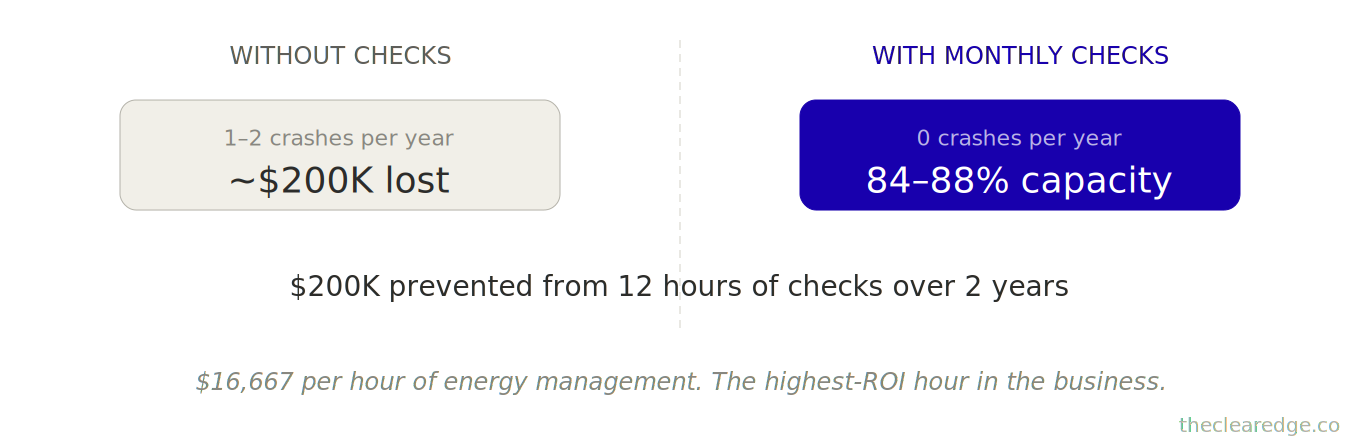
That $16,667/hour return is the economic reason the next section zooms out from Tyler’s story to what founders miss when they skip monthly checks entirely.
What You Miss When You Skip Monthly Energy Checks
Running monthly energy recalibration reveals depletion patterns operators miss when they’re just grinding.
Invisible Compound Depletion:
Energy doesn’t drop 50% overnight
It drops 5% monthly for 8-10 months
Each month feels manageable (“Just a tough week”)
By month 8, you’re at 40% capacity but adapted to a depleted state
Monthly checks reveal the decline before you adapt
Decision Quality Degradation:
At 85% capacity, your decisions stay sharp.
At 65%, your decisions are still okay.
At 45%, your decisions are consistently poor—but you don’t notice, because everything already feels hard.
One bad strategic decision ($50K partnership, $30K hire) costs more than 5 years of energy management
Monthly checks catch capacity drop before decision quality tanks
The Recovery Time Trap:
Depleting to 30% takes 8 months
Recovering from 30% back to 80% takes 2-3 months at reduced capacity
That’s a total of about 11 months tied up in a single burnout crash cycle.
Monthly checks catch depletion at 70% (recovery time: 2 weeks, not 3 months)
Team Impact Blindness:
When you’re depleted, you’re irritable and snap at the team
You create tension but don’t notice it in survival mode
A team member quits and it feels like it “came out of nowhere”
Exit interview reveals: “You’ve been difficult for months”
Monthly checks catch irritability score before it damages relationships
Monthly Energy Recalibration Versus Crash-And-Recover Cycles
Monthly energy recalibration costs 30 minutes each month, adding up to 6 hours a year, or $2,400 at a $400/hour rate.
Prevents burnout crashes averaging $87,000 (revenue loss during crash + recovery)
Crash-and-recover approach costs $0 in time proactively
Average crash every 18–24 months
Recovery time 2.7 months at 30% capacity reduction
Revenue impact: $87,000 average per crash
Net value of monthly recalibration:
$84,600–$110,000 prevention per crash cycle
When You Refuse To Downshift
Every time you choose another 60-hour push instead of a 30-minute Monthly Energy Recalibration, you’re quietly betting $80K–$113,600 that your depletion won’t catch up; place a smaller bet.
Run the Monthly Energy Recalibration Litmus Test Checklist
First Monday of every month, run this 30-minute pass before you load another 50–60 hour week.
☐ Scored all five Energy Scorecard dimensions 1–10 and calculated your overall capacity percentage for this month.
☐ Marked your capacity zone (Optimal, Functional, Warning, or Critical) and wrote which primary drains from the diagnostic are active right now.
☐ Selected the matching intervention level and wrote the exact workload cuts, batching changes, or recovery blocks you’ll implement this week.
☐ Scheduled those interventions in your calendar within the next 7 days, including any 3–7 day break if you’re below 50% capacity.
☐ Logged today’s capacity score, chosen drains, and interventions so you can see whether you’re repeating the $80K–$113,600 crash pattern.
Five measured minutes here beats financing the next $80K–$120K burnout crash out of your $120K–$140K months.
Where to Go From Here: Install the Monthly Energy Recalibration and Prevent Burnout Crash Cycles
You’re holding $120K–$140K/month on 50–60 hour weeks, and every month you skip this 30-minute check you’re quietly setting up the next $80K–$120K crash-and-recover cycle you just saw add up to $113,600 in Tyler’s example.
From here, make the Monthly Energy Recalibration a fixed First‑Monday ritual, not a one-time reset:
Set your five-dimension Energy Scorecard baseline once so sleep, decision energy, patience, strategic thinking, and physical energy all have hard numbers instead of “I’ll push through this month.”
Block a recurring First-Monday, 30-minute slot, run the full score → capacity → drain → intervention sequence, and trigger boundaries, batching, conflict resolutions, or recovery blocks any time you drop below 65% capacity.
Use those early adjustments—3–7 day resets, 15–20% workload cuts, and removal of primary drains—to keep capacity in the 84–88% zone and trade roughly 6–12 hours of energy management a year for the $80K–$200K in crashes you no longer have to finance.
That’s how this small, boring First-Monday, 30-minute ritual stops “tired but fine” from compounding into another $80K–$113,600 burnout bill and lets you keep running a $120K+ operator body at full decision quality instead of on fumes.
FAQ: Monthly Energy Recalibration System For $120K–$140K Founders
Q: How do I know if I actually need the Monthly Energy Recalibration at $120K–$140K/month?
A: You need it when you’re holding $120K–$140K/month on 50–60 hour weeks, feel decision quality slipping, and notice early burnout signs like irritability and reduced strategic thinking even though revenue still looks stable.
Q: How does the Monthly Energy Recalibration prevent the $80K–$113,600 burnout crashes described in this article?
A: It forces a 30-minute first-Monday diagnostic that catches 15–20% capacity loss early, so you take short 3–5 day breaks and moderate workload cuts instead of sliding into 60–80% depletion that triggers 2–3 month revenue crashes costing $80K–$113,600 per cycle.
Q: How do I use the Monthly Energy Recalibration with its five-dimension Energy Scorecard before I schedule another 50–60 hour week?
A: Before loading your calendar, you rate sleep, decision energy, patience, strategic thinking, and physical energy from 1–10, calculate overall capacity, and if you’re under 65% you cap at a 40-hour week, cut 15–20% of work, and intervene on the primary drain instead of blindly filling another 60-hour schedule.
Q: What happens if I keep tracking revenue instead of capacity and skip monthly energy checks?
A: Energy quietly degrades 5–10% each month for 8–10 months while you hover around $120K–$140K, then you hit 30–40% capacity, suffer a 25–35% revenue drop, and lose $80K–$113,600 over 2–3 months of forced recovery plus rework and team turnover.
Q: How much does a single undetected energy crash cost compared to running 30-minute monthly recalibrations?
A: One crash typically costs around $87,000–$113,600 in lost revenue, rework, and turnover, while 30-minute monthly recalibrations add up to roughly 6–12 hours a year of focused capacity management to prevent that six-figure loss.
Q: How do I interpret my capacity percentage and decide what to do when the Energy Scorecard shows I’m below 65%?
A: A 50–64% score is a warning zone where you immediately reduce workload by 15–20%, enforce a 40-hour hard cap, and target a return to 70% within 2–3 weeks, while anything below 50% is a critical zone that requires a 30–40% capacity cut, 5–7 days completely off, and a temporary 25–30 hour schedule for 2–4 weeks.
Q: How do I use the Monthly Energy Recalibration to stop chronic over-capacity and context switching from draining 20 hours a week?
A: In Step 2 you flag drains like working 45+ hours for 4+ weeks or switching contexts 30+ times per day, then in Step 3 you install a 40-hour weekly cap and half-day batching so switching cost drops from about 5 hours to 1 hour daily, reclaiming roughly 20 hours of weekly capacity.
Q: When should I trigger the emergency-level intervention instead of just making small tweaks to my schedule?
A: You shift to emergency intervention when your capacity score drops below 50%, you’re operating near 30–40% capacity, and symptoms like severe decision fatigue, short fuse with your team, or missed deadlines show that you need a 30–40% workload cut, a 5–7 day full break, and immediate delegation.
Q: How does the First-Monday Protocol help me maintain $120K+ revenue without recurring burnout crashes?
A: By running the same 30-minute check on the first Monday every month, you catch capacity dips around 65–70%, make small reductions like declining 1–2 low-value projects or taking a 3-day break, and keep capacity in the 84–88% range so revenue stays around $120K–$129K without 2–3 month collapses.
Q: Why does ignoring the Monthly Energy Recalibration keep leading to recurring 8–10 month depletion cycles and six-figure losses?
A: Because without a monthly measurement, you adapt to gradual 5–10% energy loss, keep pushing at 50–60 hours, and only notice the problem when you’re at 30–40% capacity, which reliably produces 8–10 month depletion arcs, 2–3 month recoveries, and repeated $80K–$120K crashes instead of short early resets.
⚑ Found a Mistake or Broken Flow?
Use this form to flag issues in articles (math, logic, clarity) or problems with the site (broken links, downloads, access). This helps me keep everything accurate and usable. Report a problem →
› More to Explore: Quick Navigation · Monthly Rituals
➜ Help Another Founder, Earn a Free Month
If this system just saved you from losing $80K–$113,600 to an invisible burnout crash, share it with one founder who needs that relief.
When you refer 2 people using your personal link, you’ll automatically get 1 free month of premium as a thank-you.
Get your personal referral link and see your progress here: Referrals
Get The Monthly Energy Recalibration Toolkit
You’ve read the system. Now implement it.
Premium gives you:
Ready-to-use PDF toolkit—every template, diagnostic, and formula pre-filled, zero setup, immediate use
Plug-and-play AI diagnosis sessions—drop into Claude, Gemini or ChatGPT, answer a few questions, save hours of guessing, get your exact next move
Audio key points—concentrated frameworks you can absorb in minutes, implement while you move
Unrestricted access to the complete library—every system, every update
What this prevents: Another $113,600 burnout crash from eight months of untracked depletion at $120K–$140K/month.
What this costs: $49/month.
Download everything today. Implement this week. Cancel anytime, keep the downloads.
Already upgraded? Scroll down to download the PDF, audio, and your AI session.
