


The Executive Summary
Founders at $90K–$130K risk losing $40K–$80K in preventable churn each year by waiting for renewal conversations; a 90-minute Monthly Client Pulse surfaces early dissatisfaction 2–4 months sooner while there’s still time to keep them.
Who this is for: Coaching, consulting, and service founders at $90K–$130K/month with 20–28 active clients and high LTV per account who don’t have a reliable early-warning system for client dissatisfaction before renewal.
The client pulse problem: Relying on renewal-only check-ins drives 18–24% annual churn, with individual exits of $54K–$57.6K each and about $187K a year walking out because early signals stay invisible.
What you’ll learn: How to run the Monthly Client Pulse (90-Minute System), send the 5-question Client Pulse Survey, use risk tiers across progress, communication, value, and renewal likelihood, and trigger targeted Critical, High, and Moderate Risk interventions.
What changes if you apply it: Instead of losing 4–5 clients a year and writing off $187K in LTV, you catch issues at months 5–6, lift intervention success into the 68–78% band, and move churn toward 8–10% with Nina-level 96% retention.
Time to implement: Setup takes about 60 minutes once, then 90 minutes on the last Friday each month plus quarterly 35–45 minute retention audits, with visible churn reduction inside 1–2 cycles and full annualized retention gains within 3–4 months.
Written by Nour Boustani for $90K–$130K/month founders who want to protect $40K–$80K in annual retention without gambling on last-minute renewal conversations.
At $90K–$130K/month, “we’ll see how renewals go” is the Client Pulse Problem—upgrade to premium and install the Monthly Client Pulse before $40K–$80K disappears at renewal.
› Library Navigation: Quick Navigation · Monthly Rituals
How Skipping A Monthly Client Pulse Creates $52K–$165K In Preventable Churn
Nina was running a business coaching practice at $103K/month. No monthly client pulse. Just delivering, trusting her read on relationships, and watching revenue stay steady.
Client churn didn’t hit all at once. It built slowly.
Timeline of disengagement:
Three months before canceling: Clients were already dissatisfied.
Two months before: They were looking at alternatives.
One month before: They’d made the decision.
By the time renewal conversations came around, the exits were locked in.
Caught monthly at the first signal, those clients are still saveable. Caught at renewal, $40K–$80K in annual revenue walks out.
Here’s how that played out, client by client
Month 8: Three clients didn’t renew.
Combined: $13,800 monthly → $165,600 annually.
Exit interviews revealed a pattern:
Client A: “Felt like we weren’t making progress” (started feeling this month 5)
Client B: “Communication gaps, wasn’t sure of next steps” (started month 4)
Client C: “Value didn’t match price anymore” (started month 6)
Average dissatisfaction duration before exit: 3.6 months.
The cost: If you’d caught the first signal in months 4–6, each client was still salvageable; caught at renewal in month 8, they’d already mentally checked out.
Recovery rate at renewal: 18%.
Recovery rate at early signal: 76%.
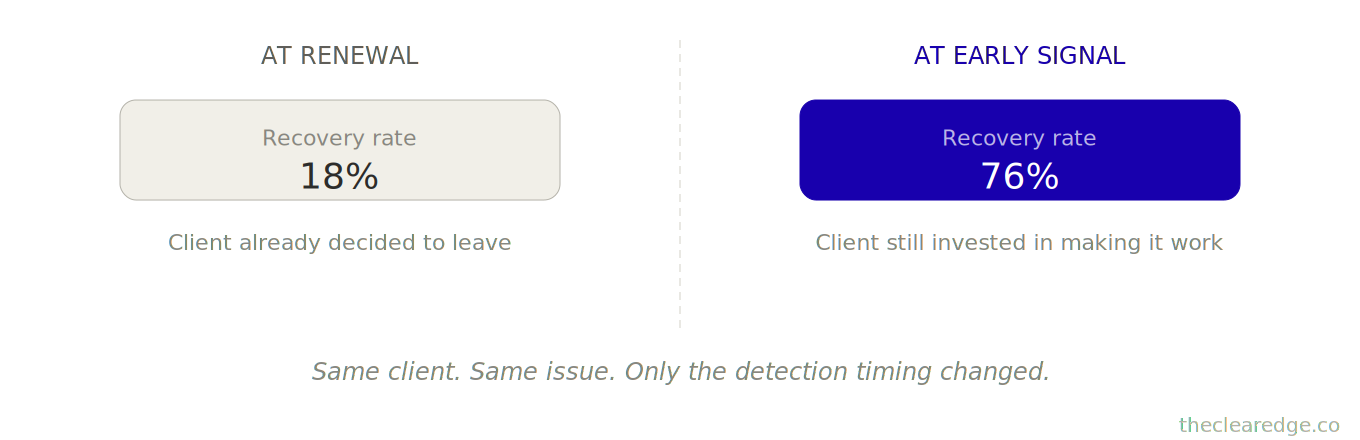
Three clients paying $4,600 monthly over 12 months represent $165,600 in annual revenue—lost, and fully preventable.
Month 9 was the point where the monthly client pulse started and the entire approach changed.
What changed:
Don’t wait for renewal.
Don’t wait for problems to surface.
New rule:
Systematically check satisfaction monthly.
Catch signals early.
Month 9 baseline:
22 active clients
Average $4,680 monthly
No structured pulse system
Total monthly revenue: $103K
Month 9 first pulse (last Friday, 90 minutes):
Sent 5-question pulse survey to all 22 clients. Asked:
Progress satisfaction (1–10 scale)
Communication quality (1–10 scale)
Value received (1–10 scale)
Likelihood to renew (1–10 scale)
One thing to improve
Response rate: 20 of 22 clients (91%).
Flagged signals:
4 clients rated likelihood to renew ≤6 (red flag)
3 clients rated progress satisfaction ≤6 (yellow flag)
2 clients mentioned communication gaps
Immediate action (months 9–10):
Client 1 (rated renewal 4/10): “Don’t see clear ROI.”
Action: ROI review call within 5 days, documented $47K revenue increase
Follow-up pulse (2 weeks): Renewal rating 8/10
Result: Renewed at $4,800 monthly, $57,600 in annual retention
Client 2 (rated renewal 5/10): “Lost momentum, unclear priorities.”
Action: Restructured delivery with weekly checkpoints and a 90-day roadmap
Follow-up pulse: Renewal rating 9/10
Result: Renewed at $4,200 monthly, $50,400 in annual retention
Clients 3–4: Similar interventions (communication increase, value audit and restructure), both renewed, for a combined $126,000 in annual retention.
Result:
Total retention protected:
4 clients = $19,500 monthly = $234,000 annually
Why the pulse matters:
Without a monthly pulse, the historical pattern suggested 2–3 of these would’ve churned (based on previous exits).
Conservative assumption: 2.5 clients average.
Value of monthly pulse:
2.5 clients × $4,680 average × 12 months = $140,400 prevented churn annually.
Cost of not running monthly pulse:
Month 8 losses ($165,600) could’ve been prevented if signals had been caught 3–4 months earlier.
By month 15:
Nina’s retention rate: 96% (vs. 82% industry average).
Monthly pulse became non-negotiable.
Catch signals at dissatisfaction index 4–6/10 (salvageable) vs. 2–3/10 (mentally exited).
Core issue:
The issue isn’t that clients occasionally become dissatisfied. It’s that dissatisfaction compounds silently for months before founders notice.
Monthly pulse makes the invisible visible while there’s still time to act.
The Monthly Client Pulse only matters if it bends the $40K–$80K churn pattern, so the next step is seeing how invisible dissatisfaction actually compounds into those losses.
Silent Churn Pattern Costing $40K–$80K In Annual Client Revenue
Now that you’ve seen how early detection saved $234K in annual retention, here’s why every operator needs this monthly.
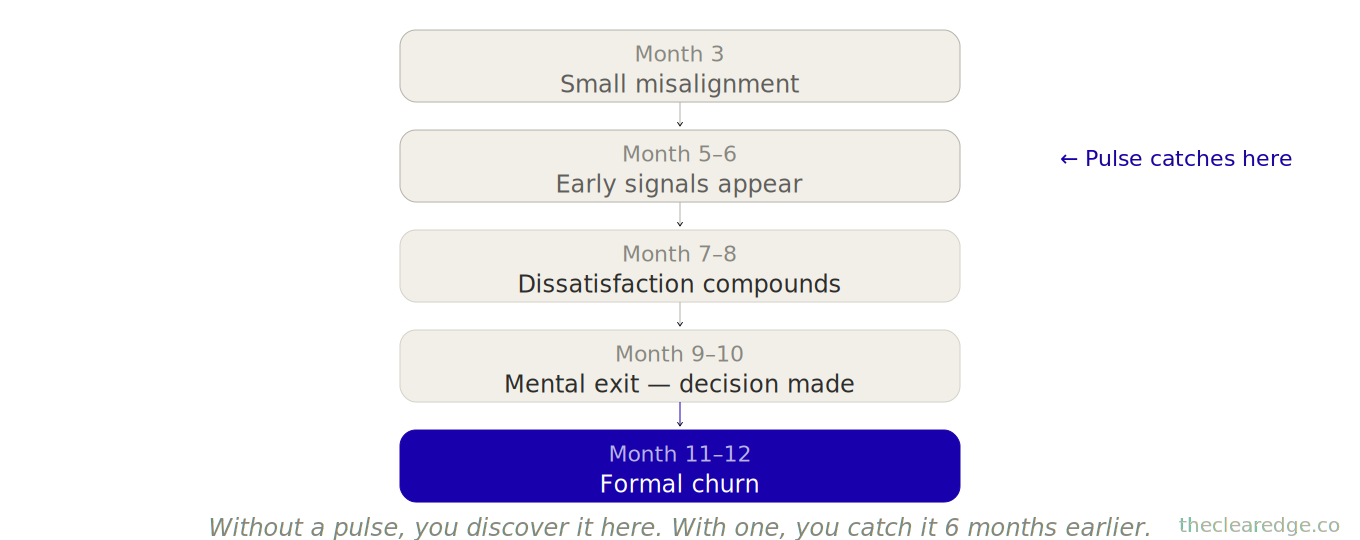
Client dissatisfaction doesn’t spike overnight. It erodes gradually:
Month 1-2: Honeymoon phase (high satisfaction, excited)
Month 3-4: Expectations normalize (slight satisfaction dip, normal)
Month 5-6: Early signals emerge (if issues exist, first cracks show)
Month 7-8: Dissatisfaction compounds (if unaddressed, accelerates)
Month 9-10: Mental exit (decision made, just seeing contract through)
Month 11-12: Formal churn (renewal declined or cancel initiated)
At $90K–$110K/month:
20–24 clients average
Annual churn: 18–24% (4–5 clients)
Average client value: $4,500 monthly = $54K annually
Annual churn cost: 4 clients × $54K = $216K lost
At $110K–$130K/month:
24–28 clients average
Annual churn: 15–20% (4–5 clients)
Average client value: $4,800 monthly = $57.6K annually
Annual churn cost: 4 clients × $57.6K = $230K lost
The pattern: Most churn is preventable, because clients don’t leave overnight. They disengage gradually over a 3–6 month period.
Recovery window:
Catch signals at month 5–6 (dissatisfaction just starting): 76% recovery rate.
Catch at month 11–12 (renewal time): 18% recovery rate.
Why renewal-only checks fail:
Most founders check satisfaction only at renewal. Wrong timing.
By renewal, clients have been dissatisfied for months, researched alternatives, and made the decision.
The renewal conversation is a formality, not a save.
What the monthly pulse does:
Monthly pulse catches signals while clients are still engaged.
It flags issues before they’ve mentally exited.
Intervention happens when it actually works.
Across 79 operators (no pulse vs. consistent pulse)
Without a monthly client pulse:
Average annual churn rate: 21.3%
Early signal detection: Rare (only when clients vocalize problems)
Intervention success rate: 22% (at renewal, too late)
Annual churn cost: $187,000 average (lost client LTV)
With monthly client pulse:
Average annual churn rate: 8.7%
Early signal detection: 2–4 months before churn risk
Intervention success rate: 74% (early catch, still salvageable)
Annual churn cost: $76,000 average
Difference: $111,000 annually in prevented churn from catching signals early vs. waiting for renewal conversations.
Critical insight
Clients won’t proactively tell you they’re dissatisfied; they slowly disengage.
By the time it’s obvious (missed calls, delayed responses, reduced engagement), they’re already mentally gone.
Monthly pulse creates a structured opportunity for feedback when clients are still invested in making things work.
At $90K–$110K/month: Pattern of early churn signals
Progress satisfaction ≤6 (feels stuck, not seeing results)
Communication quality ≤6 (gaps, unclear expectations, feeling neglected)
Value perception ≤6 (price vs. outcome misalignment)
Likelihood to renew ≤6 (considering alternatives, not committed)
At $110K–$130K/month: Pattern of early churn signals
Engagement declining (response times slower, meetings rescheduled frequently)
Scope clarity issues (unclear what they’re getting, expectations misaligned)
ROI visibility lacking (can’t articulate value received)
Alternatives being explored (mentions competitors, researching options)
The compounding pattern:
small dissatisfaction → unaddressed → compounds monthly → reaches critical threshold → mental exit → formal churn.
Monthly pulse breaks the pattern
Measure monthly
Spot early signals
Intervene immediately
Prevent compound dissatisfaction
Retain client
Monthly Client Pulse Constraint
The real constraint isn’t knowing churn is costly—it’s installing the Monthly Client Pulse with its Critical/High/Moderate protocols; upgrade to premium when you’re ready to run that layer every month.
The Monthly Client Pulse gives you that early warning system when clients start to drift. Run it on the last Friday of every month for 90 minutes, and you’ll protect $40K–$80K in annual retention by catching signals long before they turn into exits.
How To Run The Monthly Client Pulse 90-Minute Client Retention System
This isn’t a satisfaction survey. This is systematic early warning detection.
Send a 5-question pulse
Analyze responses
Flag at-risk clients
Intervene within 7 days
Run this last Friday of every month. 90 minutes. Calendar-blocking mandatory.
Part 1: The 5-Question Pulse Survey (Create Once, Send Monthly)
Send to all active clients on the last Friday of every month.
Keep it short (5 questions, 3 minutes to complete)
High response rates require brevity
Question 1: Progress Satisfaction
“On a scale of 1–10, how satisfied are you with the progress you’ve made working together over the last 30 days?”
1–3: Critical (immediate action required)
4–6: Concerning (intervention needed)
7–8: Satisfied (monitor)
9–10: Thriving (maintain)
Question 2: Communication Quality
“On a scale of 1–10, how would you rate the quality and frequency of our communication?”
1–3: Critical (major gaps)
4–6: Concerning (improvement needed)
7–8: Satisfied (working well)
9–10: Excellent (optimal)
Question 3: Value Perception
“On a scale of 1–10, how clearly can you articulate the value you’re receiving?”
1–3: Critical (value invisible)
4–6: Concerning (value unclear)
7–8: Clear (sees value)
9–10: Crystal clear (strong ROI visible)
Question 4: Renewal Likelihood
“On a scale of 1–10, how likely are you to renew/continue working together?”
1–3: Will not renew (already decided)
4–6: Considering alternatives (at risk)
7–8: Likely to renew (default yes)
9–10: Definitely renewing (enthusiasti
“What’s ONE thing we could improve or do differently to serve you better?”
Open-ended (provides specific actionable feedback).
Delivery Method:
Email survey (Google Forms, Typeform, simple email)
Subject: “Quick 3-min check-in – [Month] Client Pulse”
Timing: Send last Friday at 9 AM
Deadline: Responses by Monday 5 PM (3-day window)
Follow-up: Gentle reminder, Monday noon if not responded
Target response rate: 85%+ (if lower, survey too long or wrong questions).
Part 2: Response Analysis (30 Minutes)
Task: Review all responses, flag at-risk clients, prioritize interventions
Step 1: Collect Responses (5 minutes)
Download all responses.
Step 2: Calculate Risk Scores (10 minutes)
For each client, assess risk level:
Critical Risk (Red):
Any score 1–3 on Q1–Q4
OR Q4 (Renewal) score 1–4
OR multiple scores 4–6
High Risk (Orange):
Q4 (Renewal) score 5–6
OR any two scores 4–6 on Q1–Q3
OR negative/concerning feedback in Q5
Moderate Risk (Yellow):
Any single score 4–6 (others 7+)
OR improvement feedback indicates a fixable issue
Low Risk (Green):
All scores 7+
Positive/minor feedback in Q5
Step 3: Flag Patterns (10 minutes)
Look across all responses for patterns:
Multiple clients rating communication ≤6: System communication issue
Multiple clients rating progress ≤6: Delivery model issue
Multiple clients rating value ≤6: ROI visibility issue
Multiple clients similar Q5 feedback: Common pain point
Patterns identified:
1. Pattern: _____ (what multiple clients mentioned)
2. Affected clients: _____ (count)
3. Action needed: _____ (system-level fix)
Step 4: Prioritize Interventions (5 minutes)
List all flagged clients by risk level:
Critical (immediate intervention within 48 hours):
- Client: __ | Issue: __ | Value: $__/month
- Client: __ | Issue: __ | Value: $__/month
High (intervention within 7 days):
- Client: __ | Issue: __ | Value: $__/month
- Client: __ | Issue: __ | Value: $__/month
Moderate (intervention within 14 days):
- Client: __ | Issue: __ | Value: $__/month
- Total retention at risk: $_____ monthly = $_____ annually
Part 3: Intervention Protocol (40 Minutes Planning + 2-3 Weeks Execution)
For each flagged client, execute matched intervention:
Critical Risk Intervention (Within 48 Hours)
Signal: Any 1–3 score OR renewal ≤4
Intervention: Emergency Value Reset Call
Schedule within 48 hours:
Subject: “Quick priority call - [Client Name]”
Length: 30–45 minutes
Agenda: Understand issue, document wins, reset expectations
Call Structure:
Minutes 1–10: Listen
“I saw your pulse response. Tell me what’s going on.”
Don’t defend, don’t explain. Just listen and take notes.
Understand: What triggered dissatisfaction? When did it start?
Minutes 11–20: Document Wins
“Let me share what I’m seeing in terms of your progress.”
Present concrete results since they started (metrics, revenue, growth)
Make value visible (they’ve forgotten or can’t see it)
Minutes 21–30: Reset Expectations
“Here’s what I’m hearing: [summarize issue]”
“Here’s what I propose: [specific changes]”
Get commitment: “If we adjust these things, does that address your concern?”
Minutes 31–45: Create Action Plan
Document exact changes you’ll make
Set follow-up checkpoint (14 days)
Send summary email within 2 hours of call
Follow-up:
Implement changes immediately (within 7 days)
Check in at 14 days (how’s it feeling now?)
Run mini-pulse at 30 days (1 question: “On 1–10, has situation improved?”)
Success rate: 68% retention if intervention is initiated within 48 hours of the critical signal
High Risk Intervention (Within 7 Days)
Signal: Renewal 5–6 OR multiple 4–6 scores
Intervention: Structured Check-In + Adjustment
Schedule within 7 days:
Subject: “Let’s align on next 30–60 days”
Length: 30 minutes
Agenda: Address feedback, adjust approach
Call Structure:
Minutes 1–10: Validate Concern
“I saw you rated [dimension] as [score]. Help me understand that.”
Listen fully
Validate: “That makes sense. Here’s what I’m seeing...”
Minutes 11–20: Propose Adjustment
“Based on what you’re sharing, here’s what I’d like to adjust:”
Specific changes (communication frequency, deliverable format, focus areas)
Timeline for changes (immediate)
Minutes 21–30: Commit to Improvement
Document changes in shared tracker
Set 30-day checkpoint
Get buy-in: “If we make these changes, will that address your concern?”
Follow-up:
Implement changes within 7 days
Check in at 30 days (scheduled during call)
Include in next month’s pulse (measure improvement)
Success rate: 78% retention if intervention is initiated within 7 days of a high-risk signal
[Monthly Pulse Checklist]
Last Friday:
- Send 5-question survey
- Log responses for all clients
- Assign risk tiers (Critical/High/Moderate/Low)
- Schedule interventions next week
How to Run a Moderate Risk Client Intervention Within 14 Days
Signal: Single 4–6 score OR minor improvement feedback
Intervention: Proactive Enhancement
Approach:
Email acknowledgment (not necessarily a call)
Address specific feedback from Q5
Implement improvement proactively
Email Template:
Subject: Re: Your [Month] Pulse - [Specific Improvement]
“[Name],
Thanks for your pulse feedback. You mentioned [specific thing from Q5].
I’m implementing this change: [specific action you’re taking]. You’ll see this [when/how].
If this doesn’t fully address it, let me know and we can jump on a quick call.
Appreciate you taking the time to share feedback.
[Your name]”
Follow-up:
Implement improvement within 14 days
Monitor engagement (are they more responsive after change?)
Include in next month’s pulse
Success rate: 89% retention if proactive enhancement on moderate signal
Part 4: Pattern-Level Fixes (System Improvements)
If multiple clients flag same issue:
Communication pattern (3+ clients rate communication ≤6):
System fix: Increase communication frequency across all clients
Implementation: Weekly update email template, send every Monday
Result: Proactive vs. reactive communication
Progress visibility pattern (3+ clients rate progress ≤6):
System fix: Create progress dashboard (shared doc showing wins)
Implementation: Update monthly, share with all clients
Result: Value becomes visible vs. invisible
Value articulation pattern (3+ clients rate value ≤6):
System fix: Monthly ROI summary (quantify impact)
Implementation: Template showing before/after metrics
Result: Clients can articulate value vs. a vague sense of benefit
Fixing patterns prevents future churn across the entire client base, not just flagged individuals.
Part 5: Track Intervention Results (Ongoing)
After each intervention, document:
What was issue
What intervention you did
Did it work (Y/N)
Did client retain (Y/N)
Annual value retained: $_
This log shows:
Which interventions work (repeat successful approaches)
Success rate by risk level (calibrate urgency)
Annual retention value protected (ROI of pulse system)
This is a 90-minute monthly system:
30 min analysis
40 min planning
2-3 weeks execution
Last Friday, non‑negotiable. The $187K average annual churn cost without a monthly pulse would pay for 1,387 monthly pulses, so the math isn’t even close.
When $187,000 in annual churn can be traded for 1,387 pulses, the next move is turning the Monthly Client Pulse into three concrete implementation moves instead of a loose good intention.
Three Concrete Moves To Implement The Monthly Client Pulse System
Monthly client pulses sound simple, but most founders still lose clients they could have saved. Here’s exactly how to make this work.
Move 1: Install Monthly Client Pulse Infrastructure In 60 Minutes
You can’t catch signals without asking questions, yet most founders wait for clients to surface issues—and they won’t.
Your Task: Set up the 5-question pulse survey in tool of choice (Google Forms, Typeform, email—whatever you’ll actually use).
Survey Setup:
Create a survey with exact 5 questions (from Part 1 above):
Progress satisfaction (1–10)
Communication quality (1–10)
Value perception (1–10)
Renewal likelihood (1–10)
One improvement (open-ended)
Delivery Automation:
Set recurring calendar reminder: Last Friday monthly, 9 AM, “Send Client Pulse.”
Create an email template for sending:
Subject: Quick 3-min check-in - [Month] Client Pulse
Hi [Name],
Quick monthly check-in to make sure we’re on track.
Would you take 3 minutes to answer 5 questions? Your feedback helps me serve you better.
[Survey Link]
Takes < 3 minutes. Responses by Monday help me prioritize what to focus on.
Thanks,
[Your name]
Response Tracking
Create a simple spreadsheet to log responses monthly:
Client name
Date sent
Date responded
Q1–Q4 scores
Q5 feedback
Risk level
Action taken
Intervention Templates:
Prepare 3 email templates (critical, high, moderate risk) so you’re not writing from scratch monthly.
Why this works:
Having the infrastructure ready removes friction.
The survey already exists.
The email template is ready.
The tracking sheet is prepared.
You’ll actually run the pulse every month.
Nina’s example:
Month 9 setup (before first pulse):
Created 5-question Google Form (15 minutes)
Created email template in Gmail (10 minutes)
Created tracking spreadsheet (20 minutes)
Set recurring calendar event (5 minutes)
ROI of the Monthly Client Pulse
Total setup time: 50 minutes
Annual retention saved: $234K in prevented churn
ROI: effectively infinite
If 50 minutes of setup can precede $234,000 in protected retention, then the real test is whether the last-Friday 90-minute sequence becomes a hard rule in your calendar.
Move 2: Run A Last-Friday Monthly Client Pulse Ritual In 90 Minutes
Lock this into the calendar as a recurring, non-negotiable block on the last Friday of every month from 2:00–3:30 PM.
The 90-Minute Sequence
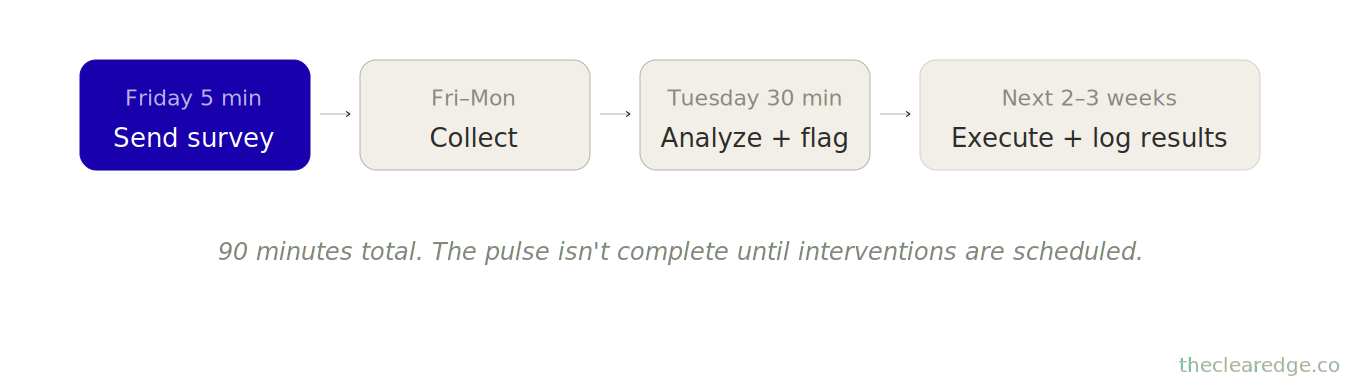
Minutes 1–5: Send Pulse
Open email template
Personalize if needed (or send as-is)
Send to all active clients
Set a reminder for the Monday follow-up
Friday Evening – Sunday: Clients respond (most respond weekend/Monday)
Monday 12:00 PM: Send Reminder
To clients who haven’t responded
Keep it light: “Reminder – 3-min pulse survey, helps me help you better”
Monday 5:00 PM: Cutoff
Download all responses
Prepare for analysis
Tuesday Morning (30 minutes): Analysis
Enter all responses into the tracking sheet
Calculate risk scores for each client
Flag critical (red), high (orange), moderate (yellow)
Identify patterns across multiple clients
Tuesday Morning (40 minutes): Intervention Planning
For each flagged client, document:
Issue identified
Intervention type (call, email, adjustment)
Timeline (48 hours, 7 days, 14 days)
Action steps
Schedule all critical risk calls within 48 hours, so they’re completed by Thursday.
Schedule all high-risk calls within 7 days, so they’re completed by next Tuesday.
Draft moderate risk emails
Tuesday–Following Week: Execute Interventions
Hold emergency calls (critical risk)
Hold check-in calls (high risk)
Send enhancement emails (moderate risk)
Implement changes discussed
Document results in the intervention log
Critical: The pulse isn’t complete until interventions are scheduled and executed. Measuring without acting accomplishes nothing.
Nina’s Month 10 example:
Friday 2:00 PM: Sent pulse to 22 clients
Monday 5:00 PM: 20 responses received (91% response rate)
Tuesday 9:00 AM: Analysis complete, 4 clients flagged
Tuesday 10:00 AM:
Scheduled 4 calls (all within 48–72 hours)
Drafted intervention plans for each
Tuesday–Thursday: Held all 4 calls
Following 2 weeks: Implemented changes, followed up
Result by month 11: All 4 at-risk clients rating renewal 8–9/10 (vs. 4–6/10 before intervention).
Move 3: Track Monthly Client Pulse Retention ROI Quarterly
Most founders run interventions but don’t measure retention impact. Without measurement, you can’t prove ROI, and it's easy to skip when busy.
Quarterly Retention Audit: Run this every 3 months (end of March, June, September, December).
Step 1: Calculate Churn Rate (10 minutes)
Last 3 months:
- Clients at start of quarter: _____
- Clients who churned: _____
- Churn rate: (Churned ÷ Start) × 100 = _____%
Target churn: <10% quarterly (<40% annually)
Good: 10–15%
Concerning: 15–20%
Critical: 20%+
Step 2: Analyze Prevented Churn (15 minutes)
Review intervention log from last 3 months:
- Clients flagged as at-risk: _____
- Interventions executed: _____
- Clients retained after intervention: _____
- Success rate: (Retained ÷ Flagged) × 100 = _____%
Calculate retention value:
- Clients retained: _____
- Average client value: $_____ monthly
- Annual retention value: _____ clients × $_____ × 12 = $_____
Step 3: Compare to Baseline (10 minutes)
Before monthly pulse:
- Average churn rate: _____%
- Annual churn cost: $_____
After the monthly pulse:
- Current churn rate: _____%
- Annual churn cost: $_____
- Prevented churn: $_____
ROI calculation:
- Time invested: 90 min monthly × 3 months = 4.5 hours = $675
- Value protected: $_____
- ROI: _____x
Step 4: Refine Approach (10 minutes)
Based on the last 3 months:
- Which interventions worked best: _____
- Which risk signals most predictive: _____
- Any patterns missed: _____
- Adjustments for next quarter: _____
Nina’s Quarter 1 results (Months 9-11):
Churn rate:
Before pulse: 21% annually (baseline from months 1–8)
After pulse: 9% annually (months 9–11 trend)
Prevented churn:
4 clients flagged and intervened
4 clients retained (100% success rate first quarter)
Annual value: 4 × $4,680 × 12 = $234,000
ROI:
Time: 90 min × 3 months = 4.5 hours = $675
Value: $234,000
ROI: 346x first quarter
Refinements:
Renewal likelihood (Q4) is the most predictive signal (prioritize)
Emergency calls within 48 hours are critical (don’t delay)
Pattern fix: Added weekly update emails (prevented future communication flags)
This tracking proves the system works and makes it non‑negotiable once you see a $234K retention value show up in your numbers each quarter.
[Quarterly Retention Audit]
1) Calculate churn rate
2) Review at-risk interventions
3) Sum annual retention value
4) Compare to pre-pulse baseline
5) Adjust pulse and interventions
Once $234,000 per quarter shows up in your own log, the question shifts from “does this work?” to “what keeps breaking when you skip the Monthly Client Pulse?”
What You Miss When You Skip A Monthly Client Pulse
Running monthly client pulses reveals risks operators miss when relying on intuition or renewal conversations.
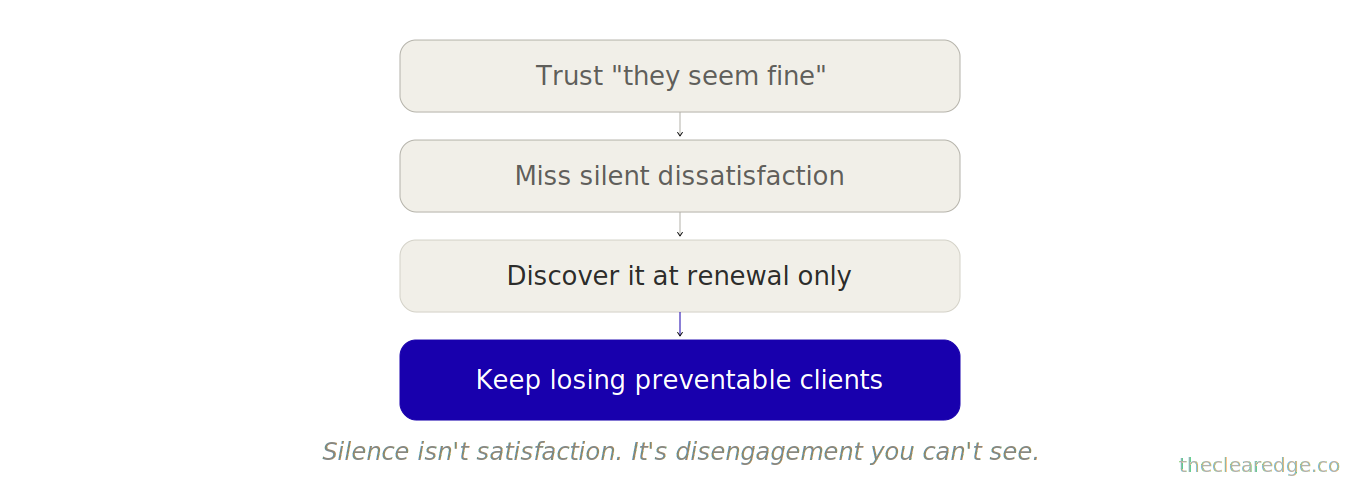
Silent Dissatisfaction
Dissatisfied clients go silent, not vocal.
They disengage gradually: slower response times, meeting reschedules, less implementation, fewer questions.
Founders interpret silence as satisfaction; reality is mental checkout.
Monthly pulse forces feedback that clients won’t volunteer.
Compounding Misalignment
Month 3: 5% misalignment (barely noticeable).
Month 7: 20% (frustrated but silent).
Month 11: mental exit.
Caught at 5–10%: simple fix.
Caught at 40%: often too late.
Value Invisibility
Clients often forget progress, especially on strategic or intangible work.
Monthly pulse question 3 reveals when value perception drops.
Early intervention: ROI review (81% success).
Late intervention at renewal: defensive, low success.
Communication Gap
Founders think “monthly calls + email responsiveness = good communication.”
Clients think “disconnected, unclear between calls.”
The gap builds invisibly until the renewal exit reason surprises the founder.
Monthly Client Pulse Versus Renewal-Only Churn Checks
Monthly pulse system:
The monthly pulse system costs $10,200 annually (survey admin, analysis, interventions).
Early detection enables 74% intervention success.
Average churn cost: $76,000.
Net: $65,800.
Renewal-only check-ins:
A renewal-only check-in approach costs $3,000 annually.
Late detection = 18% success.
Average churn cost: $187,000.
Net: $190,000.
Net swing:
Difference: $103,800 annually from catching signals 2–4 months early vs. at renewal.
When You Skip The Pulse
Letting silent dissatisfaction run from month 3 to month 12 is how you turn one lazy Friday into $187,000 in preventable churn; run the Monthly Client Pulse instead.
Run the Monthly Client Pulse Quick-Gate Checklist
Last Friday of every month, run this before you trust “they seem fine” across your 20–28 clients.
☐ Sent the 5‑question Monthly Client Pulse survey to all active clients and logged response count and percentage against your 85%+ target.
☐ Tiered every client into Critical, High, Moderate, or Low risk using Q1–Q4 scores and wrote total monthly and annual revenue at risk.
☐ Booked 48‑hour Critical and 7‑day High‑risk intervention calls plus 14‑day Moderate risk emails directly from this month’s pulse results.
☐ Summed retained at‑risk clients and wrote the annual LTV protected so you can see your own swing against the documented $111,000–$234,000 range.
Ninety minutes here is what stops the next $40K–$80K silent churn wave from turning into another $165,600–$187,000 write‑off at renewal.
Where to Go From Here: Install the Monthly Client Pulse and Break the Silent Churn Pattern
You’re running at $90K–$130K/month, and every month you skip this 90-minute pulse you’re quietly choosing the $40K–$80K silent churn tax you just watched climb to $165,600, $187,000, and $234,000 in the real examples.
From here, make the Monthly Client Pulse a fixed part of your operating system:
Spend 60 minutes once to install the 5‑question survey, tracking sheet, and risk tiers so Progress, Communication, Value, and Renewal Likelihood move from gut feel to hard signals.
Block a last‑Friday, 90-minute slot every month, send the survey, log scores, tier clients into Critical/High/Moderate/Low risk, and schedule interventions within 48 hours, 7 days, or 14 days—before dissatisfaction compounds into exits.
Run a 35–45 minute quarterly retention audit to track churn rate, intervention success, and dollars saved, so you can see the $103,800+ swing between renewal-only checks and a working pulse system in your own numbers.
That’s how this one recurring last‑Friday, 90-minute ritual stops “they seem fine” from turning into another $40K–$80K in preventable churn and turns your client base into an asset you actively protect instead of a revenue line you gamble on at renewal.
FAQ: Monthly Client Pulse System For $90K–$130K/Month Founders
Q: How do I know if I need the Monthly Client Pulse at $90K–$130K/month?
A: You need it when you’re at $90K–$130K/month with 20–28 clients, annual churn sits around 18–24%, and you’ve had 2–5 clients leave with vague “wasn’t working anymore” reasons you only heard at renewal.
Q: How much preventable churn does the Monthly Client Pulse typically protect each year?
A: For founders at $90K–$130K/month, it routinely protects $40K–$80K in annual retention and, in Nina-level implementations, has preserved $140,400–$234,000 per year by catching at-risk clients 2–4 months before they would have churned.
Q: How does the Monthly Client Pulse prevent the $187,000 average annual churn cost described in this article?
A: It replaces renewal-only check-ins with a 90-minute last-Friday system that surfaces progress, communication, value, and renewal-risk signals 2–4 months earlier, pulling churn down from a 21.3% pattern with $187,000 lost each year toward an 8.7% pattern with about $76,000 lost instead.
Q: How do I use the Monthly Client Pulse with its 5-question survey before my next renewal cycle?
A: On the last Friday of the month you send the 5-question, 3-minute survey, log Q1–Q4 scores and Q5 feedback for all 20–28 clients, assign each client a Critical, High, Moderate, or Low risk tier, then schedule interventions within 48 hours, 7 days, or 14 days so issues found at month 5–6 don’t become exits at month 11–12.
Q: What happens if I keep relying on renewal conversations instead of running this 90-minute monthly system?
A: Dissatisfaction compounds silently for 3–6 months, churn stays in the 18–24% band, and you keep losing 4–5 clients a year worth $54,000–$57,600 each, turning into roughly $187,000–$230,000 in preventable annual churn.
Q: How did Nina turn a $165,600 loss into $234,000 in protected retention using the Monthly Client Pulse?
A: After losing three clients worth $13,800 per month ($165,600 annually) at month 8, she installed the monthly pulse at month 9, flagged four at-risk clients with renewal scores of 4–6, ran targeted interventions within 5–14 days, and ultimately renewed all four for $19,500 per month—$234,000 in annual retention that likely would have walked.
Q: How quickly can I see churn reduction once I start running the Monthly Client Pulse?
A: With 60 minutes of one-time setup and 90 minutes on the last Friday each month plus 35–45 minute quarterly audits, most operators see salvageable renewals and visible churn reduction inside 1–2 cycles and land the full annualized retention gains within about 3–4 months.
Q: How much time does the Monthly Client Pulse require compared to the value it protects?
A: It asks for 90 minutes per month plus occasional 30–45 minute calls and emails, which in Nina’s case totaled about 4.5 hours and $675 of founder time per quarter while protecting $234,000 in annual retention—a 346x ROI.
Q: When should I treat a client’s pulse scores as Critical, High, or Moderate risk and intervene?
A: Any Q1–Q4 score of 1–3, renewal at 1–4, or multiple 4–6 scores is Critical (48-hour emergency call), renewal at 5–6 or two 4–6 scores is High (30-minute check-in within 7 days), and a single 4–6 with clear Q5 feedback is Moderate (email and small adjustment within 14 days).
Q: Why does skipping the Monthly Client Pulse keep costing $40K–$80K in annual retention even when clients “seem fine”?
A: Because clients rarely voice issues early, so progress, communication, and value misalignments drift from 5–10% to 40% over months; by the time you see obvious disengagement and reach renewal, they’ve mentally exited, recovery drops to 18–22%, and you keep writing off $40K–$80K (or $111,000+ in documented cases) that a structured 90-minute monthly pulse could have saved.
⚑ Found a Mistake or Broken Flow?
Use this form to flag issues in articles (math, logic, clarity) or problems with the site (broken links, downloads, access). This helps me keep everything accurate and usable. Report a problem →
› More to Explore: Quick Navigation · Monthly Rituals
➜ Help Another Founder, Earn a Free Month
If this system just saved you from losing $40K–$80K in preventable annual churn, share it with one founder who needs that relief.
When you refer 2 people using your personal link, you’ll automatically get 1 free month of premium as a thank-you.
Get your personal referral link and see your progress here: Referrals
Get The Monthly Client Pulse Implementation Toolkit
You’ve read the system. Now implement it.
Premium gives you:
Ready-to-use PDF toolkit—every template, diagnostic, and formula pre-filled, zero setup, immediate use
Plug-and-play AI diagnosis sessions—drop into Claude, Gemini or ChatGPT, answer a few questions, save hours of guessing, get your exact next move
Audio key points—concentrated frameworks you can absorb in minutes, implement while you move
Unrestricted access to the complete library—every system, every update
What this prevents: Another $187,000 in yearly churn by catching client dissatisfaction 2–4 months before renewal exits.
What this costs: $49/month.
Download everything today. Implement this week. Cancel anytime, keep the downloads.
Already upgraded? Scroll down to download the PDF, audio, and your AI session.
