


The Executive Summary
Founders at $10K–$30K/month quietly leave $7K–$84K a year on the table by fixing the wrong problems; a simple Bottleneck Audit shows exactly where revenue leaks and how to plug them in under 90 minutes.
Who this is for: Service founders, coaches, and course creators at $10K–$30K/month working 50–60 hour weeks who feel “always busy” yet stuck because every new fix moves revenue less than expected.
The Bottleneck Problem: Misdiagnosing constraints leads to wasted $3,200–$7,000 projects, 180+ hours of scattershot work, and missed jumps like $13K → $22.1K or $7K → $15K that were available from a single correct fix.
What you’ll learn: A punchy Bottleneck Audit that maps your full revenue flow, benchmarks each stage against real baselines, and uses simple math to reveal the one constraint that will move revenue fastest.
What changes if you apply it: You stop guessing, fix show rate instead of traffic, close rate instead of branding, pricing instead of volume, and see jumps like $7K → $15K, $13K → $22.1K, or $15.2K → $34.2K in 60–90 days.
Time to implement: Expect 30 minutes today to map and measure your funnel, 2 focused hours this week to fix the biggest bottleneck, and 30 days to track results before moving to the next constraint.
Written by Nour Boustani for $10K–$30K/month founders who want precise, compounding revenue gains without wasting six months and tens of thousands optimizing the wrong 4%.
If you’re stuck at $10K–$20K working 50–60 hours, upgrade to premium, install the Momentum Formula inside the The Clear Edge OS, and reallocate your week into three finished revenue moves.
› Library Navigation: Quick Navigation · The Clear Edge OS
Why $10K–$20K Founders Stall From Focus Leaks and Scattered 50–60 Hour Weeks
Most “stuck at $12K/month” stories follow the same pattern — you’re working hard, but momentum is leaking in ten directions you can’t see.
Here’s how that looked in real numbers.
A consultant at $12K/month couldn’t explain why he felt exhausted. He was working 50-hour weeks, shipping regularly, and hitting his task list every day.
But revenue hadn’t moved for four months. Still at $12K, working harder every week.
What we did (20-minute map):
11 half-finished projects, none producing revenue
73 tabs open across three windows
Slack checked 40+ times daily
8 different “strategies” running side by side
Zero completed systems
What it felt like:
It all registered as “staying on top of things,” not as a problem.
Each piece was a leak. Small on its own. Together, they drained everything.
Result:
$12K/month → $17K/month in six weeks
No new tactics. Just stopped the bleeding.
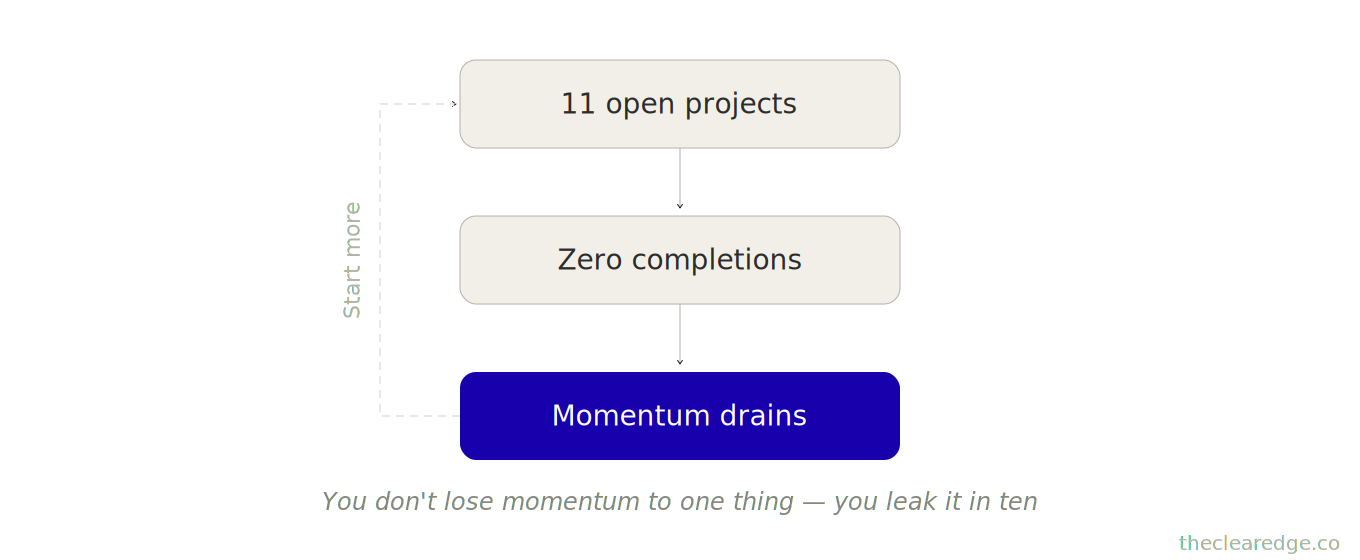
Here’s what most founders miss: you don’t lose momentum to one catastrophe; you lose it to countless small leaks that quietly drain your energy over time.
The pattern across stalled founders:
Across 47 stalled founders I’ve audited, the pattern holds: 9–14 active projects with zero completion.
Every open tab adds mental load.
Every half-finished task sits in your head, stealing space.
Every new side project pulls attention off what’s already working.
Momentum comes from fewer things, finished — not more things, started.
Focus Leak Patterns Stalling $5K–$50K Service, Coaching, and Course Founders
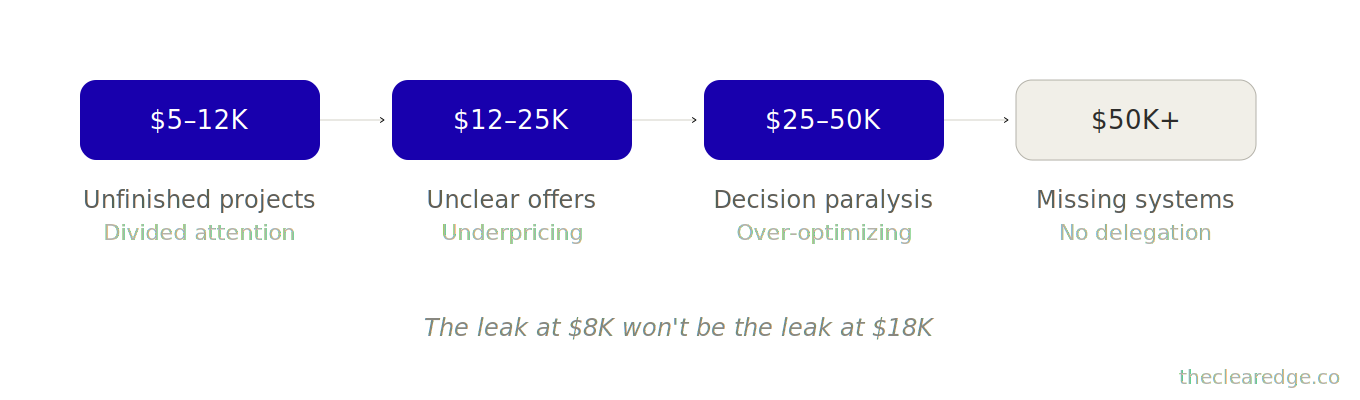
Now that you’ve seen how leaks kill growth, here’s where they hide at each revenue stage.
At every revenue stage, there’s a predictable pattern:
Focus leak patterns by revenue band:
At $5–12K/month: Divided attention across too many unfinished projects
At $12–25K/month: Unclear offers or underpricing that signals doubt
At $25–50K/month: Decision paralysis from trying to optimize everything
At $50K+/month: Lack of systems (next article covers this)
The leak you had at $8K won’t be the leak at $18K. What got you here won’t get you there.
Case 1: Tool chaos and time leaks
An agency owner I worked with had seven Notion workspaces, four project management tools, and three different content calendars.
He spent two hours daily just deciding where to put information.
Time cost:
10 hours weekly
520 hours yearly — 13 work weeks lost to tool chaos
Revenue cost:
At $150/hour (his billing rate), that’s $78,000 in annual opportunity cost just from tool confusion
Case 2: “Almost ready” offers
A coach in the same stage was running three offers at once: a group program, 1-on-1 coaching, and a course. None were fully built — all were “almost ready.”
Revenue stuck at $8K/month because nothing was ever finished enough to sell confidently.
Time stuck: “Almost ready” for seven months
Revenue left on the table:
At even $3K extra per month from one completed offer, she’d lost $21K in revenue just from the inability to finish
Case 3: Underpricing as a confidence leak
Another consultant kept her price at $1,200 because “that’s what people in my industry charge,” even though she was easily worth $3,000.
The low price signaled uncertainty, so clients treated her like a budget option, negotiated hard, and took forever to close.
Each leak feels small, but together they drain everything.
How leaks feel inside a week
A coach starts Monday energized, with a clear plan and plenty of motivation.
By Wednesday, they’re exhausted from juggling too many moving pieces.
By Friday, they can’t clearly remember what they actually finished.
When the weekend comes, they feel like they worked hard all week but got nowhere.
What’s actually happening:
They spent the week context-switching between 15 incomplete things instead of finishing 3 complete ones.
The brain doesn’t track effort. It tracks completion.
When nothing finishes, you feel like you did nothing — even if you worked 60 hours.
You’ve probably felt this too.
What cognitive load actually looks like
Every time you open your task manager and see “Finish ebook (80% done),” your brain spends energy processing it.
Should I work on this today?
How much time will it take?
When will I finish it?
Behind the scenes:
That’s mental bandwidth burning in the background.
Multiply that same cognitive load across 11 unfinished projects.
Your brain ends up running 11 background processes at once, all competing for attention.
No wonder you feel exhausted.
The math on what leaks actually cost
The consultant at $12K/month:
Workload:
11 active projects
4 hours weekly on each
Time math:
11 × 4 = 44 hours weekly on incomplete work
44 × 4 = 176 hours monthly spent without finishing
His rate: $12,000 ÷ 200 hours = $60/hour.
After cutting to 3 projects, he freed 128 hours monthly, closed 2 clients at $3,500 each, and brought in $19K that month — a new effective rate of $95/hour.
Impact:
58% revenue increase from focus alone
Leaks cost him $7K monthly ($84K yearly)
Edge case: founders with strong inbound pipelines can survive leaks longer — but they still pay opportunity cost. Your pipeline masks the bleeding until it doesn’t.
This isn’t theory — it’s how $10K–$20K actually moves.
Running this with the toolkit keeps it repeatable.
At $7K–$84K yearly lost to unfinished work, guessing doesn’t scale; the premium toolkit lets you apply the same Momentum Formula structure every week instead of rebuilding it.
When $7K–$84K leaks are on the table, you don’t need another tactic, you need a system that tells you exactly which move to run next.
The Momentum Formula: Three-Move Focus System to Stop Revenue Leaks at $10K–$30K Months
Founders often lose the thread by assuming momentum comes from doing more, when in reality it comes from finishing what’s already started.
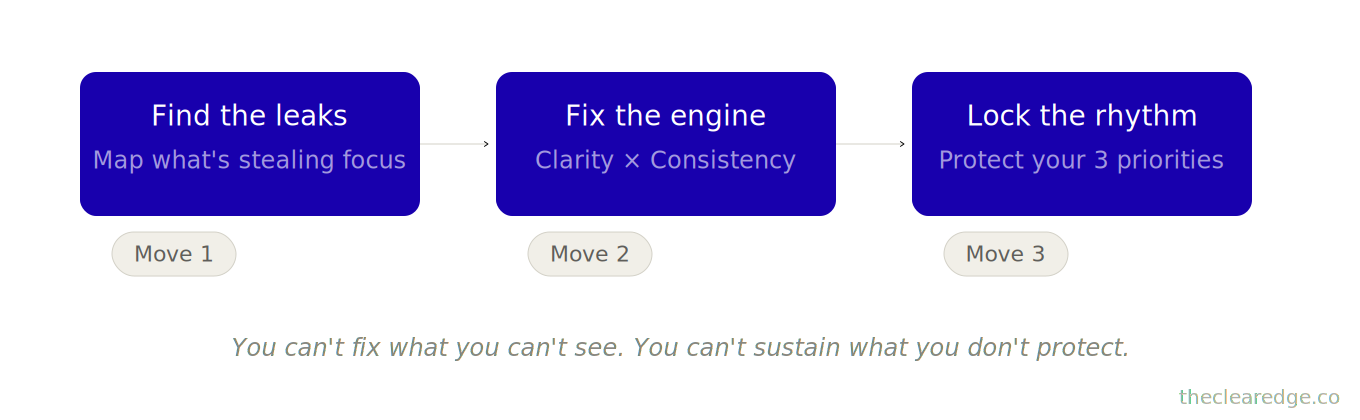
The three moves:
Move 1: Find the Leaks — Map what’s stealing focus
Move 2: Fix the Engine — Apply Clarity × Consistency formula
Move 3: Lock the Rhythm — Protect your three priorities
Why this sequence matters
You can’t fix what you can’t see.
You can’t sustain what you don’t protect.
Most founders skip straight to tactics without plugging the leaks first.
Quick example: same effort, less leaking
A consultant I worked with wanted to “do more outreach.”
We audited his week first to see where his time was actually going.
We found 18 hours every week bleeding into low-value noise.
We closed those leaks and freed that time.
With the same outreach volume, his results tripled because his attention was no longer scattered.
Each move builds on the last with real numbers and examples.
You don’t start by pushing harder; you start by seeing exactly where 50–60 weekly hours actually go before you decide what to cut or protect.
Move 1: Find Focus Leaks and Map Your 50–60 Hour Week by Revenue Impact
Most founders don’t realize how much energy they’re bleeding until they sit down and map it.
Look at your screen right now and count how many tabs are open. Each open tab is a tiny pull on your attention and energy.
Tab Overload Case
An agency owner I worked with had 87 tabs open at once. We closed them all, and he couldn’t remember what 80 of them were even for, joking that his browser had more windows than his house.
Here’s what happened:
Instant clarity as soon as the tabs were gone.
His brain stopped processing 87 options every time he looked at his browser.
His focus sharpened within five minutes of closing everything.
He said it felt like “someone turned the noise off.”
That’s what leaks do: they create constant background noise that makes every task harder.
Unfinished tasks example
How many unfinished tasks are sitting in your head waiting for closure?
Another consultant counted 19 things she was “working on.”
We finished 4 in one week.
The other 15 turned out not to matter.
We deleted those 15 tasks.
Those 15 tasks had been running in the background for months, prompting the same loop every morning: Should I work on this? When will I finish? Why can’t I get this done?
Deleting them freed up mental space she didn’t even realize was occupied.
[MOVE 1: QUICK LEAK SCAN]

For this week, list counts for:

[ ] Unfinished projects
[ ] Open tabs
[ ] Slack / email checks
[ ] Active offers / strategies
[ ] Recurring meetings

If any row feels high,
you’ve found a leak.
Finding leaks shows where energy disappears; the Completion Audit is the first time you force every project to justify a place in your next 30 days.
The Completion Audit: Cut 10–15 Open Projects Down to 3 Revenue Drivers
Here’s how to identify which projects actually matter and kill the rest.
The Audit Process
List every active project. Score each 1–10 on two factors:
Revenue impact if completed (1 = low, 10 = high)
Completion timeline (1 = months away, 10 = could finish this week)
Multiply the scores.
A project that’s high revenue (8) but far from done (2) scores 16.
A project that’s medium revenue (6) but nearly finished (9) scores 54.
Keep the top 3 scores. Kill or pause everything else.
Mini case: 8 active projects
One consultant did this audit with 8 active projects.
Top 3 scores: 72, 63, 56
Bottom 5 scores: 28, 24, 20, 12, 9
She finished the top 3 in three weeks and made $14K from those three.
The bottom 5? Deleted. Haven’t thought about them since.
Example: 10 incomplete projects → 3 finished
One course creator had 10 incomplete things competing for attention:
3 online courses “in progress” (none sellable)
2 ebooks “almost done” (neither finished)
1 membership site “being built” (no members)
4 webinar ideas “in planning” (none scheduled)
We killed 7. Finished 3 in 30 days.
Results from the 3 completed projects:
$8K from finished course (first week)
$3K from ebook (next month)
$564 recurring from membership (12 members at $47/month)
Total: $11,564 in the first 60 days.
The other 7 incomplete projects? Still wouldn’t be done six months later, still making $0.
Projects trimmed. Focus sharpened. Revenue unlocked.
Do this today
Close every tab and finish one small task completely.
Even if the task is tiny, finishing it will reset your focus faster than trying to generate more motivation.
Mini case: one welcome email
One coach finished a welcome email she’d been “almost done with” for three weeks.
She sent it and used it for the next 8 clients.
That single unfinished email had been draining her mental space for 21 days.
She finished it in 30 minutes and then used it for months.
Move 2: Fix the Engine by Applying Clarity × Consistency to a $10K–$20K Week
Once you know where the leaks are, here’s how to fix the engine that’s supposed to drive your momentum.
The formula: Clarity × Consistency = Momentum
If either is zero, momentum is zero.
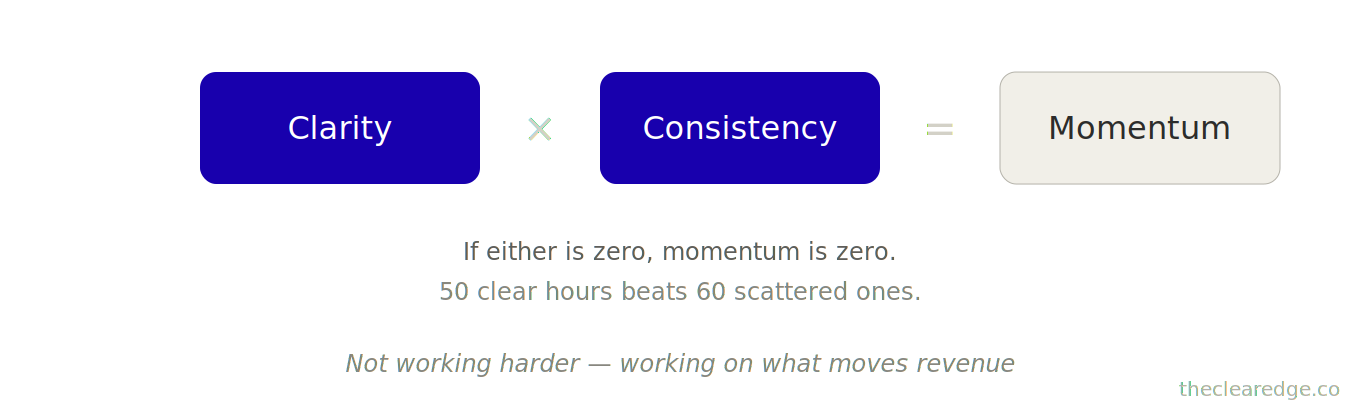
Most founders have consistency maxed and clarity missing, so they end up working 50 hours on the wrong things.
Clarity isn’t about motivation; it’s knowing exactly which three moves generate revenue and which 47 don’t.
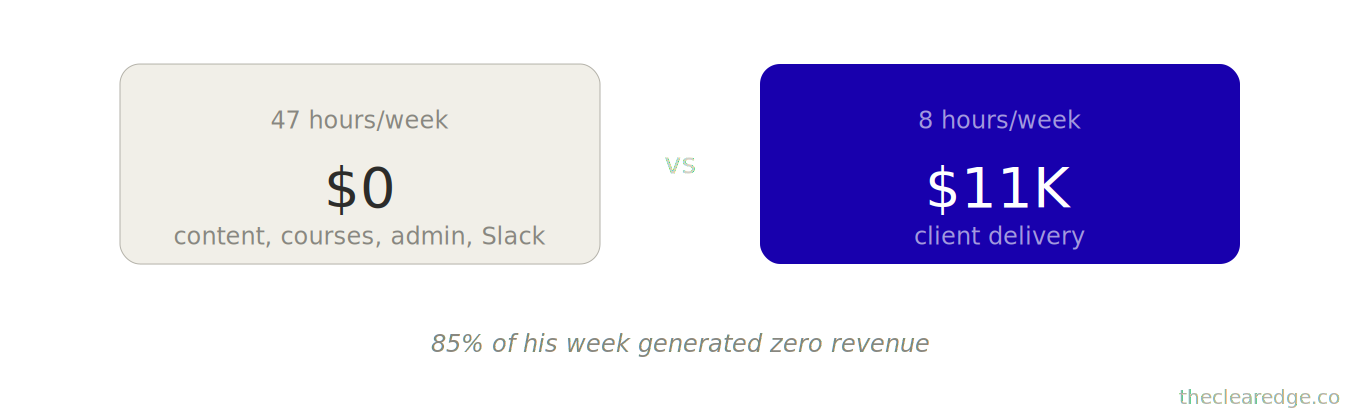
Where his 55 hours actually went
A consultant working 55 hours weekly couldn’t figure out why revenue stayed flat at $11K/month. We mapped where his hours went:
8 hours weekly: Client delivery (generated 100% of revenue)
12 hours weekly: Content creation (generated 0% of revenue)
10 hours weekly: “Learning” courses he’d already bought (generated 0%)
15 hours weekly: Tool research, admin chaos, Slack (generated 0%)
10 hours weekly: Networking, coffee chats with no clear outcome (generated 0%)
47 of his 55 hours generated $0. Only 8 hours generated $11K.
Flipping the allocation
We flipped his week and cut everything that was generating $0. Those 47 hours were redirected to:
Client delivery: 8 hours (stayed the same)
Outreach to qualified leads: 25 hours (new)
Refining his offer and pricing: 10 hours (new)
Building one reusable proposal template: 5 hours (new)
Everything else: 7 hours (reduced from 47)
Result: $11K → $18K in 60 days with the same total hours, just a different allocation. That’s what clarity looks like—not working harder, but working on what actually moves revenue.
Consistency isn’t willpower. It’s eliminating the things that break your rhythm before they start.
Before: random “consistent” outreach
An agency owner was “consistent” with outreach — sent 20 messages weekly.
But he’d send them randomly:
15 on Monday morning when fresh
3 on Wednesday between meetings
2 on Friday afternoon when exhausted
Quality varied wildly:
Monday messages: professional, thoughtful, personalized
Friday messages: generic, rushed, typo-filled
Response rate reflected it: 25% on Monday messages, 8% on Friday messages.
After: locked rhythm
We locked his rhythm.
10 messages
Monday 9–10 am
10 messages
Thursday 9–10 am
Same volume. Same time slots. Energy consistent.
Response rate jumped to 22% across all messages.
Revenue followed: $16K → $21K in 90 days.
Consistency compounds when you protect it from interruption.
[MOVE 2: CLARITY × CONSISTENCY]

Clarity = know your 3 revenue moves
Consistency = do them every week

If clarity is 0, momentum is 0.
If consistency is 0, momentum is 0.

You only get momentum when BOTH are above 0.
Once you see how a few protected hours shifted $16K → $21K in 90 days, the next step is wiring that behavior into a repeatable weekly system.
How to Lock Clarity and Consistency Into a Repeatable Weekly Revenue System
Step 1: Identify your three revenue moves.
For most service founders, this is: outreach, sales calls, and delivery.
For course creators: content, email, and sales page optimization.
For agencies: client acquisition, retention, upsells.
Write yours down. If you can’t narrow it to three, you don’t have clarity yet.
Step 2: Block time for those three moves only.
A coach blocked:
Monday 9–11 am (client calls)
Tuesday 2–4 pm (content)
Thursday 9–12 pm (outreach)
Everything else is scheduled around those blocks.
Before: her three revenue moves happened “whenever she had time” (never consistently).
After: locked rhythm, predictable momentum.
Revenue: $9K → $14K in 75 days from rhythm alone.
Step 3: Make everything else optional.
This is the hardest part. Most founders treat every task as urgent.
Most tasks are optional distractions disguised as priorities.
One consultant had 27 “priorities.”
We cut that list down to 3 and paused the other 24 indefinitely.
Her fear was that “everything will fall apart” if she stopped working on those 24 items.
In reality, nothing fell apart—revenue grew, stress dropped, and her energy returned.
The 24 “urgent” tasks weren’t urgent. They were just loud.
Do this today
Write down your three revenue moves.
Block time for them this week.
Make everything else wait.
Move 3: Lock the Rhythm and Protect Your Three Revenue Priorities for 12 Weeks
Now that you’ve found the leaks and fixed the engine, here’s how to protect momentum from backsliding.
Most founders restart this process every Monday. They find focus and get momentum, then by Friday they’ve context-switched 40 times and lost the thread.
Locking rhythm means building defenses that protect your three moves from interruption.
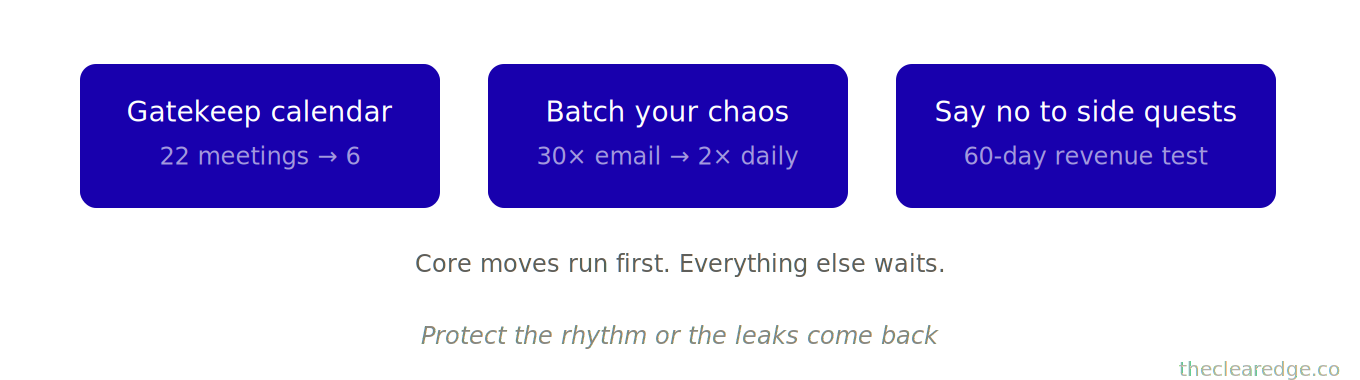
If your three revenue moves are the engine, these defenses are the guardrails that keep 12-week gains from sliding back into $12K-level chaos.
Three Defenses That Stop Focus Leaks in Your Calendar, Inbox, and Opportunities
Defense 1: Gatekeep Your Calendar
An agency owner had 22 recurring meetings every week, and half of them were “check-ins” that could have been handled with async updates.
He was spending 11 hours a week in meetings that generated $0, so we cut his calendar down to 6 essential meetings and freed up 15 hours.
Those 15 hours were then redirected into client work and outreach instead of low-yield calls.
Revenue: $14K → $19K in 60 days from meeting reduction alone.
How to gatekeep: Every recurring meeting gets a quarterly audit.
Ask: “Does this generate revenue or move progress?”
If no to both, cancel it.
Defense 2: Batch Your Chaos
A course creator checked email more than 30 times a day. Every check caused a context switch, and every context switch cost about 15 minutes to refocus, adding up to 7.5 hours a week lost to email interruptions.
We batched her email into two blocks a day at 10 am and 4 pm, processed the same volume, and saved over 7 hours a week. She redirected those hours into course creation, launched 2 additional courses that year instead of 1, and generated an extra $8K in revenue from batching alone.
How to batch:
Pick two time slots each day for email, Slack, and social media.
Keep those apps closed outside your chosen time slots.
Every interruption you prevent saves about 15 minutes of refocus time.
Defense 3: Say No to Side Quests
A consultant was invited to 3 podcast interviews, 2 guest posts, 1 speaking gig, and 4 networking events in a single month. All of them felt like “opportunities,” so he said yes to every one.
He spent 40 hours that month on those activities and generated zero clients, while his outreach dropped from 20 messages a week to 5. Revenue fell from $13K to $9K that month.
The next month, he said no to everything except his three core revenue moves.
Revenue: $9K → $16K.
How to say no:
Score every new opportunity with a single question.
Ask: “Will this directly generate revenue in the next 60 days?”
If the answer is no, treat it as a side quest that can wait.
The Weekly Momentum Check to Track Leaks, Side Quests, and Completed Revenue Moves
Every Friday, run this 5-minute audit:
Did I complete my three revenue moves this week? (Yes/No for each)
How many side quests pulled me off track? (Count them)
What’s one leak I can close next week? (Write it down)
Mini case: 12 weeks of momentum checks
One consultant ran this audit for 12 weeks.
Week 1: completed 1 of 3 moves, 8 side quests.
Week 12: completed 3 of 3 moves, 0 side quests.
Revenue: $12K → $19K over those 12 weeks.
The audit kept him honest. Every week, he could see: Am I protecting my rhythm or bleeding again?
Do this today
Schedule 15 minutes this Friday for your first momentum check.
Block that slot in your calendar now so it actually happens
What Happens When $10K–$30K Founders Apply the Momentum Formula as a Weekly System
Here’s what actually shifts when founders close leaks and lock rhythm:
1. Clarity increases because you know what moves revenue.
One agency owner:
“I used to spend hours deciding what to work on. Now I know: outreach Monday/Thursday, client work Tuesday/Wednesday, admin Friday morning. Zero decision fatigue.”
Before the framework: every morning was 30 minutes of “what should I focus on today?”
After: 15 hours monthly saved from decision elimination alone.
2. Focus compounds because context-switching stops.
A course creator tracked her deep work hours before and after.
Before: 8 hours weekly across 15 tasks.
After: 18 hours weekly across 3 tasks.
Same total hours worked. More than double the focused hours.
3. Progress becomes visible instead of feeling scattered.
You can point to finished work instead of vague “I’ve been busy.”
One consultant:
“I can finally show what I accomplished instead of just feeling exhausted.”
Before the framework: “Worked on proposal template, started new blog post, researched tools, had 3 meetings, planned next course module.”
After the framework: “Finished proposal template. Sent to 4 prospects. Closed 2 clients. $7K added to pipeline.”
Same effort. One feels like chaos, the other feels like progress.
4. Income increases because leaks were capped in revenue.
One agency owner went from $14K/month → $23K/month in 90 days just by closing leaks that were eating 20 hours weekly.
Those 20 hours had been spent on:
Unnecessary meetings (6 hours)
Tool management (4 hours)
Social media scrolling “for research” (3 hours)
Managing a failed partnership (4 hours)
Revising old content that didn’t need revising (3 hours)
This is classic constraint thinking: if you pour resources into parts of the system that aren’t the real bottleneck, nothing moves faster.
When he cut those leaks, he redirected 80 hours monthly to:
Outreach: 40 hours
Client delivery improvements: 24 hours
Proposal refinement: 16 hours
That 80-hour monthly shift generated $9K monthly increase.
That’s $112/hour return on redirected time.
5. Energy comes back because you’re finishing things instead of starting more.
Completion fuels your business; unfinished work quietly drains it.
One course creator:
“I forgot what it felt like to finish something. Now I finish things every week and I’m not exhausted anymore.”
She used to end every week with 10–15 things “in progress,” and now she ends every week with 2–3 things “done.”
The psychological difference is massive: “in progress” means you’re still carrying the work, while “done” means you get to put it down.
Momentum builds predictably instead of randomly.
One consultant:
“Revenue used to feel random. Now I know exactly what drives it.”
Before: good months and bad months with no clear pattern ($11K, $8K, $14K, $7K).
After locking his rhythm: predictable climb ($12K, $13K, $14K, $16K, $17K).
Steady. No mystery.
The Real Revenue and Time Cost of Never Closing Focus Leaks at $10K–$30K
Case 1: 9 months “busy,” $0 earned
One consultant spent 9 months with 12 active projects, finished none of them, made no money from any, burned out, and ended up taking 2 months off.
When he came back, we picked 2 projects, finished both in 6 weeks, and made $18K, while the other 10 projects stayed unfinished and worthless.
Those 9 months:
1,800 hours of work (50 hours weekly)
$0 revenue
$0/hour rate
The 6 weeks after: 300 hours of work, $18K revenue, which works out to a $60/hour rate.
What changed wasn’t his skill, his market, or his luck—just his ability to finish what he started. Every week you leak costs you months of progress.
Case 2: Underpricing leak over 18 months
Another coach kept her price at $1,200 per client for 18 months while averaging 3 clients a month, making $64,800 total in that period.
When she finally raised her price to $3,000 per client and kept the same volume, she made $54,000 in the next 6 months.
The math on that leak:
18 months × 3 clients × $1,200 = $64,800 earned
18 months × 3 clients × $3,000 = $162,000 potential
Low price cost: $97,200 over 18 months.
That’s real money she didn’t make because she was afraid to charge what she was worth.
Case 3: “Busy mode” instead of growth
Another agency owner stayed in “busy mode” for a year, launching nothing new, building nothing, and just maintaining existing clients.
Revenue stayed flat at $18K while exhaustion climbed to the point where he almost quit.
The business math:
Stuck at $18K/month when you could be at $30K? That’s $144K lost over 12 months.
Year two flat = $288K cumulative
Year three = $432K
Every year you stay stuck compounds the loss.
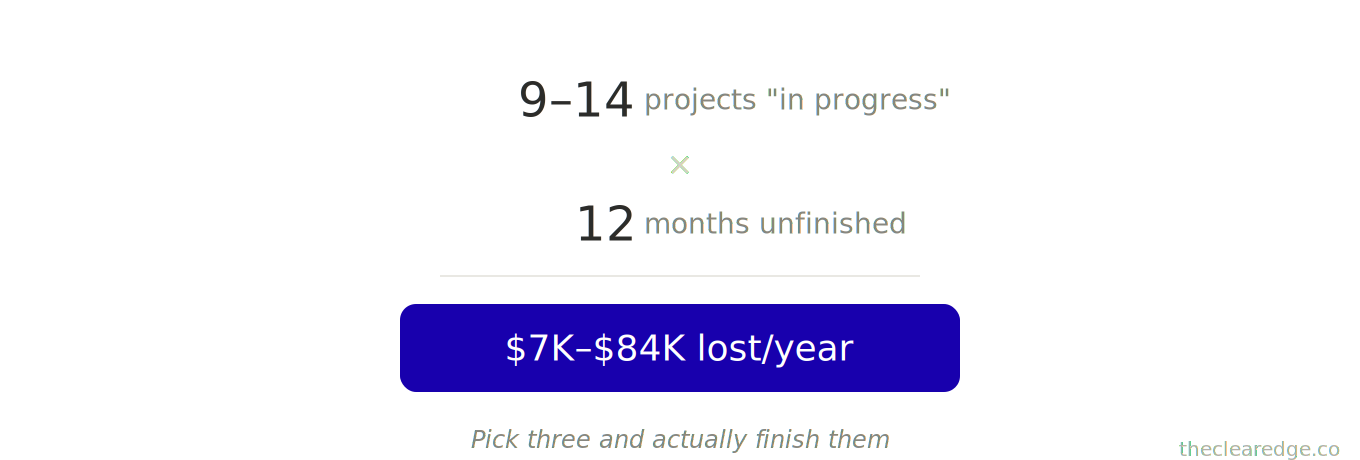
The Cost Of Staying “Almost Done”
Every week you keep 9–14 projects “in progress” instead of finished, you’re quietly choosing to leak $7K–$84K a year; pick three and actually finish them.
Run the Momentum Formula Field Test Checklist
Next time you’re stuck between $10K and $20K with 9–14 projects open, pull this and run it before starting anything new.
☐ Listed every active project and wrote its Completion Audit score so only the top 3 revenue drivers stay live for the next 30 days.
☐ Scored this week’s hours with Clarity × Consistency and wrote how many of your 50–60 hours hit your three weekly revenue moves.
☐ Wrote your three revenue moves for this week and blocked them first in your calendar before any meetings, email, or side quests.
☐ Checked calendar, inbox, and “opportunities” against those three moves and marked each keep, cut, or pause using the 60-day revenue test.
☐ Logged weekly revenue, finished revenue moves, and count of side quests so you can see if you’re repeating the $12K → $17K or $14K → $23K pattern.
This is how you stop $7K–$84K focus leaks from quietly compounding while you stay stuck at $12K–$18K.
Your Move: How to Start the Momentum Formula Today in 10, 30, and 30 Days
Before you check anything else tomorrow morning, do this.
Today (10 minutes):
Close every tab on your browser — notice how much clearer your mind feels.
Finish one small thing completely — even if it’s tiny.
Notice how much better that feels than starting something new.
This Week (30 minutes):
Check the formula: Were you clear on what mattered, or just busy?
Audit your projects: how many are actually finished vs. “in progress”?
Pause one side project for seven days — watch what rises to the top.
Next 30 Days:
Write down your three focus moves — what actually moves revenue?
Guard those three ruthlessly — say no to everything else.
Make everything else optional — if it’s not one of the three, it waits.
The question that exposes your real bottleneck
What’s one small leak that keeps draining your time or energy?
Drop your answer below. I read every reply.
Be specific. “Too many projects” doesn’t help you fix it, but “I have 8 unfinished blog posts and 3 half-built courses” does.
FAQ: Momentum Formula Focus System
Q: How does the Momentum Formula help a $12K/month founder grow to $17K–$23K without adding more projects?
A: It closes focus leaks across 9–14 unfinished projects, redirects 40–80 hours monthly into three revenue moves, and uses Clarity × Consistency to turn changes like cutting to 3 projects into jumps such as $12K → $17K in six weeks or $14K → $23K in 90 days.
Q: How do I use the Momentum Formula with its three moves before I start another new project?
A: First run Move 1 (Completion Audit) to list and score every project, then use Move 2 (Clarity × Consistency) to focus on three revenue moves, and finally apply Move 3 (Lock the Rhythm) to gatekeep your calendar, batch chaos, and kill side quests before adding anything new.
Q: How do I run the Completion Audit to cut from 10–15 open projects down to the right 3?
A: List every active project, score each 1–10 for revenue impact and 1–10 for time-to-complete, multiply the scores, then keep only the top 3 and pause or delete everything else so you can replicate outcomes like $11,564 in 60 days from three finished projects instead of $0 from ten half-built ones.
Q: What happens if I keep bleeding focus across unfinished projects instead of closing leaks?
A: You repeat patterns like 11 active projects × 4 hours weekly = 176 hours monthly on incomplete work, which kept one consultant stuck at $12K for four months and silently cost him $7K per month or $84K per year in lost revenue.
Q: How do I know whether my real leak is too many projects, unclear offers, or decision paralysis?
A: Match your stage to the pattern: at $5–12K it’s divided attention across 9–14 unfinished projects, at $12–25K it’s unclear or underpriced offers like charging $1,200 instead of $3,000, and at $25–50K it’s trying to optimize everything instead of finishing a few high-impact moves.
Q: How much money do focus leaks actually cost if I stay underpriced or scattered for 12–18 months?
A: Examples in the article show leaks like tool chaos consuming 520 hours yearly at $150/hour for $78,000 in cost, a coach losing $21,000 from seven months of “almost ready,” and another founder leaving $97,200 on the table over 18 months by charging $1,200 instead of $3,000 for three monthly clients.
Q: How do I apply Clarity × Consistency so my 50–60 hour weeks finally move revenue?
A: Identify the 8–10 hours already generating income, cut 40+ hours of zero-revenue activities like tool research and aimless networking, and reallocate them into three specific moves—such as outreach, delivery, and one reusable asset—so shifts like 8 revenue hours → 55 focused hours can move $11K → $18K in 60 days.
Q: What happens if I improve consistency but never gatekeep my calendar, email, and side quests?
A: Context switching across 22 meetings, 30+ inbox checks, and six “opportunities” a month quietly eats 20+ hours weekly, leading to drops like $13K → $9K when outreach falls from 20 messages to 5, instead of gains like $14K → $19K or $16K → $21K from batching chaos and cutting non-revenue meetings.
Q: How much time should I budget each week to keep momentum using this formula?
A: Expect about 10 minutes today to close tabs and finish one task, 30 minutes this week for a project audit, 15 minutes every Friday for the Weekly Momentum Check, and then 60–90 days of guarding your three moves to see compounding lifts like $9K → $14K in 75 days or $12K → $19K in 12 weeks.
Q: What happens if I never fix leaks and stay “busy” at the same revenue level for years?
A: You risk outcomes like 1,800 hours over nine months producing $0 from 12 unfinished projects, or staying at $18K instead of $30K and losing $144K per year—compounding to $288K by year two and $432K by year three—while energy collapses and the business starts to feel unsustainable.
Up Next: The Bottleneck Audit for Finding the One Constraint Blocking Your Next $10K
In “The Bottleneck Audit: Unblock Your Next $10K Month for $15K–$30K Operators,” we unpack why most founders at $15K–$25K aren’t stuck from lack of effort—they’re fixing the wrong bottleneck while the real one compounds quietly.
Navigate The Clear Edge OS Systems for Scaling From $5K to $150K
Start here: The Complete Clear Edge OS — Your roadmap from $5K to $150K with a 60-second constraint diagnostic.
Use daily: The Clear Edge Daily OS — Daily checklists, actions, and habits for all 26 systems.
LAYER 1: SIGNAL (What to Optimize)
The Signal Grid • The Bottleneck Audit • The Five Numbers
LAYER 2: EXECUTION (How to Optimize)
The Momentum Formula • The One-Build System • The Revenue Multiplier • The Repeatable Sale • Delivery That Sells • The 3% Lever • The Offer Stack • The Next Ceiling
LAYER 3: CAPACITY (Who Optimizes)
The Delegation Map • The Quality Transfer • The 30-Hour Week • The Exit-Ready Business • The Designer Shift
LAYER 4: TIME (When to Optimize)
Focus That Pays • The Time Fence
LAYER 5: ENERGY (How to Sustain)
The Founder Fuel System • $100K Without Burnout
INTEGRATION & MASTERY
The Founder’s OS • The Quarterly Wealth Reset
AMPLIFICATION (AI & Automation)
The Automation Audit • The Automation Stack
⚑ Found a Mistake or Broken Flow?
Use this form to flag issues in articles (math, logic, clarity) or problems with the site (broken links, downloads, access). This helps me keep everything accurate and usable. Report a problem →
› More to Explore: Quick Navigation · The Clear Edge OS
➜ Help Another Founder, Earn a Free Month
If this system just saved you from leaking $84K–$144K in focus and unfinished work while staying stuck at $12K–$18K, share it with one founder who needs that relief.
When you refer 2 people using your personal link, you’ll automatically get 1 free month of premium as a thank-you.
Get your personal referral link and see your progress here: Referrals
Get the Momentum Formula Toolkit to Close Focus Leaks and Redirect 40–80 Hours Monthly
You’ve read the system. Now implement it.
Premium gives you:
Ready-to-use PDF toolkit—every template, diagnostic, and formula pre-filled, zero setup, immediate use
Plug-and-play AI diagnosis sessions—drop into Claude, Gemini or ChatGPT, answer a few questions, save hours of guessing, get your exact next move
Audio key points—concentrated frameworks you can absorb in minutes, implement while you move
Unrestricted access to the complete library—every system, every update
What this prevents: Bleeding focus and months of work on 11 unfinished projects instead of three that pay.
What this costs: $49/month.
Download everything today. Implement this week. Cancel anytime, keep the downloads.
Already upgraded? Scroll down to download the PDF, audio, and your AI session.
