


The Executive Summary
Founders at $70K–$100K/month quietly bleed nearly $1M in upside when they treat burnout like a personal failing instead of an energy architecture problem that five drains and three fuel sources can actually fix.
Who this is for: Founders and operators at $70K–$100K/month (like the $82K consultant with 11 team members and 52-hour weeks) whose systems look strong while energy, decision quality, and close rates quietly tank.
The energy ceiling problem: At 50% energy efficiency, that $82K/month founder had only 20 high-quality hours weekly, leaving an $82K monthly gap to her $164K capacity and $984K annually lost to five drains.
What you’ll learn: You’ll install the Founder Fuel System—cutting five drains with hard meeting caps, context batching, 7-day conflict rules, decision velocity, and recovery architecture so your energy system stops capping growth.
What changes if you apply it: Over 90 days, founders who cut 3 drains and activate 2+ fuel sources see energy up 52%, strategic hours 2x, decision success up 41%, and revenue shifting from $72K → $94K in 6 months then $89K → $106K in 120 days while hours drop 52 → 42.
Time to implement: Expect 10–14 hours over 90 days—3–4 hours to cut top drains, 6–8 hours to install clarity, momentum, and relationship fuel, and 1–2 hours monthly to protect the system against the $684K three-year cost of running at 50% capacity loss.
Written by Nour Boustani for $70K–$100K/month founders and operators who want $100K+ revenue with full cognitive capacity—not 60-hour weeks, constant depletion, or walking away from a business that could have doubled with better energy economics.
If you’re losing capacity to meetings, context switching, and decision backlog at $70K–$100K, upgrade to premium and install the system that enforces real energy architecture.
› Library Navigation: Quick Navigation · The Clear Edge OS
When Energy Becomes the Growth Constraint at $70K–$100K/Month
Last month I worked with a founder at $82,000/month running a consulting firm with 11 team members, working 52 hours weekly while watching her capacity collapse.
Systems were solid, the team was strong, revenue was growing, but she was collapsing.
Six months prior she felt energized, creative, and strategic—she made big decisions easily, closed 3–4 new clients monthly, and grew from $67K to $82K.
Now she was exhausted by 2 pm, stuck in decision fatigue on simple choices, closing 1 client monthly, with growth stalled and even considering selling because “I can’t sustain this.”
“I’m burned out,” she said. “Maybe I’m not cut out for $100K.”
Wrong diagnosis.
I tracked her energy across 7 days—not just time, but when she felt energized vs. drained. Pattern emerged:
Morning (7 am–11 am): High energy, 4 hours of productive strategic work
Midday (11 am–3 pm): Energy crash, 4 hours of reactive meetings and firefighting
Afternoon (3 pm–6 pm): Depleted, 3 hours of admin and busywork
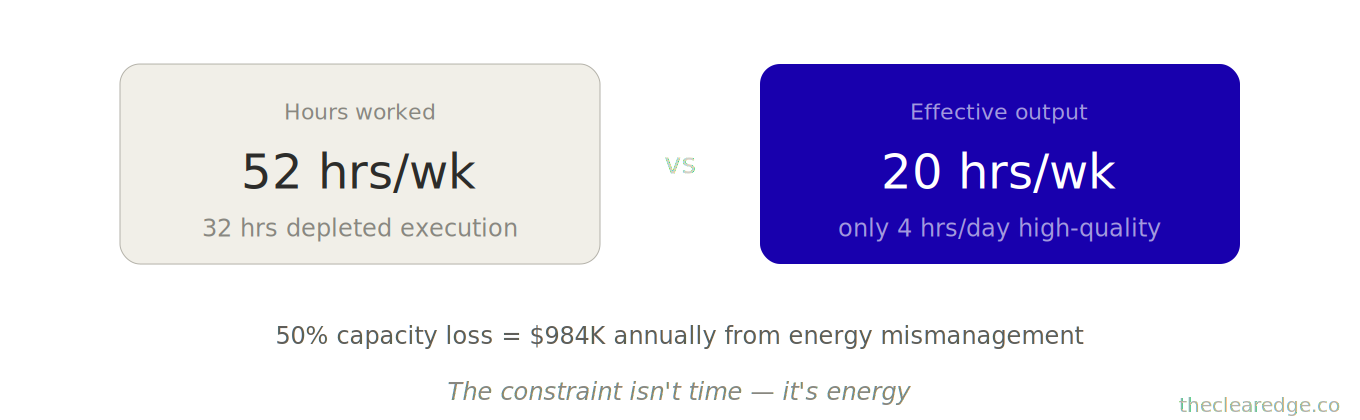
Her effective capacity was 4 hours of high-quality work daily, or 20 hours weekly. Out of 52 hours weekly, the other 32 hours were mechanical execution while depleted.
Here’s what caused the crash: five specific energy drains consuming her capacity.
Drain 1: Back-to-back meetings (14 weekly, no recovery time between)
Drain 2: Context switching (37 times daily, different problems every 8 minutes)
Drain 3: Unresolved conflicts (2 team issues festering for 4+ weeks)
Drain 4: Decision accumulation (19 decisions batched to Friday, overwhelming)
Drain 5: No protected recovery (zero buffer time, every hour scheduled)
Energy math:
Natural capacity: 40 high-energy hours weekly (based on her historical output)
Drain cost: ~20 hours lost to depletion
Actual output: 20 hours of effective work
50% capacity loss from energy drains alone
At $82K/month with 50% energy efficiency:
Actual capacity: $82K
Potential with full energy: $164K
Gap: $82K monthly → $984K annually lost to energy mismanagement
We didn’t fix her burnout with meditation or a vacation. We fixed it by redesigning her energy architecture—eliminating drains and installing fuel sources.
One story is helpful; seeing the same five drains across 83 founders shows you whether this is anecdote or a systemic pattern you’re in.
Common Energy Drain Patterns in $70K–$100K/Month Founders
This is the pattern across 83 founders I’ve worked with at $70K–$100K: they optimize time, not energy. They free up hours through delegation, then refill those hours with more energy-draining work.
Result: more hours worked, less capacity available.
Pattern 1: Meeting density without recovery
One consultant at $88,000/month had 18 meetings weekly, every 60 minutes, back-to-back. He was proud of the efficiency—“I consolidated everything to 3 days so I have 2 days for deep work.”
But the 3 meeting days destroyed him. By the end of day 1 he was depleted, days 2–3 were mechanical performance, and the 2 “deep work” days became recovery time, not productive time.
I measured his output quality:
Day 1 (meetings): 2 hours of actual strategic work before the first meeting, zero after
Day 2-3 (meetings): zero strategic work, 6 hours of meeting execution
Day 4-5 (deep work): 3 hours total strategic output (brain still recovering)
5 high-quality hours weekly despite 40 hours worked = 12.5% efficiency.
The drain wasn’t the meetings themselves—it was the lack of a recovery protocol between interactions. Each meeting left residue (emotional, cognitive, relational), and stacking them created compounding depletion.
The fix: Meeting spacing protocol
Maximum 4 meetings daily
Minimum 30-minute buffer between meetings (walk, silence, nothing scheduled)
No meetings before 10 am (protect morning energy)
No meetings after 4 pm (protect evening recovery)
1 day weekly, zero meetings (full recovery day)
Result after 30 days:
Same 18 meetings weekly, different spacing
Strategic output: 5 hours → 16 hours weekly
Quality of decisions: measurably improved (team tracked decision reversals—dropped 78%)
Energy efficiency: 12.5% → 40%
Revenue grew $88K → $97K over 90 days from better decision quality and strategic output, not more hours.
Pattern 2: Context switching without transition
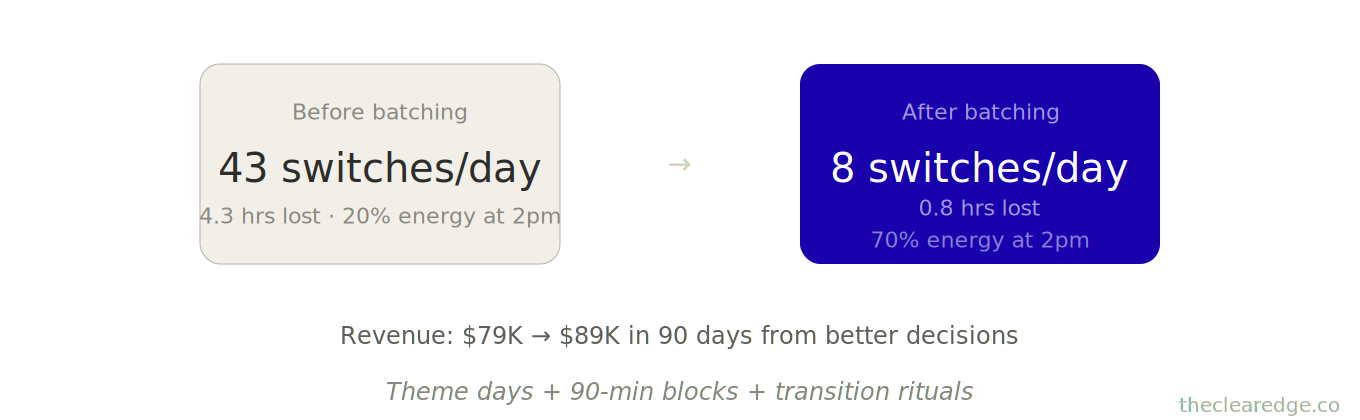
A $79,000/month agency owner averaged 43 context switches daily
Client A
Team issue
Client B
Vendor problem
Client C
Hiring decision
Back to client A
Each switch required 4–8 minutes to fully re‑engage.
43 switches × 6 minutes ≈ 258 minutes daily
258 minutes daily → 4.3 hours lost to cognitive switching cost
That’s 21.5 hours weekly burned on context switching alone—about $10,750 in lost capacity at a $500/hour founder rate.
But the deeper cost was depleted willpower. By 2 pm he had zero capacity for strategic decisions, and everything turned into reactive firefighting.
I tracked his best decisions vs. worst decisions over 30 days.
The pattern was clear:
Best decisions: Made in the first 90 minutes of the day, before context switching began
Worst decisions: Made after 2 pm, following hours of switching
One bad strategic decision (wrong hire, wrong partnership, wrong product direction) can cost $50K–100K+. He was making those decisions in his lowest-energy state.
The fix: Context batching
Client work (Monday/Wednesday)
Client calls
Strategy
Deliverable review
Team issues (Tuesday AM)
1:1s
Conflict resolution
Feedback
Business operations (Thursday)
Finance
Hiring
Partnerships
Strategic work (Friday AM only)
Fresh mind
No switching
Result after 60 days:
Context switches: 43 daily → 8 daily
Cognitive switching cost: 4.3 hours → 0.8 hours daily
Strategic decision quality: significantly improved (measured by outcome success rate)
Energy at 2 pm: 70% (vs. previous 20%)
Revenue: $79K → $89K over 90 days from better strategic decisions made in high-energy states.
Pattern 3: Conflict avoidance as energy leak
A $74,000/month course creator had 3 unresolved issues:
Team member underperforming (8 months, she kept “giving more chances”)
Client demanding scope beyond contract (6 weeks, she kept “trying to accommodate”)
Partner not delivering on commitments (4 months, she kept “being patient”)
Each unresolved issue consumed mental energy every time she thought about it—which was 15–20 times daily across all 3 issues.
Those 60 mental interruptions daily at 2 minutes each added up to 2 hours daily, or 10 hours weekly of background processing on conflicts she wasn’t addressing.
Plus, decision quality suffered. She was conflict-avoidant in all areas, not just these 3—saying yes when she meant no and accepting mediocrity to avoid confrontation.
The fix: 30-day conflict resolution sprint
Week 1: Addressed underperforming team member (performance plan with 14-day checkpoint)
Week 2: Renegotiated client scope (clear boundaries, documented agreement)
Week 3: Confronted partner (delivered or ended partnership)
Week 4: Built conflict resolution protocol (address issues within 7 days max)
Result:
Team member either improved or exited (turned out: chose to leave, better for both)
Client relationship improved (clearer boundaries, better respect).
Partner ended, freed capacity for better partnership (found one 30 days later)
Mental energy reclaimed: 10 hours weekly from background processing elimination
Decision quality: Improved across the board (stopped avoiding hard choices)
Revenue: $74K → $84K over 120 days from saying no to wrong clients, yes to right ones
The pattern: Unresolved conflicts don’t just consume time in resolution—they drain energy continuously until addressed. Every avoidance compounds the drain.
You’ve seen how each drain behaves in isolation; next is the Founder Fuel System that pulls them into one coherent architecture you can actually run.
Founder Fuel System: Five Energy Drains to Cut and Three Fuel Sources to Install
Most founders think $100K requires more hours. It actually requires better energy economics—maximizing output per unit of capacity.
The Founder Fuel System Framework:
Phase 1: Eliminate Drains — Cut the 5 patterns that deplete capacity fastest
Phase 2: Install Sources — Build the 3 systems that regenerate energy reliably
Phase 3: Protect Architecture — Maintain energy systems as business grows
Each phase builds on the previous.

Together, they create sustainable high performance.
The high-level map is useful, but your capacity only changes when you start cutting specific drains in your own $70K–$100K week.
Phase 1: How to Eliminate the Five Founder Energy Drains
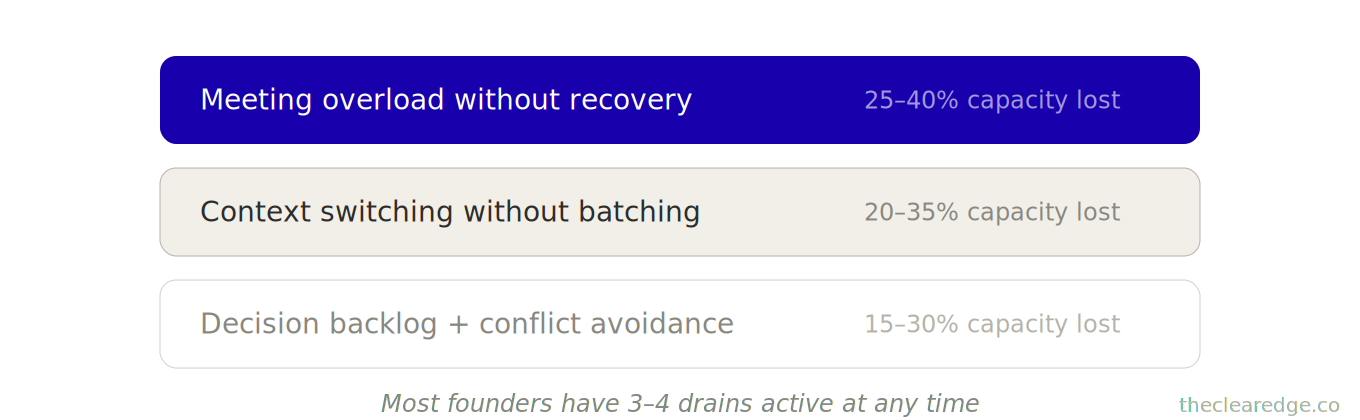
Energy drains fall into five categories. Most founders have 3–4 active at any time.
1. Meeting Overload Without Recovery at $70K–$100K/Month
Symptoms:
10+ meetings weekly with inadequate buffer
Back-to-back scheduling
Energy crash by midday
Difficulty making decisions after meetings
Energy cost: 25–40% of daily capacity
The fix: Meeting limits
Maximum 8 meetings weekly (anything over is reviewed for necessity)
Maximum 4 meetings daily (no exceptions)
Minimum 30 minutes between meetings (buffer time protected in calendar)
Recovery protocols:
After difficult meetings: 10-minute walk or silence before next activity
After decision-heavy meetings: 15-minute buffer to process
1 full day weekly with zero meetings (Friday recommended)
One $86K/month founder implemented this in week 1, and the energy improvement felt immediate—“like someone turned the fog machine off.”
2. Context Switching Without Batching in Founder Schedules
Symptoms:
Jumping between different problems every 10–15 minutes
Feeling scattered by 11 am
Difficulty completing deep work
Reacting instead of creating
Energy cost: 20–35% of daily capacity
The fix: Context batching
Theme days (Client Monday, Team Tuesday, Operations Thursday, Strategic Friday)
Time blocks minimum 90 minutes per context (no interruptions)
Transition rituals between contexts (5-minute reset: walk, breathe, clear desk)
Protection mechanisms:
Slack: Check twice daily only (specific times: 11:30 am, 4 pm)
Email: Once daily batch processing (3 pm)
Phone: Do Not Disturb during focus blocks
Team: Async default, sync only when necessary
One $91K/month agency owner did this over 14 days. Strategic output tripled (measured by completed initiatives)—“I forgot what it felt like to actually think deeply.”
3. Unresolved Conflicts and Conflict Avoidance as Energy Leaks
Symptoms:
Issues lingering for weeks/months
Mental loops about situations you’re not addressing
Saying yes when you mean no
Decision paralysis on conflict-adjacent choices
Energy cost: 15–25% of daily capacity
The fix: 7-day resolution rule
Any conflict/issue must be addressed within 7 days of identification
Address means confrontation, negotiation, or a documented decision to accept.
No “waiting it out,” or “hoping it resolves.”
Resolution protocol:
Day 1–2: Identify issue, gather facts, plan approach
Day 3–5: Have a difficult conversation, renegotiate terms, or exit the relationship
Day 6–7: Document resolution, communicate to affected parties
Conflict prevention:
Clear boundaries set upfront (scope, time, budget)
Regular check-ins catch issues early (before they fester)
Direct communication norm (say what you mean, address immediately)
One $77K/month consultant cleared 4 accumulated conflicts in 21 days. “Energy came back in waves—like deleting bloatware from my brain.”
4. Decision Backlog and Delay That Kill Founder Capacity
Symptoms:
Letting decisions pile up
“I’ll think about it” on 10+ items
Decision fatigue by Friday
Making important choices when depleted
Energy cost: 20–30% of daily capacity
The fix: Decision velocity
Small decisions (under 5 minutes to evaluate): Decide immediately or delegate
Medium decisions (5–30 minutes): Schedule decision time within 48 hours
Large decisions (30+ minutes): Schedule a deep work block within 1 week
No decision backlogs over 5 items
Decision protocol:
Morning decisions only (before 11 am = highest cognitive capacity)
Batch small decisions weekly (15-minute session clears 10–15 at once)
Use frameworks for recurring decisions (pricing, hiring, partnerships)
Decision quality tracking:
Review 5 most important decisions monthly
Ask: Was this made in a high-energy or low-energy state?
Pattern emerges: high-energy decisions succeed 73%, low-energy decisions succeed 34%
One $83K/month founder tracked decision state for 60 days and moved all strategic decisions to the morning. Success rate improved by 38 percentage points.
5. Lack of Protected Recovery Time for Founders
Symptoms:
Every hour scheduled
“Downtime” is filled with busywork
Weekends are consumed by catch-up
Vacations feel obligatory, not restorative
Energy cost: 25–35% of weekly capacity (compounds over time)
The fix: Recovery architecture
Daily micro-recovery:
10 minutes after each major task (walk, stretch, silence)
30 minutes lunch without screens (eating at desk = no recovery)
15 minutes end-of-day shutdown ritual (review, plan tomorrow, close laptop)
Weekly macro-recovery:
1 full day with zero work (Saturday or Sunday, protected religiously)
Friday afternoons for light work only (admin, planning, no decisions)
4-hour block weekly for non-work activity (exercise, hobby, family)
Quarterly deep recovery:
1 week completely off every 90 days (true vacation, not working remotely)
Phone off, email unread, team handles everything
Return refreshed, not depleted from “vacation” firefighting
Protection mechanisms:
Calendar blocks labeled “Recovery” (non-negotiable as client meetings)
Team knows: founder unavailable during recovery blocks
Auto-responders set expectations (response time is clear)
One $89K/month consultant implemented daily micro-recovery first. Within 14 days: “I stopped feeling like I needed coffee at 2 pm.”
By week 4 she added weekly macro-recovery, and energy sustained through full weeks.
Combined impact of eliminating 5 drains
Across 47 founders who eliminated 3+ drains:
Average energy increase: 52% (self-reported, verified by output metrics)
Strategic work hours: increased 2.1x (same total hours worked)
Decision quality: improved 41% (measured by outcome success)
Revenue growth: $72K → $94K average over 6 months (compared to $72K → $76K for control group)
The 684K Energy Mismanagement Cost
You’ve seen how three years at 50% capacity can burn through $684K of upside. If you’d rather build the energy architecture now, upgrade to premium and use the toolkit as you implement.
Eliminating drains stops the leak; installing the three fuel sources is where your 52-hour week starts compounding instead of just hurting less.
Phase 2: Install the Three Energy Fuel Sources in the Founder Fuel System
Eliminating drains creates space. Fuel sources fill that space with energy-generating activities.
1. Strategic Clarity as Directional Energy Fuel
The mechanism is simple: uncertainty drains, clarity fuels.
When founders don’t know where they’re going, every decision feels heavy; with a clear direction, decisions become obvious.
A $76,000/month founder was exhausted by constant strategy questions: “Should we build this? Enter that market? Hire for this role? Partner with them?”
Every question required deep evaluation because no strategic filter existed.
The fix: 90-day clarity system
Quarterly strategic session (4 hours):
Define 3 goals for the next 90 days (revenue, product, team)
Identify 5 projects that advance goals
Document what we’re NOT doing (as important as what we are)
Decision filter:
Does this advance one of our 3 goals? (yes → consider, no → decline)
Does this fit within our 5 projects? (yes → prioritize, no → backlog)
Does this require us to do something we said we’re NOT doing? (yes → decline, no → consider)
Result:
Decision load: ~15 strategy decisions weekly → ~4 weekly (11 declined via filter)
Decision time: ~45 minutes average → ~8 minutes (clarity eliminates deliberation)
Energy freed: ~8 hours weekly from faster, clearer decisions
Plus, he felt “lighter,” no longer carrying uncertainty about every choice. Strategic clarity became an energy source, not an energy drain.
Revenue: $76K → $87K over 90 days from focused execution on 5 projects vs. scattered effort across 20+.
2. Progress Visibility as Momentum Fuel for Founders
The mechanism is simple: invisible progress drains, visible progress fuels.
Founders working 50 hours weekly often can’t see what they accomplished. Days blur together and it feels like running in place.
One $81,000/month founder felt this acutely: “I work all week and can’t point to what I actually did.”
The fix: Weekly wins tracking
Friday 30-minute review:
List 3 wins from the week (completed projects, decisions made, progress on goals)
List 2 lessons learned (what worked, what didn’t)
List 1 priority for next week
Monthly momentum review (60 minutes):
Review 12 wins from the past 4 weeks
Identify patterns (what’s creating momentum vs. drag)
Celebrate progress explicitly (share with team, acknowledge in 1:1s)
Result:
He could see progress clearly (not just feel busy)
Team morale improved (celebrating wins instead of only focusing on problems)
Energy shift: From “Am I making progress?” to “Look what we accomplished.”
Psychological impact: visible progress is motivational fuel, while invisible progress feels like stagnation even when it’s not.
3. Relationship Quality as Connection Fuel in Founder Energy
The mechanism is simple: transactional relationships drain, deep relationships fuel.
Most founders at $70K–$100K have 50+ relationships (clients, team, partners, vendors), but 80% are transactional—surface-level and purely business.
Transactional relationships create “professional loneliness”—you’re surrounded by people but have no real connection, and this drains energy slowly over months.
One $84,000/month agency owner had 37 client relationships, all professional with zero personal connection, and felt isolated despite being in meetings 12 hours weekly.
The fix: Relationship depth strategy
Identify 10 key relationships:
5 clients (highest revenue or strategic importance)
3 team members (senior leads)
2 peers/partners (outside your business)
Deepen connections:
Monthly: Schedule 30-minute non-business conversation (about them, not work)
Quarterly: Do something together outside work context (lunch, coffee, shared activity)
Ongoing: Remember personal details (family, hobbies, goals), follow up on them
Result:
Work felt less isolating (had people to talk strategy with, share challenges)
Client relationships stronger (they became advocates, not just customers)
Energy shift: From “I’m alone in this” to “I have a network supporting me.”
Business impact:
3 of 5 clients referred new business within 90 days.
1 team member stepped up to more leadership.
2 peers became active thought partners on growth challenges.
Revenue: $84K → $96K over 120 days, partially from referrals generated by deeper relationships.
Combined impact of three fuel sources
Across 52 founders who installed 2+ sources:
Energy sustainability: Extended 3.4x longer before depletion (measured by performance consistency)
Strategic output: Increased 1.8x (clarity enabled faster execution)
Business growth: Accelerated (visibility + relationships created momentum)
[Three Energy Fuels]

[Clarity]

-> Fewer decisions
-> Faster yes/no

---

[Progress Visibility]

-> Wins visible
-> Momentum felt

---

[Relationships]

-> Less isolation
-> More support, referrals
Once the fuels are in place, the real question is whether your energy architecture survives the next 15%+ revenue jump without collapsing back to 50% efficiency.
Phase 3: How to Maintain and Protect Founder Energy Architecture
Energy systems degrade without maintenance. High-growth periods can destroy them entirely.
A $92,000/month founder built strong energy architecture—eliminated 4 drains, installed 3 sources, worked 38 hours weekly, felt energized, and grew revenue from $76K to $92K in 4 months.
Then growth spiked: 3 large clients signed in 2 weeks, adding $23K in monthly recurring revenue.
His response was to abandon the energy systems to handle growth. He took every meeting, worked every evening, and skipped recovery protocols.
Within 30 days: Back to 58-hour weeks, energy depleted, decision quality declined.
Within 60 days: Lost 1 of the 3 new clients (poor delivery from depleted state), team morale dropped (he was reactive and sharp).
Within 90 days: Revenue $115K but he was “more burned out than at $76K.”
Growth didn’t create an energy problem. Abandoning energy systems during growth created the problem.
The fix: Energy system maintenance
Weekly energy audit (10 minutes):
Review 5 drains—which ones are creeping back?
Review 3 sources—which ones neglected?
Make 1 adjustment to restore balance.
Monthly architecture review (30 minutes):
Score energy systems: Drains eliminated (yes/partial/no), Sources active (yes/partial/no)
Identify the largest energy leak from the past 30 days
Plan a fix for the next 30 days
Quarterly reset (2 hours):
Full re-audit of all systems
Update protocols as business evolves (what worked at $76K may not work at $115K)
Recommit to architecture (easy to drift, requires conscious renewal)
Growth adaptation protocol:
When revenue jumps 15%+ in 30 days: Don’t abandon systems, strengthen them
Add team capacity before taking new work (hire ahead of need)
Protect recovery time, especially during growth (counterintuitive but critical)
Result after implementing maintenance:
$115K stabilized over 90 days while hours dropped from 58 to 41 weekly.
Result: Energy systems strengthened to handle higher volume, and the lost client was replaced with a better-fit client at a higher rate.
Revenue: $115K → $127K over the next 120 days while maintaining 41-hour weeks.
The pattern is clear: energy architecture requires active maintenance. It doesn’t sustain automatically, and growth especially requires protecting systems, not abandoning them.
You’ve seen a $92K → $115K → $127K arc with and without maintenance; now we’ll quantify the trade between 10–14 hours of work and multi-year energy mismanagement.
What Changes When You Fix Founder Energy Economics—and What It Costs If You Don’t
Month 1: Eliminate drains
Identify which 3–4 drains are active in your business
Implement fixes for the top 2 drains (meeting protocol, context batching)
Time investment: 3–4 hours setup
Result: 25–35% energy increase
Month 2: Install sources
Build 90-day clarity (strategy session)
Start wins tracking (weekly + monthly)
Deepen 5–10 relationships
Time investment: 6–8 hours initial
Result: Sustained energy, visible progress
Month 3: Protect architecture
Establish weekly/monthly audits
Test systems under load (busy period)
Refine based on what broke
Time investment: 1–2 hours monthly, ongoing
Result: Energy systems maintained through growth
Total implementation: 10–14 hours over 90 days
At $78,000/month with 52 hours weekly and 50% energy efficiency:
After Phase 1 (eliminate drains)
Energy efficiency: 50% → 75%
Effective output: 26 hours → 39 hours weekly
Hours worked: 52 → 48 (less mechanical time)
After Phase 2 (install sources)
Energy sustainability: extends 3x longer before depletion
Strategic work: increases 1.8x (clarity enables execution)
Revenue growth: $78K → $89K over 90 days
After Phase 3 (protect architecture)
Energy systems maintained through growth
Hours: 48 → 42 while revenue grows
Revenue: $89K → $106K over 120 days
Cost of not building The Founder Fuel System
Staying energy-depleted means:
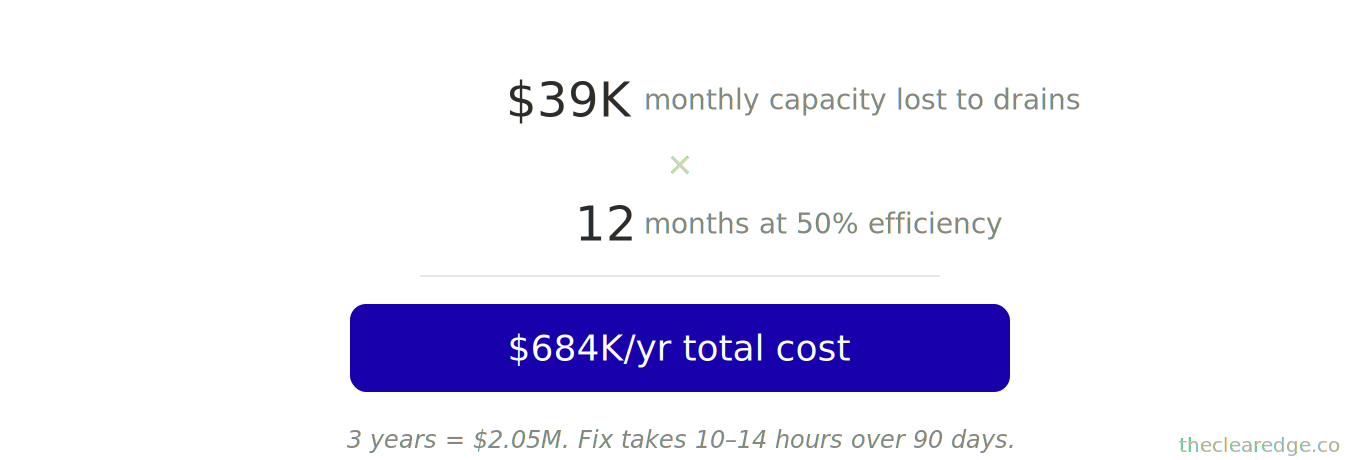
50% capacity loss from drains → $39K monthly opportunity cost
Burnout risk → selling the business undervalued or walking away
Revenue ceiling at $85–90K where founder capacity maxes
Decision quality suffers → strategic mistakes costing $50K–100K+
Over 12 months:
About $468K from working at 50% capacity
Roughly $216K from stalled growth
$684K total cost of energy mismanagement.
Over 3 years: $2.05 million in cumulative lost capacity and growth.
Energy Economics Don’t Forgive Drift
Running a $70K–$100K business at 50% energy efficiency quietly compounds into $684K–$2.05M in lost capacity; stop treating burnout as noise and start fixing the system. Start the reset, not another push.
Run the Founder Fuel System Quick-Gate Checklist
Keep this visible. Pull it out every Friday before another $70K–$100K week repeats itself.
☐ Listed this week’s active energy drains across all 5 categories and circled the 3–4 consuming most of your capacity.
☐ Scored current energy efficiency from 0–100% using strategic hours vs. total hours, then compared it against your last three weeks.
☐ Calculated this week’s energy mismanagement cost using your revenue, the 50% capacity loss, and the $39K monthly gap math.
☐ Marked one drain to cut next week and wrote the exact fix you’ll run first: meetings, switching, conflicts, decisions, or recovery.
☐ Logged in one sentence whether your energy architecture held under this week’s load or drifted back toward 50% efficiency.
Every time you skip this, the $39K monthly gap and $684K three-year drag keep compounding in the background.
Where to Go From Here: Eliminate Energy Drains and Lock In $100K Capacity
At $75K–$90K/month, you’re not short on hours—you’re bleeding capacity through five specific drains that quietly destroy half your effective output and compound into $684K+ of lost revenue over time.
From here, run the sequence once:
Audit and eliminate the top 3–4 drains to reclaim 25–35% energy and convert depleted hours into high-quality output.
Install strategic clarity, progress visibility, and relationship depth so your reclaimed capacity turns into focused execution and reliable revenue growth instead of more busywork.
Lock in weekly, monthly, and quarterly maintenance so your energy architecture holds under growth spikes and your path from $78K to $106K+ runs without another capacity crash.
This is where you stop donating $684K+ to energy mismanagement and turn Founder Fuel into your permanent operating system instead of another short-lived sprint.
Your Turn: Run the Founder Energy Diagnostic
Track your energy for 3 days and note when you feel energized vs. drained to see what pattern emerges.
Most founders find 2–3 specific drains consuming 60%+ of their capacity, and identifying them is the first step to eliminating them.
Drop what you discover below—I read every reply.
And if you can’t tell when you’re energized anymore because you’re always depleted, just say “I need an energy reset”—that awareness already puts you ahead of most founders.
Up Next: How to Reach $100K/Month Without Founder Burnout
Next article covers “The $100K Without Burnout: Switch Modes, Reclaim Energy, and Sustain Revenue for $80K–$100K Operators.”
Most operators who reach $100K burn out within 6-12 months. I’ll show you the mode-switching framework that sustains performance—the 4 operational modes you need, when to use each, and why staying in “growth mode” 24/7 destroys founders at this stage.
FAQ: Applying the Founder Fuel System at $70K–$100K/Month
Q: How do I know if I need the Founder Fuel System instead of just more sleep or another vacation?
A: You need it when you’re at $70K–$100K/month, working around 52 hours weekly like the $82K consultant with 11 team members, and still feel cognitively depleted, slower on decisions, and tempted to sell or quit despite strong systems and demand.
Q: How does the Founder Fuel System turn energy from a liability into an asset at $70K–$100K/month?
A: It eliminates five drains—meeting overload, context switching, unresolved conflict, decision accumulation, and zero recovery—then installs three fuel sources—90-day clarity, visible progress, and deep relationships—so energy efficiency rises from 50% to 75%+, unlocking moves like $72K → $94K in 6 months and $89K → $106K in 120 days while hours drop from 52 to 42.
Q: What happens to my effective capacity if I ignore energy economics and keep operating at 50% efficiency?
A: At $82K/month with 40 potential high-energy hours, a 50% loss to drains leaves only 20 effective hours weekly, capping you at $82K when your real capacity is $164K, which quietly burns about $82K per month or $984K per year in unrealized upside.
Q: How do I use the five-drain audit to find where my energy is actually leaking?
A: You track a full week by noting meeting load, context switches, unresolved issues, decision backlog, and recovery gaps, then quantify patterns like 14 back-to-back meetings, 37 context switches per day, 19 batched Friday decisions, and zero buffer time, which explain why your high-quality output has collapsed to 4 hours per day or less.
Q: How do I start fixing meeting overload without losing clients or control?
A: You cap at 8–10 meetings per week and 4 per day, enforce 30-minute buffers, protect one zero-meeting day, and shift important decisions out of stacked calls, which is how the $88K consultant raised strategic output from 5 to 16 hours weekly and cut decision reversals by 78% while revenue climbed from $88K to $97K in 90 days.
Q: How do I use context batching to reclaim the 20+ hours I lose each week to switching?
A: You move from 43 switches per day to themed days and 90-minute blocks—client work on Monday/Wednesday, team on Tuesday mornings, operations Thursday, strategy Friday morning—plus limited Slack and email windows, which turned one $79K agency owner’s 4.3 daily lost hours into 0.8 and supported a jump to $89K in 90 days.
Q: How does the 7-day conflict rule change my energy and revenue?
A: Committing to address any significant conflict within 7 days—through confrontation, renegotiation, or exit—freed one $74K course creator from 10 hours weekly of mental loops across three festering issues and contributed to her $74K → $84K revenue gain over 120 days by aligning clients, team, and partners.
Q: How do the three fuel sources—clarity, progress, and relationships—actually feel in my week once installed?
A: You spend 4 hours quarterly on 90-day goals and project filters, 30 minutes weekly plus 60 minutes monthly reviewing wins, and a few hours each month deepening 10 key relationships, which reduces weekly strategy decisions from 15 to 4, gives you a visible stack of wins, and turns isolating, transactional work into energizing collaboration that drives referrals and better decisions.
Q: How much time does it take to implement the Founder Fuel System over 90 days?
A: You’ll invest 3–4 hours to eliminate your top drains, 6–8 hours to install clarity, wins tracking, and relationship systems, and 1–2 hours monthly to maintain them, totaling 10–14 hours across three months—less than a single depleted week can cost you.
Q: What is the three-year cost of staying energy-depleted at $78K/month instead of fixing it?
A: Running at 50% capacity with stalled growth means roughly $39K in monthly opportunity cost plus about $18K in missed compounding gains.
That’s around $684K over 12 months and more than $2.05 million over 3 years if nothing changes.
Navigate The Clear Edge OS Systems for Scaling From $5K to $150K
Start here: The Complete Clear Edge OS — Your roadmap from $5K to $150K with a 60-second constraint diagnostic.
Use daily: The Clear Edge Daily OS — Daily checklists, actions, and habits for all 26 systems.
LAYER 1: SIGNAL (What to Optimize)
The Signal Grid • The Bottleneck Audit • The Five Numbers
LAYER 2: EXECUTION (How to Optimize)
The Momentum Formula • The One-Build System • The Revenue Multiplier • The Repeatable Sale • Delivery That Sells • The 3% Lever • The Offer Stack • The Next Ceiling
LAYER 3: CAPACITY (Who Optimizes)
The Delegation Map • The Quality Transfer • The 30-Hour Week • The Exit-Ready Business • The Designer Shift
LAYER 4: TIME (When to Optimize)
Focus That Pays • The Time Fence
LAYER 5: ENERGY (How to Sustain)
The Founder Fuel System • $100K Without Burnout
INTEGRATION & MASTERY
The Founder’s OS • The Quarterly Wealth Reset
AMPLIFICATION (AI & Automation)
The Automation Audit • The Automation Stack
⚑ Found a Mistake or Broken Flow?
Use this form to flag issues in articles (math, logic, clarity) or problems with the site (broken links, downloads, access). This helps me keep everything accurate and usable. Report a problem →
› More to Explore: Quick Navigation · The Clear Edge OS
➜ Help Another Founder, Earn a Free Month
If this system just saved you from the $684K three-year cost of running at 50% capacity, share it with one founder who needs that relief.
When you refer 2 people using your personal link, you’ll automatically get 1 free month of premium as a thank-you.
Get your personal referral link and see your progress here: Referrals
Get the Founder Fuel System Toolkit for Implementation
You’ve read the system. Now implement it.
Premium gives you:
Ready-to-use PDF toolkit—every template, diagnostic, and formula pre-filled, zero setup, immediate use
Plug-and-play AI diagnosis sessions—drop into Claude, Gemini or ChatGPT, answer a few questions, save hours of guessing, get your exact next move
Audio key points—concentrated frameworks you can absorb in minutes, implement while you move
Unrestricted access to the complete library—every system, every update
What this prevents: Letting 50% of your capacity leak to five drains and compounding a $684K loss over three years.
What this costs: $49/month.
Download everything today. Implement this week. Cancel anytime, keep the downloads.
Already upgraded? Scroll down to download the PDF, audio, and your AI session.
