


The Executive Summary
Founders at $30K–$40K/month quietly bleed six figures a year as distraction eats revenue hours; protecting 20 focused hours turns the same 47–52 hours into $47K–$54K months.
Who this is for: Course creators, coaches, and agency founders at $30K–$40K/month working 47–52 hour weeks who feel “always on” while real revenue work keeps getting interrupted.
The Focus Problem: Unprotected time leaks 15–25 hours weekly, costing $60K–$120K annually and up to $77,616 per month as high-value work loses to Slack, email, meetings, and fake-urgent tasks.
What you’ll learn: A punchy Focus That Pays system with three moves—identify your 20 revenue hours, build a moat around them, and measure revenue per protected hour.
What changes if you apply it: Calendars center on 20 protected revenue hours weekly, hours shift from 52 → 45–47, and revenue climbs from $32K–$41K → $47K–$54K+ with smoother, compounding growth.
Time to implement: Spend 15–25 minutes auditing last week, 4 weeks locking your moat and tracking, and see visible lift inside 30–90 days with six‑figure upside over 12 months if you maintain it.
Written by Nour Boustani for $30K–$50K/month founders who want $47K–$54K focus-fueled growth without 60-hour weeks, random revenue swings, or watching high-value hours disappear into Slack and meetings.
If distraction is quietly taxing $60K–$120K a year from your calendar, use this as your line in the sand and upgrade to premium to implement Focus That Pays end-to-end.
› Library Navigation: Quick Navigation · The Clear Edge OS
Why Revenue Stalls at $38K Months for 30K–40K Founders Working 47–52 Hours
This is what a $38K ceiling actually looks like: a full 52-hour week where high-value time keeps losing to low-value demands.
Three weeks ago, I talked to a course creator making $38,000/month who’d been stuck there for 7 months. Working 52 hours per week. Felt busy every single day.
He couldn’t understand why revenue wouldn’t move.
I asked him to track for one week, hour by hour, logging what he actually did versus what he planned to do.
Here’s what we found:
52 hours worked per week
18 hours on revenue work (sales calls, content creation, customer success)
34 hours on everything else (meetings about meetings, Slack responses, “quick questions,” dashboard checking, email management)
His effective revenue rate:
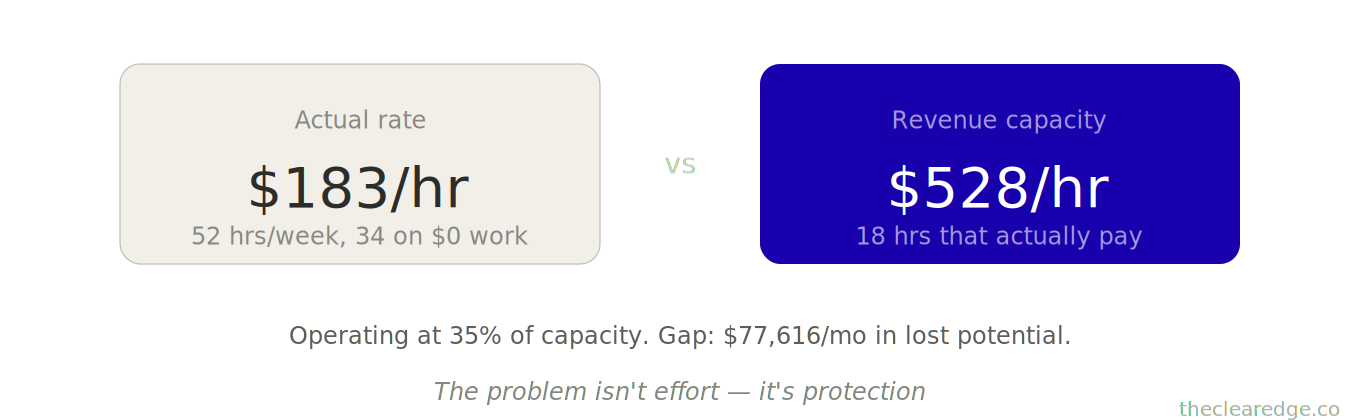
$38,000 ÷ 72 revenue hours monthly = $528/hour
$38,000 ÷ 208 total hours monthly = $183/hour
He was operating at $183/hour while sitting on $528/hour capacity.
The gap: 34 hours weekly × 4.33 weeks = 147 hours monthly
At $528/hour capacity = $77,616 monthly lost to distraction
(Monthly calculation = weekly hours × 4.33.)
“I thought I was being responsive,” he said. “Available. Accessible.”
Wrong framework.
Being responsive to everyone makes you unavailable for revenue work. Every “quick question” trades $528/hour time for a $0 return, and every meeting without a clear outcome costs real money.
His real problem wasn’t effort. It was protection.
We rebuilt his week around one business rule: guard 20 hours weekly for work that generates revenue, and schedule everything else around those hours.
Protecting the hours that make money is the real constraint at $38K, not finding more clients.
Changes:
Revenue blocks:
7–11 am Monday, Wednesday, Friday (12 hours).
2–5 pm Tuesday and Thursday (6 hours).
7–9 am Saturday (2 hours).
Total: 20 protected hours.
No meetings during revenue blocks, no Slack or email, and the phone stays in another room.
All “quick questions” batched to 11 am–12 pm daily
Team check-ins moved to 4–5 pm Monday/Thursday only
Stopped attending six standing meetings that had no revenue impact
Timeline:
Week 1: Shipped three pieces of content in protected blocks (previous average: 1 per week)
Week 2: Completed sales sequence rewrite (sat unfinished for 4 months)
Week 3: Closed four new customers from better content + sequence
Month 2: Revenue hit $47,000 (+$9K)
Month 3: Revenue hit $54,000 (+$16K from baseline)
Hours/week: 52 → 47
Revenue hours: 18 → 20 (protected)
Revenue: $38K → $54K (+$16K)
Revenue per Protected Hour = New revenue generated ÷ Protected hours used
This is your North Star metric. Track it weekly.
The 20-Hour Protection Plan
Identify your 20 — Define which specific activities generate revenue, block 20 hours weekly
Build the moat — Make interruption expensive (phone away, apps closed, auto-decline on)
Measure the return — Track revenue per protected hour weekly
Enforce 90 days, no exceptions — Prove the system works before adjusting
Growth didn’t come from more effort; it came from 20 protected hours doing the work that actually pays.
The Distraction Pattern Capping $30K–$50K Founders Who Can’t Protect Revenue Hours
Now that you’ve seen protection in action, here’s why it collapses for most founders.
Distraction types change by stage, but the failure mode remains the same: high-value hours are lost to low-value demands.
At every revenue stage, there’s a predictable distraction pattern:
At $15K–25K/month:
Revenue work: 12–15 hours weekly
Everything else: 35–40 hours
Primary leak: Doing work that should be delegated or deleted (client delivery tasks you could pay $20–$30/hour for, using time that drives $200–$500/hour in revenue).
At $25K–40K/month:
Revenue work: 15–20 hours weekly
Everything else: 30–35 hours
Primary leak: Meetings without outcomes and “staying on top of everything” that feels important but generates $0.
At $40K–60K/month:
Revenue work: 18–25 hours weekly
Everything else: 25–30 hours
Primary leak: Saying yes to non-core opportunities (speaking gigs, partnerships, “collaborations” that consume weeks and produce nothing).
At $60K+/month:
Revenue work: 20–30 hours weekly
Everything else: 20–25 hours
Primary leak: Managing team drama and fixing problems that shouldn’t exist (wrong hires, no systems, constant firefighting).
The revenue ceiling isn’t a strategy problem; it’s a protection problem.
What got you to your current level won’t get you to the next because, even as distraction types change, the pattern stays the same: high-value hours keep losing to low-value demands.
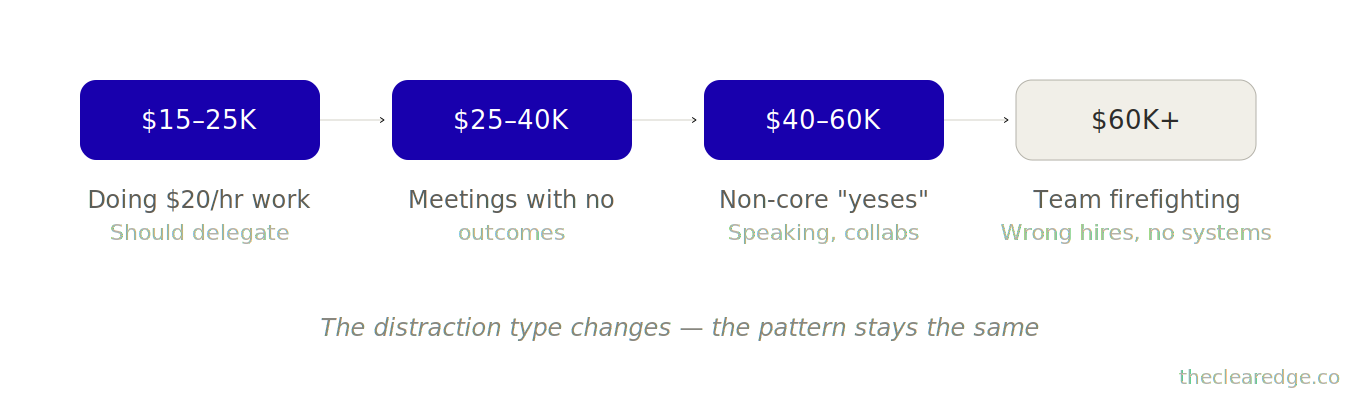
At $30K–$50K/month, the pattern looks like this:
Founders know what makes money but can’t defend it from interruption.
Across 53 businesses I’ve audited at this stage, 76% lose 15–25 hours weekly to unprotected time, and that leak costs $60K–$120K annually in lost capacity.
This follows a basic economic principle, often described as opportunity cost: the highest-value work must be protected from the lowest-value demands, or the business caps out at the founder’s distraction threshold.
You grow by being unavailable to the wrong things.
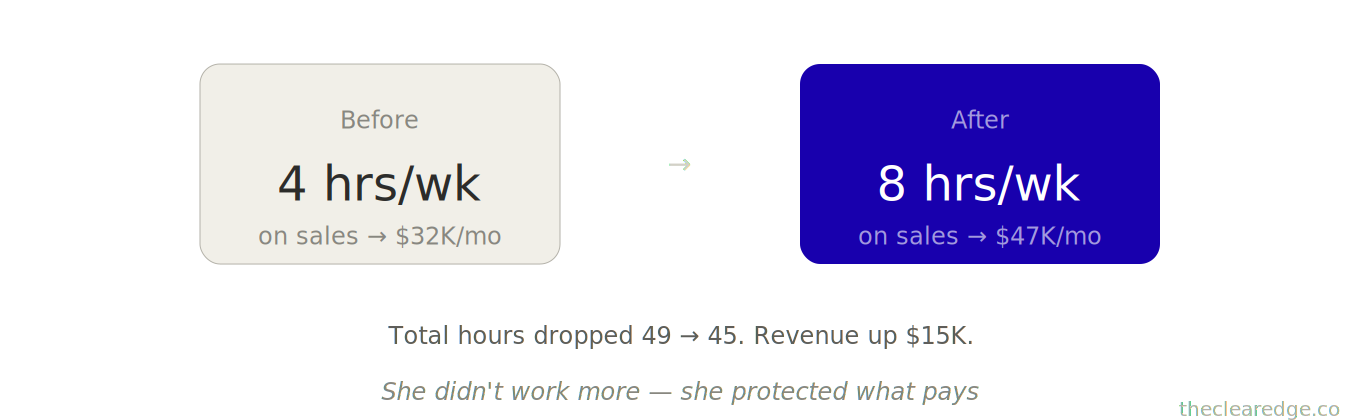
Case: Consultant at $32K/month with a full calendar but no sales time
Earning $32,000/month from 9 clients, each at $3,555.
Working 49 hours per week with capacity for 2–3 more clients.
Couldn’t find time for sales because her calendar was full.
Her week breakdown:
Client delivery: 27 hours
Sales/marketing: 4 hours
Email management: 11 hours
Team coordination: 5 hours
“Urgent” client requests outside scope: 2 hours
The constraint wasn’t sales skill. It was time allocation.
Current math:
4 hours weekly on sales = 17 hours monthly
Close rate: 38% from qualified conversations
Conversations per month: 6
New clients: 2.3 monthly (she was stuck because delivery consumed all the time)
Potential math if sales time doubled:
8 hours weekly on sales → 35 hours monthly
Same close rate: 38%
Conversations would double: 12 monthly
New clients: 4.6 monthly → +$16,373 in new revenue within 90 days
The gap: $196,476 annually from not protecting sales time.
We didn’t change her sales process. We protected her sales hours.
Changes:
Sales blocks: Tuesday/Thursday 9 am–12 pm (6 hours weekly, immovable)
Email: Checked 10 am, 2 pm, 5 pm only (30 minutes each, for a total of 1.5 hours daily, down from 2.5).
Team coordination: Monday 3–4 pm standing meeting replaced six scattered check-ins
“Urgent” client requests: Batched to 5–6 pm daily unless actual emergency
Result:
Sales hours: 4 → 8 weekly
Conversations: 6 → 11 monthly
New clients: Month 1: +2, Month 2: +3, Month 3: +2
Hours/week: 49 → 45
Sales hours: 4 → 8 (protected)
Revenue: $32K → $47K (+$15K)
She stopped letting urgency dictate her calendar and started protecting the hours that compound.
Another agency founder was stuck at $41,000/month for 8 months with 12 clients at $3,416 each, working 51 hours per week, and wanting to hit $60,000 but unable to scale delivery.
He thought he needed better systems. Wrong diagnosis.
His actual time breakdown:
Client work: 24 hours weekly
Internal meetings: 14 hours weekly (6 standing meetings + ad-hoc “syncs”)
Administrative work: 8 hours weekly
Revenue work (sales, content, strategy): 5 hours weekly
The math everyone misses
14 hours in meetings × 4.33 weeks = 60.6 hours monthly
At his $400/hour proven capacity → $24,240 monthly opportunity cost
If half those meetings were eliminated and reallocated to revenue work: $12,120 monthly in recovered revenue generation capacity
Over a year: $145,440 in lost opportunity costs from unnecessary meetings.
We didn’t build new systems. We cut the meeting culture.
Changes:
Killed 4 of 6 standing meetings and only kept Monday planning plus Friday review.
Asked “Can this be a Loom?” before booking any meeting, using quick screen-recorded videos instead of live calls when possible.
Set a hard rule of no meetings before 1 pm so mornings stayed reserved for revenue work.
Required every meeting to have a clear outcome, a decision to be made, and a maximum length of 30 minutes.
Timeline:
Week 1: Freed 9 hours from eliminated meetings
Week 2: Reallocated 6 hours to sales (outreach, proposals, follow-ups)
Month 1: Closed two new clients = $48,248
Month 2: Closed one more = $51,664
Month 3: Hit $58,496 (one client expansion + one new client)
Results:
Hours/week: 51 → 46
Meeting hours: 14 → 5
Revenue work hours: 5 → 14
You’ve probably felt this pattern too: a full calendar, flat revenue, and busy days where nothing meaningful moves.
The answer isn’t better time management; it’s ruthless time protection.
When I ask what those “protected” hours actually produced, the usual response is silence.
Founders who break through aren’t the ones doing more—they’re the ones protecting less, and defending it viciously.
The Focus That Pays Framework for Guarding 20 Weekly Revenue Hours at $30K–$50K
Here’s where founders lose focus.
You can’t protect time you haven’t defined. Most founders defend “focus time” but can’t explain what it’s for. “Deep work” sounds good, but without a revenue link, it’s just noise.
The question isn’t “How do I focus better?” It’s “Which 20 hours each week actually generate revenue—and how do I make those hour
Knowing Focus That Pays Isn’t Running It
You’ve got the Focus That Pays framework now; if you want it driving your calendar instead of sitting in your notes, upgrade to premium and use the toolkit that turns definition into execution.
The Three Focus That Pays Moves to Run a 20-Hour Weekly Protection System
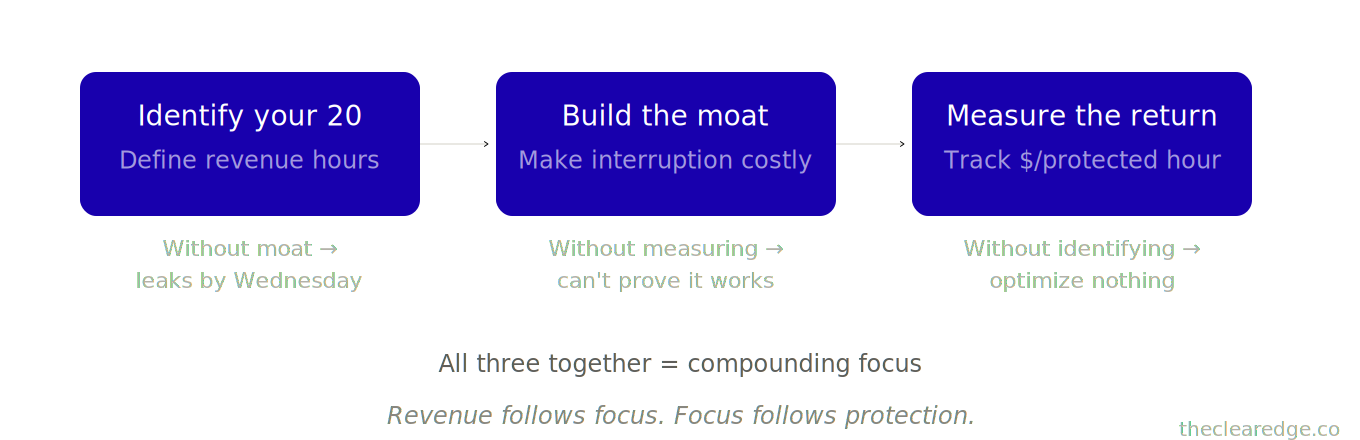
Move 1: Identify Your 20 — Define which specific activities generate revenue, then block 20 hours weekly for them
Failure mode: Identify without a moat → you’ll leak time by Wednesday.
Move 2: Build the Moat (Make Interruption Expensive) — Create systems that defend those 20 hours from interruption, urgency, and low-value demands
Failure mode: Build without measuring → you protect time but don’t know if it’s working.
Move 3: Measure the Return — Track revenue per protected hour to prove the system works and adjust what gets protection
Failure mode: Measure without identifying → you track everything but optimize nothing.
Why this sequence matters
Identifying without building means you know what matters, but can’t defend it.
Building without measuring means you protect time, but don’t know if it’s working.
Measuring without identifying means you track everything but optimize nothing.
All three together create compounding focus.
Here’s what this looks like when executed properly:
A membership creator was making $24,000/month from 480 members at $50 each. Working 48 hours per week and spending 31 hours on member support, community management, and “engagement.”
Only 8 hours weekly on content creation (the thing that brought in new members).
Growth profile before protection:
Growth rate: 12–18 new members monthly
Churn rate: 8–14 members monthly
Net growth: 4 new members per month, or $200 in added revenue.
At that pace, it would take about 130 months to reach $50K.
The constraint wasn’t content quality; it was content volume.
They needed more content to attract members, but support work ate the available time, so we ran all three moves.
Move 1 (Identify Your 20)
Tracked what actually drove new members: content—articles, videos, and posts—not community engagement or individual support questions.
They needed 20 hours a week protected for content creation but were only getting 8.
Move 2 (Build the Moat)
Shifted member support to async (recorded weekly FAQ video addressing common questions instead of 1:1 responses)
Community management: Appointed three power members as moderators (paid in free membership)
Set “office hours” twice weekly for live questions (instead of all-day availability)
Batched all admin work to Friday, 2-5 pm
Result: Support time dropped from 31 to 12 hours per week, freeing 19 hours.
Move 3 (Measure the Return)
Week 1-4: 20 hours on content → Shipped 4 articles, 6 videos, 12 posts
New members: 47 (up from 12-18 average)
Churn: 11 (similar to baseline)
Net growth: +36 members → +$1,800 monthly
Revenue per protected hour: $1,800 ÷ 80 hours = $22.50/hour in new recurring revenue (this compounds monthly)
Timeline:
Month 1: +36 members = $25,800 total
Month 2: +41 members = $27,850 total
Month 3: +38 members = $29,750 total
Month 4: +44 members = $31,950 total
Results:
Hours/week: 48 → 44
Support hours: 31 → 12
Revenue: $24,000 → $31,950 (Month 4)
Growth came from reallocation, not addition.
Let me walk you through each move with real numbers and examples.
Move 1: Identify Your 20 Highest-Return Weekly Revenue Hours at $30K–$50K
Not all hours are equal. Some make money; most don’t.
The trap is treating all work as equally important. Email feels productive, meetings feel necessary, and Slack responses feel like leadership—but none of them generates revenue.
Revenue work has one definition: activity that directly leads to money in the bank within 90 days.
For most businesses, that’s:
Sales conversations and follow-ups
Content that attracts buyers
Product/service delivery that earns referrals
Strategic decisions that multiply output
Everything else is support work. Support work matters, but it doesn’t make money; revenue work does.
A coach making $29,000/month tracked her hours for two weeks.
Found she spent:
6 hours weekly on sales (calls, proposals, follow-ups)
4 hours weekly on content (posts, emails, videos)
8 hours weekly on program delivery
14 hours weekly on email/admin
12 hours weekly on “business development” (networking events, coffee chats, exploratory calls that went nowhere)
4 hours weekly on learning/courses
Only 18 hours weekly generated revenue. The other 30 hours were support work or wasted motion.
The math:
Her close rate: 42% from qualified sales calls
Average deal: $4,800
Calls per week: 4
New clients monthly: 7 (roughly 1.75 weekly)
If she doubled sales hours from 6 to 12, calls per week would increase to 8.
New clients monthly: 14
Additional revenue: 7 clients × $4,800 = +$33,600 monthly
Potential annual impact: $403,200 from protecting 6 more hours weekly for sales.
But she was spending 12 hours weekly on networking that produced zero clients and 4 hours on courses that didn’t improve her current business.
We didn’t add work. We reallocated.
New allocation:
Sales: 6 → 14 hours weekly (doubled, now protected)
Content: 4 → 6 hours weekly (increased)
Program delivery: 8 hours (same, efficient)
Email/admin: 14 → 6 hours (batched to 2 hours daily max)
Networking: 12 → 2 hours (only qualified events)
Learning: 4 → 0 hours (paused for 90 days)
Total protected revenue hours: 20 weekly (14 sales + 6 content
Result after 90 days:
New clients: 7 monthly → 13 monthly average
Hours/week: 52 → 47
Revenue hours: 6 → 14 (protected)
Revenue: $29,000 → $48,200
Same hours worked. Different allocation. Better protection.
Protection multiplies value. Availability divides it.
How to identify your 20 revenue hours
Step 1: Track every hour for one week, noting what you actually did—not what you planned.
Step 2: Label each hour as Revenue Work (R) or Support Work (S): R directly generates money within 90 days; S is everything else.
Step 3: Calculate how many revenue hours you worked this week; if you’re under 20, find the gap, and if you’re over 20, confirm those hours truly count as revenue work (most don’t).
Step 4: Identify which support work can be:
Eliminated (does it matter, and would anything break in 30 days if you stopped? If not, kill it).
Delegated (can someone else do it? If yes, hand it off).
Batched (can it be done in one block instead of scattered? Put it in a single slot).
Automated (can a system handle it? Build or install that system).
Step 5: Reallocate the hours you free up into revenue work until you reach 20 protected hours per week.
This isn’t theory; it’s you moving hours from work that pays $0 into the 20 hours that actually drive revenue.
[Identify Your 20]

Step 1: Track 1 full week

Step 2: Label each hour R or S

Step 3: Count total R hours

Step 4: Cut S (eliminate/delegate/
        batch/automate)

Step 5: Reallocate until
        R = 20 hrs/wk
Once your 20 revenue hours are defined, the constraint stops being “what should I do?” and becomes “will these hours survive a 47–52 hour week without leaking?”
Move 2: Build a Moat Around Your 20 Revenue Hours So Interruptions Get Expensive
Identifying the 20 hours means nothing if you can’t protect them.
The trap is putting “deep work” on your calendar and then watching it get interrupted, rescheduled, or filled with “urgent” requests.
Protection isn’t just calendar blocking; it’s building systems that make interruptions expensive and distractions unlikely.
When you increase friction for low-value demands, they show up less often—what’s hard to interrupt gets interrupted less.
Case: When “deep work blocks” fail without a moat
A consultant making $35,000 per month blocked 8 am–12 pm each day for revenue work.
Within three days, client requests, team questions, and “quick calls” blew up those blocks.
He hadn’t built a moat around his time; he’d only declared a boundary without any enforcement.
Here’s how a real moat around your 20 revenue hours actually looks in practice:
Physical protection:
Phone in another room (literally out of reach)
Slack/email closed (not just minimized—closed)
Door closed or “Do Not Disturb” sign if in office
Headphones on even if not listening to anything (signal to others)
Schedule protection:
Revenue blocks marked as “Busy” on the calendar (no details shared)
All meeting requests auto-decline during protected hours
“I’m available from 2–5 pm for meetings” as the default response
No exceptions policy for the first 30 days (proves nothing breaks)
Communication protection:
Auto-responder on email: “I check email at 11 am, 2 pm, and 5 pm. Response within 24 hours.”
Slack status: “Deep work until 12 pm. Emergency? Call me.”
Team knows: Protected hours mean no questions unless the business is on fire.
Request protection:
“Can this wait until 2 pm?” becomes the default response
Batch all “quick questions” to one 30-minute block daily
“Let me get back to you this afternoon,” instead of an immediate response
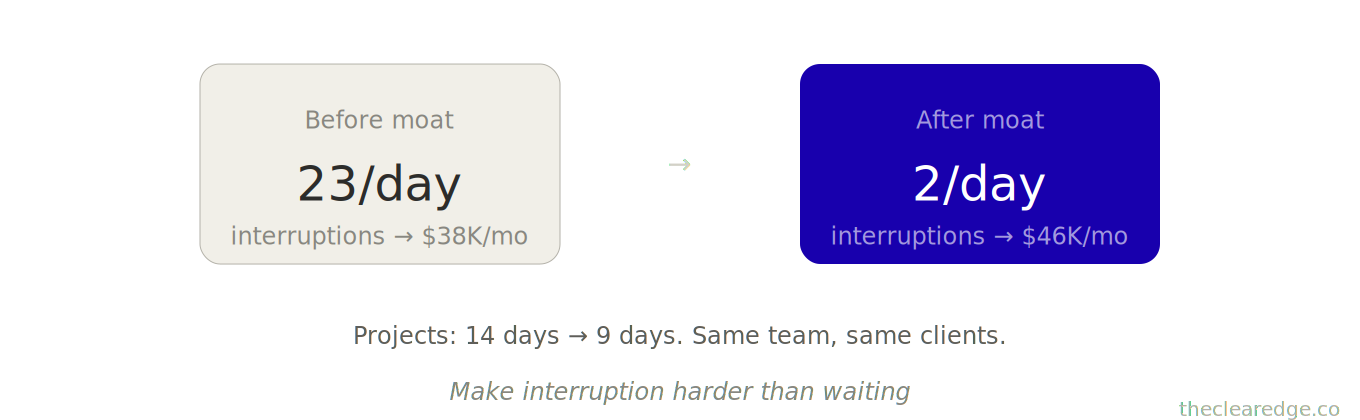
An agency owner implemented this system when revenue was at $38,000 per month, with a team of four, after years of being available all day for questions.
Before:
Interrupted 23 times daily, on average
Questions ranged from “Where’s the logo file?” to “Should we change this design?”
Never completed a full hour of uninterrupted work
Projects took 3x longer than estimated
After (with moat):
Protected blocks: 8–11 am + 2–4 pm daily
Team trained: Hold non-urgent questions for the 11:30 am daily standup or 4:30 pm check-in
Documentation created: Common questions answered in shared doc
Decision framework given to team: “If it doesn’t affect client deliverable or deadline, decide yourself.”
Timeline:
Week 1: 16 interruptions daily (team testing boundaries)
Week 2: 8 interruptions daily (team adapting)
Week 3: 3 interruptions daily (actual emergencies only)
Week 4: 1–2 interruptions daily (system working)
Result:
Projects that took 14 days started completing in 9 days
Same team, same clients, faster delivery
Freed capacity for 2 additional clients
Hours/week: 51 → 47
Interruptions: 23/day → 2/day
Revenue: $38K → $46K (+$8K)
The moat worked because it made interruption harder than waiting.
Edge case: “What if my business requires availability?”
Test it. Most founders assume their business requires immediate availability, and most are wrong.
One service business owner was convinced that clients needed an instant response. “They’ll go elsewhere if I don’t answer right away.”
We tested it: 24-hour response time instead of 2 hours.
Result after 30 days:
Zero clients complained
Zero clients left
One client mentioned it once (“noticed you respond in batches now”)
Owner reclaimed 18 hours monthly from not constantly checking messages
The urgency was in his head, not the market.
Build your moat:
Week 1: Set physical boundaries (phone away, apps closed)
Week 2: Add schedule boundaries (blocks marked busy, auto-decline on)
Week 3: Train your team/clients (set expectations, batch communication)
Week 4: Enforce ruthlessly (no exceptions, prove nothing breaks)
Protection compounds. The first week is hard. The fourth week is automatic.
[Build The Moat]

Week 1: Physical
phone away, apps closed

---

Week 2: Schedule
blocks busy, auto-decline

---

Week 3: Communication
batch replies, set expectations

---

Week 4: Rules
no exceptions for 30 days
Pushback and proof: 20 protected hours grow revenue without adding more total hours.
“My clients need instant replies.”
30-day test: 24-hour response time instead of instant.
Churn change: 0
Hours reclaimed: 18 monthly
Urgency was in your head, not the market.
“My team needs me.”
Daily standups and clear sync documentation cut interruptions by about 70% by Week 3. What feels like leadership is often just solving problems that shouldn’t exist in the first place.
“My work has long sales cycles.”
Track expected value per protected hour.
1 protected hour → 0.5 proposals sent
Expected value: $3,145 per hour (at 34% close rate, $18,500 average deal)
Move 3: Measure Revenue Per Protected Hour for Your 20 Weekly Focus Blocks
You can’t protect what you can’t prove—and that’s where most founders fall apart.
You can’t improve what you don’t measure, and you won’t defend what you can’t prove works.
The real trap is protecting time without tying it to revenue: “I focused better this week” means nothing, while “I closed three deals from Tuesday’s protected sales block” means everything.
Measurement creates accountability—to you and to the system.
A course creator making $31,000/month implemented protected time but couldn’t tell if it worked. “I think I’m more productive?”
Not good enough.
We added measurement:
Revenue Activity Tracker (simple spreadsheet):
Column 1: Date
Column 2: Protected hours used (0-20 weekly)
Column 3: Revenue activity completed (content shipped, calls held, proposals sent)
Column 4: Revenue result (deals closed, members added, products sold)
Column 5: Revenue per protected hour (total new revenue ÷ protected hours)
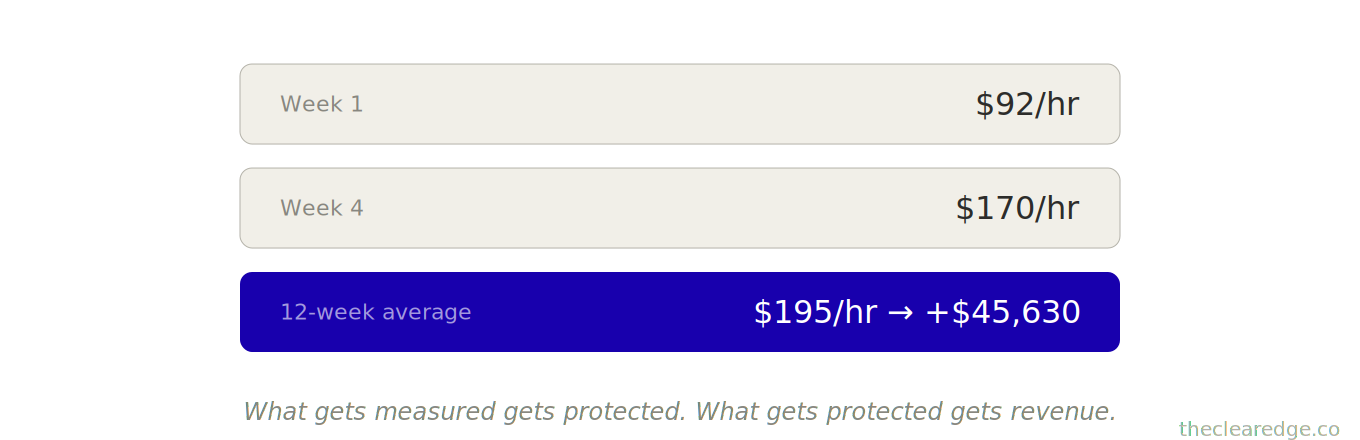
Week 1:
Protected hours: 18
Activity: 3 videos, 2 articles, 8 sales calls
Result: 5 new members ($250), 2 course sales ($1,400)
Revenue per hour: $1,650 ÷ 18 = $91.67/hour
Week 4:
Protected hours: 20
Activity: 4 videos, 3 articles, 10 sales calls
Result: 12 new members ($600), 4 course sales ($2,800)
Revenue per hour: $3,400 ÷ 20 = $170/hour
Improvement: +$78.33/hour in 4 weeks (85% increase in revenue per protected hour)
Over 12 weeks:
Average protected hours: 19.5 weekly
Average revenue per hour: $195
Additional revenue: 19.5 × $195 × 12 weeks = $45,630 above baseline
Measurement proves the system works. Proof reinforces the behavior.
What gets measured gets protected. What gets protected gets revenue.
What to measure
Input metrics:
Protected hours used per week (target: 20)
Interruptions per day (target: <3)
Hours reallocated from support to revenue work (track the shift)
Output metrics:
Revenue activity completed (calls, content, proposals—whatever drives your business)
Deals closed or revenue generated during protected time
Revenue per protected hour (total revenue ÷ protected hours)
Trend metrics:
Week-over-week revenue per hour (improving or declining?)
Monthly revenue growth (correlates with protected time?)
Time to revenue (how fast do protected hours convert to money?)
One consultant tracked this for 90 days. Found that:
Monday/Wednesday protected blocks generated $287/hour average (sales calls)
Tuesday/Thursday protected blocks generated $94/hour average (content creation)
Friday protected blocks generated a $31/hour average (admin work dressed as “strategy”)
Action: Eliminated Friday “strategy” block. Reallocated to Monday/Wednesday sales.
Revenue per week increased by $512 (2 hours × $256 difference in return).
Small shifts compound when measured.
Edge case: “What if my revenue is project-based or has long sales cycles?”
Track leading indicators instead of closed revenue.
For long sales cycles:
Qualified conversations held
Proposals sent
Follow-ups completed
Pipeline value moved forward
For project work:
Proposals submitted
Client delivery milestones hit
Referrals generated
Portfolio pieces completed
The goal: Connect protected time to forward motion, even if cash doesn’t hit immediately.
One agency with 90-day sales cycles tracked:
Protected hours → Proposals sent (direct correlation)
Proposals sent → Close rate at 34%
Close rate × Average deal ($18,500) = Expected value per proposal ($6,290)
Math: 1 protected hour → 0.5 proposals sent → $3,145 expected value per hour
Measuring expected value maintained motivation during the lag between work and payment.
Set up your measurement:
Daily (2 minutes): Log protected hours used + revenue activity completed
Weekly (10 minutes): Calculate revenue per protected hour + identify patterns
Monthly (20 minutes): Review trends + adjust what gets protected based on return
Measurement turns “I think this works” into “This generated $X per hour—let’s do more.”
[Measurement Loop]

Daily:
 - log protected hours
 - log revenue activity

---

Weekly:
 - sum new revenue

calc:
 - Revenue ÷ Protected hrs = Rev per protected hr

---

Monthly:
 - spot trends
 - reallocate to
   highest-return blocks
Hidden Problems of Protecting 20 Revenue Hours Nobody Talks About
You’ve seen the framework. Here’s where it breaks if you’re not careful.
1. Protecting the Wrong 20 Hours That Don’t Convert to Revenue
Not all “revenue work” generates equal return. Some founders allocate 20 hours to low-yield activities and wonder why revenue stays flat.
One coach protected 20 hours for “content creation,” but because her content didn’t convert, the work felt productive without actually driving revenue.
Her numbers:
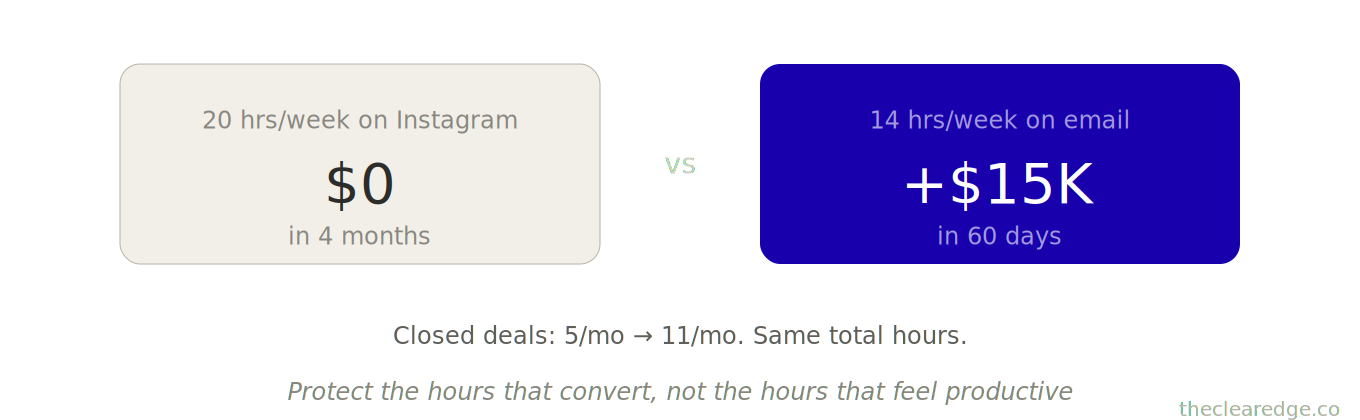
20 hours weekly on Instagram posts
1,200 followers
8–12 likes per post
Zero DMs asking about services
Zero sales from Instagram in 4 months
Meanwhile, her email list (840 subscribers) had a 38% open rate and a 4.2% click rate. Every email she sent generated 2–3 consultation requests.
The fix: Reallocated 12 of her 20 protected hours from Instagram to email content (newsletters, nurture sequences, sales emails).
Result in 60 days:
Email list growth: 840 → 1,180 subscribers
Consultation requests: 12 monthly → 31 monthly
Closed deals: 5 monthly → 11 monthly
Hours/week: 48 → 46
Email hours: 2 → 14 (protected)
Revenue: $22K → $37K (+$15K)
Lesson: Protect the 20 hours that actually convert, not the 20 hours that feel productive.
In 68% of stalled founders I’ve audited, the same pattern shows up: they stay highly active on low-return channels while the few high-return channels sit dormant.
2. Building a Moat but Letting Exceptions Destroy Your Protection
Boundaries decay without reinforcement; what works in Week 1 collapses by Week 8 if you don’t defend it consistently.
One consultant built near-perfect protection—blocked calendar, closed apps, trained his team—and it worked beautifully for six weeks.
Then one “urgent” client request slipped into protected time, he answered, then another followed, and by Week 10 his protected time had disappeared.
Why it failed:
Exception became permission.
Once he broke his own boundary, everyone else did too.
The fix:
No exceptions for 90 days.
Prove the system works before adjusting it.
After reinstituting the rule, he had 12 weeks of consistent protection.
Hours/week: 51 → 45
Protected hours: 0 → 20
Revenue: $33K → $47K (+$14K)
Lesson: A boundary you break once is gone.
3. Measuring Activity Instead of Revenue Outcomes From Protected Hours
Some founders track protected hours used but not revenue generated.
“I did my 20 hours!”
Great. Did you make money?
One agency owner proudly reported: “Protected 20 hours every week for 8 weeks!”
When I asked about revenue impact, he got silent; he’d protected time for strategic planning that produced zero revenue.
His mistake:
Protected time for thinking, not doing. Strategy without shipped output doesn’t pay.
The fix:
Protected hours must have tangible output.
Calls held
Content shipped
Proposals sent
Revenue generated
After shifting to output-focused protection:
Hours/week: 54 → 48
Protected hours with output: 0 → 18
Revenue: $29K → $37K (+$8K)
Lesson: Measure output and outcome, not just input.
4. Ignoring the Opportunity Cost of 20 Protected Hours in a 50-Hour Week
Protecting 20 hours for revenue work means those 20 hours aren’t available for anything else, so if you’re not deliberate about what you stop doing, you just stack new work on top of an already full week.
One course creator protected 20 hours for content but kept all her support commitments, so her week jumped from 48 to 58 hours and she burned out within five weeks.
The fix:
For every hour protected, identify one hour to eliminate, delegate, or batch. Addition requires subtraction.
Lesson: Focus time only works if you make space for it by removing something else.
What Changes When You Protect 20 Revenue Hours—and the Cost If You Don’t
When you protect 20 hours weekly for revenue work, three things shift:
1. Revenue becomes predictable.
You stop hoping for good weeks and start engineering them. Twenty protected hours weekly become 80 hours monthly of guaranteed revenue activity, so the math becomes reliable.
One founder’s protected sales time led to a predictable pipeline, closing 2–4 deals monthly instead of a random 0–6.
Revenue shifted from $18K–$42K monthly swings to a steady $38K–$44K range.
Predictability enables planning.
2. Hours become valuable.
Once you see that protected hours generate $150–$300 per hour in revenue, you stop wasting time on $0-per-hour activities and start asking, “Is this worth $200 per hour of my time?”
One consultant stopped attending networking events after calculating that they produced zero clients in 18 months.
Four hours monthly for 18 months is 72 hours, which is a $14,400 opportunity cost at his $200-per-hour rate.
He stopped going, used that time for sales calls instead, and closed three new clients in the next 60 days.
3. Energy compounds.
Protected time removes decision fatigue. You no longer spend mental energy defending your calendar or feeling guilty about saying no; the system decides for you.
Clarity creates momentum because decisions become automatic. Those default decisions preserve energy, and preserved energy compounds into consistent output.
One agency owner said: “I used to wake up stressed about everything pulling at me. Now I wake up clear on my 20 hours. Everything else can wait.”
Clarity creates momentum.
The Real Revenue Cost of Running $30K–$40K Months With No Time Protection
One course creator spent 18 months stuck between $26K and $32K per month, always busy but never breaking through and unable to see why.
We audited her year:
Average weekly hours: 51
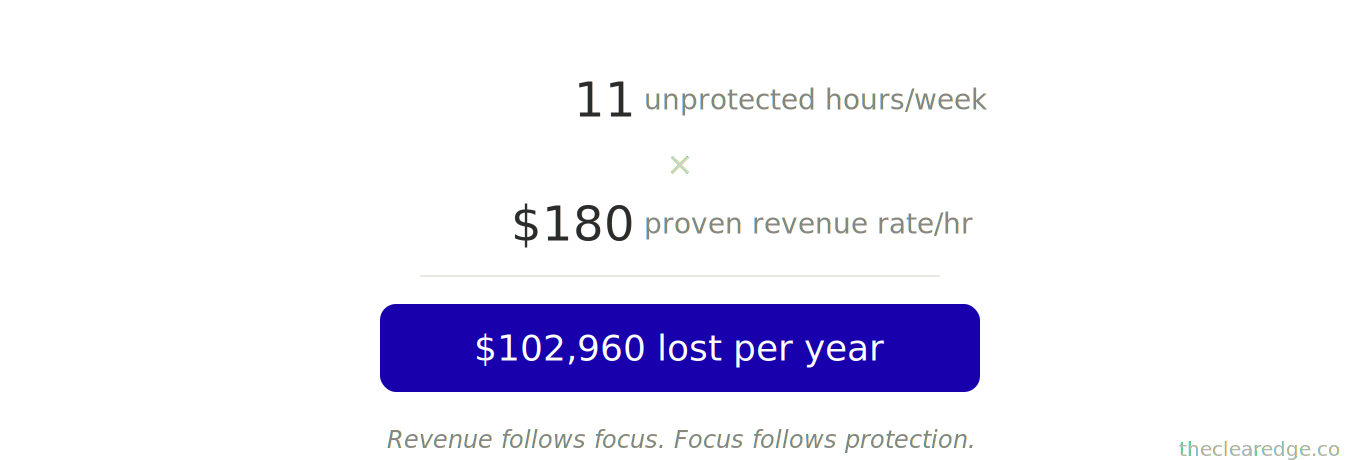
Average protected revenue hours: 9
Average support/admin hours: 42
If she’d protected 20 hours weekly for revenue work:
Additional revenue hours: 11 × 52 weeks = 572 hours yearly
At her proven $180/hour revenue generation rate: $102,960 lost annually
That’s the cost—not theoretical, but actual money left on the table because time wasn’t protected.
Over 3 years at this pattern: $308,880 in lost revenue from not protecting focus time.
The real cost of unprotected time: 8 unprotected hours weekly → 936 hours yearly → 23.4 work weeks annually spent generating $0.
The time compounds. The losses multiply.
Protection isn’t optional if you want to grow; it’s the only way the business math works.
Revenue follows focus. Focus follows protection.
The Cost Of Letting Hours Leak
Every week you leave 15–25 high‑value hours unprotected, you quietly choose to forfeit $60K–$120K a year in capacity; start protecting your 20 and let The Clear Edge OS prove it.
Run Your Focus That Pays Field Test Checklist
Next week, every time you sit down to plan or start work, pull this and run it before you say yes to anything else.
☐ Counted last week’s true revenue hours, labeled every block R or S, and wrote the gap between R and 20 protected hours.
☐ Picked your top 3 revenue activities and blocked 20 immovable Focus That Pays hours on next week’s calendar around them.
☐ Turned on your moat rules for the first block (phone away, Slack/email closed, auto-decline on) and logged whether the full block stayed interruption-free.
☐ Logged this week’s revenue, total protected hours used, and revenue per protected hour so you can compare against the $32K–$41K → $47K–$54K lift.
Five focused minutes here keeps 15–25 high-value hours from leaking and quietly forfeiting $60K–$120K in yearly capacity.
Start Monday: 20-Hour Focus That Pays Protection Plan for Next Week
Before Monday morning, do this:
This Weekend (15 minutes)
Audit last week
Track where your hours actually went.
Label each hour as Revenue (R) or Support (S).
Count your R hours and, if you’re under 20, identify the gap.
Identify your top 3 revenue activities
Decide what actually makes money in your business (sales, content, delivery that earns referrals).
Write them down specifically so you know what deserves protection.
Block your 20 hours
Put 20 hours on next week’s calendar.
From Monday to Friday, find 4 hours each day and make those blocks immovable.
Monday Morning (5 minutes)
Turn on protection by putting your phone in another room, closing email and Slack, and setting your calendar to auto-decline meetings during blocks.
Start your first protected block without over-planning: ship one piece of work, hold one sales call, or make one proposal to prove the system works.
Next 30 Days (10 minutes weekly)
Measure your return by tracking protected hours used and revenue generated, then calculate revenue per hour and watch it compound.
Adjust what’s protected by cutting low-return activities and giving more time to high-return ones.
Defend ruthlessly for 30 days with no exceptions so you can prove nothing breaks when you’re unavailable.
20 Hours to Protect
If you could only work 20 hours next week, what would you do? That’s what should be protected this week.
Drop your answer below. I read every reply.
FAQ: 20-Hour Focus That Pays Protection System for $30K–$50K Operators
Q: How does the Focus That Pays framework turn 20 protected hours into $47K–$54K months?
A: By guarding 20 revenue hours weekly, reallocating work from low-value tasks, and tracking revenue per protected hour, founders shift from $32K–$41K ranges into $47K–$54K+ months without increasing total hours.
Q: How do I identify my 20 weekly revenue hours before I protect them?
A: Track every hour for one week, label each as Revenue or Support, then reallocate until at least 20 hours go to activities that reliably generate money within 90 days like sales calls, content, and delivery that drives referrals.
Q: How do I use the Focus That Pays framework with its three moves before I plan next week’s calendar?
A: First identify which 20 hours actually generate revenue, then build a moat around those blocks, and finally measure revenue per protected hour weekly so your calendar reflects what pays instead of what shouts the loudest.
Q: Why do $30K–$40K months stall even when I’m working 47–52 hours every week?
A: Revenue stalls because 15–25 hours weekly leak into unprotected time—meetings, Slack, email, and “quick questions”—which can quietly destroy $60K–$120K annually and up to $77,616 per month in lost capacity.
Q: What happens if I keep letting high-value hours lose to low-value demands?
A: You lock in a pattern where 9–18 unprotected revenue hours weekly compound into 572+ hours a year of $0 output, which at proven rates like $180/hour can cost $102,960 annually and over $300,000 across three years.
Q: How much time should I expect to spend implementing the Focus That Pays system before I see revenue lift?
A: Plan for 15–25 minutes to audit last week, about 4 weeks to lock in your moat and tracking, and then 30–90 days to see visible revenue gains with six-figure upside over the next 12 months if you maintain protection.
Q: What happens if I protect time but don’t build a real moat around my calendar?
A: “Focus blocks” get overrun by interruptions, exceptions erode boundaries, and you end up back at 18 revenue hours inside 52-hour weeks instead of 20 protected hours that move revenue from $38K toward $54K.
Q: How do I measure revenue per protected hour so I know this system is working?
A: Log daily protected hours, the revenue activities completed, and the resulting sales or member growth, then divide new revenue by total protected hours so you can see numbers like $91.67/hour growing toward $195/hour over 12 weeks.
Q: When should I reallocate my 20 hours if the activities I protect aren’t converting?
A: Review your numbers every week, cut low-yield activities like channels that produce zero clients in 4–6 months, and shift those protected hours into proven drivers such as email, sales calls, or proposals that already show measurable conversion.
Q: What happens if I protect 20 hours without subtracting anything from my existing workload?
A: Your week quietly bloats from, say, 48 to 58 hours, burnout hits within a few weeks, and you abandon the system instead of trading low-return support or “busy” tasks for high-return revenue work on a 1:1 basis.
Up Next: The One-Build System to Create Once and Sell to 100 Clients
In “The One-Build System: Create Once, Sell to 100 Clients for $30K–$50K Operators,” we break down how to build systems into your delivery so revenue grows without hourly increases.
Navigate The Clear Edge OS Systems for Scaling From $5K to $150K
Start here: The Complete Clear Edge OS — Your roadmap from $5K to $150K with a 60-second constraint diagnostic.
Use daily: The Clear Edge Daily OS — Daily checklists, actions, and habits for all 26 systems.
LAYER 1: SIGNAL (What to Optimize)
The Signal Grid • The Bottleneck Audit • The Five Numbers
LAYER 2: EXECUTION (How to Optimize)
The Momentum Formula • The One-Build System • The Revenue Multiplier • The Repeatable Sale • Delivery That Sells • The 3% Lever • The Offer Stack • The Next Ceiling
LAYER 3: CAPACITY (Who Optimizes)
The Delegation Map • The Quality Transfer • The 30-Hour Week • The Exit-Ready Business • The Designer Shift
LAYER 4: TIME (When to Optimize)
Focus That Pays • The Time Fence
LAYER 5: ENERGY (How to Sustain)
The Founder Fuel System • $100K Without Burnout
INTEGRATION & MASTERY
The Founder’s OS • The Quarterly Wealth Reset
AMPLIFICATION (AI & Automation)
The Automation Audit • The Automation Stack
⚑ Found a Mistake or Broken Flow?
Use this form to flag issues in articles (math, logic, clarity) or problems with the site (broken links, downloads, access). This helps me keep everything accurate and usable. Report a problem →
› More to Explore: Quick Navigation · The Clear Edge OS
➜ Help Another Founder, Earn a Free Month
If this system just saved you from watching $60K–$120K in annual revenue capacity leak into distraction, share it with one founder who needs that relief.
When you refer 2 people using your personal link, you’ll automatically get 1 free month of premium as a thank-you.
Get your personal referral link and see your progress here: Referrals
Get the Focus That Pays Toolkit to Guard 20 Hours and Support $47K–$54K Months
You’ve read the system. Now implement it.
Premium gives you:
Ready-to-use PDF toolkit—every template, diagnostic, and formula pre-filled, zero setup, immediate use
Plug-and-play AI diagnosis sessions—drop into Claude, Gemini or ChatGPT, answer a few questions, save hours of guessing, get your exact next move
Audio key points—concentrated frameworks you can absorb in minutes, implement while you move
Unrestricted access to the complete library—every system, every update
What this prevents: Letting 11 unprotected revenue hours quietly disappear into support work instead of running the Focus That Pays protection you just saw in the math above.
What this costs: $49/month.
Download everything today. Implement this week. Cancel anytime, keep the downloads.
Already upgraded? Scroll down to download the PDF, audio, and your AI session.
