


Read time: 14 minutes
› Library Navigation: Quick Navigation · The Weekly Protocol
The Executive Summary
If you keep turning down work, add up what you refused before you hire anyone. Compare the monthly total with one contractor’s cost to produce part of your work. Hire when the refused work covers that cost 3 times or more. Tom, a solo brand designer, found $8,000 a month he was refusing and signed 2 more projects 23 days later.
Who this is for: solo freelancers and consultants at $20K-$60K a month, losing ready clients over a full calendar.
The problem: your calendar is full, so you turn away clients ready to pay. Turning away 6 projects at $4,000 each costs you $24,000 a quarter.
The fix: 5 steps:
List every project you refused in 90 days, in dollars.
Pick one lane a contractor can produce from your brief.
Divide what you turn down each month by the contractor’s monthly cost.
Pay for a 5-hour first task on a past job.
Run a 2-week trial with a written stop rule.
Time to first result: 1 hour. You get the dollars you turned down this quarter, set against what one contractor costs you.
Written by Nour Boustani for the solo freelancer who wants to say yes to the next client.
Try this now (under 2 minutes):
Search your inbox for “booked”, “not until” and “referred you to”.
Count the replies you sent since the start of the quarter.
Multiply it by your usual price: that’s what you turned away.
Why You Keep Saying No to Clients Who Would Pay You
A client you’d love to work with asks if you can start next month. You see November in your calendar and type “I’m fully booked until December, can I pencil you in then?” You know they’ll hire someone else by Friday.
That reply loses you the project, because ready clients want to start now. Andy Strote, who sells a book on starting an agency, agrees. Clients wait “a week or two, but not much longer”.
The money you refuse never reaches your books, and no report ever totals it for you. You decide to hire when you feel tired, and that feeling points you at the wrong person.
Hire a Producer Before You Hire an Assistant
The usual advice says to hire an assistant first and buy back your time. An assistant takes your email, your scheduling and your invoices. Those hours come back in 20-minute pieces between client calls.
The work you’re refusing is design, writing or build work. A refused brand project needs 12 hours of production in long stretches. Freed admin minutes never add up to that.
Hire the person who produces the work your clients pay for. An assistant just clears your inbox so you can stare at a full calendar sooner.
Why I start with a producer, not an assistant:
I’ve watched an assistant clear an inbox while the same client inquiries kept getting a no.
I’d add an assistant once the production lane has paid for itself for 3 months.
Check the Refused Work Against the Contractor’s Cost
Hire a contractor for one lane when the monthly work you refused covers their monthly cost 3 times or more. Check the multiple over the full 90 days, then over the most recent 2 months alone. If both reach 3, the demand is steady and not one busy month.
If the multiple comes out between 1 and 3, raise your next quote before you hire. Below 1, your calendar is fine as it stands.
I took the 3 from Andy Strote’s pricing advice: charge a client about 3 times what you pay the subcontractor. No survey measured it. That margin leaves room for your time and one bad month.
Start With a Contractor, Then Decide on Staff or AI
A contractor costs their rate, and the cost stops when the work stops. You can end the trial after 2 weeks.
A part-time employee costs more than the wage. At firms with 1-49 workers, across all jobs, pay averages $27.88 an hour.
The total cost of that employee is $37.64 an hour, about $1.35 per $1 of wage.
AI speeds up resizes, outlines and first passes, but it can’t take responsibility for a wrong file.
Wait on an employee until the lane fills 20 hours a week for 6 months. Whether someone counts as a contractor or an employee is a legal question. Check with your accountant or lawyer before the first paid task.
How Tom Found $8,000 a Month He Was Refusing
Tom is a solo brand designer billing $22,000 a month. He sells 5 identity projects a month at about $4,000 each, plus 2 small retainers at $1,000 each. Tom works about 200 hours a month. Since July, 8 of those hours each week fall in his evenings.
On Monday 24 August at 9:10am, a specialty coffee roaster emailed him to ask for a start on 3 September. Tom opened his calendar and started typing “I’m fully booked until December.” It would have been his seventh no since June.
He stopped, sent a holding reply at 9:40am and searched his inbox. In 30 minutes he had the list:
6 projects refused over the quarter at about $4,000 each: $24,000.
4 of the 6 arrived in the most recent 2 months, 2 in each, for $16,000.
All 6 were identity projects like the ones he already sells.
The full 90 days and the last 2 months each came to $8,000 a month. A production designer costs $2,200 a month for 44 hours at $50. The refused work covers the contractor’s cost 3.6 times.
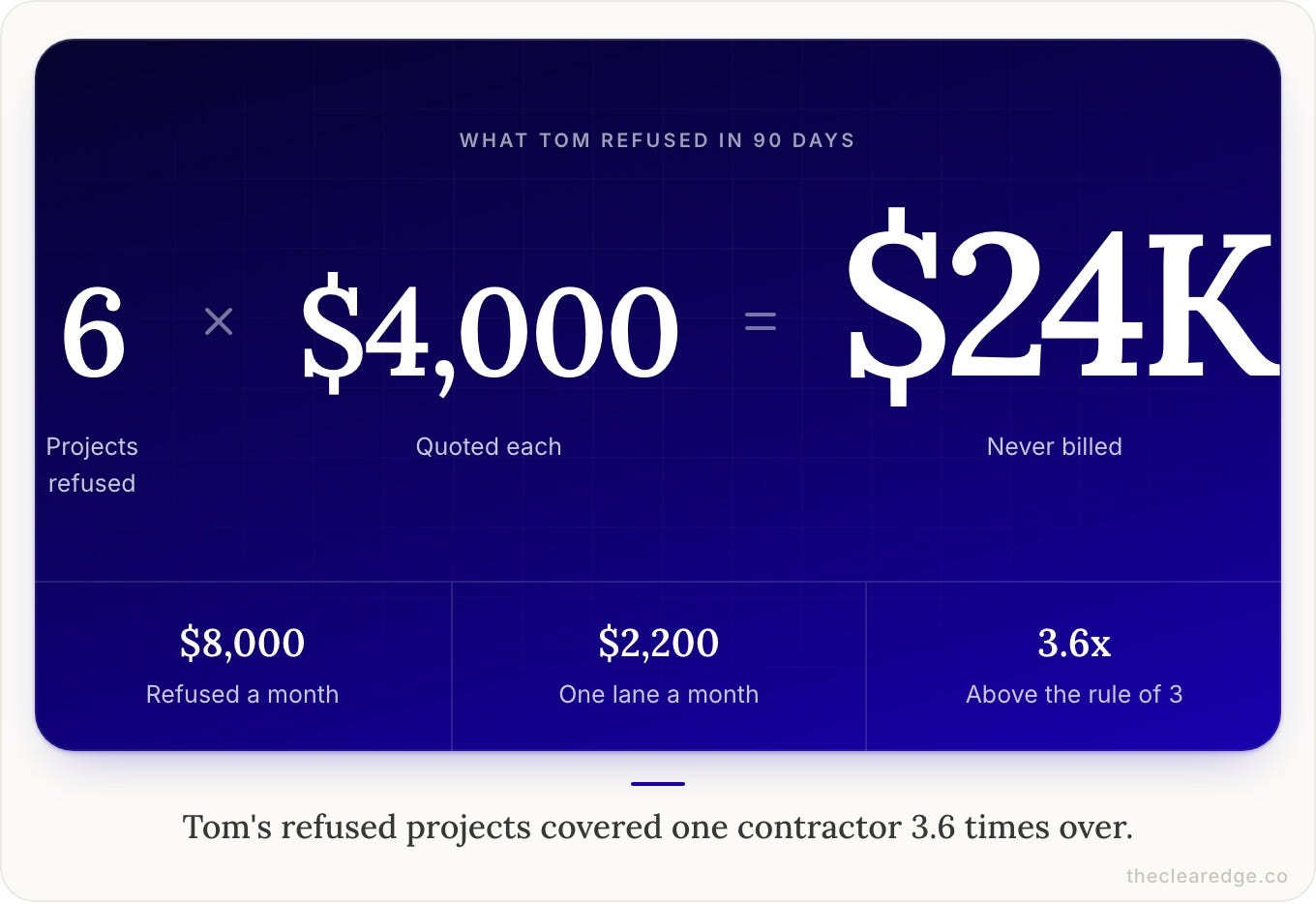
He brought in Ines, a production designer he’d sent 2 overflow referrals to in 2025. She took his production work. By 16 September he’d signed the roaster and one more client he’d have refused. The two projects came to $8,000.
“I’d love to do your rebrand. Can I confirm a 3 September start by Monday? I’m lining up my production designer this week.”
