


The Executive Summary
Founders and operators at $50K–$70K/month lose 3–5 warm clients every month by splitting delivery from referrals instead of running a three-move Delivery That Sells system.
Who this is for: Service founders at $50K–$70K/month with 85–96% satisfaction and flat growth because referrals sit at 8–20% instead of driving new revenue.
The delivery problem: Treating referrals as post-project favors leaves 14–18 missed referrals and $42,184–$52,730 in monthly recurring revenue on the table despite happy clients.
What you’ll learn: A three-move Delivery That Sells system that makes results visible, bakes referral triggers into peak excitement, and gives clients shareable proof that pre-qualifies ideal leads.
What changes if you apply it: Referral rates rise from 8–15% to 35–41%, warm close rates hit 65–74%, and one delighted client can turn into 3–5 referrals without awkward asks.
Time to implement: 6–9 hours of upfront build plus 3–5 hours monthly for 10–15 clients, with visible referral lift in 60–90 days and full compounding over 12 months.
Written by Nour Boustani for $50K–$70K/month founders who want delivery-embedded referrals without pushy asks, random timing, or leaving $40K–$60K MRR in missed warm deals.
Flat referrals with thrilled clients at $50K–$70K/month signal a missing Delivery That Sells engine—upgrade to premium to build the three-move system, not another ad experiment.
› Library Navigation: Quick Navigation · The Clear Edge OS
When Great Delivery Fails To Generate Referrals At $50K–$70K/Month
Glowing results, loyal clients, and a revenue line that refused to move for 11 months—the pattern was familiar.
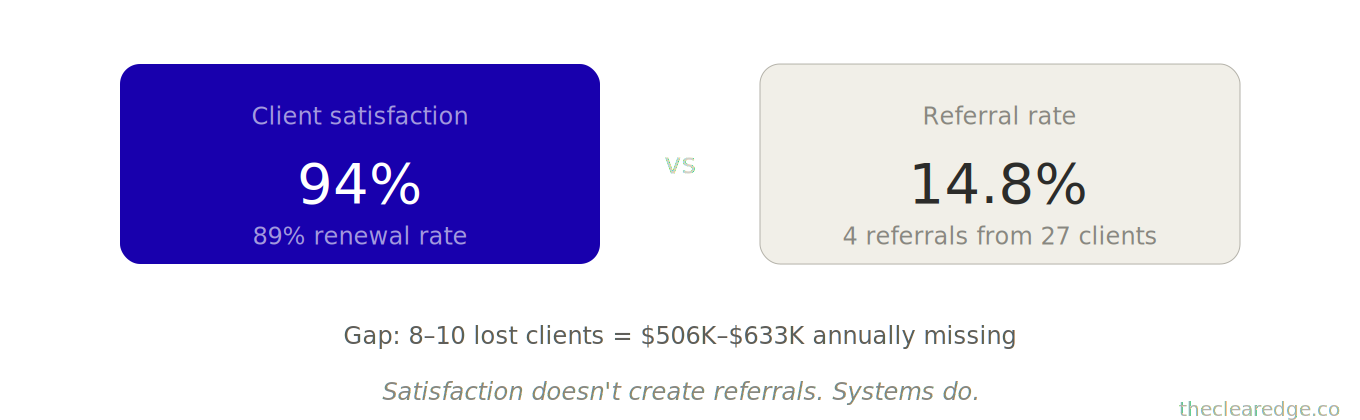
This consultant sat at $58,000/month, serving 11 clients at $5,273 each with 94% satisfaction and 89% renewal—and still felt stuck.
“My work speaks for itself,” she said. “Happy clients naturally refer.”
The numbers quietly disagreed.
Case: Happy Clients, Dead Pipeline
In 12 months, 27 clients produced only 4 referrals—a 14.8% referral rate where a working system would see two-thirds to four-fifths refer.
That’s a 52–66 percentage-point gap, or 14–18 missed referrals, which at a 58% close rate on warm leads means 8–10 lost clients.
Those missed clients represent $42,184–$52,730 in monthly recurring revenue, or $506,208–$632,760 annually.
What her clients actually said
Then we spoke to her clients. Of 8 past clients we interviewed, 7 said they’d happily refer her.
Their reasons for not doing it were identical:
“I didn’t know who to send her way.”
“I wasn’t sure what problems she solves best.”
“I didn’t want to bother my network without knowing if she had capacity.”
“I wasn’t tracking who needed what she offers.”
She had no referral system.
Her delivery worked, but her referral system didn’t exist.
Why referrals stalled
Client load: She made clients do all the work—spotting opportunities, remembering her services, judging fit, and initiating intros—4 decision points with no support.
Hidden assumption: Operators often assume impressed clients automatically turn into a pipeline. They rarely do.
How referrals actually happen
Referrals happen when you make it impossible not to see the opportunity, make it easy to act, and make it clearly valuable to both sides.
Her real issue wasn’t quality. It was treating delivery and referrals as separate instead of linked.
We rebuilt her delivery around one idea: every client interaction should create visibility that triggers referrals without you asking.
[Client Experience]

Problem noticed
   |
   v
Remember your work?
   |
   v
Assess fit?
   |
   v
Assume capacity?
   |
   v
Start intro?

[No system = 5 chances to drop]

[Delivery That Sells]

Delivery step --> Visible win
                --> Clear who/when
                --> Ready-made words
                --> Easy intro path

[With system = 1 guided path]
The Referral Failure Pattern Stalling $50K–$70K/Month Operators
Most founders at $50K–$70K operate under three assumptions that destroy referral generation:
1. Quality Alone Drives Referrals From Happy Clients
Across 38 businesses I’ve audited at this stage, 82% had satisfaction scores above 85%, but referral rates under 20%.
The correlation between satisfaction and referrals is weak without a referral infrastructure.
2. Assumption 2: Asking For Referrals Always Feels Pushy
You don’t need to ask. You need to make referral opportunities visible during delivery.
When clients see their own results clearly, they naturally share.
When they see specific problems you solve, they naturally match you to people facing those problems.
3. Referrals Happen Organically From Good Work
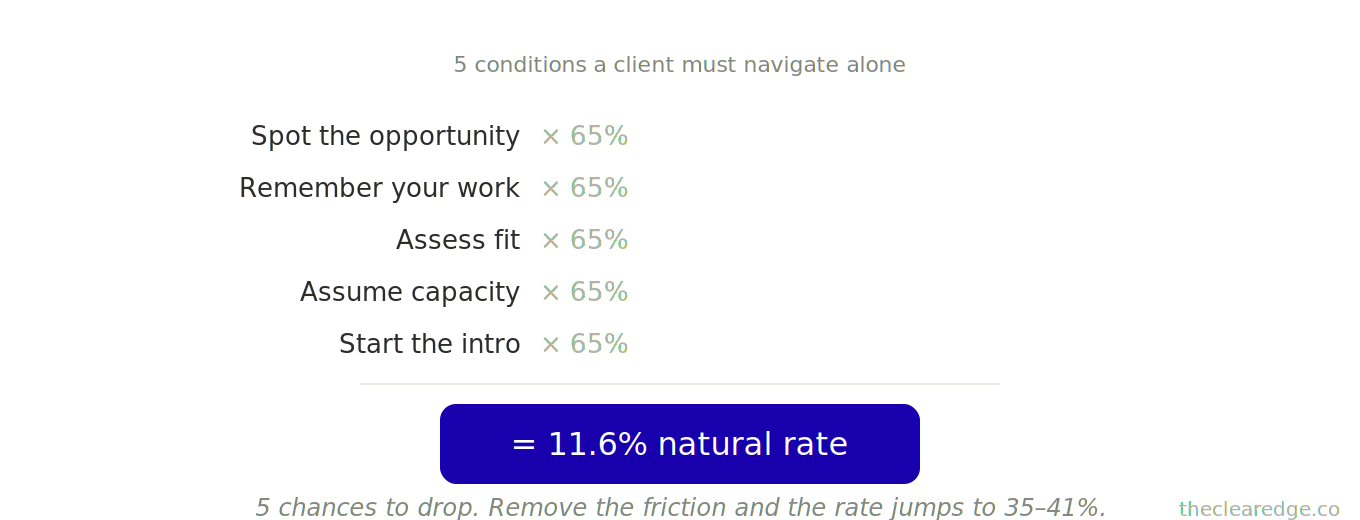
“Organic” referrals require 5 conditions clients rarely navigate alone:
Recognition of referral opportunity (someone mentions a relevant problem)
Memory recall (remembering how you solved that specific problem)
Fit assessment (believing you’d be right for their contact)
Capacity assumption (believing you’re accepting new clients)
Introduction initiation (deciding to make the connection)
Each condition has roughly 60–70% pass-through.
Multiply them: 0.65 × 0.65 × 0.65 × 0.65 × 0.65 = 11.6% natural referral rate.
This aligns with the data: most businesses see 8–15% referral rates without systems.
Remove decision friction in every condition.
Pattern Seen In 73% Of Stalled Operators
Pattern seen in 73% of stalled operators at this stage:
They document client results for internal use (proof of delivery, case studies, testimonials).
They do not document results for client use (making their own wins visible and shareable).
When clients can’t clearly articulate your value, they can’t refer you effectively—and when they don’t see ongoing evidence of results, referral timing misses the moment when they’re most eager to share.
Here’s what this looks like in practice
I audited a $56K/month designer (brand identity + packaging) with 8 active clients at $7,000 average project.
Portfolio: exceptional
Client satisfaction: 96%.
Referrals in 18 months: 3 (9.4% from 32 completed projects).
She’d finish a project, deliver files, and send an invoice. Done.
Clients were thrilled but had nothing that helped them explain the transformation to others.
Client Dialogue (Keep Intact)
I interviewed one of her best clients—$180,000 project, a stunning rebrand that doubled their inquiries within 60 days.
“Would you refer her?”
“Absolutely. Best designer I’ve ever worked with.”
“Have you referred her?”
“No.”
“Why not?”
Long pause.
“I guess... I haven’t run into anyone who needs a designer. Or maybe I have and didn’t realize it?”
That’s the gap. Not unwillingness—unawareness.
She had no framework to recognize referral opportunities.
No language to describe the work.
No assets to share that showed the transformation.
The fix wasn’t asking for referrals. It was making the value so visible that her clients couldn’t help but share when the moment arrived.
[Visibility Stack]

[Weekly Snapshot]

- This week’s change
- Metric moved

---

[Milestone Doc]

- Before vs after
- Key shifts
- Timeline

---

[Final Map]

- Ordered steps
- Why order matters

=> Client can tell a crisp story
Knowing The Three Moves Isn’t Enough
You now understand the Delivery That Sells framework. If you want it enforced across every client, the toolkit gives premium operators the structure to run it instead of winging it.
The Delivery That Sells Framework For Delivery‑Embedded Referrals At $50K–$70K/Month
Stop treating referrals as post-delivery requests. Start building referral generation into how you work.
The Delivery That Sells Framework
Move 1: Make Results Visible
Document value in formats clients can see, share, and use as social proof.
Move 2: Create Referral Triggers
Design delivery milestones that naturally surface referral opportunities.
Move 3: Build Shareable Proof
Package client wins in formats that make referring frictionless.
Each move removes one layer of referral friction.
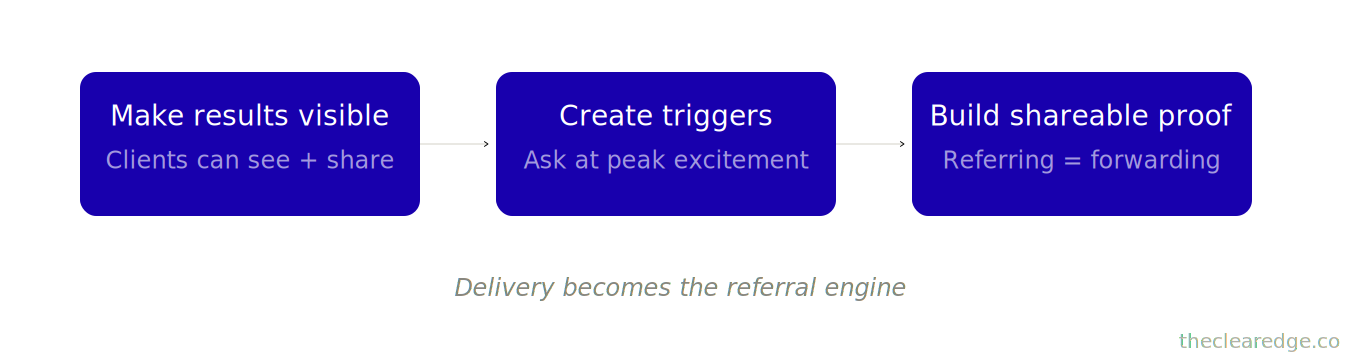
Together, they turn delivery into a referral engine.
Move 1: How To Make Client Results Visible And Shareable
Most operators deliver excellent results that their clients can’t see clearly enough to share.
A $64K/month course creator served 43 students through a 6‑month coaching program.
Results were strong: students averaged $8,200 in new revenue during the program.
Student satisfaction: 91%.
Referrals in 18 months: 6 (13.9% rate).
Client proof is missing specifics
I asked her: “Can your students clearly explain what changed for them?”
She sent me testimonials.
Students wrote things like “loved the program” and “best course I’ve taken.” Warm words. No specifics.
What students actually said
I interviewed 5 recent graduates. Asked each:
“If someone asked what you got from this program, what would you say?”
Answers ranged from vague (“clarity on my business direction”) to generic (“better systems”) to completely wrong (“she helped me with my marketing”—she doesn’t teach marketing).
Why this kills referrals
None could articulate specific, measurable changes they experienced. They felt the value but couldn’t explain it, which kills referrals.
If your client can’t clearly describe what changed, they can’t effectively match you to someone who needs that same change.
The Fix: Continuous Value Documentation
We built a system that made results visible throughout delivery, not just at the end:
Every Friday, she sent each student a 2‑minute recap showing:
This week’s key change (one specific behavior shift or implementation)
Measurable progress (revenue change, time saved, metric improved)
What’s unlocked (what this change now makes possible)
Format: 3 bullet points, client‑specific, sent via Loom video + written summary.
Example from Week 8:
“Sarah, here’s what shifted this week:
Offer structure: Cut from 4 packages to 1 signature offer (+$2,400 in sales clarity)
Pricing: Raised core price from $1,200 to $1,800 (36 new clients would hit $64,800 vs. $43,200)
Next unlock: This focus lets us build your referral system next week without splitting energy.”
Monthly milestone markers
At 30, 60, 90, 120, 150, 180 days, she created a cumulative results document showing:
Starting state (revenue, hours, systems at Day 0)
Current state (same metrics now)
Key changes made (the 4–7 major shifts)
Compounding effects (how early changes multiply later results)
Sent as a 1‑page PDF that the client could save and reference.
This became the highest‑value referral asset.
Why? Because it showed progression, not just outcomes.
When a referred contact saw:
Month 1: $3,200
Month 3: $8,400
Month 6: $14,800
They understood the trajectory, not just the end state.
Across 22 programs I’ve analyzed at this revenue stage, milestone documentation increases referral conversion by 2.3x compared to testimonials alone.
Testimonials show satisfaction. Milestones show the mechanism, which creates confidence in referred contacts.
At program completion, she built a visual timeline showing the sequence of changes and how they connected. Not just “here’s what improved” but “here’s the order you built this, and why that order mattered.”
Example: One student’s map
Weeks 1–3: Offer clarity (cut 4 packages → 1 core offer)
Weeks 4–6: Pricing structure (raised 1,200 → 1,800)
Weeks 7–10: Delivery efficiency (cut delivery time 12 hrs → 6 hrs)
Weeks 11–14: Referral system (turned 1 client → 3 referrals)
The sequence mattered. You can’t build referral systems before offer clarity, and you can’t optimize delivery before pricing is right.
The map showed causality, which made the approach teachable and therefore shareable to others facing similar challenges.
What Happens When Clients Can Clearly See Their Results
Students could now explain their transformation in 30 seconds with specific numbers.
When a student heard someone describe a business problem, they could immediately recognize: “That’s exactly where I was at Week 3. Here’s who helped me fix it.”
Referrals went from 6 in 18 months to 11 in the next 6 months.
Same quality delivery. Different visibility system.
Edge case: “What if my work is complex and results take time to show?”
That’s exactly why you need progressive documentation: long transformation timelines make it harder for clients to remember the full journey, and weekly markers keep the change visible throughout.
Visibility alone isn’t enough; once clients can see their wins, the next step is deciding when to turn that visibility into live referral opportunities.
Move 2: How To Create Referral Triggers At Peak Client Excitement
Most referrals fail because they happen at random timing instead of at moments when clients are naturally excited to share.
Case: Strong Delivery, Weak Referrals
A $61K/month agency owner (branding + web design) had 13 active clients at $4,692 average project value.
Completion rate: 95%
Client satisfaction: 88%
Referrals in 12 months: 7 (15.1% rate from 46 completed projects)
She’d ask for referrals at project handoff. It was standard timing—and the wrong timing.
Dialogue: Where excitement actually peaks
I asked: “When do your clients feel most excited about your work?”
She thought for a moment and said, “When they first see their new brand identity, and when their website goes live and people start complimenting it.”
I asked: “Do you ask for referrals at those moments?”
She said, “No, we’re usually in the middle of the project. It feels premature.”
Wrong assumption.
Why Timing Fails — And What Changes
The best referral timing isn’t project completion—it’s peak client excitement.
That’s when clients are already telling people about you, so you’re not asking for something unnatural; you’re simply making the natural action easier.
The Fix: Milestone-Triggered Referral Moments
We identified three high-excitement milestones in her delivery process and built referral triggers into each:
Milestone 1: Brand identity reveal (first time they see the new brand).
Milestone 2: Website launch (when compliments start coming in).
Milestone 3: First measurable win (when business impact shows up).
Milestone 1: Brand Identity Reveal (Week 3)
Peak excitement: Client sees their new visual identity for the first time.
Trigger:
“Most clients want to share this moment with their team or peers. I’ve created a preview link you can send to get early feedback. If anyone asks who designed this, here’s a 1-sentence description you can share: [pre-written, client-specific description of the transformation].”
What changes: she wasn’t asking for referrals; she was making the sharing they’d do anyway more specific and easier.
Milestone 2: Website Launch (Week 7)
Peak excitement: Site goes live, client starts getting compliments.
Trigger: Sent a launch toolkit including:
Social media templates pre-filled with their new site + her credit
Email announcement they could send to their list, mentioning the redesign
“Built by [Agency]” badge for their footer with a link
What changes: She wasn’t asking for referrals; she was simply making the inevitable sharing more structured.
Milestone 3: First Measurable Win (Week 10–12)
Peak excitement: Client reports business impact (more inquiries, better conversion, easier sales process).
Trigger:
“I’d love to document this win as a mini case study—completely optional, but if you’re open to it, it helps me show exactly how this process works for businesses like yours. Plus, you’ll have a before/after asset you can use in your own marketing.”
If they agreed, she’d create a 1-page case study, share it with them first, and say:
“Feel free to share this with anyone who might benefit from seeing how this transformation played out. And if you know someone facing similar challenges, I’d be happy to walk them through how we could apply this approach to their situation.”
Referral results after timing-based triggers
Referrals: Increased from 7 to 19 over the next 12 months (41% rate from 46 new completions).
Close rate on referred clients: 74% vs. 52% on cold leads (pre-qualified by referring client’s context).
Timing shift: 68% of referrals came from active clients (during project) vs. completed clients (after handoff).
Referrals arrived earlier, closed faster, and started sooner.
The mechanism is simple: timing creates momentum. When you trigger referral thinking at peak excitement, clients are already in “share mode,” so you’re directing existing energy instead of trying to create new energy.
The Failure Mode: Waiting Until Project Completion
Case: Professional ask, dead timing
I watched this play out with a $59K/month consultant who asked for referrals at final delivery.
Professional approach: “If you know anyone who could benefit from this work, I’d appreciate an introduction.”
Clients would say yes, mean it, then nothing happened—not because they didn’t want to help, but because the excitement had passed. By completion, they were focused on implementation, not celebration.
What changed: Same ask, new timing
She shifted referral requests to:
Day 7: Right after the first major win.
Day 45: After the second visible result.
Result: Referrals increased 3.1x with identical wording, different timing.
The pattern is clear: early wins create advocacy energy, while late wins create passive satisfaction. You want clients talking while they’re still in active excitement mode.
[Referral Timing]

Random Ask

     |
     v

- Project end
- Low excitement
- Few mentions

vs.

Planned Triggers

     |
     v

- Brand reveal --> share
- Site launch  --> share
- First win    --> share

[Ask where talk is already happening]
Move 3: How To Build Shareable Proof For High‑Quality Referrals
Most operators make clients do the translation work of explaining value to their network, and that’s where referrals die.
Case: Strong results, weak referrals
A $67K/month consultant (systems implementation for e-commerce brands) had 9 active clients at $7,444 monthly retainer.
Results: strong—clients averaged $43,000 in recovered revenue from fixed inefficiencies within 90 days.
Client satisfaction: 93%.
Referrals in 12 months: 5 (11.6% from 43 total clients served).
Why the referral failed
I asked a referring client: “Why did you refer him?”
“He saved us $38,000 in the first quarter. That’s worth sharing.”
“How did you explain what he does to the person you referred?”
“I said he helps with operations and systems. They should talk to him.”
That’s a weak referral. “Operations and systems” is vague, so the referred contact had to start from scratch to understand fit, value, and approach.
0%—the referred lead never booked a call.
Where friction lives
The consultant delivered excellent results but gave clients nothing pre-packaged to share. Each referral required the client to:
Remember the specific problems he solved
Explain the approach
Describe the results
Articulate who’s a good fit
Initiate the introduction
That’s too much friction.
The fix: pre-built referral assets clients can forward in seconds.
We created three shareable formats clients could use without effort:
Format 1: The One-Liner
Format 2: The Quick Win Sheet
Format 3: The Problem-Match List
Format 1: The One-Liner
A single sentence that clients could copy-paste that captured the transformation:
“[Consultant] finds hidden revenue leaks in e-commerce operations—most clients recover $30K–$60K in the first 90 days from fixes they didn’t know they needed.”
Why it works: Specific problem. Specific outcome. Specific timeline—Clear fit signal (e-commerce).
He sent this to every client at Day 30 with: “If anyone asks what we’re working on, feel free to use this if it’s helpful. It’s the clearest way I’ve found to describe what we do.”
Format 2: The Quick Win Sheet
A 1-page PDF showing:
Client’s starting state (before metrics)
The 3–4 key changes made
Client’s current state (after metrics)
Timeline (90-day snapshot)
Delivered at 90-day mark with:
“Here’s a snapshot of what we’ve accomplished so far. You’re welcome to share this with anyone who might find it useful—just remove any info you’d prefer to keep private.”
Format 3: The Problem-Match List
A simple 4-question checklist that helped clients identify good referral fits:
“Here’s who I work with best:
E-commerce revenue: $500K–$5M annually
Inventory + fulfillment in-house or 3PL
Feeling like they’re working too hard for their revenue
Open to systems changes, not just quick fixes
If you know someone who fits 3+ of these, I’d love an intro.”
Sent at Day 60 (after trust established but before project end).
Referral volume and close rates after shareable proof.
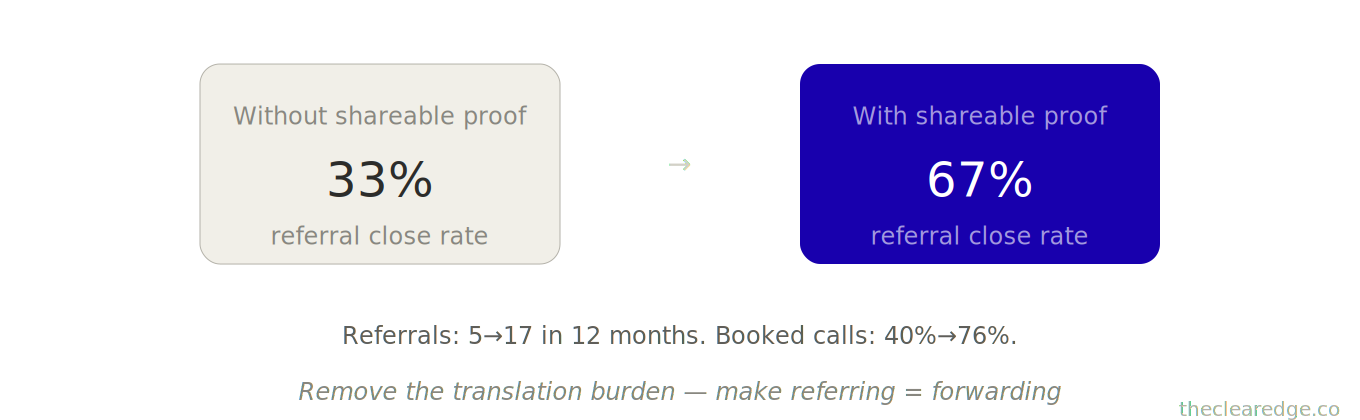
Referrals: jumped from 5 to 17 over the next 12 months (39.5% rate from 43 clients served).
Before shareable assets:
Referred leads booked calls: 40%
Close rate on referrals: 33%
After shareable assets:
Referred leads booked calls: 76%
Close rate on referrals: 67%
Why it works:
Referring clients could qualify referrals using the problem-match list before making introductions.
Referred contacts arrived with context (having seen the one-liner or quick win sheet), not starting from zero.
The mechanism:
Pre-packaged proof removes the translation burden from the referring client.
Ready-made proof removes the education burden from the referred contact.
With clear, shareable proof in place, both sides move faster.
You’ve reduced friction during delivery; the next failure pattern shows up after projects end, when referral intent fades into simple referral amnesia.
The Hidden Problem Of Referral Amnesia After Great Delivery
Even with great delivery, most clients forget to refer you.
Across 41 operators at the $50K–$70K stage, 78% of past clients say they’d refer, but only 18% actually do.
The gap isn’t willingness; it’s whether they recognize referral triggers in real time.
After a project ends, clients are focused on their own business, not yours.
So when someone in their network mentions a problem you solve, they don’t connect it to you unless you’ve given them a clear pattern to match.
Example: “I’d definitely refer” that never turns into action
That $64K/month course creator had students who’d say, “I’d definitely refer her.”
When one of her students heard a colleague mention they were struggling with pricing, that student didn’t think to make an introduction.
Those same students had never explicitly connected “pricing struggles” to the specific work she teaches in her program.
I tested this with 12 of her past students.
Question: “If a peer mentioned they were exhausted by delivery, would you think to refer them to this program?”
9 out of 12 said no or “maybe.”
These were students who’d solved that exact problem in the program.
They’d lived the transformation.
They hadn’t anchored “exhausted by delivery” to “this is what the program fixes.”
The disconnect: They experienced the solution but didn’t have language connecting common problem statements to the solution they’d experienced.
The solution: pattern anchors that trigger referrals months later.
At three specific points in her delivery, she’d say:
“By the way, if you ever hear someone say [specific phrase clients use when they have this problem], that’s exactly the issue we just solved for you. I work with people at that exact stage.”
Anchors she used:
Week 4: “If you hear someone say ‘I’m working too hard for what I’m making,’ that’s the efficiency problem we just fixed.”
Week 9: “If you hear ‘I can’t seem to raise my prices,’ that’s the positioning gap we just solved.”
Week 14: “If you hear ‘I’m exhausted by delivery,’ that’s the systems issue we just built out.”
She was programming referral recognition.
When her students heard those phrases, they’d instantly connect the problem to her solution.
Result: 63% of her referrals came from clients who said something like:
“My friend used the exact phrase you mentioned—I immediately thought of you.”
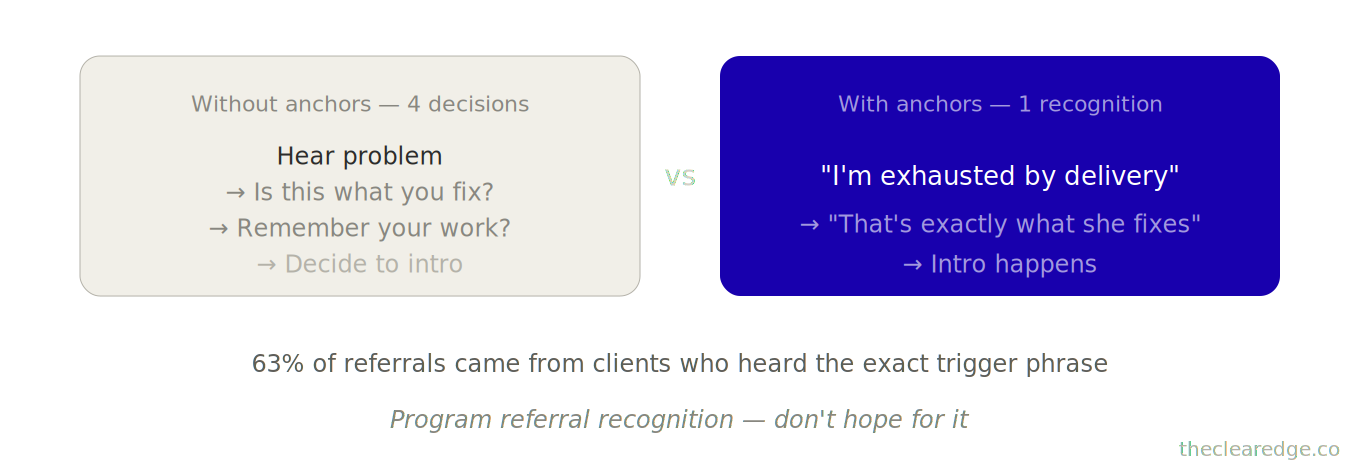
Why it works: from four steps to one
Human memory anchors to specific language.
When you give clients the exact phrases that signal a referral opportunity, you create automatic pattern matching—clients hear the trigger phrase, memory activates, and the referral happens.
Without anchors, clients need to:
Hear a problem
Analyze if it matches what you do
Remember you solve that problem
Decide to make an introduction
With anchor
They hear the phrase and immediately connect: “That’s exactly what [your name] fixes.”
You’ve collapsed four decisions into one recognition moment.
We’ve covered the mechanisms; now we’ll put numbers on what a Delivery That Sells system actually costs in hours and what changes when you install it.
What A Delivery That Sells System Changes And What It Costs To Build
Here’s a baseline example—your numbers will shift based on client volume and average project value.
Changes required
Week 1–2: Build 3 referral assets: one-liner, problem-match list, quick win template
Time investment: 4–6 hours (one-time build)
Weeks 3–4: Integrate milestone triggers into the existing delivery process
Time investment: 2–3 hours to map triggers and write scripts
Ongoing: Weekly value documentation (2 minutes per client), monthly milestone docs (15 minutes per client)
Time investment: 3–5 hours monthly for 10–15 active clients
Total implementation: 6–9 hours initial + 3–5 hours monthly ongoing
What you get
At 35% referral rate (conservative, given case study data of 39–41%):
20 clients served annually × 35% → 7 referrals
7 referrals × 65% close rate (warm leads) → 4–5 new clients from referrals
Value per referred client (assuming $5,500 average project value)
5 clients × $5,500 = $27,500 in new revenue
Plus: Lower acquisition cost (no ad spend, faster close cycle)
Opportunity cost of not building the Delivery That Sells system
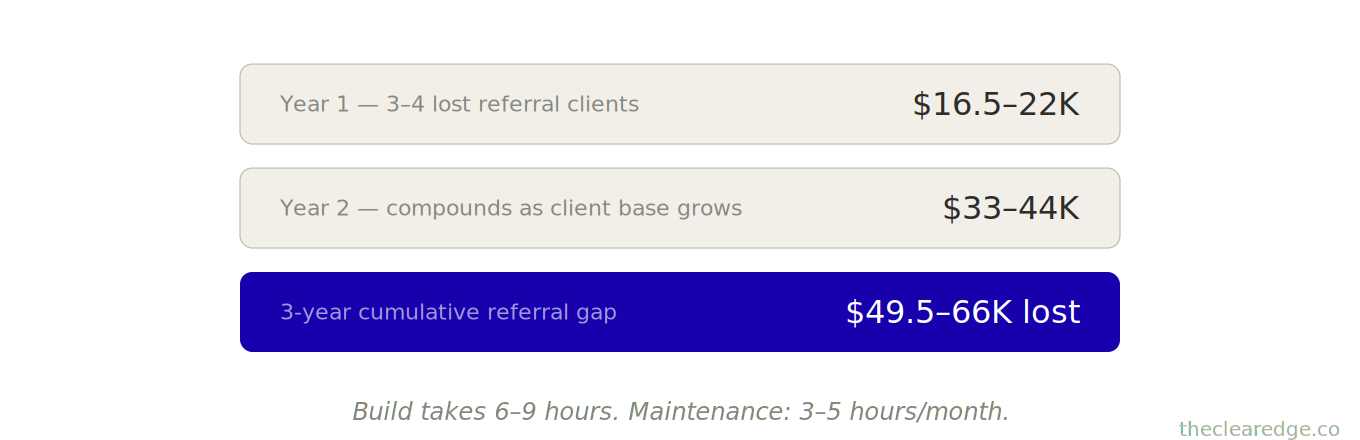
At a 15% natural referral rate:
20 active clients × 15% = 3 referrals.
3 referrals × 50% close rate ≈ 1–2 new clients.
Gap: 3–4 lost referral clients annually, $16,500–$22,000 in missed revenue.
Over 3 years: $49,500–$66,000 in cumulative lost revenue from referrals that should have happened
Delivery Without Referrals Is Slow Bleed
If you keep treating delivery and referrals as separate, you’re choosing to leave 3–4 clients and $16,500–$22,000 a year on the table; build the system that converts today’s delivery into next quarter’s pipeline.
Run Your Delivery That Sells Quick-Gate Checklist
Pull this every time a client hits a visible win or peak‑excitement delivery milestone.
☐ Logged this week’s client win using your 3-bullet progress snapshot, including metric moved and what that change unlocks next.
☐ Updated the client’s milestone doc with before/after metrics and timeline, keeping their transformation map current to this exact moment.
☐ Checked whether one of your live milestone triggers applies now, and used the matching referral phrase or script in this interaction.
☐ Listed any phrases the client used to describe their struggle or result, then matched them to your pattern anchors for future referrals.
☐ Calculated current referral rate vs. your 35–41% referral target and marked today’s win as counted or missed toward that number.
Every time you skip this, 3–4 referral clients and $16,500–$22,000 drift toward the referral amnesia pile instead of your pipeline.
Your First Implementation Steps For Delivery That Sells
You don’t need to build all three moves at once. Start with the highest-leverage change.
This week
1. Day 1-2: Write your one-liner
Format: “I help [specific client type] solve [specific problem]—most clients see [specific result] in [specific timeline].”
Test it with 2-3 current clients: “Does this capture what we’re doing?”
2. Day 3: Create problem-match list
List 4 signals that indicate someone is a good referral fit
Send to 3 active clients who are currently seeing results
3. Day 4-5: Map your 3 highest-excitement delivery milestones
Identify when clients naturally feel excited to share
Write a 1-sentence trigger script for each moment
Next week: Implement weekly progress snapshots for 1–2 clients
Format:
3 bullets showing this week’s change
Measurable progress
What’s unlocked
Time:
2 minutes per client
Week 3: Build a quick win sheet template
Before/after metrics
Key changes
Timeline
Use with the next client who hits the 60–90 day mark.
The test
If a current client were asked tomorrow, “What does [your name] do?”, could they explain it clearly in 30 seconds with a specific example?
If not, your visibility system needs work.
FAQ: Running The Delivery That Sells System In A $50K–$70K/Month Business
Q: How does the Delivery That Sells system turn one happy client into 3–5 referrals without pitching?
A: It embeds three moves into delivery—making results visible, creating referral triggers at peak excitement, and giving clients shareable proof—so referrals appear naturally while work is in progress, not as awkward post-project asks.
Q: What happens if I keep treating delivery and referrals as separate instead of using delivery-embedded referrals?
A: You stay stuck at 8–20% referral rates even with 85–96% client satisfaction, leaving 14–18 missed referrals and $42,184–$52,730 in monthly recurring revenue (up to $632,760 annually) on the table.
Q: How much time and money does it actually take to implement Delivery That Sells at $50K–$70K/month?
A: Expect 6–9 hours of one-time build for assets and triggers, then 3–5 hours monthly for 10–15 active clients, which typically lifts referrals from 8–15% to 35–41% within 60–90 days and compounds over 12 months.
Q: How do I use Delivery That Sells with its three moves before I try to “push harder” on sales and marketing?
A: Before adding new acquisition channels, build Move 1 (visibility), Move 2 (triggers), and Move 3 (shareable proof) into your current delivery so existing 20–27 clients per year can generate 3–5 referrals each, turning today’s work into your warmest pipeline.
Q: When should I rely on quality alone and when do I need a formal Delivery That Sells system?
A: Once you’re at $50K–$70K/month with 85%+ satisfaction but referrals stuck under 20%, quality has already plateaued as a growth lever and you need structured visibility, triggers, and assets to unlock the remaining 52–66 percentage-point referral gap.
Q: How do I make results visible so clients can explain my value in 30 seconds with real numbers?
A: Use weekly 2-minute progress snapshots plus 30–180 day milestone docs and a final transformation map that show before/after metrics (like $3,200 → $8,400 → $14,800) so clients remember the exact sequence and outcomes instead of vague “game-changing” praise.
Q: When should I insert referral triggers so they feel natural instead of pushy for my clients?
A: Place them at three peak excitement milestones—like a Week 3 brand reveal, Week 7 launch, and the first measurable win around Week 10–12—so you’re simply structuring sharing clients already want to do instead of bolting on a request at final delivery.
Q: How do I build shareable proof so clients can refer me without doing extra explanation work?
A: Create a one-liner, a 1-page quick win sheet with 90-day before/after metrics, and a simple 4-question problem-match list so clients can copy-paste your positioning, show exact results (like $30K–$60K recovered in 90 days), and quickly spot perfect-fit referrals.
Q: Why do “organic” referrals stall at 8–15% even when 78% of clients say they’d happily refer?
A: Because clients must navigate five unguided steps—recognizing a problem, recalling your work, assessing fit, assuming your capacity, and initiating an intro—each with roughly 60–70% pass-through, which mathematically collapses into an 11.6% natural referral rate without systems.
Q: When do pattern anchors and referral phrases matter most for keeping referrals flowing after a project ends?
A: Use them at three points in delivery—like Weeks 4, 9, and 14—by tying common phrases (“I’m working too hard for what I’m making,” “I can’t raise my prices,” “I’m exhausted by delivery”) directly to your solution so clients instantly recognize referral opportunities months later.
Up Next: The Delegation Map For $50K–$70K/Month Founders
Most operators at $50K-$70K try to delegate tasks. Wrong approach. You need to delegate decisions—that’s what actually frees your time.
In the next article: “The Delegation Map: First Hand-Offs That Break the $50K Ceiling for $50K–$65K Operators,” I’ll show you the exact sequence: which decisions to hand off first, how to transfer them without losing quality, and why most delegation fails (hint: you’re delegating the wrong things in the wrong order).
Navigate The Clear Edge OS Systems for Scaling From $5K to $150K
Start here: The Complete Clear Edge OS — Your roadmap from $5K to $150K with a 60-second constraint diagnostic.
Use daily: The Clear Edge Daily OS — Daily checklists, actions, and habits for all 26 systems.
LAYER 1: SIGNAL (What to Optimize)
The Signal Grid • The Bottleneck Audit • The Five Numbers
LAYER 2: EXECUTION (How to Optimize)
The Momentum Formula • The One-Build System • The Revenue Multiplier • The Repeatable Sale • Delivery That Sells • The 3% Lever • The Offer Stack • The Next Ceiling
LAYER 3: CAPACITY (Who Optimizes)
The Delegation Map • The Quality Transfer • The 30-Hour Week • The Exit-Ready Business • The Designer Shift
LAYER 4: TIME (When to Optimize)
Focus That Pays • The Time Fence
LAYER 5: ENERGY (How to Sustain)
The Founder Fuel System • $100K Without Burnout
INTEGRATION & MASTERY
The Founder’s OS • The Quarterly Wealth Reset
AMPLIFICATION (AI & Automation)
The Automation Audit • The Automation Stack
⚑ Found a Mistake or Broken Flow?
Use this form to flag issues in articles (math, logic, clarity) or problems with the site (broken links, downloads, access). This helps me keep everything accurate and usable. Report a problem →
› More to Explore: Quick Navigation · The Clear Edge OS
➜ Help Another Founder, Earn a Free Month
If this system helped you see where $42,184–$52,730 in monthly recurring revenue might be leaking through missed referrals, share it with one founder who needs that clarity.
When you refer 2 people using your personal link, you’ll automatically get 1 free month of premium as a thank‑you.
Get your personal referral link and see your progress here: Referrals
Get The Delivery That Sells Toolkit Inside The Clear Edge OS
You’ve read the system. Now implement it.
Premium gives you:
Ready-to-use PDF toolkit—every template, diagnostic, and formula pre-filled, zero setup, immediate use
Plug-and-play AI diagnosis sessions—drop into Claude, Gemini or ChatGPT, answer a few questions, save hours of guessing, get your exact next move
Audio key points—concentrated frameworks you can absorb in minutes, implement while you move
Unrestricted access to the complete library—every system, every update
What this prevents: Staying stuck at 8–20% referrals even with 85–96% client satisfaction.
What this costs: $49/month. Download everything today. Implement this week. Cancel anytime, keep the downloads.
Already upgraded? Scroll down to download the PDF, audio, and your AI session.
