


The Executive Summary
Founders and operators at $50K–$70K/month burn 624+ hours and $312,000 re-deciding work; the Delegation Map’s three-level decision transfer stops the bleed and starts freeing your week.
Who this is for: Service founders and operators at $50K–$70K/month with small teams stuck in 60–80 hour weeks because every client decision, exception, and approval still routes through them.
The delegation map problem: Delegating tasks but not decisions creates bottlenecks, compounding into 3,120 repeat decisions, 624 hours, and $312,000 yearly spent re-answering questions and re-approving work.
What you’ll learn: How to use The Delegation Map Framework: Three Levels of Decision Transfer—Level 1: Execute Decisions, Level 2: Modify Decisions, Level 3: Create Decisions—with mistake protocols that stop decision hoarding and failed handoffs.
What changes if you apply it: You stop acting as the approval bottleneck while your team owns Level 1 and 2 decisions, freeing about 20 hours monthly, unlocking $10,000 in recaptured capacity, and making a 2-week vacation realistic.
Time to implement: Expect 15–24 hours of upfront work over 4 weeks plus 3–4 hours monthly to maintain and refine decision frameworks, with meaningful delegation gains inside 90 days.
Written by Nour Boustani for $50K–$70K/month founders who want scalable delegation and reclaimed capacity without 70–80 hour weeks and failed handoffs that force them to take decisions back.
If you’re at $50K–$70K and still re-deciding the same work every week, upgrade to premium and turn The Delegation Map into a documented, enforced decision system.
› Library Navigation: Quick Navigation · The Clear Edge OS
When Every Decision Still Runs Through You
You burn 624 hours and $312,000 a year because every decision still runs through you.
I worked with a founder at $63,000/month running a content agency with 4 team members.
Revenue was strong. His schedule was destroyed.
Working hours: 68 per week
Client-facing work: 22 hours
Team questions: 18 hours
Decision-making: 14 hours
Admin/coordination: 14 hours
He’d delegated plenty:
Content creation to writers.
Design to a designer.
Client communication to a project manager.
Invoicing to a VA.
But every piece of work still stopped with him for approval; every edge case came back as a question, and every client request needed his input on scope, pricing, and timeline.
“I’ve delegated the work,” he said. “But I’m still working 68 hours.”
The problem wasn’t task delegation—he’d done that. The problem was decision delegation; he’d kept every judgment call.
I tracked his interruptions for 5 days.
Questions: 73 from his team
Response time: 90 minutes average (checked Slack every 1–2 hours)
Context switching: 4–8 minutes per question to refocus
Time cost: 73 questions × 12 minutes average (including context switching), which is 14.6 hours weekly just handling decisions he should’ve transferred.
Here’s the deeper issue: I categorized the 73 questions.
Clarifying decisions he’d already made: 29 (39.7%)
Decisions that followed existing patterns: 31 (42.5%)
Genuinely novel decisions: 13 (17.8%)
That means 82.2% of the questions coming to him were decisions he’d already made that should’ve been written into rules and handed off.
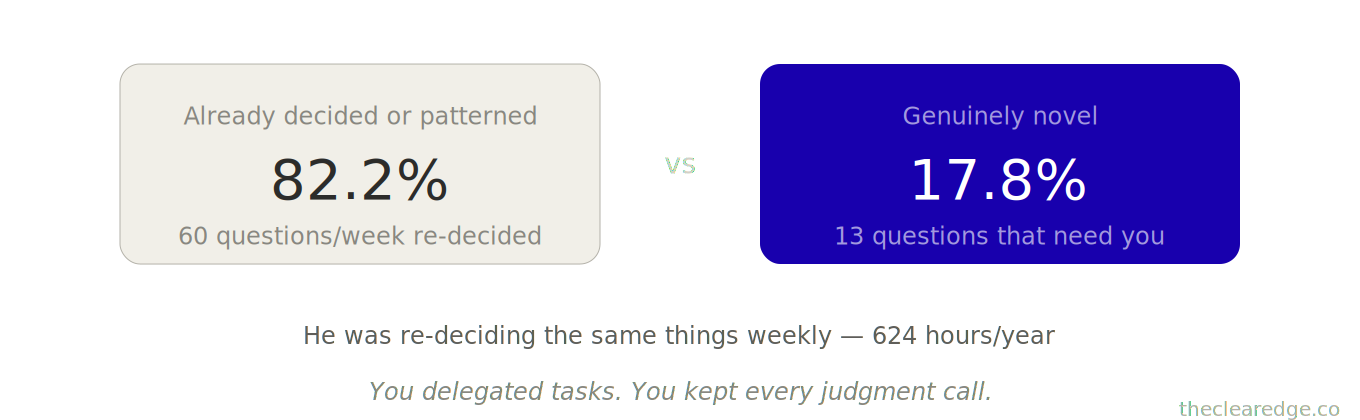
He was re-deciding the same things weekly.
Annual impact:
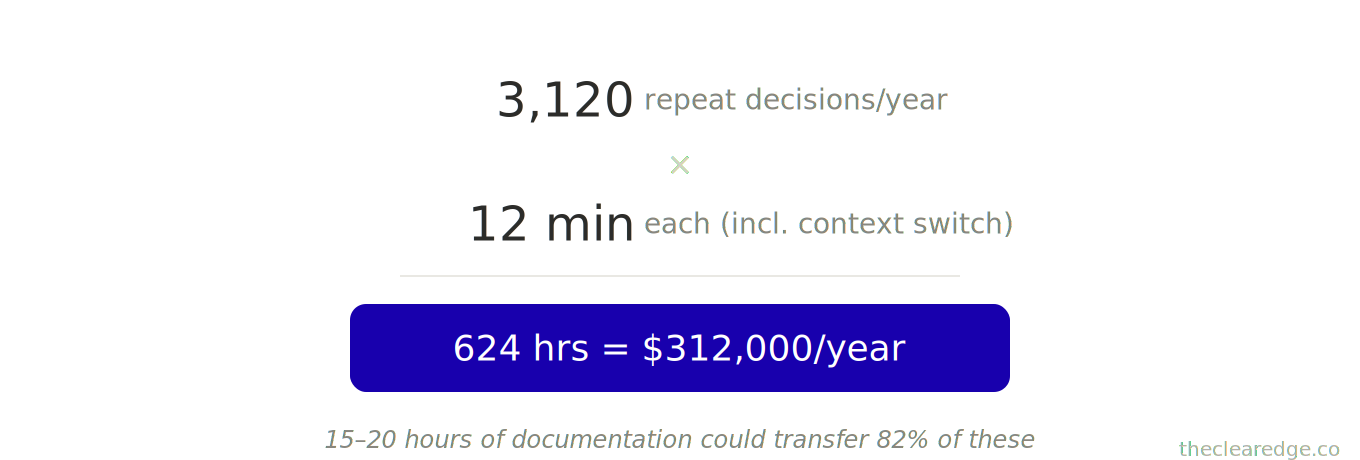
Decisions per year: 60 repetitive questions × 52 weeks = 3,120 decisions
Time spent: 3,120 decisions × 12 minutes = 624 hours → 15.6 work weeks
Capacity value: 624 hours × $500/hour = $312,000 in founder time on decisions that 15–20 hours of documentation could transfer
When I asked why his team kept asking, the answer was simple:
“I’m not sure what he wants,” and “Last time I guessed wrong, we had to redo it.”
His team wasn’t incompetent. They had no clear decision framework, and he’d delegated execution without delegating judgment criteria, so every task came with implied questions.
How perfect does this need to be?
What’s the priority if we’re behind?
When do I loop you in vs. decide myself?
What trade-offs are acceptable?
Without clear answers, they defaulted to asking, which felt safer than guessing wrong.
Why Task Delegation Without Decision Rights Fails
He thought delegation meant handing off activities. It doesn’t.
Delegation means transferring decision-making authority for defined situations. Tasks without decision rights don’t free your time; they just add coordination overhead.
We rebuilt his delegation around one principle—transfer decisions in sequence, starting with the highest-frequency, lowest-risk choices first.
Delegation Failure Pattern For $50K–$70K Founders
Most founders at $50K–$70K delegate in the wrong order, turning delegation into slower timelines, extra rework, and even more dependency on them.
1. Delegating High-Stakes Pricing And Quality Too Early
I’ve seen 34 founders at this stage try to delegate pricing, client onboarding, or quality control as first moves.
91% had to reverse it within 60 days.
Why it fails:
High-stakes decisions need deep context about business positioning, client expectations, and long-term strategy.
Your team doesn’t yet have the depth of context required to make those high-stakes calls reliably.
Explaining that context for each decision currently takes longer than just making the call yourself.
2. Delegating Tasks While Keeping All Approvals
Pattern seen in 68% of stalled delegation attempts, where the founder hands off execution (”write the blog post”) but keeps approval rights (”I’ll review before publishing”).
Team member works → waits for approval → gets feedback → redoes work → waits again.
Total time: 2-4x longer than if the founder had done it themselves—Delegation created more work, not less.
I measured this with a $66K/month agency owner who had delegated blog writing to a team member but reviewed every draft; the average post went through 2.3 revision rounds before approval.
Time breakdown per post:
Team member writes: 3 hours
Waits for her review: 1-2 days (she batched reviews)
She reviews: 25 minutes
Team member revises: 1.5 hours
Waits for second review: 1-2 days
She reviews again: 15 minutes
Total cycle time: 4-6 days, 5.2 hours combined time
Compared to when she wrote posts herself—2.5 hours and published the same day—the delegation was creating 2.1x more work and 3–4x longer timelines because she’d delegated the task but not the decision criteria for “good enough to publish.”
When we documented her quality standards and gave the writer full publishing authority (she spot-checked 20% of posts after publication), the math flipped.
Writer creates + publishes: 3.2 hours (slightly longer because they’re more careful)
She spot-checks later: 10 minutes average
Total cycle time: Same day, 3.3 hours combined time
Efficiency gain:
1.6x faster
Eliminated 4-6 day delay
Freed 1.9 hours of her time per post.
3. Delegating Without Written Decision Criteria
Across 47 businesses I’ve audited at this revenue stage, 79% made decisions verbally without writing them down.
Result:
Same questions repeated weekly because there’s no reference
Team learns your preferences slowly through trial and error instead of quickly through documented patterns
The pattern: Founders treat delegation like a binary switch—either they do it, or someone else does it—wrong model.
Delegation is a sequence.
You transfer decision-making authority gradually, starting with low-risk, high-frequency decisions where patterns are clear. As your team builds judgment in safe domains, you expand their authority into higher-stakes areas.
Why the sequence matters
Founders who respect the sequence let their team build decision muscle on simple, repeatable calls first
Confidence and accuracy grow inside those safe domains before touching strategic choices
Most delegation failures happen because founders skip the sequence and try to hand off complex judgment calls before their team has built decision-making muscle on simpler choices.
[Wrong Model]

[Founder]
   |
   v
[Team Member]

(Tasks handed off once)

---

[Correct Model]

[Level 1] Execute Decisions
    |
    v
[Level 2] Modify Decisions
    |
    v
[Level 3] Create Decisions

(Authority expands over time)
Fifteen Weeks Lost Re-Deciding Repeatable Decisions
Reading the framework shows you where your time leaks. If you want support to install The Delegation Map Framework so those 15.6 work weeks don’t repeat, upgrade to premium and use the toolkit.
You’ve seen how the failures stack; now you need a clear three-level map that shows exactly which decisions to transfer first and how to stage the rest.
The Delegation Map: Three Levels Of Decision Delegation
Stop delegating randomly. Start with a map.
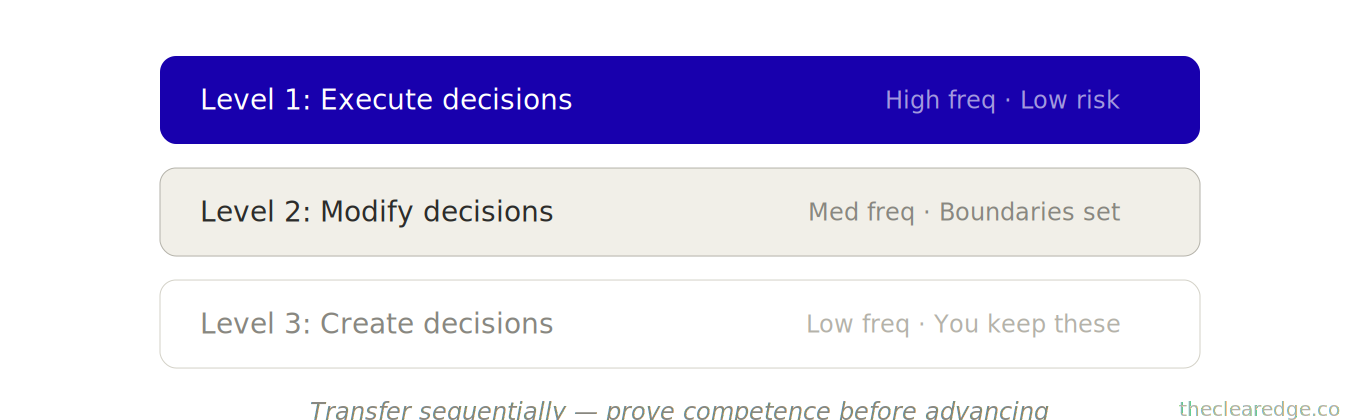
Level 1: Execute Decisions
Transfer repetitive, pattern-based decisions with clear criteriaLevel 2: Modify Decisions
Transfer judgment calls within defined boundariesLevel 3: Create Decisions
Transfer strategic choices that shape direction
Each level requires more context and carries a higher risk.
You move through them sequentially, proving competence at each level before advancing.
Mapping the levels is useful, but the shift happens when you see a concrete Level 1 example and what it looks like in a real business.
Level 1: How To Delegate Repeatable Execution Decisions
These are decisions you’ve made 100+ times with consistent criteria, and your team should handle them without asking.
A $68K/month consulting firm owner had 6 consultants delivering client projects, and she personally reviewed every deliverable before it went to clients.
Deliverables reviewed monthly: 28–34
Time per review: 45 minutes
Total review time: 21–25.5 hours monthly
“I can’t risk low-quality work reaching clients,” she said.
I asked: “How often do you reject a deliverable?”
She pulled the data.
Last 90 days: 94 deliverables reviewed
Rejected for rework: 7 (7.4% rejection rate)
Of those 7 rejections, 5 came from the same new consultant, so the rest of the team was effectively at a 3% rejection rate.
What the math shows
92.6% of her review time was validating work that would’ve been fine without her
She was paying an opportunity cost of 21–25.5 hours monthly to catch 2 issues that could’ve been prevented with better onboarding
The fix wasn’t eliminating the review; it was transferring the review decision to someone else.
[Before]

Consultant -> Founder review
        -> Revisions
        -> Founder review
        -> Client

---

[After]

Consultant -> Quality Lead review

         -> Client

Founder -> Spot-check 15% later
Step 1: Document quality criteria
She spent 4 hours creating a quality checklist covering the 12 most common issues she caught in reviews:
Claims without supporting data
Recommendations without implementation steps
Missing client-specific context
Formatting inconsistencies
Unclear next actions
Each criterion had 2-3 examples of “good” vs. “needs work.”
Step 2: Transfer review authority
Promoted her most senior consultant to Quality Lead.
New workflow:
Consultant completes the deliverable.
Quality Lead reviews it using the checklist.
Quality Lead either passes it to the client or sends it back to the consultant if issues are found.
She spot-checks 15% of deliverables randomly.
Step 3: Exception handling
Quality Lead escalates only if:
Client is new (first 2 deliverables get her review)
The issue isn’t covered by the checklist (triggers the checklist update)
Deliverable involves a strategic recommendation of over $50K in client impact
Result Of Delegating Level 1 Quality Decisions
Month 1:
She reviewed 15 deliverables (spot-checks + exceptions) vs. the previous 32
Time saved: ~13 hours that month
Month 3:
She reviewed 6 deliverables
Time saved: 19.5 hours
Capacity recaptured: $9,750 at $500/hour founder rate
Quality didn’t drop; client satisfaction was 94% before and 96% after, as the Quality Lead was more detail-oriented than she was.
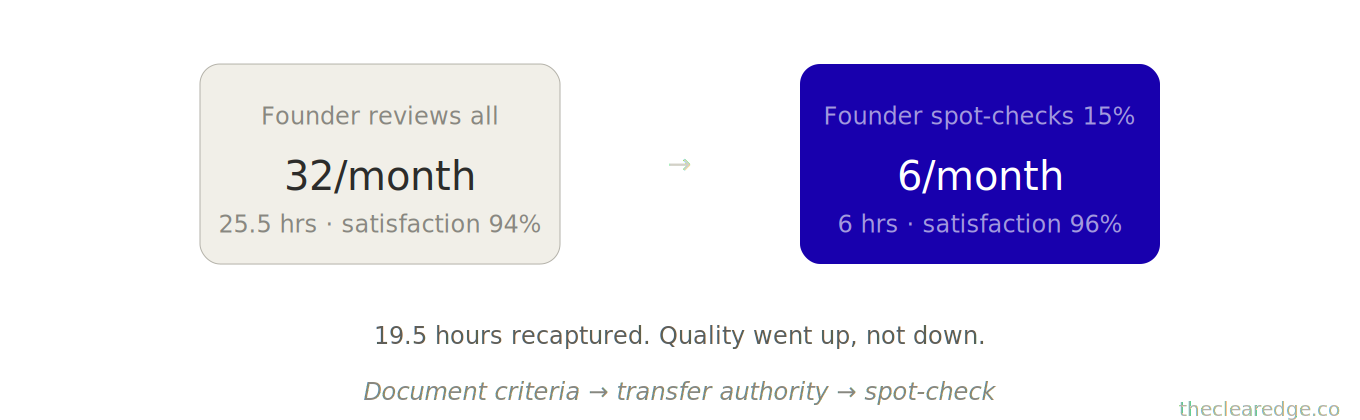
The pattern: Level 1 delegation transfers execution of decisions you’ve already made. You document the decision criteria, assign someone to apply those criteria, and spot-check to ensure quality holds.
Across 52 delegation implementations I’ve tracked at this stage, Level 1 transfers have a 89% success rate when criteria are documented vs. a 34% success rate when handed off verbally.
Documentation removes interpretation variance—everyone applies the same standard.
What to delegate first at Level 1
Quality checks on standardized deliverables
Response templates for common client questions
Approval on expenses under $500
Scheduling for meetings that follow consistent patterns
First-draft creation for recurring content
Common failure: Delegating Level 1 decisions without documented criteria. Your team won’t guess your standards correctly—you need to write them down first.
Once Level 1 standards live on paper, the next constraint is judgment calls inside boundaries, which is where Level 2 decisions sit.
Level 2: Delegating Context-Based Client And Student Decisions
These are decisions that follow a pattern but still need judgment calls based on context, inside clear boundaries you’ve set.
A $71K/month course creator had 3 team members supporting 220 active students. Student questions came through support tickets—40-60 weekly. She personally answered 80% of them because “students expect to hear from me.”
Time cost:
Tickets handled weekly: 32–48
Time per ticket: 8 minutes
Weekly time spent: 4.3–6.4 hours
Monthly time spent: 17–26 hours
But when I reviewed 90 days of tickets, the pattern was clear:
Technical issues (login, access, platform bugs): 31%
Content clarification (explaining lesson concepts): 28%
Encouragement/motivation (feeling stuck, losing momentum): 23%
Strategic advice (applying concepts to their specific situation): 18%
The first 3 categories (82% of tickets) didn’t require her expertise. They required pattern-based responses with minor customization. Only the 18% strategic advice tickets needed her direct input.
The fix: Transfer Levels 1–2 to the team, keep Level 3 for herself.
[Support Tickets]

Level 1 (Execute)
- Technical issues
- Simple clarifications

Level 2 (Modify)
- Overwhelm / motivation
- Context-based guidance

Level 3 (Create)
- Strategic advice
(Founder keeps these)
System To Delegate Level 2 Support And Communication Decisions
Step 1: Build Response Frameworks For Repeat Support Patterns
She built a response library with 15 templates covering the most frequent questions.
Each template had:
Core answer (the factual response)
Personalization points (3–4 places to customize based on the student’s situation)
Escalation triggers (when to loop her in)
Example template for “I’m overwhelmed by the content”:
“Hi [Name],
I can see you’re working through [specific module]. That section covers a lot—most students feel this at [week number].
Here’s what usually helps: [suggestion based on their progress].
If you’d like to talk through your specific situation, reply and I’ll set up a quick call.
You’re making progress—[specific encouragement based on their work].”
Step 2: Transfer Support Decisions With Clear Escalation Rules
Team handled tickets for categories 1–3 using templates, customizing based on student context. She handled category 4 (strategic advice).
Boundaries:
The team could modify templates freely for the student context
The team could offer quick calls if the student seemed stuck
Team escalated if the student asked something entirely new (triggered template creation)
Result Of Delegating Level 2 Judgment Calls
She answered 7–11 tickets weekly (strategic only) vs. the previous 32–48
That’s 25–37 tickets shifted to the team, saving 20–23 hours monthly.
Student satisfaction: 89% before, 91% after (faster response times from team handling routine questions)
The pattern: Level 2 delegation transfers judgment within boundaries. Your team can modify your approach based on context, but they’re working within a defined framework you’ve created.
What to delegate at Level 2:
Client communication for standard situations (with escalation rules)
Pricing for add-on services (within defined ranges)
Scope adjustments on projects (up to +/- 10% of original)
Hiring decisions for junior roles (you approve the last candidate)
Content topic selection (from approved category list)
Common failure: No escalation rules, so the team either asks about everything (defeating delegation) or makes calls outside their authority (creating problems).
You need clear triggers for when to escalate.
Failure example
A $69K/month SaaS consultant delegated client communication to an account manager with the boundary “handle routine updates, escalate strategic decisions.” Vague boundary.
What happened:
A client requested a $12,000 scope expansion.
The account manager treated it as a routine change and agreed without checking with her.
The client expected the expanded scope delivered, but the founder didn’t have the capacity.
The founder had to renegotiate the agreement, which damaged the client relationship.
The fix: It wasn’t pulling back delegation—it was clarifying escalation triggers.
New rule:
“Any scope change over $2,000 or 5 hours of additional work requires my approval before agreeing.”
Why it works:
Specific thresholds remove judgment ambiguity
The team knows exactly when to escalate
The founder knows nothing gets agreed outside bounds
With bounded judgment working at Level 2, the remaining choke point is the truly strategic work—Level 3 decisions that shape the business itself.
Level 3: When To Delegate Strategic Direction Decisions
These are strategic decisions that shape business direction. They can’t follow templates because each situation is unique.
Most founders at $50K–$70K shouldn’t delegate Level 3 decisions yet because you’re still building the business model, defining positioning, and holding context your team doesn’t have.
Exception: One specific Level 3 domain can be delegated early if you hire someone with domain expertise you lack.
The $68K/month consulting firm owner (mentioned earlier) wasn’t a marketing expert.
She’d grown through referrals and networking, with no real marketing system in place.
She wanted to build content marketing but didn’t know where to start.
Strategic Marketing Delegation Example
Bad delegation: Hire someone to “handle marketing” with no direction.
Good delegation: Hire a marketing strategist, give them decision authority for the marketing approach, but set outcome constraints.
How to Safely Delegate Level 3 Strategic Decisions
She hired a part-time marketing lead ($3,500/month) and gave them Level 3 authority for marketing within defined constraints:
Decision authority given to the marketing lead
Choose marketing channels
Set content calendar and topics
Decide promotion strategy
Allocate marketing budget
Outcome constraints for delegated marketing decisions
Must generate 15 qualified leads monthly within 6 months
Budget: $2,000/month maximum
Brand voice: Must match her existing client communication style (provided samples)
Monthly review: They present data + reasoning, she approves/adjusts direction
Result
Month 6:
Qualified leads generated: 18
Clients converted: 4
New monthly recurring revenue: $28,000
Her time investment: 2 hours monthly (review meetings) vs. trying to learn and execute marketing herself (20+ hours monthly if she’d done it).
The pattern: Level 3 delegation works when you hire for expertise gaps and give them decision authority within outcome boundaries. You don’t tell them how to do the work—you define what success looks like and let them create the path.
When to delegate Level 3:
You lack expertise in the domain (technical, marketing, or finance)
You’ve hired someone with proven competence
You can define clear success metrics
You’re willing to let them own the approach
Common failure: Hiring experts and then micromanaging their decisions breaks Level 3 delegation. If you’re going to second-guess every choice, don’t delegate Level 3—hire for execution and keep strategic decisions yourself.
The Hidden Problem: Founder Decision Hoarding After Mistakes
Even after documenting decisions and transferring authority, founders pull decisions back when things go wrong.
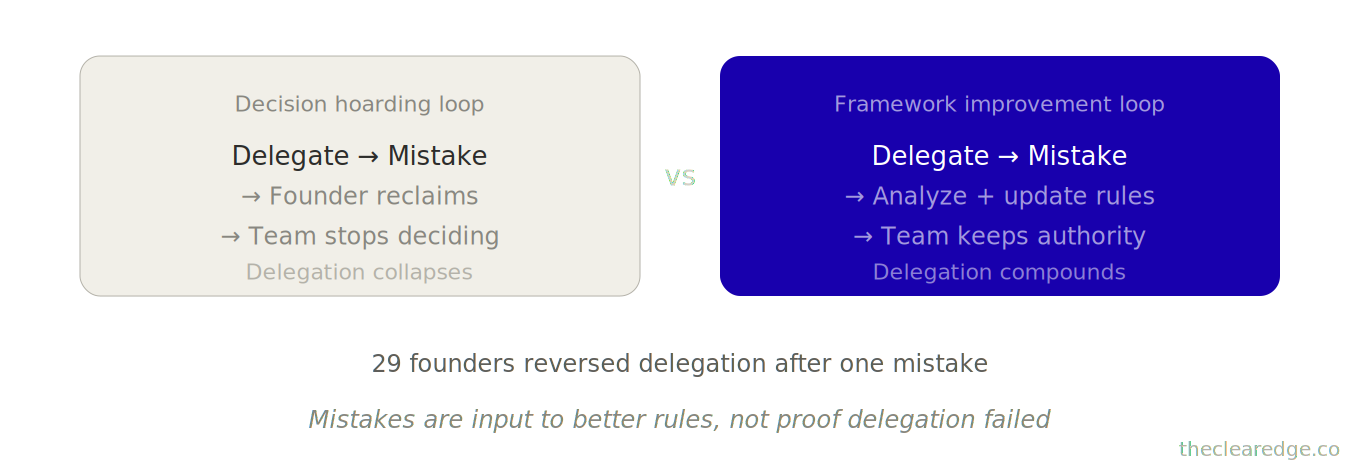
I’ve watched 29 founders at this stage successfully delegate, then reverse course after one mistake.
Pattern: Team makes a decision within their authority, the outcome isn’t perfect, the founder steps back in and reclaims the decision, and the team stops taking initiative.
Example: the $71K/month course creator (mentioned earlier) gave her team authority to handle encouragement tickets.
One team member sent an overly casual response to a frustrated student.
The frustrated student complained about the tone of that response.
The founder immediately reclaimed all student communication for 3 weeks and reviewed every response before it went out.
Result: The team became afraid to make calls, started escalating everything again, and delegation collapsed.
The fix: Mistake protocols
When a delegated decision goes wrong, you don’t reclaim authority—you improve the decision framework.
Result: You keep the delegation in place while tightening how decisions get made next time.
Why it fails without this: One mistake triggers full rollback, so the team learns that taking initiative is risky and temporary.
Why it works: You treat mistakes as input to better rules, not proof that delegation itself was wrong.
The fix: Steps
Step 1: Analyze what went wrong.
Step 2: Determine if it was a judgment error (fixable with coaching) or a missing criteria (fixable with documentation).
Step 3: Update the framework or provide training.
Step 4: Team retains authority with improved guidance.
In her case, the issue was tone, not judgment.
The team member understood what to say to the student, just not how to say it.
The founder added tone guidelines to the response library (for example, “when the student is frustrated, acknowledge specifically before offering solutions”).
The team kept authority over student communication, and the problem didn’t repeat.
The pattern: Delegation is iterative.
What you do: Transfer authority → monitor outcomes → improve frameworks when issues emerge → maintain delegation.
What breaks it: If you reclaim authority after every mistake, your team stops taking real ownership because they expect you to step back in.
If you step back in after every mistake, your team treats delegation as temporary and stops building any real judgment.
Implementation Time And Capacity Impact Of The Delegation Map
Here’s a baseline example—your numbers will shift based on team size and complexity.
Week 1–2: Audit your decision load
Track every decision for 5 days (use voice notes or quick Slack DMs to yourself).
Categorize decisions into Level 1/2/3.
Time investment: 30 minutes daily tracking plus 2 hours of analysis, for a total of 4.5 hours.
Week 3: Document Level 1 decisions
Choose 3–5 highest-frequency Level 1 decisions.
Write criteria, examples, and exception rules.
Time investment: 1–2 hours per decision, for a total of 3–10 hours.
Week 4: Transfer Level 1 authority
Meet with team member(s).
Walk through criteria and assign ownership.
Set a spot-check schedule.
Time investment: 2–3 hours initial transfer + 1 hour weekly spot-checking.
Month 2: Document Level 2 frameworks
Build templates for 2–3 Level 2 decision types.
Define escalation rules and boundary definitions.
Time investment: 4–6 hours creation + 2 hours training.
Ongoing: Decision framework updates
When mistakes happen or new patterns emerge, update documentation.
Time investment: 1–2 hours monthly.
Total implementation: 15–24 hours initial + 3–4 hours monthly ongoing.
[Weeks 1-2]

- Track decisions
- Classify Level 1/2/3

---

[Week 3]

- Document 3-5 Level 1
(decisions + criteria)

---

[Week 4]

- Transfer Level 1
+ spot-check

---

[Month 2]

- Build Level 2 rules
+ train team

---

[Ongoing]

- Update frameworks
1-2 hours monthly
Time and Capacity Gained From Decision Delegation
Conservative delegation success rate:
60% of Level 1 decisions
40% of Level 2 decisions transferred within 90 days
If you’re currently handling 50 decisions weekly:
Level 1 (repetitive):
30 Level 1 → 18 transferred
Math: 18 decisions × 10 minutes → 3 hours weekly saved
Level 2 (judgment):
15 Level 2 → 6 transferred
Math: 6 decisions × 20 minutes → 2 hours weekly saved
Level 3 (strategic):
5 Level 3 → 0 transferred (you keep these)
Total time saved:
Weekly: 5 hours
Monthly: 20 hours
Recaptured capacity: $10,000 at $500/hour founder rate
Opportunity Cost of Staying the Decision Bottleneck
Staying in execution mode at $50K–$70K caps your revenue ceiling. Without delegation infrastructure, you hit 70–80 hour workweeks trying to maintain current revenue, with no bandwidth to add new clients or build new offerings.
Cost:
Stalled revenue growth
Founder burnout
Team dependency
Inability to take time off
Over 12 months: Missed opportunity to reach $90K–$120K by freeing 20 hours monthly for business development, strategic partnerships, or new product development.
You’ve seen the math and the upside; the next step is shrinking this into a one-decision test you can run this month.
How To Run Your First Decision Delegation Test
Don’t try to delegate everything at once. Start with one decision this week.
Day 1: Track your decisions
For 5 days, note every time someone asks you a question or you make a call about their work.
Use voice memos or quick notes.
Don’t categorize yet—just capture.
Day 6: Analyze patterns
Group your notes.
Which 3 decisions came up most frequently?
Those decisions are your Level 1 candidates.
Day 7: Document one decision
Pick the highest-frequency Level 1 decision.
What the decision is
Criteria for making it (with examples)
Exception cases (when to escalate)
Who should own it going forward
Week 2: Transfer with training
Meet with the person who’ll own this decision.
Walk through your documentation.
Have them apply it to 3 past examples to confirm understanding.
Assign ownership.
Week 3: Spot-check only
Resist the urge to review every instance.
Spot-check 20% randomly.
If quality holds, you’re done with this decision.
If not, update the criteria and re-train.
Week 4: Add a second decision
Repeat the process with your second-highest-frequency Level 1 decision.
The test
If you took a 2-week vacation, could your business run without daily check-ins? If not, you haven’t delegated decisions—you’ve only delegated tasks.
The Delegation Trade You Are Making
If you won’t let go of repeatable decisions, you’re choosing another week of Slack pings, approvals, and context switching over one afternoon defining rules; pick one client decision to document and hand off.
Run The Delegation Map Quick-Gate Checklist
Next time a team question or approval hits your inbox, run this before you answer or jump in yourself.
☐ Logged the decision as Level 1, 2, or 3 using your Delegation Map, based on frequency, risk, and how many times you’ve made this call before.
☐ Checked whether this decision already has documented criteria, examples, and escalation rules; if not, wrote them before responding once more.
☐ Scored whether this fits inside delegated Level 1–2 authority; if yes, sent it back with the framework instead of taking the decision back.
☐ Wrote whether the outcome exposed a judgment error or missing criteria, then updated the decision framework or coaching plan accordingly.
☐ Logged if you reclaimed any delegated decision after a mistake; if you did, reversed it and kept authority with the team using updated rules.
Every pass prevents another loop of 3,120 repeat decisions and 624 hours of donated founder time from creeping back into your week.
Where to Go From Here: Install The Delegation Map and Reclaim Founder Capacity
If you are operating in the $50K–$65K band and acting as the decision bottleneck, you are donating 20+ hours monthly and thousands in recoverable capacity.
From here, run the sequence once:
Track and categorize every decision for 5 days into Level 1/2/3 to see exactly where your attention is leaking into repetitive calls.
Document and transfer your highest-frequency Level 1 decisions using criteria, examples, and exception rules so your team can execute without pulling you back into every thread.
Install weekly spot-checks and monthly framework updates so 60% of Level 1 and 40% of Level 2 decisions stay delegated while you use the recaptured hours for growth work.
Run this as your new operating rhythm and The Delegation Map becomes the permanent plug in your decision leak, not a one-off clean-up.
FAQ On The Delegation Map Three-Level Decision System
Q: How does The Delegation Map turn 60–80 hour weeks into reclaimed founder time and capacity?
A: By transferring Level 1 and 2 decisions to your team using documented criteria and boundaries, you free about 20 hours monthly and recapture roughly $10,000 in founder capacity while staying within $50K–$70K/month revenue.
Q: How much time and money do I lose each year by hoarding repeat decisions at $50K–$70K/month?
A: In the case study above, re-deciding 60 repetitive questions weekly compounds to 3,120 decisions and 624 hours yearly, which at a $500/hour founder rate burns $312,000 that 15–20 hours of documentation work could redirect.
Q: What happens if I keep delegating tasks but not decisions as my team grows?
A: You become the approval bottleneck, creating 2–4x longer timelines, 70–80 hour weeks, and up to 15.6 work weeks annually lost to re-approvals, stalled client work, and repeated questions instead of growth.
Q: How do I use The Delegation Map Framework with its three decision levels before hiring or promoting again?
A: Audit decisions for 5 days, classify them into Level 1 (execute), Level 2 (modify), and Level 3 (create), then document Level 1 and 2 criteria and escalation rules before matching roles to those mapped responsibilities.
Q: When should I delegate a decision as Level 1: Execute Decisions instead of keeping it myself?
A: Use Level 1 when you’ve made the same call 100+ times with consistent criteria—like standardized quality checks, expense approvals under $500, or recurring client responses—so a team member can follow a checklist while you spot-check 15–20% of outcomes.
Q: What happens if I delegate pricing, onboarding, or quality control too early at this revenue stage?
A: Founders who start delegation with high-stakes decisions see about 91% of those handoffs reversed within 60 days, usually because their team lacks positioning and strategy context, leading to mispriced deals, rework, and damaged client relationships.
Q: How do I use The Delegation Map to reduce approval loops that make delegated work take 2–4x longer?
A: Document “good enough” quality standards, give your team full publishing or delivery authority with clear checklists, and move yourself to 15–20% spot-checks, which consistently flips cycles from 4–6 days and 5.2 hours to same-day delivery in about 3.3 hours.
Q: When should I start delegating Level 2: Modify Decisions so my team can use judgment without blowing up projects?
A: Once you’ve defined response templates, pricing ranges, and scope boundaries—like allowing +/- 10% scope changes or requiring escalation for any scope shift over $2,000 or 5 hours—you can safely let your team adapt decisions within those constraints.
Q: When is it safe to delegate Level 3: Create Decisions without losing control of the business?
A: Delegate Level 3 only when you’ve hired a proven expert, can define clear success metrics—such as 15 qualified leads monthly within 6 months on a $2,000/month budget—and are willing to review results in 2-hour monthly check-ins instead of dictating tactics.
Q: Why does decision hoarding keep happening even after I document and transfer decisions using this system?
A: Decision hoarding returns when founders reclaim authority after a single imperfect outcome instead of using mistake protocols—analyzing what went wrong, updating criteria or coaching, and keeping the team’s Level 1–2 authority intact so judgment keeps compounding.
Up Next: Delegating Quality Without Lowering Standards
Next article covers “The Quality Transfer: Delegate 15 Hours Without Losing Standards for $55K–$75K Operators,” I’ll show you how to transfer work without compromising quality, why “trust but verify” actually slows everything down, and the specific handoff protocols that let you maintain standards while freeing up 15+ hours weekly.
Navigate The Clear Edge OS Systems for Scaling From $5K to $150K
Start here: The Complete Clear Edge OS — Your roadmap from $5K to $150K with a 60-second constraint diagnostic.
Use daily: The Clear Edge Daily OS — Daily checklists, actions, and habits for all 26 systems.
LAYER 1: SIGNAL (What to Optimize)
The Signal Grid • The Bottleneck Audit • The Five Numbers
LAYER 2: EXECUTION (How to Optimize)
The Momentum Formula • The One-Build System • The Revenue Multiplier • The Repeatable Sale • Delivery That Sells • The 3% Lever • The Offer Stack • The Next Ceiling
LAYER 3: CAPACITY (Who Optimizes)
The Delegation Map • The Quality Transfer • The 30-Hour Week • The Exit-Ready Business • The Designer Shift
LAYER 4: TIME (When to Optimize)
Focus That Pays • The Time Fence
LAYER 5: ENERGY (How to Sustain)
The Founder Fuel System • $100K Without Burnout
INTEGRATION & MASTERY
The Founder’s OS • The Quarterly Wealth Reset
AMPLIFICATION (AI & Automation)
The Automation Audit • The Automation Stack
⚑ Found a Mistake or Broken Flow?
Use this form to flag issues in articles (math, logic, clarity) or problems with the site (broken links, downloads, access). This helps me keep everything accurate and usable. Report a problem →
› More to Explore: Quick Navigation · The Clear Edge OS
➜ Help Another Founder, Earn a Free Month
If this system just saved you from burning 624+ hours and $312,000 in re-deciding work, share it with one founder who needs that relief.
When you refer 2 people using your personal link, you’ll automatically get 1 free month of premium as a thank‑you.
Get your personal referral link and see your progress here: Referrals
Get The Delegation Map Toolkit And Full Access
You’ve read the system. Now implement it.
With premium, you get:
Ready-to-use PDF toolkit—every template, diagnostic, and formula pre-filled, zero setup, immediate use
Plug-and-play AI diagnosis sessions—drop into Claude, Gemini or ChatGPT, answer a few questions, save hours of guessing, get your exact next move
Audio key points—concentrated frameworks you can absorb in minutes, implement while you move
Unrestricted access to the complete library—every system, every update
What this prevents: Staying the approval bottleneck while your team keeps routing repeatable decisions back to you instead of using a defined system.
What this costs: $49/month.
Download everything today. Implement this week. Cancel anytime, keep the downloads.
Already upgraded? Scroll down to download the PDF, audio, and your AI session.
