


The Executive Summary
Consultants and agencies in the $30K–$50K/month range burn 18 hours weekly on bad-fit clients instead of higher-margin, referral-rich work when they accept anyone who can pay.
Who this is for: Consultants, coaches, and agencies at $30K–$50K/month working 50+ hours weekly with energy-draining clients and capacity, not leads, as the main constraint.
The client fit problem: Bad-fit clients eat 18 hours weekly and 23.4 work weeks yearly and flatten growth even at $35K–$38K/month by trading margin and energy for fake pipeline health.
What you’ll learn: The Client Fit Matrix 2x2, the 5-Question Fit Evaluation System, and a 50-point scoring system that cleanly separates Quadrant 1 “yes” clients from Quadrant 3 “nightmare” clients.
What changes if you apply it: You swap low-fit, scope-creep engagements for Quadrant 1 clients, drop from 52 to low-40s hours weekly, and raise effective rates from $29/hour to $42/hour.
Time to implement: Spend 15 minutes per prospect to qualify, 30 minutes to score current clients, 20 minutes to build your template, and 3–6 months to rotate out bad fits.
Written by Nour Boustani for mid-five to low-six-figure consultants and agencies who want sustainable growth without energy-draining clients that quietly stall their business.
At $30K–$50K/month, saying yes without the Client Fit Matrix keeps the Client Fit Problem eating 18 hours weekly; start premium access to run every prospect through the 50-point Fit Evaluation System.
› Library Navigation: Quick Navigation · Mini-Frameworks
The Revenue And Time Trap Of Bad-Fit Consulting Clients
Nightmare clients rarely appear as “nightmares” on the initial call; they show up later as 18 hours a week you never planned to spend. Here’s how that played out in a consulting business that stayed stuck at $38K/month with 11 clients until we ran the Client Fit Matrix.
Case study: 11-client consulting business (stuck at $38K/month)
Starting point:
Monthly revenue: $38,000/month
Active clients: 11
Average per client: $3,455
Close rate: 72% on qualified calls
Client satisfaction: 88%
Trend: Revenue frozen for 7 months
“I close most prospects I talk to,” she said. “But half my clients are exhausting.”
The numbers told the real story.
Time breakdown per week:
Client work: 32 hours (delivery)
Prospect calls: 6 hours (3–4 calls weekly)
Client management: 14 hours (emails, calls, revisions, scope creep)
Total: 52 hours working
Client breakdown:
5 great clients: Clear expectations, fast responses, pay on time, refer others
6 problem clients: Unclear needs, slow decisions, scope creep, constant questions
She spent 18 hours weekly managing the 6 problem clients — 936 hours a year, or about 23 work weeks, on clients who generated $20,730/month (54% of revenue) but consumed 64% of her time.
Why traditional qualification missed it
Her discovery calls ran 45 minutes, proposals landed, deals closed, and 2 weeks in she’d realize 6 of those clients needed 936 hours yearly for just $20,730/month that traditional BANT or MEDDIC never screened out; the Client Fit Matrix does because it scores fit, not just budget and authority.
She spent 18 hours weekly managing the 6 problem clients. That’s 936 hours yearly, 23.4 work weeks on clients who generated $20,730/month (54% of revenue) but consumed 64% of her time.
The math breaks down worse:
Great clients: $17,270/month from 14 hours weekly → $31/hour effective rate
Problem clients: $20,730/month from 18 hours weekly → $29/hour effective rate
Problem clients paid less per hour and created an energy drain that killed business growth momentum.
“I just need to close more deals,” she said.
Wrong diagnosis.
She didn’t need more clients. She needed better qualifications. The problem wasn’t closing — it was accepting the wrong prospects in the first place.
Most operators miss this:
Not every prospect who is willing to buy should become a client. At $30K–$50K, your real constraint is not lead volume but capacity, and every bad-fit client occupies a slot that could go to a great-fit client.
The pattern repeats across 76 businesses I’ve audited: founders accept prospects based on budget alone without systematically evaluating fit. This leads to a situation where revenue grows, but energy drains, delivery suffers, and scaling stalls.
She needed a qualification filter — something faster than intuition but more reliable than guessing from a single conversation.
The Client Qualification Pattern That Keeps You Stuck With Bad-Fit Clients
Most qualification decisions happen in seconds based on gut feel. A prospect mentions budget, you think “this works,” the call ends, and you send a proposal.
There is no systematic evaluation, no scoring, and no framework beyond checking whether they can afford your rate, which is why 40–60% of closed clients shouldn’t have been accepted.
Here’s where that plays out at different revenue stages.
Pattern 1: The Budget-Only Client Qualification Trap For Consultants And Agencies
One consultant qualified prospects on one criterion:
“Can they afford my $4,500 monthly retainer?”
If the answer was yes, he sent a proposal; if it was no, he declined. There was no other evaluation, no fit assessment, and no energy check.
Budget-only qualification in action
Revenue: $31,500 from 7 clients
Time: 58 hours weekly
Burnout: 9 months in, completely exhausted
“Three of my clients are nightmares,” he said. “But they pay on time, so I keep them.”
The cost breakdown revealed the trap
4 good clients: $18,000/month, 18 hours weekly, $62/hour effective rate
3 nightmare clients: $13,500/month, 22 hours weekly, $30/hour effective rate
He was working 55% of his week for 43% of his revenue at half the hourly rate of his good clients.
Budget qualification alone creates this pattern: you accept anyone who can afford you, regardless of whether working together makes sense.
Pattern 2: The Say-Yes-To-Everything Client Acceptance Pattern
One coach couldn’t say no. Every prospect who expressed interest got accepted.
“I don’t want to turn away potential clients,” she said. “I can make any situation work.”
Say-yes-to-everything in numbers
Revenue: $29,000 from 9 clients
Referral rate: zero in the past 8 months
Energy: depleted
The problem:
4 of her 9 clients had unclear goals, changed directions mid-engagement, and required extensive hand-holding.
Those 4 clients consumed 19 hours weekly but generated only $12,889/month.
When you accept everyone, you train yourself to serve clients who don’t know what they want. That creates delivery chaos and kills referrals, because unclear clients don’t refer when they can’t explain what you did or why it worked.
Pattern 3: Scope-Creep Qualification Misses In Service And Agency Projects
One agency accepted clients based on project scope, matching their capabilities.
“Can we deliver this? Yes? Then we accept.”
They didn’t evaluate: client communication style, decision-making speed, internal alignment, or realistic expectations.
The numbers on scope-creep clients
43% of projects went over budget due to scope creep
The average project took 37% longer than estimated
Client satisfaction 71%
They qualified based on “can we do the work?” instead of “will this client enable us to do our best work?”
Capability match is necessary but insufficient. You also need:
Communication compatibility
Decision-making alignment
Realistic expectations
Mutual energy fit
The Client Fit Matrix 2x2 For High-Fit Consulting And Agency Clients
Here’s the framework that turns random qualification into systematic client selection.
1. Every prospect gets evaluated on two dimensions:
Budget: can they afford this?
Fit: should we work together?
2. You plot them on a 2x2 matrix, and the quadrant they land in determines your decision.
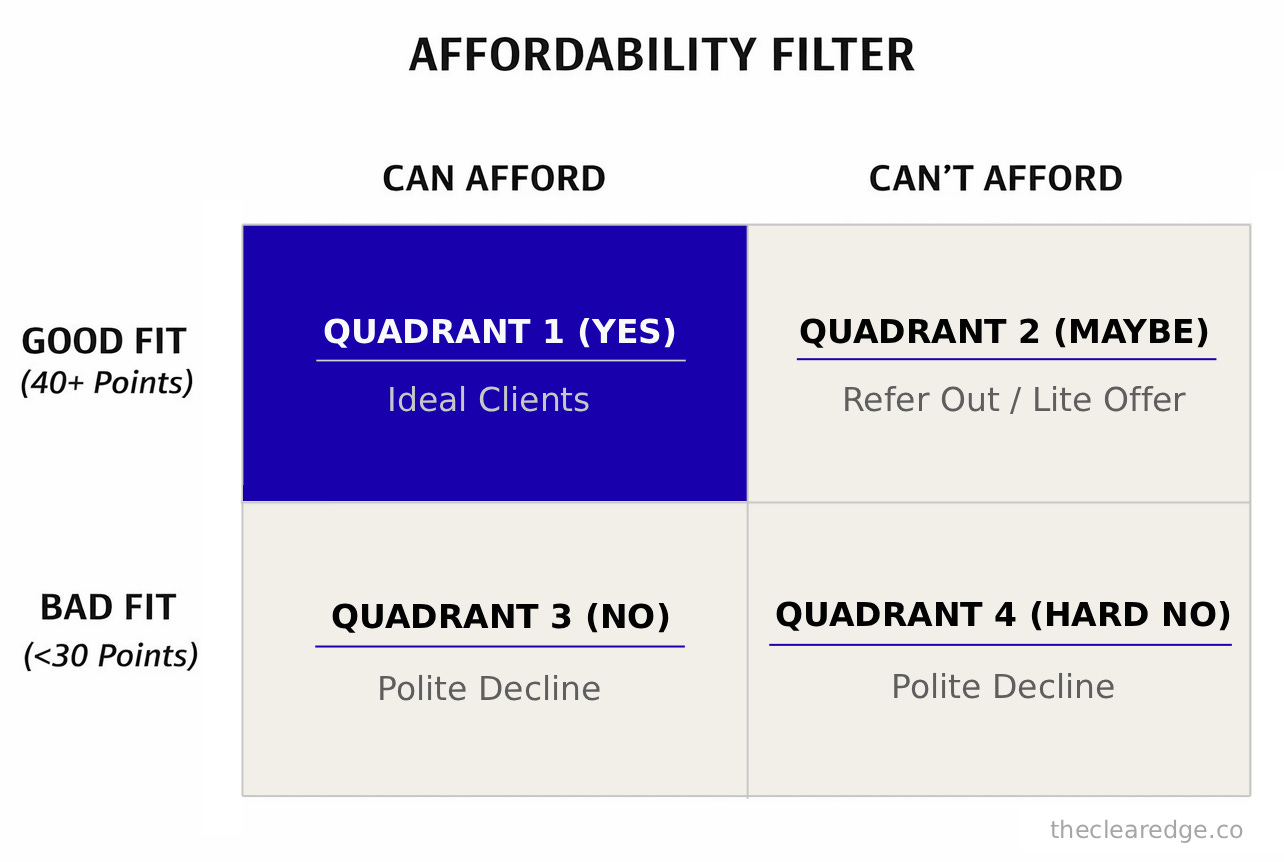
Axis 1: Budget
Can afford (at or above your pricing)
Can’t afford (below your minimums)
Axis 2: Fit
Good fit (scores >40/50 on fit questions)
Bad fit (scores <30/50 on fit questions)
Quadrant 1: Can afford + Good fit = YES
These are your ideal clients, with both the budget and the right fit. You accept them immediately, and they generate revenue, referrals, energy, and strong case studies.
Quadrant 2: Can’t afford + Good fit = MAYBE
These clients are a great fit, but their budget is too low. You can refer them to someone at their budget level to build a future relationship, or offer a lighter version of your service at their price point, but you do not discount your main offer because that devalues your positioning.
Quadrant 3: Can afford + Bad fit = NO
These clients have money, but you are misaligned on expectations, communication, or energy. You politely decline working with them, because they become nightmare clients who pay well but drain energy, create scope creep, and kill momentum, and no amount of money compensates for the energy drain they create.
Quadrant 4: Can’t afford + Bad fit = HARD NO
These clients have the wrong budget and the wrong fit. You politely decline with no negotiation and do not waste their time or yours.
The 5-Question Client Fit Evaluation System And 50-Point Scoring Model
Budget is simple to verify — you ask, they answer. Fit is different; it demands a more systematic evaluation instead of a one-off gut check.
Here’s the 5-question scoring system that replaced gut-feel qualification for 83 operators I’ve worked with.
Question 1: Do they understand the problem? (Awareness Score: 1–10)
Ask:
“Describe the problem you’re trying to solve and why it matters to your business.”
Score 8–10 (high awareness):
They articulate the problem clearly.
They explain impact with numbers.
They show they’ve researched solutions.
They say things like: “We’re losing $15K monthly to this bottleneck and we’ve tried 3 approaches that didn’t work.”
Score 4–7 (partial awareness):
They know something’s wrong.
They can’t quantify the impact.
They haven’t tried solving it meaningfully.
They say “We need to get better at X” without specifics.
Score 1–3 (low awareness):
Vague problem description.
No context and no urgency.
They say “We should probably improve this” without understanding why or what success looks like.
Why this matters:
Clients who don’t understand their problem will keep questioning your recommendations, changing direction mid-project, and struggling to implement. Clear understanding of the problem is what predicts whether they will implement successfully.
Question 2: Are they committed to solving it? (Motivation Score: 1–10)
Ask:
“What happens if this doesn’t get fixed in the next 90 days?”
Score 8–10 (high motivation):
They describe clear, painful consequences.
They’ve quantified the downside.
They say things like: “We’ll miss our $500K revenue target,” or “Our top performer will quit,” or “We’ll lose 3 key clients.”
There are real stakes and a real timeline.
Score 4–7 (moderate motivation):
They show general concern but no specific consequences.
They talk in preferences, not stakes.
They say, “It would be good to fix,” or “We’d like to improve.”
This is a nice-to-have, not a must-fix.
Score 1–3 (low motivation):
There is no urgency and no stakes.
They say, “Just exploring options,” or “Thinking about this.”
They behave like tire-kickers who will ghost after the proposal.
Why this matters:
Motivation predicts implementation. Unmotivated clients don’t do the work, don’t implement recommendations, don’t see results, and then blame you for lack of progress.
Question 3: Will they implement recommendations? (Follow-Through Score: 1-10)
Ask:
“Walk me through your last 3 business improvements — what did you implement and how long did it take?”
Score 8–10 (strong implementer):
They have a clear track record of implementation.
They describe 3 specific improvements with timelines, challenges overcome, and results achieved.
They are implementers, not collectors of advice.
Score 4–7 (mixed follow-through):
They have a mixed track record.
They implemented 1–2 things, and started others that stalled.
They are capable but need structure.
Score 1–3 (non-implementer):
They have no implementation history or a long list of “started but didn’t finish” projects.
They collect strategies but don’t execute.
This is a red flag — they’ll treat your work as another shelf item.
Why this matters:
You can’t generate meaningful results if clients don’t implement. Non-implementers create zero ROI, rarely refer, and are the most likely to request refunds because “it didn’t work,” which usually means they never actually did the work.
Question 4: Do you have expertise in their situation? (Capability Score: 1–10)
Ask yourself:
“Have I solved this exact problem for this type of client before?”
Score 8–10 (proven zone):
You’ve solved this 5+ times for similar clients with documented results.
You know the failure points, edge cases, and fastest path to results.
This is your proven zone.
Score 4–7 (adjacent zone):
You’ve solved similar problems or worked with similar clients, but this is a slight variation.
You’re 80% confident and 20% learning.
Score 1–3 (learning zone):
This is new territory. You think you can help, but you’re guessing.
You’d be learning on their dime.
You pass, unless you’re intentionally building new expertise at discounted rates.
Why this matters:
Working outside your expertise creates longer timelines, worse results, and unhappy clients. Your best work comes from proven expertise, not learning experiments.
Question 5: Will this work be energizing? (Energy Score: 1–10)
Ask yourself:
“On a scale of 1–10, how excited am I to work on this?”
Score 8–10 (energy-giving work):
You feel genuinely excited.
The client’s problem is interesting.
Their communication style matches yours.
You respect their work.
You’d tell peers about this engagement.
Score 4–7 (neutral work):
You feel neutral, not excited and not drained.
You’ll do good work, but won’t think about it off-hours.
The relationship is transactional.
Score 1–3 (energy-draining work):
The work feels energy-draining.
There are red flags in the conversation, such as a disrespectful tone, unrealistic expectations, values misalignment, or a generally bad vibe.
Thinking about working together exhausts you.
Why this matters:
Energy-draining clients quietly slow the entire business down by killing momentum. They occupy mental space, create constant decision fatigue, and keep you from doing your best work for the clients who are actually great fits. You can tolerate one or two neutral clients, but you cannot afford any energy-draining ones.
The Scoring System
Add scores from all 5 questions. Maximum is 50 points.
Quick reference:
- Prospect: [Name]
- Date: [Today's date]
- Budget: Can afford / Can't afford
- Scores: Awareness __/10  Motivation __/10  Implementation __/10  Capability __/10
- Energy __/10
- Total: __/50
- Quadrant: [1/2/3/4]
- Decision: [Accept/Decline/Refer]
41–50 points
Exceptional fit. Strong YES.31–40 points
Good fit. YES if the budget works.21–30 points
Marginal fit. Proceed with caution or decline.0–20 points
Poor fit. Decline.
This scoring removes gut-feel inconsistency. You evaluate every prospect using the same criteria and the same scale, then compare scores across prospects, spot patterns in who works well, and refine your qualification over time.
How To Apply The Client Fit Matrix In Your Sales Process
Here’s the step-by-step application that turns this framework into your qualification process.
Step 1: First conversation (15 minutes)
When a prospect reaches out, schedule a 15-minute call with a clear agenda: understand their situation and see if you’re a fit.
Start with a budget question: “What’s your budget for solving this?”
If they’re in range, continue to fit questions.
If below the range, you’ve saved both parties’ time.
Step 2: Fit evaluation (during conversation)
Ask the 5 fit questions conversationally. Don’t make it feel like an interview — weave them into a natural discussion.
“Tell me about the problem you’re facing...”
“What happens if this doesn’t get fixed soon...”
“What business improvements have you implemented recently...”
Score mentally during the call or immediately after.
Step 3: Plot on a matrix (2 minutes)
After the call, calculate the total fit score and plot the prospect on the matrix:
Budget: Can afford (at/above pricing) + Fit Score >40
Quadrant 1 (YES)Budget: Can’t afford + Fit Score >40
Quadrant 2 (MAYBE — refer or lite offer)Budget: Can afford + Fit Score <30
Quadrant 3 (NO — decline)Budget: Can’t afford + Fit Score <30
Quadrant 4 (HARD NO)
Step 4: Decision and communication (5 minutes)
For YES prospects (Quadrant 1):
“Based on our conversation, I think we’re a strong fit. I’ll send proposal by [date]. Let’s schedule follow-up for [date + 3 days].”
For MAYBE prospects (Quadrant 2):
“I love the problem you’re solving and think we’d work well together. Your budget is below my minimum for this scope. Two options: I can refer you to [name] who works at your budget level, or we can scope down to a lighter version at $[their budget]. Which interests you?”
For NO prospects (Quadrants 3 and 4):
“Thanks for sharing your situation. After our conversation, I don’t think I’m the right fit for this project. I recommend [alternative resource/solution]. Appreciate your time.”
No long explanations. No apologies. Clean, respectful decline.
Step 5: Track and refine (ongoing)
Keep simple tracking:
How many prospects per month
How many in each quadrant
Close rate by quadrant
Client performance by fit score
After 3 months, you’ll see patterns:
Which fit questions predict success most
What score threshold works best
Which budget range converts best
What types of prospects score highest
Use data to refine how you qualify.
If you notice that clients scoring 8+ on motivation but only 5–7 on implementation still succeed when you add structured accountability, treat that as a signal and adjust your scoring weights to reflect it.
2x2 Beats Gut Feel
If you’re nodding at the budget-only and yes-to-everything traps, you don’t need more stories. You need premium access to the Client Fit Matrix so each prospect lands in the right quadrant.
Case Study: Applying The Client Fit Matrix To An 11-Client Consulting Business
Here’s how this played out for the consultant from the opening. She implemented the Client Fit Matrix, and in the next 30 days, 12 prospects reached out.
Prospect batch evaluation
4 prospects in Quadrant 1 → (Can afford + Good fit)
Budget: $3,500–$4,800/month
Fit scores: 42, 44, 38, 46
Decision: Accepted all 4, sent proposals
2 prospects in Quadrant 2 → (Can’t afford + Good fit)
Budget: $1,800–$2,200/month (below her $3,000 minimum)
Fit scores: 43, 41
Decision: Referred to a colleague who works at $2K–$3K range
3 prospects in Quadrant 3 → (Can afford + Bad fit)
Budget: $4,000–$5,500/month
Fit scores: 22, 18, 26
Signals: Vague problem descriptions, no urgency, poor implementation history
Decision: Declined all 3
3 prospects in Quadrant 4 → (Can’t afford + Bad fit)
Budget: $800–$1,500/month
Fit scores: 19, 15, 21
Decision: Declined all 3
Results after 90 days
From 4 accepted Quadrant 1 prospects:
Clients: 3 closed (75% close rate), adding $11,400/month in new revenue.
Average time to close: 9 days (fast because strong fit)
Client management time: 8 hours/week for all 3 (efficient)
Total client base after replacing poor fits
8 great-fit clients: $28,800/month
2 acceptable-fit clients: $6,600/month (existing clients finishing contracts)
Total: $35,400/month from 10 clients
Weekly time breakdown
Client work: 28 hours (delivery)
Client management: 9 hours (down from 14)
Prospect calls: 5 hours
Total: 42 hours (down from 52)
Impact:
Revenue: $38K to $35.4K (−7% temporary dip from declining bad fits)
Weekly hours: 52 to 42 (−19% time)
Effective hourly rate: $29/hour to $42/hour (+45% efficiency)
Client satisfaction: 88% to 96% (serving better-fit clients)
Referrals: 0 to 4 in 90 days (happy clients refer)
Energy: Self-reported “exhausted” to “sustainable”
By month 4, referrals from great-fit clients were filling the pipeline. She accepted 2 more Quadrant 1 clients, reached $41,400/month, worked 44 hours per week, and maintained 95% satisfaction.
The business became sustainable once qualification turned into a systematic process rather than a gut-feel decision.
The Client Qualification Questions That Actually Predict Fit And Implementation
Here are the exact questions that reveal fit beyond the 5-question scoring system. Use these to triangulate and verify scores.
For awareness verification
Question:
“What have you tried already to solve this?”
If they’ve tried 3+ approaches and can articulate why each failed, they understand the problem deeply.
If they say “nothing yet” or “just thinking about it,” they’re at the exploration stage with low awareness.
For motivation verification
Question:
“Who else in your organization cares about fixing this?”
If multiple stakeholders are aligned and pushing for a solution, motivation is real.
If they say “just me” or “I’m trying to convince my team,” you’ll face internal resistance that kills implementation.
For follow-through verification
Question:
“Show me your calendar for the next 30 days.”
Implementers have time blocked for implementation.
Non-implementers have fully booked calendars with no space for new initiatives.
If they can’t find 5–10 hours weekly for your work, they won’t implement, regardless of motivation.
For capability verification
Question:
“What does success look like 90 days from now?”
If their success criteria match what you deliver, you have capability.
If they want outcomes you can’t deliver or don’t measure, a capability mismatch exists.
For energy verification
Question:
“What’s your communication style and how do you prefer to work with service providers?”
If their answer matches your style (weekly check-ins vs. monthly reviews, Slack vs. email, high-touch vs. hands-off), energy fit exists.
If mismatched, every interaction will create friction.
Advanced Client Fit Matrix Applications And Edge Cases
Edge Case 1: Quadrant 2 clients who grow into Quadrant 1
When you refer Quadrant 2 prospects (Can’t afford + Good fit) to colleagues, maintain a light relationship:
Add to the monthly newsletter
Check in quarterly and ask, “How’s business growth?”
When their budget grows, they remember you turned down money to help them. One consultant referred 14 prospects over 18 months, and 6 of those prospects later returned as Quadrant 1 clients once their budgets increased, generating $43,200 in revenue from people she had initially declined.
Edge Case 2: When great clients have bad initial fit scores
Sometimes, Quadrant 1 clients score 35-38 on fit (just below threshold) but you have a strong intuition they’ll be great.
Use provisional acceptance:
“I think we could work well together but I want to ensure success. Let’s do a paid trial project at $[lower rate] for 30 days. If it works well, we’ll continue at $[full rate].”
This de-risks both parties. 67% of provisional clients convert to full engagements; 33% gracefully exit after trial because both parties learned it wasn’t the right fit.
Edge Case 3: Rescoring existing clients
Apply the matrix to the current client roster. You’ll likely find 2-3 bad-fit clients (Quadrant 3) you accepted before having a framework.
Strategy: Don’t fire immediately.
Wait for natural exit points such as contract renewal or project completion.
Let bad-fit clients transition out while you fill the pipeline with Quadrant 1 prospects.
Replace bad fits with good fits gradually over 3–6 months
Edge Case 4: When you’re desperate for revenue
The matrix assumes you have a choice. What if you need clients now and can’t afford to decline?
Modified approach:
Accept the Quadrant 1 and Quadrant 3 clients short-term
Charge 20-30% premium for Quadrant 3 (bad fit) clients to compensate for energy drain
Aggressively market to attract Quadrant 1 prospects
As the Quadrant 1 pipeline fills, let the Quadrant 3 contracts expire
This prevents the revenue gap while systematically improving client quality.
Integrating The Client Fit Matrix With Your Sales Process
The matrix isn’t standalone — it integrates with your existing sales system.
Pre-qualification (before first call)
Use budget and basic fit questions in the application form.
Eliminate Quadrant 4 prospects before wasting call time.
First call
Run the full matrix evaluation.
Decide whether it’s worth investing time in a proposal.
Proposal stage
Reference fit alignment in the proposal.
“Based on our conversation, we’re aligned on [specific fit elements]. Here’s how we’ll work together...”
Onboarding — set expectations based on the fit evaluation.
If the client scored 7 on implementation, build extra accountability.
If the client scored 10, give more autonomy.
Delivery — monitor whether the actual fit matches the evaluation. If a Quadrant 1 client starts behaving like Quadrant 3, investigate what changed.
Post-delivery — use the fit score to predict referral likelihood. Quadrant 1 clients with fit scores of 45+ generate referrals 3x more often than clients scoring 35–40.
This creates qualification consistency across the entire client acquisition system from lead to delivery to referral.
The 12-Month Business Impact Of Installing The Client Fit Matrix
When you systematically accept only Quadrant 1 clients, business transforms:
Months 1–3
Revenue may dip 5–15% as you decline bad fits, and this phase is uncomfortable but necessary because you are building a foundation.
Months 4–6
Referrals from great-fit clients start flowing.
Pipeline quality improves.
Quadrant 1 prospects become 60–70% of inquiries (up from 30–40%) because great clients refer great prospects.
Months 7–9
Revenue exceeds your previous high while you work fewer hours.
You’ve replaced 10–12 mixed-quality clients with 8–10 great-fit clients at higher prices.
Great-fit clients pay premiums because they value fit too.
Months 10–12
The business becomes referral-driven.
You spend 40% less time on sales because Quadrant 1 prospects convert at 75–85% vs. 50–60% for unqualified prospects.
Your calendar fills with work that energizes rather than drains.
The data from 47 operators who implemented this matrix over 12 months:
Revenue: +32% average increase (range: +18% to +61%)
Weekly hours: −8.5 hours average decrease
Close rate: +23% improvement (better-fit prospects convert faster)
Client satisfaction: +19% improvement
Referral rate: +341% increase (great clients refer often)
Energy: 87% reported “more sustainable” or “significantly more sustainable”
The matrix doesn’t just improve client selection — it transforms business economics by creating a virtuous cycle:
Great clients refer great prospects.
Great prospects convert easily.
Great clients deliver results that create more referrals.
Common Client Qualification Mistakes To Avoid With The Client Fit Matrix
Mistake 1: Scoring generously to accept more clients
Context: When you are under revenue pressure, you’re tempted to inflate scores so more prospects “pass” your filter.
Behavior: You give prospects 7s and 8s when, based on their answers, they realistically deserve 4s and 5s.
Consequence: Inflated scores defeat the framework because you accept clients the system is explicitly warning you against.
Cost: One bad-fit client you accept this way typically costs you 2–3 great-fit opportunities over the next 6 months.
Mistake 2: Ignoring energy scores
Context: When the pipeline feels thin, you rationalize poor energy fit with “they pay well, I can tolerate them.”
Behavior: You accept clients who trigger low energy scores, even when your scoring says they will drain you.
Consequence: Energy-draining clients compound over time because every interaction takes more from you than it gives back.
Cost: One client at an energy score of −3 weekly equals −156 energy units yearly, which kills momentum and blocks scaling.
Mistake 3: Not documenting scores
Context: You keep scores in your head instead of writing them down after each call.
Behavior: You don’t track which questions you asked, what numbers you assigned, or why you accepted or declined a prospect.
Consequence: Qualification becomes inconsistent because the criteria shift from call to call based on mood and memory.
Practice: Use simple written tracking.
Prospect name: Record the exact prospect name for every call.
Date: Log the date of the conversation so you can see patterns over time.
Five scores: Capture the 5 scores—awareness, motivation, implementation, capability, and energy—each out of 10.
Total score: Add the five scores into a single total fit score out of 50.
Quadrant: Assign the prospect to a quadrant (1–4) on the Client Fit Matrix.
Decision: Write the explicit decision for this prospect: Accept, Decline, or Refer.
Outcome: If you accept them, log the outcome later so you can compare fit score to real-world results.
Payoff: After 20 scored prospects, clear patterns emerge that refine how you evaluate and who you say yes to.
Mistake 4: Changing criteria mid-pipeline
Context: When your pipeline is thin, you feel pressure to relax your standards to keep revenue stable.
Behavior: You lower your minimum fit threshold and start telling yourself “maybe 30 points is good enough.”
Consequence: Dropping the threshold breaks the integrity of the system and lets Quadrant 3 clients slip into your roster.
Guardrail: You hold the line at a 40+ fit threshold and treat a low pipeline as a signal to improve positioning or offer clarity, not a reason to accept bad fits.
Set your own line in the sand
Before this framework works, you need a personal minimum score that acts like a hiring bar for your client roster.
Ask yourself this now: What’s your minimum fit score for accepting new clients, and which 2 current clients would fail that threshold if evaluated today?
Fit, Not Effort, Sets The Ceiling
You can outwork a bad month but you can’t outwork a pipeline where 40–60% of clients never should’ve been accepted; fix who gets in before you fix how hard you work.
Run The Client Fit Matrix Quick-Gate Checklist Before Accepting New Clients
If a new prospect lands in your inbox or DMs, run this before you book more than a 15-minute call.
☐ Scored all five fit dimensions out of 50 and wrote the total fit score plus quadrant for this prospect on your qualification log.
☐ Compared today’s fit score to your minimum 40+ threshold and marked in writing whether this is Quadrant 1, 2, 3, or 4.
☐ Wrote a clear YES/NO/REFER decision based only on quadrant and score, not on short-term revenue pressure or how empty this month’s pipeline feels.
☐ Logged whether working with this prospect feels energy-giving, neutral, or draining, and wrote that energy score next to their total fit score.
☐ Tracked whether this whole pass stayed inside 15 minutes from opening their inquiry to recording the final decision and next step.
Every time you run this, you stop one more Quadrant 3 prospect from quietly turning into 18 hours weekly of drag and 23.4 work weeks of momentum loss.
Install The Client Fit Matrix And Recover Capacity For High-Margin Client Work
If you’re sitting in the $30K–$50K/month band and still accepting anyone who can pay, you’re choosing the 18 hours weekly leak and blocking the extra $26K/month this protocol protects.
From here, run the sequence once:
Map current clients into The Client Fit Matrix to see exactly where low-fit revenue drags your effective rate and clogs delivery capacity.
Apply the 15-minute qualification mechanic to every new prospect so only Quadrant 1 and 2 clients enter your pipeline and referral engine.
Set a First-Monday 30-minute review to rotate out bad-fit clients over 3–6 months, freeing calendar space for higher-margin, referral-rich work.
Run this protocol as the standing guardrail so The Client Fit Matrix becomes the permanent filter between your time and every future client.
FAQ: Implementing The Client Fit Matrix And 50-Point Client Scoring System
Q: How does the Client Fit Matrix stop bad-fit clients from burning 18 hours weekly and stalling revenue growth?
A: You score each prospect on five fit dimensions, plot them on the 2x2 Client Fit Matrix, then decline Quadrant 3 and 4 clients so the 18 hours weekly they would have consumed get redirected to Quadrant 1 clients who raise effective hourly rate, referrals, and sustainable revenue.
Q: How do I use the Client Fit Matrix with the 5-Question Fit Evaluation System before I send a proposal?
A: You run a 15-minute first call, ask the 5 fit questions during the conversation, score out of 50 points, plot the prospect on the matrix in 2 minutes, then only create proposals for Quadrant 1 (and selected Quadrant 2) prospects instead of everyone who can pay.
Q: How much time and money do bad-fit clients actually cost if I keep accepting anyone who can afford my rate?
A: In the example, 6 problem clients consumed 18 hours weekly, totaling 936 hours and 23.4 work weeks yearly, while generating $20,730/month at a lower $29/hour effective rate, which blocked higher-margin, referral-rich work from better-fit clients.
Q: What happens if I keep qualifying on budget alone instead of using the Client Fit Matrix and scoring system?
A: You fall into the budget-only qualification trap where 40–60% of closed clients shouldn’t have been accepted, like the consultant working 58 hours weekly for $31,500/month with three nightmare clients who consumed 55% of his time for just 43% of revenue at half the hourly rate of great clients.
Q: How do I practically apply the Client Fit Matrix in my sales process without slowing everything down?
A: You add budget and basic fit questions to pre-qualification, run a focused 15-minute first call for the 5 fit questions, spend 2 minutes to score and assign a quadrant, then use short, templated YES/MAYBE/NO scripts so qualification, proposals, and onboarding all run through the same consistent filter.
Q: When should I start rotating out existing bad-fit clients using this system, and how long does it take to see results?
A: You rescore your current client roster, identify 2–3 Quadrant 3 clients, let them exit at natural renewal points, and replace them over 3–6 months with Quadrant 1 clients so you can drop from 52 to low-40s hours weekly, raise effective hourly rate from $29/hour to $42/hour, and rebuild around great fits.
Q: How much revenue upside have operators actually seen over 12 months by accepting only Quadrant 1 clients?
A: Across 47 operators who implemented the matrix, revenue increased an average of 32% (range +18% to +61%), weekly hours dropped by 8.5 hours on average, close rates improved by 23%, client satisfaction rose 19%, and referral rates increased 341%, with 87% reporting the business felt more sustainable.
Q: How do I use the 50-point scoring system to decide who is a YES, MAYBE, or NO before signing a client?
A: You total the five scores (awareness, motivation, implementation, capability, energy) out of 50: 41–50 is an exceptional-fit YES, 31–40 is a good-fit YES if budget works, 21–30 is marginal and treated cautiously or declined, and 0–20 is a poor fit you decline, then combine that with budget to assign a matrix quadrant.
Q: What happens if I’m desperate for revenue and can’t afford to decline bad-fit clients right now?
A: You still prioritize Quadrant 1 clients, temporarily accept some Quadrant 3 clients at a 20–30% premium to compensate for energy drain, aggressively market for more Quadrant 1 prospects, then let Quadrant 3 contracts expire as the great-fit pipeline fills so you don’t lock yourself into permanent bad-fit dependence.
Q: When will I start to feel the compounding effect of better-fit clients and referrals after installing this system?
A: In months 1–3 revenue can dip 5–15% as you decline bad fits, in months 4–6 referrals from great-fit clients push Quadrant 1 prospects to 60–70% of inquiries, and by months 7–12 you typically exceed your previous revenue high with 8–10 great-fit clients, fewer hours, and a referral-driven pipeline.
⚑ Found a Mistake or Broken Flow?
Use this form to flag issues in articles (math, logic, clarity) or problems with the site (broken links, downloads, access). This helps me keep everything accurate and usable. Report a problem →
› More to Explore: Quick Navigation · Mini-Frameworks
➜ Help Another Founder, Earn a Free Month
If this system just saved you from bad-fit clients quietly burning 18 hours weekly, share it with one founder who needs that relief.
When you refer 2 people using your personal link, you’ll automatically get 1 free month of premium as a thank-you.
Get your personal referral link and see your progress here: Referrals
Get The Client Fit Matrix Toolkit And Implementation Assets
You’ve read the system. Now implement it.
Premium gives you:
Ready-to-use PDF toolkit—every template, diagnostic, and formula pre-filled, zero setup, immediate use
Plug-and-play AI diagnosis sessions—drop into Claude, Gemini or ChatGPT, answer a few questions, save hours of guessing, get your exact next move
Audio key points—concentrated frameworks you can absorb in minutes, implement while you move
Unrestricted access to the complete library—every system, every update
What this prevents: Trading 18 hours weekly and $20,730/month for energy-draining bad-fit clients that stall growth.
What this costs: $49/month.
Download everything today. Implement this week. Cancel anytime, keep the downloads.
Already upgraded? Scroll down to download the PDF, audio, and your AI session.
