


Read time: 14 minutes
› Library Navigation: Quick Navigation · Weekly Newsletter
The Executive Summary
When your biggest client gives notice, don’t cut staff or offer a discount. Count what you lose after the costs that leave with them, then sell them a paid hand-off on one call. Lena lost a $32,000 client on Monday. By Friday she still had her team, 13 weeks of cash and an $8,000 hand-off signed.
Who this is for: agency owners at $30K-$150K a month with a team to keep. Your biggest client just gave notice.
The problem: you see $32,000 a month gone and plan two layoffs. The true hole is half that, and layoffs cost you the team you’ll sell next.
The fix: 5 steps in 4 days:
Count your true loss and the weeks your cash covers.
Book one call with the person who signed the contract.
Offer a paid hand-off, then ask for one referral.
Freeze only unsigned costs, and set a margin target.
Count your cleared cash at 9am Friday.
Time to first result: 30 minutes for the cash sheet, then one 20-minute call by Wednesday.
Written by Nour Boustani for agency owners who just lost their biggest client and want to keep their team.
Try this now (under 2 minutes):
Find your client’s monthly fee on their last invoice.
Subtract what you pay freelancers and tools only for that account.
The number left is your true monthly loss.
Why a $32,000 Notice Leaves Only a $16,000 Cash Hole
It’s Monday at 9:40am, and your biggest client emails to end the contract. They give 30 days’ notice. They pay you $32,000 a month, 40% of everything you bill.
By 9:45 you’re planning two layoffs, and you shouldn’t make them until you’ve done the math.
You’re counting the loss in revenue, and revenue is the wrong number. Part of that $32,000 was never yours to keep. It paid the freelancers, tools and ad spend that end when your client leaves.
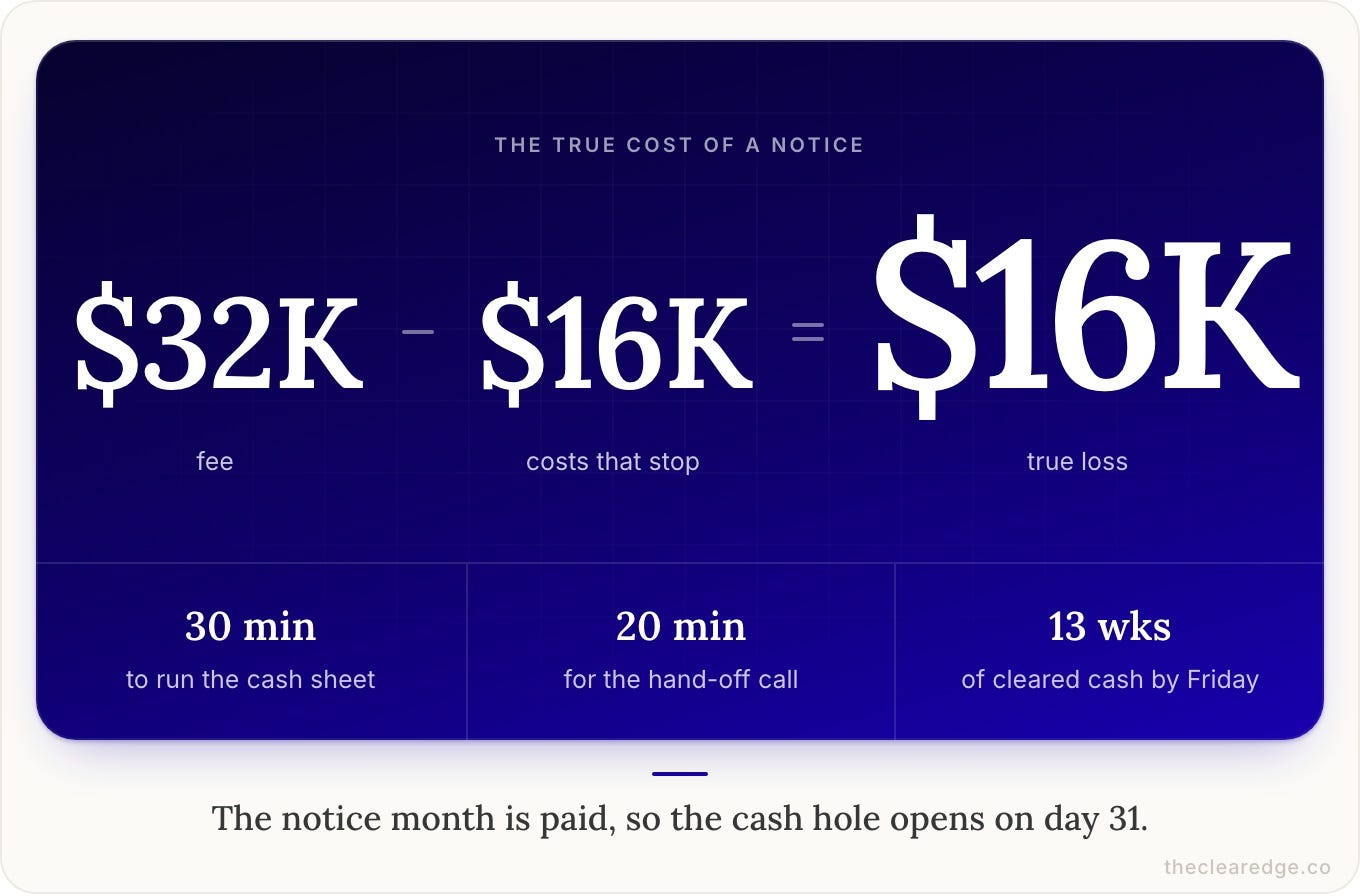
Your true loss is the fee minus those costs. Lena’s costs that stop come to $16,000 and leave her a $16,000 hole. Use your own costs, not an industry average.
Your client usually still pays you for the notice month. Lena’s client paid the full fee for all 30 days, so her cash held through them. Her cash starts falling on day 31, the first day with no fee coming in.
You’re also not alone in this. TobinLeff, an agency M&A adviser, says 15% to 20% of clients leave B2B service firms each year. TobinLeff sees some agencies near 30%.
Don’t Cut Anyone or Offer a Discount in the First 24 Hours
The usual advice is to cut staff fast and push sales. Cutting to the $32,000 figure means you cut twice as deep as the $16,000 hole.
The people you’d let go are the capacity you’ll sell to your next client.
A discount to win them back is worse. They’ve already decided, so a discount buys you nothing. Take 15% off $32,000 and you give up $4,800 a month.
Your $16,000 of margin drops to $11,200. You’d hand over 30% of it to keep a client who’s halfway out the door.
The third mistake is telling your team the whole story before you have a plan. Send a short note on Monday, then the full plan after the call. Otherwise your best people start job hunting on a rumor.
I keep the discount off the table, and here’s my thinking:
I’ve seen a client who leaves once leave again, and the lower price follows me into every renewal.
I’d rather spend that $4,800 a month on finding the next client.
How Lena Kept Her Team and 13 Weeks of Cash by Friday
Lena runs a content agency billing $80,000 a month. She has 4 staff, two of them part-time, and freelancers on each account. Her biggest client, a software company, gave 30 days’ notice on a Monday.
Her first thought was two layoffs, starting with the two part-timers. Her sheet took 30 minutes and showed a $16,000 hole, not $32,000. She had $48,000 in the bank, so 3 months of cover from day 31.
She emailed the VP of Marketing, who had signed the contract, and they met Wednesday at 11am. The VP said they’d hired an in-house writer, and the work itself was fine. So Lena offered coaching for that writer in three lengths and asked for one referral.
The software company’s CFO wouldn’t pay for 60 days, and asked for the 30 days at $6,000 instead of $8,000. Lena held at $8,000, and they signed a one-page addendum on Thursday.
Monday, the notice

- Lena's revenue: $80,000 a month
- Her biggest client: $32,000 a month
- Costs that stop with them: $16,000
- True loss: $32,000 - $16,000 = $16,000 a month
- Cash in the bank: $48,000
- Cover: $48,000 / $16,000 = 3 months
- Notice month: paid in full, so that cover starts on day 31

Thursday, the addendum signed

- 30 days of coaching their new writer: $8,000
- Starts on day 31, paid when it starts

Friday, the check

- Cleared cover: 3 months, about 13 weeks
- Once the $8,000 is paid: $56,000 / $16,000 = 3.5 months
- In weeks: 3.5 x 4.33 = 15.2
- Sales conversations booked: 3
- People let go: 0
On Wednesday afternoon, Lena sent her team the plan: who runs the hand-off and when the freelancers finish. By Friday she had 3 sales conversations booked, one of them from the VP’s intro. Nothing had closed yet, which is normal in the first week. Her cleared cash, the money already in her bank, still covered 13 weeks, and she planned her team on that.
Your client who’s leaving still needs their new person trained. Sell them that coaching before you cut a single person.
