


Read time: 14 minutes
› Library Navigation: Quick Navigation · Weekly Newsletter
The Executive Summary
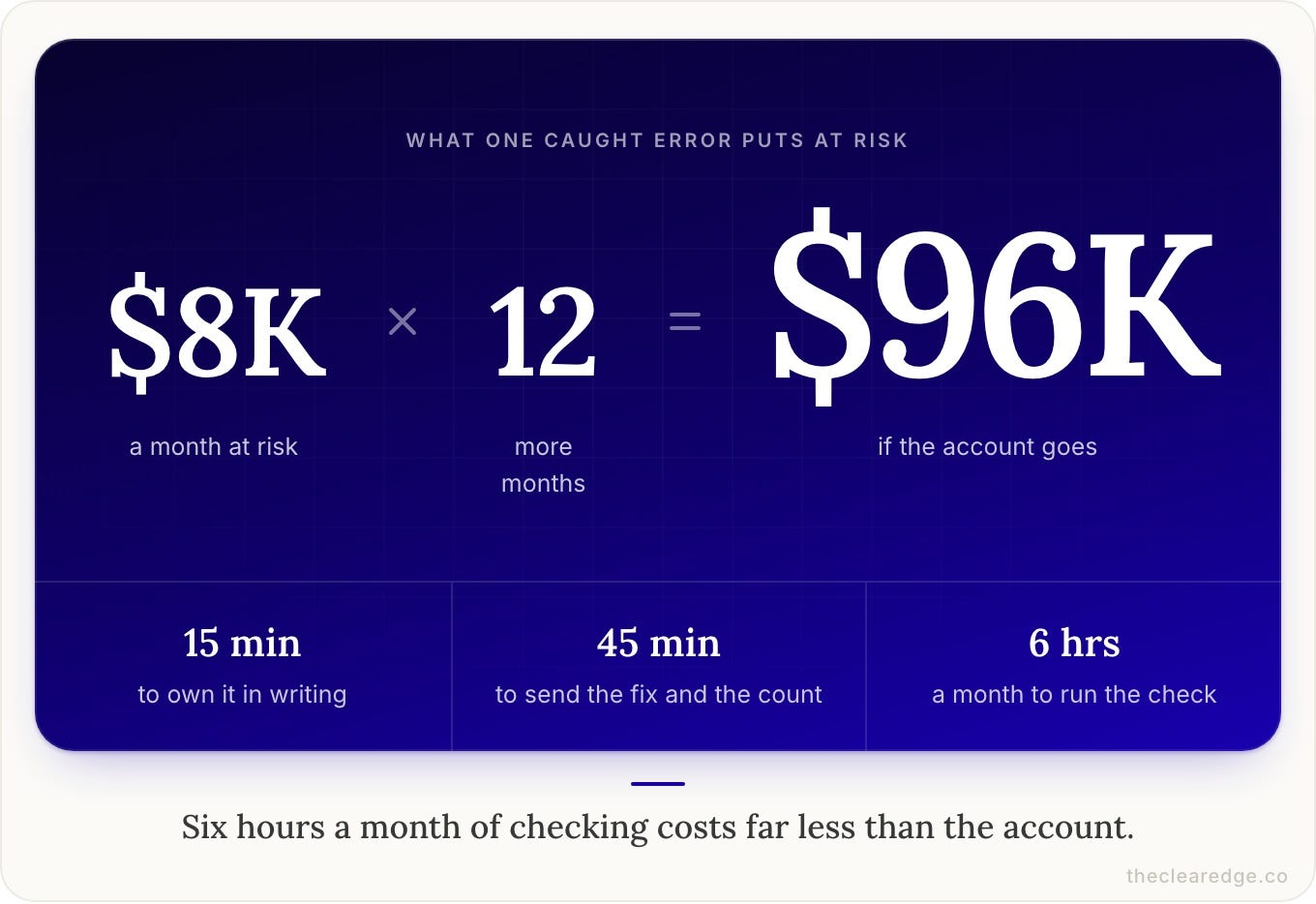
A client who finds one made-up figure in your work starts doubting every figure you sent them. From the moment their email arrives, reply within 15 minutes and check every claim in their last 3 reports. Send the count of claims checked with the fix, then call them. Jo, an agency owner, did it in one hour and kept an $8,000-a-month account.
Who this is for: agency owners at $30K-$150K a month whose client caught an AI error and could leave.
The problem: one account at $8,000 a month is $96,000 over the next 12 months. A next-day reply gives your client time to find a second error.
The fix: 5 steps on a clock:
Own it in writing by minute 15.
Check every claim in the last 3 reports by minute 40.
Send the corrected work and the count by minute 45.
Get your client on a call by minute 60.
Put two people on every report for 30 days.
Time to first result: the corrected report and the count in your client’s inbox 45 minutes after their email.
Written by Nour Boustani for the agency owner who wants to keep the client after an AI error.
Try this now (under 2 minutes):
Open the last report you sent your biggest client.
Pick the 3 figures in it that matter most to them.
Time how long each one takes to trace back to its source.
Why Your Client Now Doubts Every Other Number You Sent
Your client emails to ask where a figure comes from, because they can’t find it anywhere. You check, and it comes from nowhere: the AI invented it and nobody on your team opened a source.
Your client isn’t worried about one number anymore. They’re asking what else you got wrong, and they may be re-reading your other reports.
Getting caught costs more trust than owning up. Researchers at the University of Arizona ran 13 experiments with more than 5,000 people on AI use and trust. People trusted anyone who admitted using AI less, and trust fell further when someone else revealed it. The published study calls exposure by a third party the bigger hit.
You’ve lost the choice about whether your client knows. You still control how fast you take charge of the fix.
Never Write “The AI Made a Mistake”
“The AI made a mistake” feels honest, but your client reads it as proof that nobody was checking. Clients don’t pay for the drafting, they pay for a person who checks the work first. Nobody hires an agency for its autocomplete. Blaming the tool tells them that person was missing.
Name what failed instead, in words like “It wasn’t checked before it reached you.” That line is true, it’s yours and it points straight at the fix.
Why I never name the tool as the cause:
I’ve watched a client forgive a missed check faster than an excuse. The check is something I can change.
One study found an apology repairs trust after a failure of skill, not honesty. A missed check is a skill failure.
Answer in Minutes Because Speed Beats the Size of the Error
A small made-up figure left for a day looks like you’re hiding it. The same figure owned in 12 minutes looks like a mistake by a team that pays attention.
Deloitte Australia shows the slow version. Its report to a government department cost 440,000 Australian dollars and held made-up references. The fix took about 2 months, and Deloitte repaid its final instalment. You can reply in minutes.
Keep the Apology to One Sentence
You’ll want to write an apology that reads like a resignation letter. Stop before the second line. Harvard Business Review found that an apology running past the first seconds can lower customer satisfaction. Visible effort to fix the problem raises satisfaction.
Your first reply holds one line of ownership, then the fix, then the time the fix arrives.
How Jo Replied in 12 Minutes
Jo owns a content agency with 7 people and 9 clients, billing $64,000 a month. The biggest account is a dental-supply distributor at $8,000 a month, or 12.5% of Jo’s revenue. Each month the team writes the distributor’s market report for its sales team. The writer gives the AI 4 documents, 3 industry reports and a survey, and it drafts the summary.
Tomas is the distributor’s marketing director, and he reads every report Jo sends. On a Tuesday at 9:40, he emailed Jo about page 3.
The report said 61% of dental practices planned to switch suppliers within 12 months. Tomas couldn’t find that figure anywhere. Jo opened all 4 documents in the folder and none of them contained it.
Jo took one minute to decide what kind of error it was. Jo saw a wrong fact with no client data involved. Jo’s contract with Tomas’s company said nothing about AI, so Jo started the 60-minute clock. At 9:52 the reply went out.
“You’re right, that figure is wrong, and it’s my miss. It wasn’t checked before it reached you. I’m checking every figure in the last 3 reports now. You’ll have a corrected version with a source for each one by 10:25.”
Jo’s reply gives no reason, names no tool and skips the long sorry. It sets a time Jo could keep.
