


Read time: 14 minutes
› Library Navigation: Quick Navigation · The Weekly Protocol
The Executive Summary
When your client says an AI detector flagged your draft, don’t argue about the tool. Send proof of how you wrote it, with the version history, your notes and a 20-minute call offer. Anna, a B2B writer, sent her proof in 46 minutes and kept a $3,000-a-month client.
Who this is for: agencies and solo creators at $5K-$150K a month, losing client trust over an AI score.
The problem: your client got a high AI score on your draft and wants an answer. One $3,000-a-month client is $36,000 a year.
The fix: 5 steps:
Check honestly whether any AI tool touched the draft.
Pull the version history and your notes.
Send the proof within the hour, with a 20-minute call offer.
Agree a one-paragraph process note within 3 business days of the call.
Put that paragraph in your contract template within 7 days.
Time to first result: under 1 hour. Your client gets proof they can forward to their boss.
Written by Nour Boustani for agencies and solo creators who want to keep a client after a detector score.
Try this now (under 2 minutes):
Open your latest client draft in Google Docs and click the clock icon.
Name the oldest version with its date.
Screenshot it. That’s the first page of the proof you’d send.
Why Arguing About the Detector Loses You Your Client
At 4:40pm your client emails a screenshot with one line: “The checker says this article is 82% AI. Can you explain?” You wrote every word, so you start typing “AI detectors are notoriously unreliable.”
Stop there, because your client isn’t asking about the tool. They’re asking whether they can trust what they paid for.
Three fears sit behind that screenshot:
Google will push the page down in search.
Their boss will ask why they paid a human rate for machine text.
You used AI and didn’t tell them.
A reply about error rates answers none of the three, and it tells your client their judgment was foolish.
Don’t Reply That the Detector Is Wrong
Writer forums say to explain why detectors are useless. That argument got weaker in 2025.
Economists Brian Jabarian and Alex Imas tested the main detectors. The National Bureau of Economic Research published it. Two paid tools, GPTZero and Originality.ai, wrongly flagged 1% or less of medium and long human passages. A free open-source detector flagged more than 90% of the same human passages.
A flag from a paid tool is far more likely to be right than a flag from a free one. Against a paid tool, “the detector is broken” is a losing bet. I never argue about the tool, because the same proof answers both cases.
Why I send proof instead of arguing:
I’ve watched an agency win the argument about detectors and still lose that client the next month.
I answer the question my client asked, and that question is about trust, not software.
Check Whether Any AI Touched the Draft First
Before you reply, answer one question in writing: did any AI tool touch this draft? Count every kind of help:
A chatbot outline or headline ideas.
An AI rephrase of a clumsy paragraph.
An AI grammar rewrite, beyond spelling fixes.
Interview notes that AI transcribed or summarised.
Grammarly, which sells the feature, says its Authorship tool tracks text its AI rewrote as a separate kind of text. Turnitin, which sells an AI detector, says 54% of human sentences it wrongly flags sit next to AI sentences. If you ran paragraphs through an AI rephraser, the score may be partly right.
Never write “I used no AI” if the honest answer is “I used AI as a tool”.
Skip Sending Scores From Other Detectors
Your second instinct is to paste the draft into three free checkers and send back their low scores. More scores are still scores, and pasting client copy into outside tools needs their permission.
The Financial Times reported a case at Adelphi University, where Turnitin scored an essay 100% AI. The student sent 0% results from other detectors, and the university upheld the finding anyway. In February 2026, a judge ruled the finding without merit after he sued. The university had to clear his record.
Vanderbilt and other universities have since restricted or disabled detectors.
How Anna Kept Her $3,000 Monthly Client in 46 Minutes
Anna is a solo B2B content writer billing about $9,000 a month from 4 retainer clients. Her largest is a project-management software company, at 6 blog posts a month for $500 each. That’s $3,000 a month, a third of her income.
She drafts in Google Docs in her own Drive, and clients get a comment-only link during review. She uses Grammarly for spelling and grammar only, and she has never used AI on this client’s work.
On Tuesday 8 September at 4:40pm, Carla, the content marketing manager at the software company, emailed a screenshot. The team’s new AI detector scored Anna’s sprint-planning post 82% AI, and Carla’s director had seen it. The post was due to publish Thursday.
Anna deleted her first reply and wrote down her honest answer, spelling and grammar fixes only. By 5:26pm she’d sent Carla the proof and a call offer, 46 minutes after the flag.
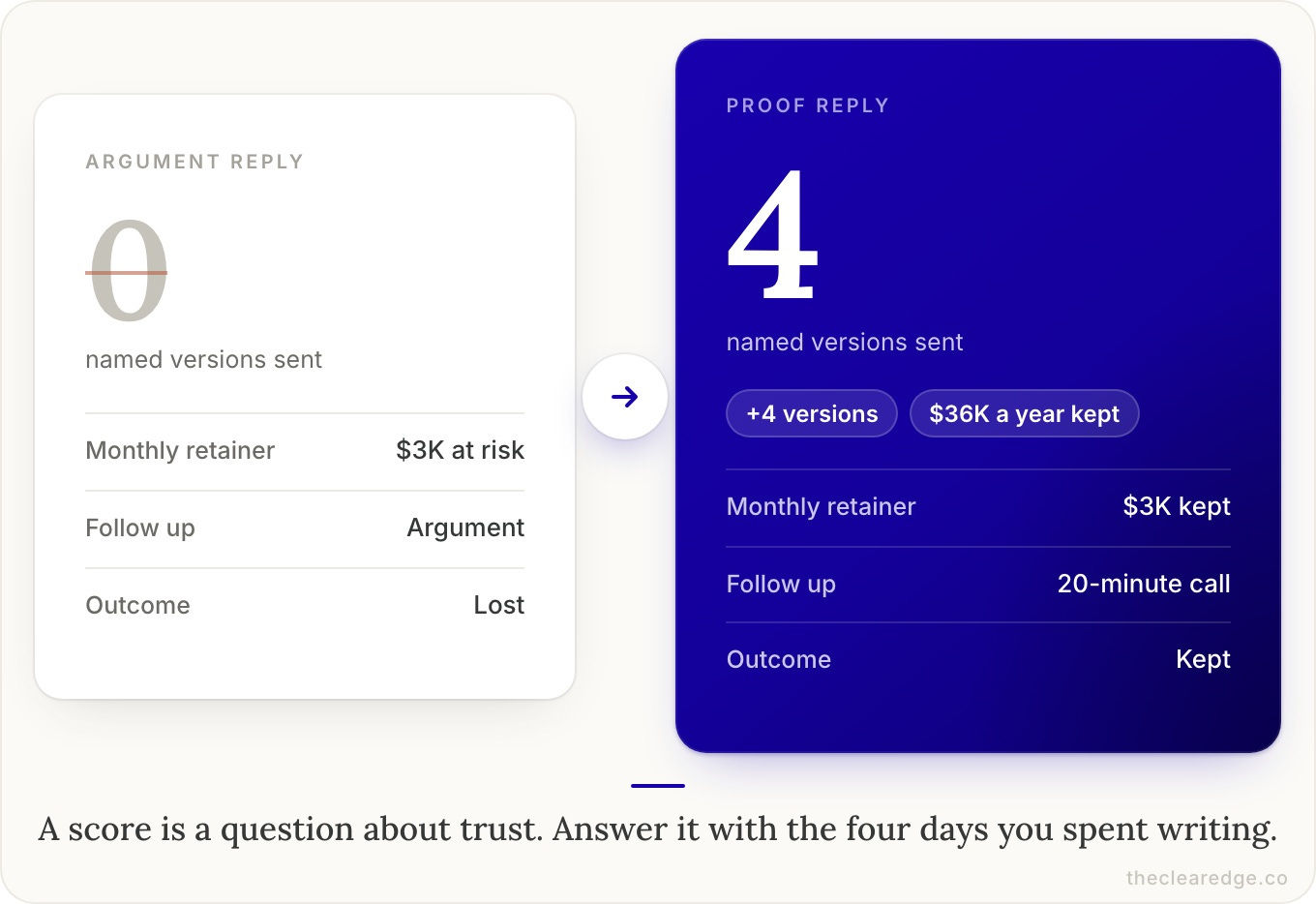
Her reply opened with thanks, not a defence:
“Thanks for flagging this, I’d want to know too. I wrote this draft myself, and I’ve attached how I built it over 4 working days.”
