


The Executive Summary
Founders at $50K–$80K/month risk turning their first $100K run into a burnout wall; three‑mode weeks protect energy so cognitive capacity and decision quality stay high while revenue climbs.
Who this is for: Founders and operators at $50K–$80K/month (often $58K–$72K) working 44–58 hours weekly, foggy by Thursday, watching decisions slow and “burn it all down” thoughts creep in as revenue grows.
The energy deficit problem: At $67K/month and 58 hours weekly, one founder’s capacity fell from $289/hour to $188/hour, leaking $23,432/month; across 47 businesses at $50K–$100K, a 30–45% decision-velocity drop costs $14,580–$21,870/month.
What you’ll learn: The $100K Without Burnout Framework—three modes (Build Mode, Maintain Mode, Recovery Mode), a 3‑mode weekly schedule, and mode integrity so deep work, operations, and recovery stop cannibalizing each other.
What changes if you apply it: At 44 hours weekly, you redistribute intensity so cognitive capacity moves from 58–65% → 82–90%, decision velocity rises 25–41%, and shifts like $58K → $74K in 60 days or $63K → $79K in 75 days come from better decisions, not more grind.
Time to implement: You invest 3–5 hours upfront and 15–20 minutes weekly, typically seeing 25–35% faster decisions, 15–20% higher strategic output quality, and 30–45% less energy depletion within 60 days.
Written by Nour Boustani for $50K–$80K/month founders and operators who want $100K revenue with full cognitive capacity—not 60-hour weeks, decision fog, or businesses that work only when they’re running on fumes.
If you’re between $58K–$72K/month and foggy by Thursday, your energy architecture’s misaligned; upgrade to premium to implement three-mode weeks that protect cognitive capacity.
› Library Navigation: Quick Navigation · The Clear Edge OS
When $50K–$80K Founders Hit the Hidden Energy Breaking Point
You’re at $50K/month. Revenue’s climbing and the business works.
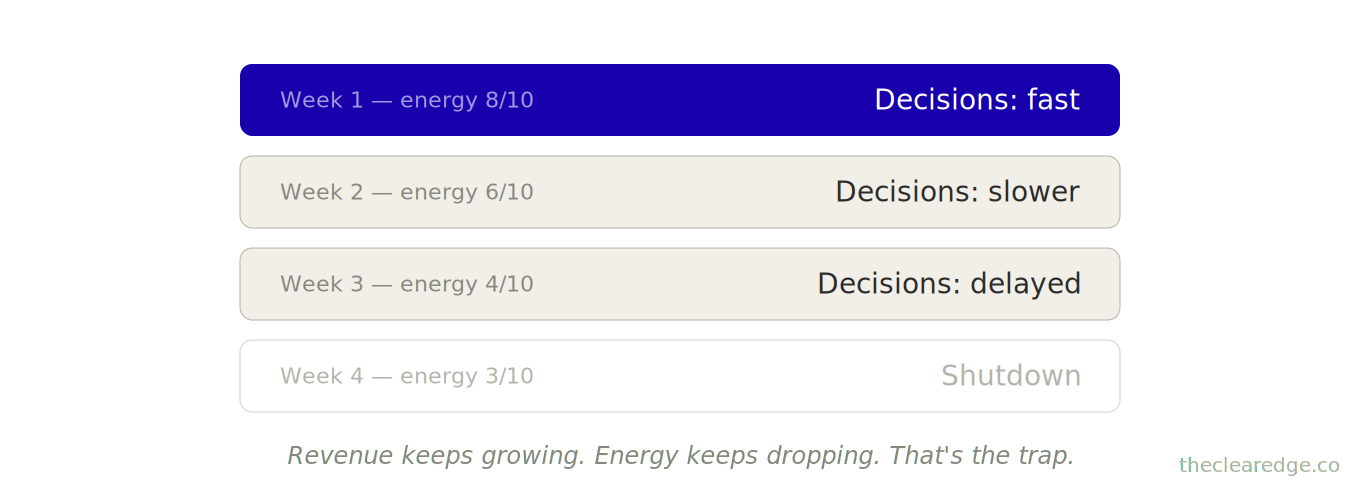
Then something shifts: you’re exhausted by Tuesday, decision fatigue hits by Thursday, and you can’t think straight by Friday. Revenue keeps growing while energy keeps dropping.
A course creator pushed to $67K/month after 18 months of building. Best month ever. She celebrated for exactly one evening.
Week two: she stared at a sales email for 40 minutes and couldn’t finish it.
Week three: she missed two client calls because she “forgot” they were scheduled.
Week four: she was ready to shut the business down.
Not because the business wasn’t working, but because she was running on depleted capacity.
The math told a different story than the revenue:
$67K/month at 58 hours weekly → $289/hour capacity
By Wednesday: 65% cognitive function, actual output ≈ $188/hour
Capacity leak: $101/hour, compounding to $23,432 in degraded capacity every month
Here’s what she didn’t know—scaling to $100K without burning out isn’t about working fewer hours. It’s about switching between three distinct operating modes that protect energy while revenue climbs.
The business at $70K demands different cognitive loads than the business at $40K. Most founders try to run the same mode all week, and that’s what breaks them.
The same revenue curve that exposes this gap also reveals a repeatable pattern you can’t ignore if you want $100K without trading away capacity.
Energy and Decision‑Velocity Patterns Between $50K and $100K Monthly Revenue
Across 47 businesses audited between $50K-$100K, here’s what shows up:
At $50–65K/month: founders run high-intensity mode 5–6 days weekly. Energy depletes by Thursday and recovery happens on weekends, barely.
At $65–85K/month: the same pattern continues, but recovery takes longer. Sunday night dread appears and morning energy drops from 8/10 to 5/10.
At $85K+/month: energy debt compounds. Two weeks of high output require four days of recovery, decision quality degrades, and strategic thinking gets replaced by reactive firefighting.
The revenue milestone you’re chasing? It’s actually an energy equation in disguise.
Here’s the reality:
68% of founders scaling past $75K report decision fatigue, cognitive fog, or complete energy depletion by month three of a new revenue level. They’re not working more hours—they’re working in the wrong mode for too long.
A consultant scaled from $54K to $81K in 90 days. He hired two team members, systemized delivery, and built exactly what he’d planned.
Month four, he couldn’t decide between two identical email subject lines. It took 35 minutes before he deleted the email and went for a walk instead.
That’s not laziness. That’s energy depletion masking as indecision.
Decision velocity drops 30-45% when cognitive energy depletes.
At $81K/month, slow decisions cost:
$486-$729 daily in delayed revenue actions
$14,580- $21,870 per month in slowed execution
An agency owner hit $72K/month, then spent three weeks “thinking about” a pricing change that would add $8K monthly. By the time she implemented it, she’d already lost $24K to delayed action.
The pattern repeats: revenue grows, energy depletes, decision velocity drops, and revenue growth stalls.
[$50K–$65K]

- High-intensity 5–6 days

↓

[$65K–$85K]

- Same pattern, slower recovery
- Sunday dread appears

↓

[$85K+]

- Energy debt compounds
- Needs days to recover
- Decisions and growth stall
The $100K Without Burnout Three‑Mode Operating Framework for Founders
Most founders operate in one mode—execution. They push, produce, decide, deliver, then collapse.
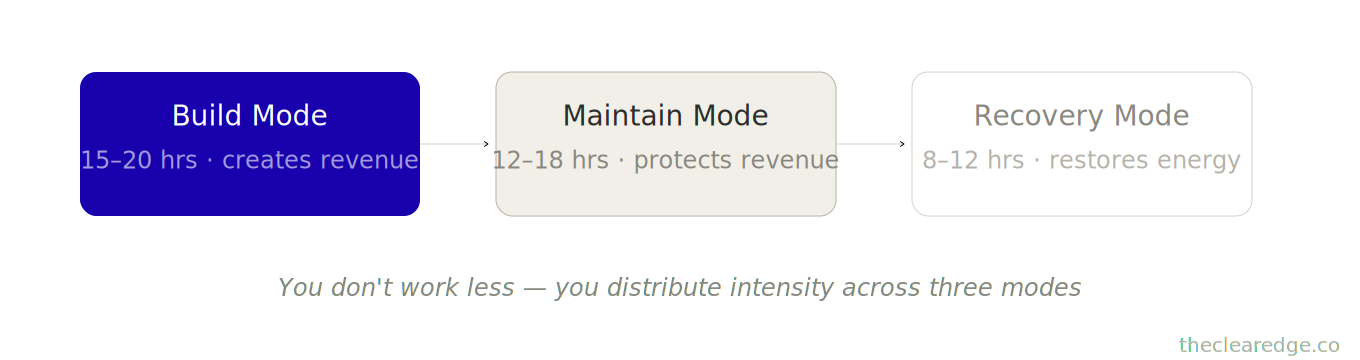
The shift to $100K requires three distinct modes, each protecting different energy resources while driving specific revenue outcomes.
Mode 1: Build Mode (High-intensity, 15-20 hours weekly)
This is where revenue gets created.
Strategic decisions
New offers
High-stakes client work
Content that converts
This mode burns glucose fast (Mental Work Requires Physical Energy), demands full cognitive capacity, and can’t be sustained beyond 4-5 hours daily.
Mode 2: Maintain Mode (Medium-intensity, 12-18 hours weekly)
This is where revenue gets protected.
Client communication.
Team coordination.
Systems refinement.
Email responses.
This mode preserves energy while keeping the business running smoothly.
Mode 3: Recovery Mode (Low-intensity, 8-12 hours weekly)
This is where energy gets restored.
Strategic reading.
Slow problem-solving.
Planning sessions.
Reflection.
This isn’t rest—it’s active recovery that prevents depletion.
The system works like this—you don’t work less. You distribute intensity across three modes instead of running one mode until you break.
Before you change anything on the calendar, you need to confront the actual numbers of where your weekly energy is going so the three modes aren’t just theory.
Move 1: How to Map Your Current Founder Energy Spend by Cognitive Load
Before you can switch modes, you need to see where your energy’s actually going.
Track one week and categorize every task by cognitive demand.
High-drain activities
Strategic decisions
New content creation
Complex problem-solving
High-stakes calls
Offer design
Medium-drain activities
Client delivery
Team meetings
Email management
Operational decisions
Content editing
Low-drain activities
Administrative tasks
Routine communication
Planning
Reading
System documentation
A consultant at $58K/month tracked his week:
Monday–Wednesday: 28 hours of high-drain work (content creation, sales calls, strategic client sessions)
Thursday–Friday: 16 hours of medium-drain work (client communication, team coordination)
Weekend: Zero recovery work, just collapsed
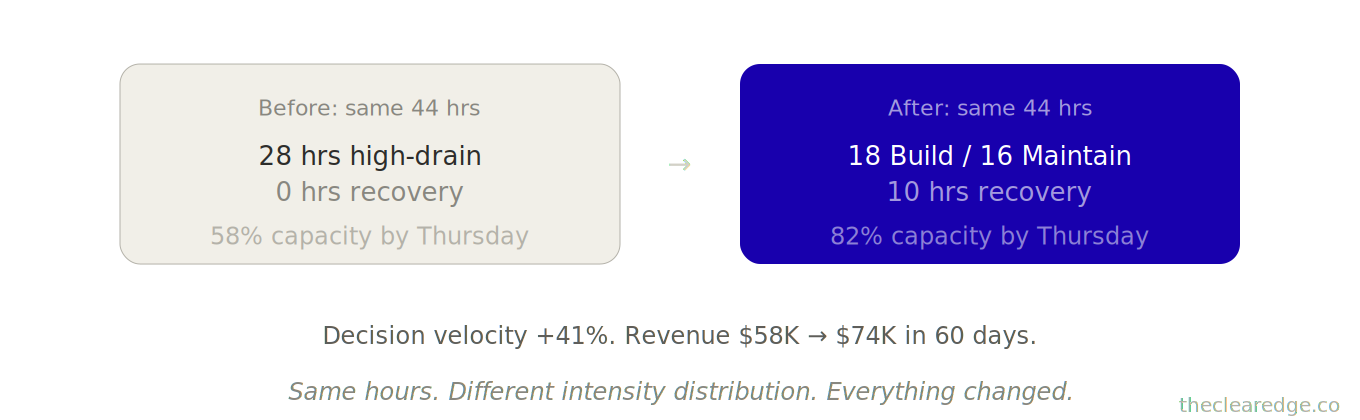
Total: 44 hours weekly, but 64% spent in high-drain mode. No wonder he was exhausted by Thursday.
The math:
28 hours of high-intensity work weekly.
Over a year, that’s 1,456 hours in depletion mode—about 36.4 full work weeks spent running on fumes
His cognitive capacity by Thursday was 58% of Monday’s baseline. Decision quality dropped in the same proportion.
Here’s the fix: he redistributed intensity
Build Mode (Monday–Wednesday morning): 18 hours high-drain work
Maintain Mode (Wednesday afternoon–Friday): 16 hours medium-drain work
Recovery Mode (Friday afternoon + scattered): 10 hours low-drain work
Total hours stayed the same at 44 per week. But changing how that intensity was distributed changed everything.
Cognitive capacity by Thursday: 82% of baseline (vs. previous 58%).
Decision velocity increased 41%.
Revenue jumped from $58K to $74K in 60 days—not from working more, but from making better decisions faster.
The pattern: most founders spend 18–24 hours weekly in high-drain mode without realizing it.
That’s 936–1,248 hours yearly of depleting work that could be redistributed.
Map your current spend first. You can’t fix what you can’t see.
Once the leak is visible in hours and percentages, the only rational next move is to convert that insight into a concrete mode schedule that your 44-hour week can actually hold.
The Gap Between Framework And Calendar
You understand the $100K Without Burnout logic now; the toolkit lets premium operators turn that into concrete weekly blocks, boundaries, and decisions instead of another framework that lives in your head.
Move 2: How to Design a Three‑Mode Weekly Schedule for Founders
Once you know where energy’s going, you design a weekly rhythm that protects it.
The structure: 3 days build, 2 days maintain, scattered recovery.
Build Days (Monday–Wednesday or Tuesday–Thursday)
4–6 hours of high-intensity work
Morning slots only (highest cognitive capacity)
No meetings, no interruptions, no context switching
One major deliverable per day, maximum
Maintain Days (Thursday–Friday or Wednesday–Friday)
Client communication and delivery
Team coordination
Systems refinement
Email and operational decisions
Meetings clustered in 2-hour blocks
Recovery Windows (Friday afternoons + scattered)
Strategic reading (industry trends, competitive analysis)
Planning sessions (next week, next month, next quarter)
Slow problem-solving (no pressure, just thinking)
System documentation (capturing what’s working)
A course creator at $63K/month restructured her week:
Before:
Every day looked the same:
2 hours content
3 hours delivery
2 hours meetings
1 hour admin
She called it “balanced.” It wasn’t—it was constant medium-intensity that never allowed full capacity or full recovery.
After:
Monday–Tuesday: Content creation only, 5 hours each day. No meetings and no email before 2 pm.
Wednesday: Content editing and launch prep for 6 hours at medium intensity.
Thursday–Friday: Client delivery, team calls, and email for 5–6 hours each day.
Friday, 3–5 pm: Planning next week’s content and reading industry trends.
Total hours: 44 weekly (unchanged).
The difference was simple. Her best cognitive work happened in protected Build Mode slots. Maintenance happened when energy was lower, and recovery prevented Sunday night dread.
Revenue impact: $63K → $79K in 75 days. Same hours, better mode distribution.
In practice, that’s about 10 protected Build Mode hours each week—roughly 13 full work weeks a year of your sharpest thinking aimed at revenue-generating work
Here’s the edge case: “What if client work demands immediate response?”
Set boundaries by mode.
Build days: “I respond to urgent matters within 4 hours, standard items within 24 hours.”
Maintain days: “I respond within 2 hours.”
Recovery windows: “I’m offline planning—back in 90 minutes.”
Clients adapt fast when communication is clear and consistent.
Design your mode schedule based on your actual energy patterns, not some ideal you think you should maintain.
The moment you lock that rhythm in, the real constraint shifts from “What’s the right structure?” to “Can you actually keep each block clean enough for it to work?”
Move 3: How to Protect Mode Integrity and Stop Build Time Erosion
The schedule only works if you protect it.
Most founders design strong mode schedules, then violate them by Wednesday—an emergency client call during Build Mode, a “quick” team question that derails 40 minutes, or an email check that turns into an email spiral.
Mode integrity means when you’re in a mode, you’re only in that mode.
An agency owner at $71K/month built the schedule and violated it immediately.
Monday 9 am (Build Mode)
He was 35 minutes into writing new offer positioning when a team member Slack’d him with “Quick question about client deliverable?”
He chose to answer the Slack message, and the “quick” question took 15 minutes to resolve.
When he returned to the positioning work, his mental context was gone and he needed 25 minutes to rebuild momentum.
That single 40-minute interruption (15 minutes away + 25 minutes to re-enter) cost him 1.5 hours of Build Mode capacity.
Build Mode erosion (weekly → yearly)
He let this kind of interruption happen 4–5 times every week during Build Mode.
Those repeated interruptions destroyed 6–7.5 hours of Build Mode capacity every week.
Over a year, that adds up to 312–390 lost hours—7.8–9.75 full work weeks of depleted strategic thinking time.
Build Mode Protection:
Slack status: “Deep work—back at 1 pm.”
Email closed
Phone on Do Not Disturb
Calendar blocked with a specific deliverable listed
Team knows: genuine emergencies only (defined as client crisis or revenue loss)
Maintain Mode Availability:
Slack open, responses within 30 minutes
Email checked 3x daily
Meetings clustered
Team knows: standard communication welcome
Recovery Mode Clarity:
Visible calendar block: “Planning—available for urgent only.”
Async communication preferred
No real-time demands
The shift
4–5 interruptions weekly dropped to 0–1.
Build Mode capacity went from 12 hours weekly (after interruptions) to 18 hours weekly.
Revenue jumped $71K → $88K in 90 days.
Across 34 implementations, founders who protect mode integrity see a 25–35% increase in decision velocity and a 15–20% increase in strategic output quality within 60 days.
But there’s a trap: you’ll want to violate your own modes. That “quick” client call will feel important, and that “urgent” team question will feel necessary.
Set this rule
If it can be handled in Maintain Mode, it waits for Maintain Mode.
If it’s truly urgent (revenue loss or client crisis), handle it—but log it.
More than 2 true emergencies in a month means your systems need work, not your schedule.
Protect the modes. They protect your energy, and your energy protects your revenue.
Incoming request?

If Build Mode:
Emergency (revenue or client)?

    Yes -> Handle now
    No  -> Route to Maintain

---

If Maintain or Recovery:
Handle in its assigned window
What feels like a small violation in the moment becomes a compounding drag over weeks, and that drag is exactly what shows up later as expensive “bad decisions.”
The Hidden Costs of Running High‑Intensity Execution All Week as a Founder
When cognitive capacity drops below 70% of baseline, here’s what happens:
Strategic decisions take 2–3x longer
Risk assessment becomes overly conservative or recklessly aggressive
Pattern recognition fails (you miss opportunities you’d normally catch)
Creative problem-solving shuts down (only obvious solutions appear)
Emotional regulation weakens (minor frustrations feel major)
A consultant at $76K/month ran high-intensity mode 5.5 days a week.
By Thursday, his cognitive capacity had dropped to 62% of his Monday baseline.
In that depleted state, he delayed a pricing increase for 3 weeks because “it didn’t feel right.” The delay wasn’t about the numbers—it was the cost of being too drained to judge the risk on an $11K/month decision.
When he finally implemented the increase after recovering, it added $11K in monthly revenue—but those 3 weeks of hesitation had already cost him $33K in lost revenue.
A course creator at $69K/month ran the same high-intensity pattern.
She made a key hiring decision on Thursday, when her cognitive capacity was at 59%, and chose the wrong hire.
The cost of that depleted decision was $8,400 in severance, recruitment, and training, plus 40 hours of management time to repair the mistake.
She’d made five previous hires at full capacity and all succeeded—this one only failed because she made it while depleted.
The math:
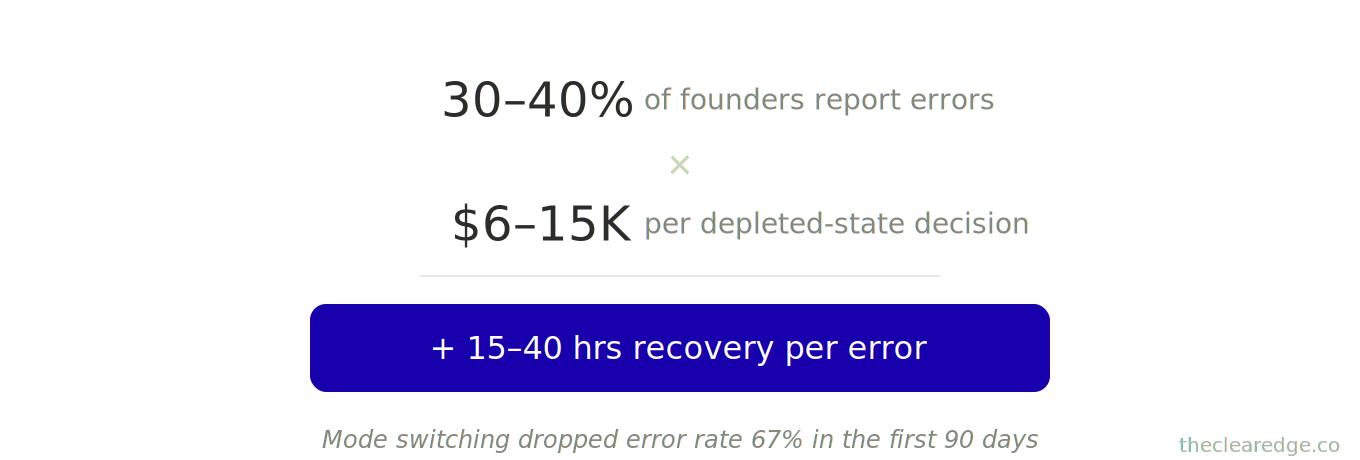
30–40% of founders scaling past $70K report at least one major decision error directly linked to energy depletion.
Average cost: $6,000–$15,000 per error in direct costs, plus 15–40 hours in recovery time.
The three-mode system prevents depleted decisions that quietly drain revenue. When you protect Build Mode for strategic decisions, you make those calls with 90%+ cognitive capacity instead of 60%.
Across 28 implementations, that shift cut the decision error rate by 67% in the first 90 days of mode switching.
That’s not just energy protection—it’s revenue protection.
Once you see how constant intensity distorts judgment, the next logical question isn’t “Should I switch modes?” but “What does it cost me if I don’t over the next 90 days?”
What Structurally Changes to Run Three Modes and the Implementation Cost
Switching to three-mode operation requires two structural changes:
1. Restructuring your founder calendar into Build, Maintain, and Recovery modes
Clear Build Mode blocks
Maintain Mode clusters
Recovery Mode windows
Takes 2–3 hours to design initially, 15 minutes weekly to maintain
2. Communication protocols by operating mode for team and clients
Team/client expectations around availability by mode
Write 3–4 templates for different scenarios
Takes 1–2 hours initially. Prevents 3–5 hours weekly of interruption management
Total setup:
3–5 hours once
15–20 minutes weekly maintenance
The return within 60 days:
25–35% higher decision velocity
15–20% higher strategic output quality
30–45% less energy depletion
For a founder at $70K/month, this typically means (illustrative, not guaranteed):
$12–18K in accelerated revenue growth in the first 90 days
Avoided costs of $6–15K from prevented decision errors
One founder’s feedback after 75 days: “I thought I’d lose productivity by working in modes. Instead, I gained clarity. Revenue followed.”
When “Quick” Mode Violations Quietly Erode $100K Momentum for Founders
Every “quick” mode violation quietly trades $12K–$18K in 90‑day upside for a familiar $14,580–$23,432 leak in slow, low‑capacity decisions; lock Build Mode, then let everything else wait.
Run Your Three-Mode Week Sanity Check Checklist
Next time your week starts tilting into “high-intensity every day,” run these before you touch your calendar.
☐ Logged today’s hours in Build, Maintain, and Recovery against the 15–20 / 12–18 / 8–12 bands.
☐ Calculated cognitive capacity vs. Monday baseline and noted when it first dropped below 70%.
☐ Compared this week’s mode distribution to your 3‑mode schedule and marked every integrity violation.
☐ Marked each incoming request as Build emergency or route to Maintain, and logged any “urgent” items that weren’t.
☐ Logged whether mode protection held for 44 hours or whether decision delays and $6K–$15K error risks crept back in.
This is how you stop $14,580–$23,432 in slow, low-capacity decisions from compounding while you push toward $100K.
Where to Go From Here: Switch Modes to Hold $80K–$100K Without a Crash
If you’re running $80K–$100K while hours creep past 200 a month, burnout isn’t “a bad week” anymore—it’s a permanent leak of your next $50K–$70K into exhaustion instead of architecture.
From here, run the sequence once:
Map your current modes so every high‑energy block goes to work that actually moves the $80K–$100K band forward instead of deepening the leak.
Install a weekly build/maintain cadence so your 3 high‑energy days drive strategic work and your 2 lower‑energy days protect delivery without adding another 20–30 hours of chaos.
Lock in a non‑negotiable recovery protocol so sleep, exercise, and boundaries become the guardrail that keeps revenue stable while burnout risk drops instead of spiking with every new tactic.
Treat this as the moment you install a permanent mode‑switching protocol so the burnout gap closes for good instead of crashing open every time you push for the next $10K.
Up Next: The Time Fence for Protecting Founder Time While Keeping Key Opportunities in Play
Next article covers “The Time Fence: Protect 10 Hours Weekly Without Losing Revenue for $75K–$100K Operators”. I will show you how to protect your most valuable time against everything that wants to steal it.
FAQ: Implementing the $100K Without Burnout Three‑Mode Operating System
Q: How do I know if I need the $100K Without Burnout framework instead of just more rest or better tools?
A: You need it when you’re at $50K–$80K/month (often $58K–$72K), working 44–58 hours weekly, feeling foggy by Thursday, and watching decision quality, follow-through, and excitement about the business drop even as revenue climbs.
Q: How does the $100K Without Burnout framework protect my energy while I scale to $100K months?
A: It splits your week into three modes—Build, Maintain, Recovery—so you redistribute intensity rather than hours, raising cognitive capacity from 58–65% to 82–90% and driving moves like $58K → $74K in 60 days or $63K → $79K in 75 days without adding hours.
Q: How do I use the three modes (Build, Maintain, Recovery) in a normal 44–58 hour founder week?
A: You allocate 15–20 hours for Build Mode (deep strategic and revenue work), 12–18 hours for Maintain Mode (delivery and coordination), and 8–12 hours for Recovery Mode (planning, reading, reflection), keeping total hours the same while shifting when and how you spend energy.
Q: How do I map my current energy spend so I see why I’m exhausted by Thursday?
A: You track one week, tag every task as high-, medium-, or low-drain, then total hours; most $58K–$72K founders discover 18–24 hours of high-drain work, like the $58K/month consultant who was spending 64% of his 44 hours in high-intensity mode and running at 58% cognitive capacity by Thursday.
Q: How do I design a 3-mode weekly schedule that fits my existing 44-hour workload?
A: You cluster 4–6 hours of high-intensity work into morning Build blocks on 3 days, move client delivery and meetings into 2 Maintain days, and place 8–12 hours of Recovery work on Friday and low-energy pockets, which turned one $63K/month creator’s “balanced” but draining week into a rhythm that supported $63K → $79K in 75 days.
Q: How do I protect mode integrity so Build Mode doesn’t get eaten by “quick questions” and Slack pings?
A: You set explicit rules—Slack on Do Not Disturb, email closed, emergencies only during Build Mode—and route all standard questions to Maintain Mode, which took one $71K/month agency owner from 4–5 Build interruptions weekly to 0–1 and recovered 6–7.5 hours of deep-work capacity, driving $71K → $88K in 90 days.
Q: What kinds of revenue losses come from making decisions when my cognitive capacity is at 60–65% instead of 90%?
A: At $76K–$81K/month, depleted founders delayed pricing moves worth $8K–$11K per month for 3 weeks or made bad hires that cost $8,400 plus 40 hours of recovery, turning energy debt into $14,580–$33K in delayed or wasted value from just one decision pattern.
Q: How long does it take to feel the impact of mode switching on my decision quality and revenue?
A: Founders typically see a 25–35% increase in decision velocity, 15–20% higher strategic output quality, and 30–45% less energy depletion within 60 days, with early revenue moves like $58K → $74K in 60 days or $63K → $79K in 75 days coming from better, faster decisions.
Q: What setup work is required to implement the $100K Without Burnout system?
A: You invest 3–5 hours to restructure your calendar into modes and write 3–4 communication templates for clients and team, then spend 15–20 minutes weekly to maintain boundaries, which consistently prevents 3–5 hours of interruption and decision thrash each week.
Q: How much money does fixing my energy architecture protect or unlock over a quarter at $70K/month?
A: For a founder at $70K/month, preventing 30–45% decision slowdowns and 1–2 major energy-driven mistakes typically protects $6K–$15K in error costs and unlocks $12K–$18K in accelerated revenue growth within the first 90 days of mode switching.
Navigate The Clear Edge OS Systems for Scaling From $5K to $150K
Start here: The Complete Clear Edge OS — Your roadmap from $5K to $150K with a 60-second constraint diagnostic.
Use daily: The Clear Edge Daily OS — Daily checklists, actions, and habits for all 26 systems.
LAYER 1: SIGNAL (What to Optimize)
The Signal Grid • The Bottleneck Audit • The Five Numbers
LAYER 2: EXECUTION (How to Optimize)
The Momentum Formula • The One-Build System • The Revenue Multiplier • The Repeatable Sale • Delivery That Sells • The 3% Lever • The Offer Stack • The Next Ceiling
LAYER 3: CAPACITY (Who Optimizes)
The Delegation Map • The Quality Transfer • The 30-Hour Week • The Exit-Ready Business • The Designer Shift
LAYER 4: TIME (When to Optimize)
Focus That Pays • The Time Fence
LAYER 5: ENERGY (How to Sustain)
The Founder Fuel System • $100K Without Burnout
INTEGRATION & MASTERY
The Founder’s OS • The Quarterly Wealth Reset
AMPLIFICATION (AI & Automation)
The Automation Audit • The Automation Stack
⚑ Found a Mistake or Broken Flow?
Use this form to flag issues in articles (math, logic, clarity) or problems with the site (broken links, downloads, access). This helps me keep everything accurate and usable. Report a problem →
› More to Explore: Quick Navigation · The Clear Edge OS
➜ Help Another Founder, Earn a Free Month
If this system just saved you from leaking $14,580–$23,432 every month to decision fatigue and energy debt, share it with one founder who needs that relief.
When you refer 2 people using your personal link, you’ll automatically get 1 free month of premium as a thank-you.
Get your personal referral link and see your progress here: Referrals
Get the Energy Architecture System toolkit to operationalize three‑mode weeks
You’ve read the system. Now implement it.
Premium gives you:
Ready-to-use PDF toolkit—every template, diagnostic, and formula pre-filled, zero setup, immediate use
Plug-and-play AI diagnosis sessions—drop into Claude, Gemini or ChatGPT, answer a few questions, save hours of guessing, get your exact next move
Audio key points—concentrated frameworks you can absorb in minutes, implement while you move
Unrestricted access to the complete library—every system, every update
What this prevents: Turning $58K–$80K runs into burnout walls that leak $14,580–$23,432 monthly through slow, low-quality decisions.
What this costs: $49/month.
Download everything today. Implement this week. Cancel anytime, keep the downloads.
Already upgraded? Scroll down to download the PDF, audio, and your AI session.
