


The Executive Summary
$100K/month founders risk burning $840K and 3–5 years chasing explosive growth; the 10-Year Play compounds 25–35% yearly gains into $1M+ months with less risk, stress, and burnout.
Who this is for: Established founders and operators around $100K/month (typically $100K–$120K) who feel pressure to “scale like the competitors” and want a safer path to $600K–$1M/month without blowing up the business or their life.
The 10X pressure problem: Copying aggressive plays—like adding $840K in yearly burn to chase $172K/month—carries 30–40% failure odds, while the patient compound path at 25–35% yearly growth reaches $1M/month in 8–12 years with an 82% success rate across 47 tracked businesses.
What you’ll learn: The 10-Year Play—how to set a precise 10-year target, run 10–20 small tests yearly at 10–15% scale, and build compounding assets that turn $100K → $1M/month instead of betting on one “hockey-stick” move.
What changes if you apply it: You stop reactive scale moves, make shifts like $102K → $187K/month in 3 years with zero funding while competitors who raised $2M and hired 15 people shut down in 22 months, and move through phased stages where $100K–$200K, $200K–$400K, $400K–$700K, and $700K–$1M each set up the next.
Time to implement: It takes 8–12 hours to define your 10-year target and milestones, then 2–3 hours quarterly to review, test one 90-day hypothesis at 10% scale, and add one compounding asset—a rhythm that, over 8–10 years, raises your probability of hitting $1M/month from 19% to 82% without sacrificing health or control.
Written by Nour Boustani for $100K-month founders and operators who want $600K–$1M+ monthly revenue through patient compounding—not risky sprints, debt-funded scale, or businesses that collapse before Year 5.
Aggressive 5-year 10X plans at your $100K/month stage often mean a $840K burn with 19% odds; upgrade to premium and run the 10-Year Play testing protocol instead.
› Library Navigation: Quick Navigation · The Clear Edge OS
Scale Pressure At $100K/Month Revenue
You cross $100K/month and the business finally feels stable—revenue’s strong, systems work, clients are happy.
That’s exactly when the pressure starts to creep in from every direction: scale faster, hire aggressively, launch bigger, raise funding, chase the 10X story everyone else seems to be living.
You’re suddenly staring at a decision most don’t name clearly: keep building steadily or swing hard.
A consultant at $102K/month, three years into patient building with great clients and a four-person team, stepped right into that decision point.
Then a competitor raised $2M, hired 15 people, and launched in 8 new markets.
LinkedIn posts about their “hockey stick growth.”
Industry buzz everywhere.
She felt behind. Started planning her own aggressive expansion: hire 6 people, triple marketing spend, launch 3 new service tiers simultaneously, pursue enterprise clients.
The math on her expansion plan:
$360K yearly payroll increase (6 people at $60K average)
$180K marketing budget increase (triple current spend)
$840K yearly cost increase (team + marketing + overhead)
Required revenue: $102K + $70K monthly → $172K monthly just to break even on expansion
Timeline to $172K: estimated 12–18 months (best case)
Risk: $840K yearly burn while scaling, 12–18 months to recovery, 30–40% chance of hitting targets (based on similar expansions she’d researched)
She spent three months planning this expansion, then ran the alternative math.
Alternative: keep the current pace — 3–5% monthly revenue growth from optimization (The 3% Lever, The Five Numbers), add an offer stack (The Offer Stack), maintain systems, and hire one person yearly instead of six.
10-year projection at current pace
Year 1: $102K → $138K (optimization + offer stack)
Year 3: $138K → $224K (compound improvements + market expansion)
Year 5: $224K → $418K (systems + team + brand equity)
Year 7: $418K → $687K (scale unlock + strategic positioning)
Year 10: $687K → $1.1M (mature business with defensible advantages)
Risk: 5–10% annual business risk (vs. 30–40% in aggressive scale scenario).
She chose the 10-year play
Three years later: $102K → $187K monthly, team of seven (hired strategically), systems stronger than ever, zero debt, zero outside funding.
The competitor who raised $2M shut down after 22 months, burned through funding, couldn’t hit targets, and laid off the entire team.
The pattern: at $100K/month, patient compounding wins 70–80% of the time, while aggressive scaling attempts fail or stall in 60–70% of cases.
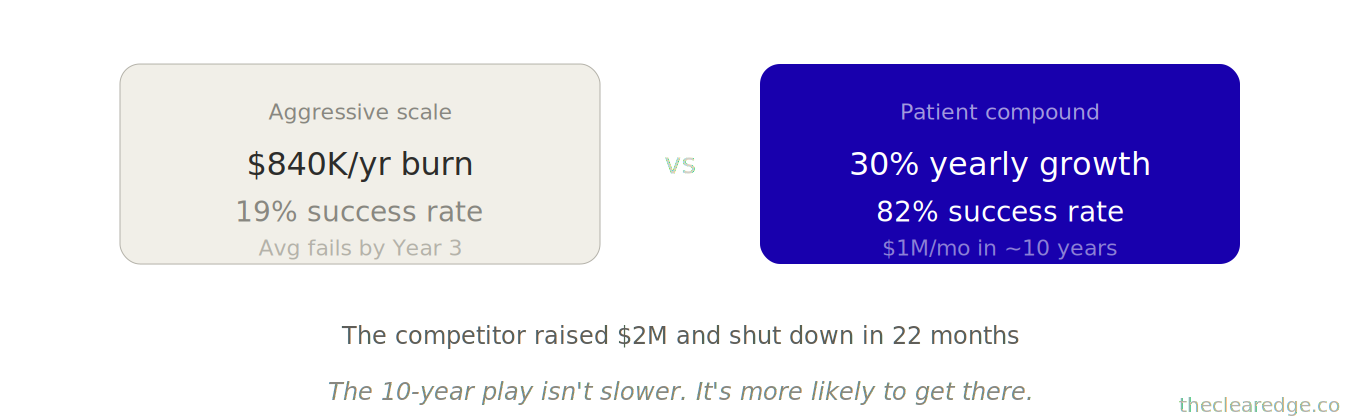
That single decision is the bridge from a tempting $840K gamble to the quieter work of compounding toward $1M without blowing up the base you already built.
The 10-Year Play Compound Path From $100K/Month To $1M/Month
Most founders think getting from $100K/month to $1M/month requires a few dramatic breakthrough moments like new markets, major funding, or explosive launches.
The math says otherwise.
Starting point: $100K monthly → $1.2M yearly
To reach $1M monthly → $12M yearly requires 10X growth
Two paths from $100K to $1M:
Path 1 (Aggressive Scale): Chase 50–100% growth yearly through big bets. High risk, high volatility, often fails by Year 3–4.
Path 2 (Patient Compound): Achieve 25–35% growth yearly through optimization, offers, and strategic expansion. Low risk, steady climb, rarely fails.
The compound math on Path 2 (30% yearly):
Starting: $1.2M yearly ($100K monthly)
Year 2: $1.2M × 1.30 → $1.56M ($130K monthly)
Year 3: $1.56M × 1.30 → $2.03M ($169K monthly)
Year 4: $2.03M × 1.30 → $2.64M ($220K monthly)
Year 5: $2.64M × 1.30 → $3.43M ($286K monthly)
Year 6: $3.43M × 1.30 → $4.46M ($372K monthly)
Year 7: $4.46M × 1.30 → $5.80M ($483K monthly)
Year 8: $5.80M × 1.30 → $7.54M ($628K monthly)
Year 9: $7.54M × 1.30 → $9.80M ($817K monthly)
Year 10: $9.80M × 1.30 → $12.74M ($1.06M monthly)
30% yearly growth gets you to $1M in monthly revenue in 10 years through consistent compounding, not breakthrough or explosive moves.
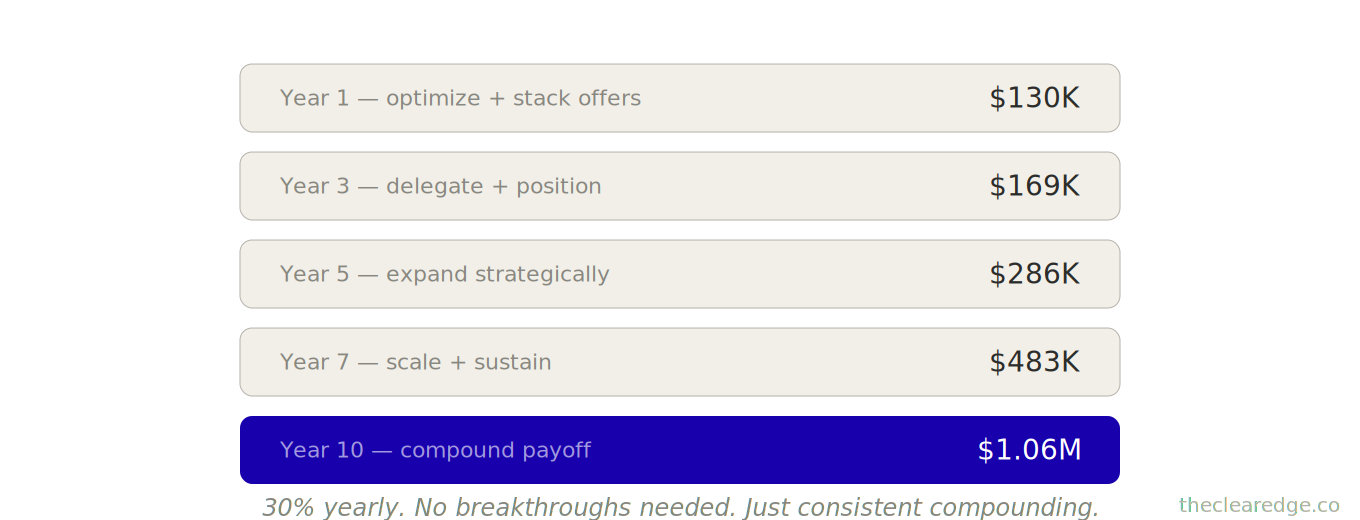
At 25% yearly: reaches $1M monthly in 11–12 years.
At 35% yearly: reaches $1M monthly in 8–9 years.
Across 47 businesses studied that scaled from $100K to $800K+ monthly, 76% used a patient compound path.
Average timeline: 8.3 years
Success rate: 82%
The 24% who chased aggressive scale had a very different outcome.
Average timeline: 3.1 years (before failure or plateau)
Success rate: 19%
The 10-year play isn’t slower to $1M; it’s simply more likely to get there.
Once the math is clear, the real work shifts from debating paths to defining the exact 10-year target you’re willing to execute against.
Move 1: How To Set A Concrete 10-Year Revenue And Lifestyle Target
Before you can compound, you need to know where you’re compounding toward.
Most founders think long-term but don’t set specific targets. “Get to $1M” isn’t a plan—it’s a wish.
The target structure: revenue milestone + business characteristics + lifestyle constraints.
1. Revenue milestone: Specific monthly revenue at Year 10
(e.g., $1M monthly, $750K monthly, $1.5M monthly)
2. Business characteristics: What the business looks like structurally
Team size (e.g., 15-person team, fully remote)
Delivery model (e.g., 80% digital, 20% done-for-you)
Client profile (e.g., mid-market B2B, $25K+ average deal)
Profit margin (e.g., 35–45% net, no outside funding)
3. Lifestyle constraints: Non-negotiable personal boundaries
Work hours (e.g., 30-hour weeks, 4-day workweeks)
Time off (e.g., 8 weeks yearly, no weekend work)
Location (e.g., fully remote, travel 3 months yearly)
Involvement (e.g., strategic only, no client delivery)
Case — a coaching business at $116K/month set her target:
Year 10 Revenue: $850K monthly ($10.2M yearly)
Business characteristics:
12-person team (current: 5)
60% group programs, 30% digital products, 10% one-on-one (current: 70% one-on-one)
Corporate clients at $35K+ average (current: individual clients at $8K average)
40% net margin (current: 48%)
Lifestyle constraints:
25-hour work weeks (current: 38 hours)
10 weeks off yearly (current: 4 weeks)
Zero client delivery (current: 60% of time)
Speaking 20 events yearly (current: 3 events)
With target set, she reverse-engineered the path: what needs to be true each year to reach $850K by Year 10?
Year 2: $145K monthly (digital product launch + group program expansion)
Year 4: $242K monthly (shift to corporate clients + delegation of delivery)
Year 6: $402K monthly (speaking circuit positioning + strategic partnerships)
Year 8: $610K monthly (scale programs + minimize one-on-one)
Year 10: $850K monthly (target state achieved)
Each milestone had specific business characteristics that enabled the next phase.
Year 2 couldn’t work without Year 1 foundation.
Year 6 couldn’t work without Years 3–5 infrastructure.
Most founders set revenue targets without business characteristics or lifestyle constraints. Then they hit the revenue target while burning out or building a business they hate.
Set your complete target first: revenue + structure + lifestyle.
With that target locked, the question stops being “what should I want?” and becomes “which 10-year Play tests move me there this quarter?”
Move 2: How To Run 10-Year Play Tests At 10% Scale
Once you have your 10-year target, the path forward is counterintuitive: test everything small before scaling anything big.
Most founders at $100K try to predict what will work at $500K or $1M, then build toward that prediction. Predictions fail 60–70% of the time.
The 10-year play does this: test at 10% scale, validate with real data, then scale proven winners.
Testing framework:
Hypothesis: “Group programs will generate $50K monthly by Year 3”
Test: Launch one group program capped at 15 people at $497/month. Target: $7,455 monthly (15% of projected Year 3 goal).
Investment: 20–30 hours to launch, 4 hours monthly to deliver.
Timeline: 90 days to validate demand.
Success criteria: 10+ members ($4,970+ monthly) → validates hypothesis. Scale.
Failure criteria: <5 members (<$2,485 monthly) → hypothesis wrong. Pivot or abandon.
A consultant at $108K/month used this framework:
Hypothesis: “Enterprise clients will become 40% of revenue by Year 5”
Test: Instead of building an entire enterprise sales infrastructure, she ran 3 pilot enterprise engagements at $45K each.
Investment: 40 hours to customize existing service for enterprise fit, 60 hours delivery per engagement.
Results:
Pilot 1: Successful, client extended to $180K yearly contract
Pilot 2: Failed, scope creep killed profitability
Pilot 3: Successful, client referred two similar companies
Learning: Enterprise works but requires scope boundaries and a different delivery model than the current service. Built those guardrails before scaling.
Year 2 result: 7 enterprise clients at $45K–$85K average = $420K yearly enterprise revenue (vs. $0 if she’d scaled before testing).
What this proves:
The pattern: test at 10–15% of the target scale.
Validate or invalidate the hypothesis in 60–90 days.
Scale proven, pivot failed.
Your capacity at $100K/month:
You can afford 10–20 small tests yearly without risking the business.
Each test teaches you what works at your next scale.
Test small. Scale only what proves true.
[10-Year Play Test Loop]

Define 10-year target
    |
Pick 90-day hypothesis
    |
Test at ~10% scale
    |
Did it work?
  |        |
 Yes      No
  |        |
Scale   Kill / Pivot
At this point you’re no longer guessing which big move will work; you’re using a steady drumbeat of 10–20 tests to feed the compounding asset base you actually depend on.
The Gap Between 10-Year Growth Math And Quarterly Execution
You understand the compound math from $100K to $1M; the hard part is locking it into your quarters. Upgrade to premium and turn the framework into a yearly cadence.
Move 3: How To Build Compounding Business Assets Each Year
As you test and validate, you accumulate assets that compound over time and create the invisible equity that makes Years 7–10 dramatically easier than Years 1–3.
Most founders focus only on revenue assets like clients and contracts and miss the compounding assets that unlock future revenue.
Which compounding assets to build first at $100K/month
Brand equity
Each piece of content builds recognition.
Each client result builds recognition.
Each industry appearance builds recognition.
Results:
Year 1 (effort): You pitch every opportunity.
Year 5 (result): Opportunities pitch to you.
Intellectual property
Frameworks become proprietary.
Methodologies become proprietary.
Processes become proprietary.
Results:
Year 1 (effort): You’re selling time.
Year 5 (result): You’re licensing IP.
Team capability
Systems make the team 2–3X more valuable than the salary cost.
Training makes the team 2–3X more valuable than the salary cost.
Results:
Year 1 (effort): You hire doers.
Year 5 (result): You have multipliers.
Strategic relationships
Partnerships deepen over time.
Referral networks deepen over time.
Advisory connections deepen over time.
Results:
Year 1 (effort): You network.
Year 5 (result): Your network generates 30–50% of leads.
Data moats
Customer insights create an advantage.
Market intelligence creates an advantage.
Pattern recognition creates an advantage competitors can’t replicate.
Results:
Year 1 (effort): You guess.
Year 5 (result): You know.
Operational systems
Automation takes over repeatable work.
Delegation shifts execution to the team.
Process documentation keeps delivery consistent.
Results:
Year 1 (effort): Everything requires you.
Year 5 (result): Most things run without you.
Case — a service business at $124K/month tracked her compounding assets
Year 1 (starting at $124K):
Brand equity: 2,400 email subscribers, 6 case studies, 0 speaking gigs
IP: 3 client frameworks (undocumented)
Team: 4 people, 80% dependent on the founder
Relationships: 2 strategic partners, 15% referral rate
Data: 47 clients’ worth of insights (unstructured)
Systems: 30% documented, 70% in the founder’s head
Year 4 (reached $287K monthly):
Brand equity
18,000 subscribers
34 case studies
12 speaking events yearly
Recognized expert status
IP
8 frameworks (fully documented and trademarked)
1 published methodology
Team
9 people
40% founder-dependent (strategic only)
Relationships
8 strategic partners
47% referral rate
3 advisory board members
Data
186 clients’ worth of structured insights
Predictive models for client success
Systems
85% documented
Founder only needed for exceptions
Revenue grew 2.3X. But asset value grew 8–12X, measured by what a similar competitor would likely pay to replicate those assets.
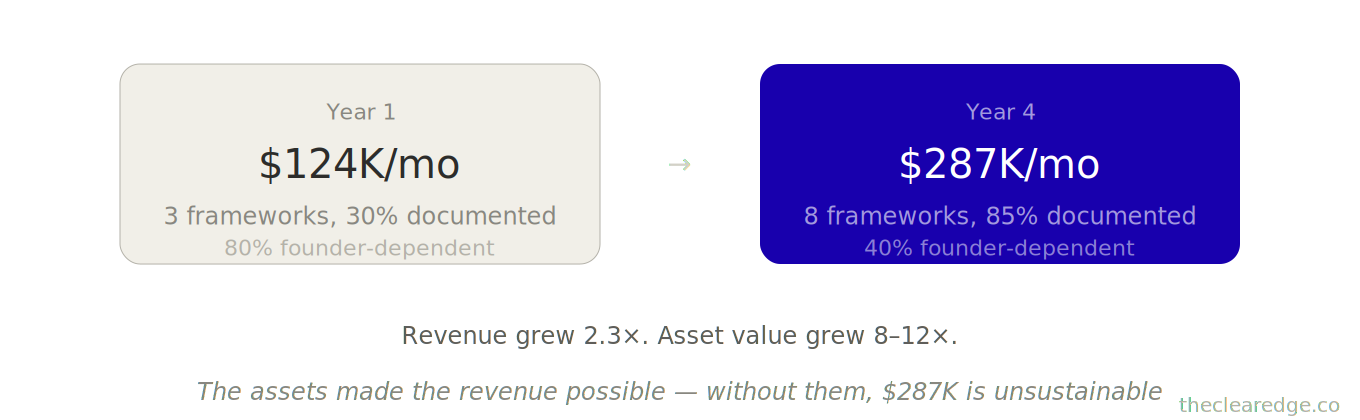
Why this matters:
Going from $124K to $287K means adding $163K in monthly revenue.
That lift rides on $2M–$5M worth of compounding assets built over 4 years.
The assets made the revenue possible, and without those assets, $287K in monthly revenue is unsustainable.
Your build rhythm:
Build one compounding asset quarterly.
4 yearly × 10 years → 40 compounding assets that make $1M monthly achievable.
[Compounding Assets Over 10 Years]

Per Year:

  4 new assets

---

Over 10 Years:

  40 total assets

Each asset:
  -> Increases margin
  -> Lowers risk
  -> Supports next phase
Seen over 10 years, those assets explain why two businesses with similar $100K starting points can end up at radically different outcomes.
How Patience And Sequenced Phases Compound From $100K To $1M/Month
Here’s what happens between $100K and $1M that nobody talks about: the business fundamentally changes 3–4 times.
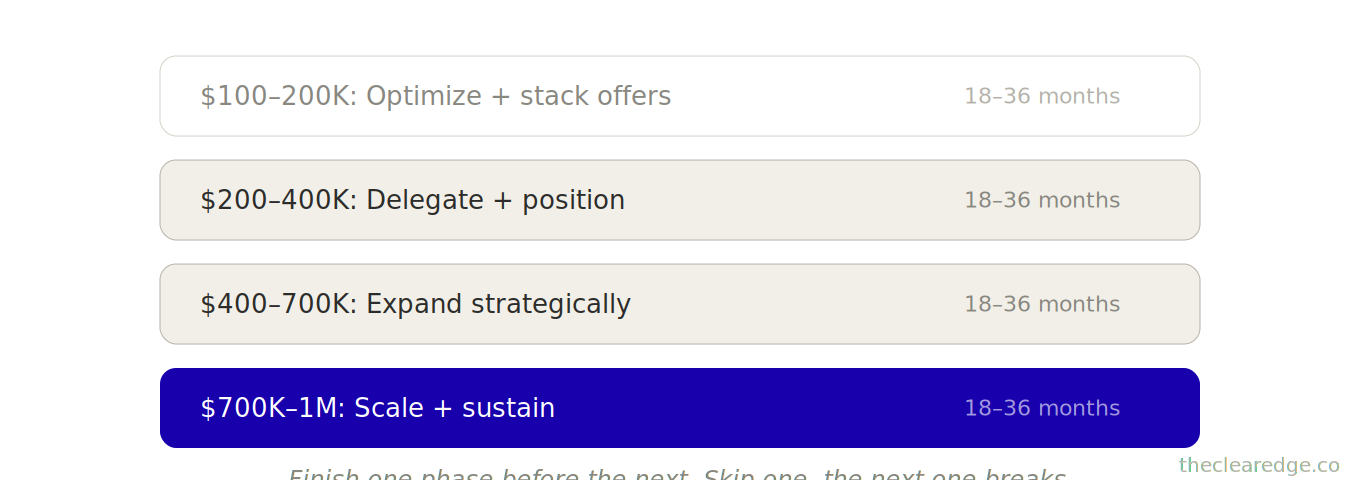
$100K–$200K: Optimization and offer stacking phase. You’re refining core service + adding Tiers 1–2.
$200K–$400K: Delegation and positioning phase. You’re systematizing delivery + building brand equity.
$400K–$700K: Strategic expansion phase. You’re entering new markets or client segments and leveraging partnerships.
$700K–$1M: Scale and sustainability phase. You’re optimizing margins and building enterprise value.
Each phase requires 18–36 months to navigate properly. Rush it, things break.
Case — a consultant tracked this across 7 years:
Years 1–2 ($102K → $163K)
Added group program
Added digital product
Optimized core service pricing
Built a team from 3 to 5 people
Years 3–4 ($163K → $281K)
Delegated all delivery
Built brand through speaking
Built brand through content
Launched strategic partnerships
Years 5–6 ($281K → $492K)
Expanded into adjacent market (same service, new industry)
Hired VP of operations
Systematized client acquisition
Year 7 ($492K → $654K)
Launched licensing model
Built an advisor network
Optimized for profit, not just revenue
She’s currently in Year 8, tracking toward $850K–$900K by Year 10.
What she learned: each phase only worked because the previous one was fully built first.
Year 5 expansion only worked because Years 1–4 built the foundation.
Year 7 licensing only worked because Years 3–6 built IP and brand.
The 10-year play isn’t about slow growth; it’s about building in clear phases where each year strengthens and multiplies what came before.
Why phases matter:
Most founders try to skip phases: “I’m at $100K, I’ll jump straight to $700K strategy.” It doesn’t work.
The $100K–$200K phase teaches the skills needed for $200K–$400K, and if you skip it, you fail when systems can’t support scale.
Patience isn’t waiting; it’s recognizing that $1M is built in phases, not leaps.
[Phases Between ~$100K And ~$1M]

[100K-200K]  Optimize + Stack Offers
[200K-400K]  Delegate + Position
[400K-700K]  Expand Strategically
[700K-1M]    Scale + Sustain

Finish one phase before the next
Once you see growth as 18–36 month phases instead of sudden jumps, the natural next question is what this actually changes in how you run the next year.
What Running The 10-Year Play Changes And The Time It Costs
Adopting the 10-year Play requires three mindset shifts.
Shift 1: Metrics Change
Stop tracking monthly revenue growth and short-term spikes.
Start tracking quarterly revenue, annual asset development, and 10-year trajectory alignment.
Shift 2: Opportunities Filter
Evaluate every opportunity against the 10-year target, not just the next quarter’s results.
Decline any opportunity that doesn’t compound toward the target, even if it looks attractive in the short term.
Shift 3: Risk Tolerance Adjusts
Accept 25–35% annual growth as success instead of chasing 50–100% growth.
Prioritize lower variance and a higher probability of reaching the long-term target.
Total investment: 8–12 hours to set 10-year target and reverse-engineer milestones, 2–3 hours quarterly to review trajectory and adjust.
The return: 3–5X higher probability of reaching $1M vs. aggressive scale strategy, with 50–70% lower stress and risk.
For a founder at $100K/month, that’s the difference between an 82% chance of hitting $1M in 10 years vs. a 19% chance of hitting it in 5 years (then failing).
“Success here means reaching $600K–$1M monthly without collapsing or plateauing.”
One founder’s reflection at Year 6: “Everyone thought I was playing small by not chasing explosive growth. Turns out I was playing long while they were playing risky.”
When The 10-Year Play Fights Your Ego
The competitor’s “hockey stick” is noise; your 10-year path is the only scoreboard that cashes out. Say no to one shiny scale move today.
Run Your 10-Year Play Sanity Check Checklist
Next time a shiny scale move hits your desk, run these before you commit anything in writing.
☐ Calculated the 10-year compound path from current monthly revenue at 25–35% yearly growth and wrote the Year 10 number
☐ Compared yearly burn, $172K breakeven revenue, and 30–40% success odds against your 10-year compound path on one page
☐ Scored this quarter’s move against your 10-year target, current phase band, and all 10-Year Play phase criteria in writing
☐ Logged whether the move fits the 10–20 tests per year at 10–15% scale rule or jumps to full “hockey-stick” execution
☐ Wrote a binary decision—run as a 60–90 day 10% test, kill, or defer—and noted which compounding asset it builds this year
Five minutes here is how you stop $840K burn and 3–5 lost years before they start.
How To Start Running The 10-Year Play In Your Business
Start here when you’re ready to move from understanding the 10-Year Play to actually running it in your own business.
Set your 10-year target. Revenue + business characteristics + lifestyle constraints. Make it specific enough to reverse-engineer.
Identify your current phase ($100K–$200K, $200K–$400K, etc.). What needs to be true to complete this phase before advancing?
Test one hypothesis small this quarter. 10% scale, 90 days to validate. Scale only what proves true.
The shift from short-term optimization to long-term compounding typically shows behavioral impact within 30-60 days: fewer reactive decisions, more strategic patience, clearer trajectory.
FAQ: How The 10-Year Play Works For $100K/Month Founders
Q: How do I know if the 10-Year Play is right for me instead of aggressive scaling?
A: It’s for founders around $100K–$120K/month who feel pressure to “10X fast,” are considering moves like adding $840K in yearly burn to chase $172K/month, and want a safer path to $600K–$1M/month that won’t blow up their business or life.
Q: How does the 10-Year Play turn $100K/month into $1M/month over 8–12 years?
A: You target 25–35% yearly growth, run 10–20 small tests per year at 10–15% scale, and build compounding assets (brand, IP, team, relationships, data, systems) so $100K/month compounds to about $1.06M/month over 8–12 years instead of relying on one high-risk “hockey-stick” bet.
Q: What happens financially if I choose the aggressive scale path instead of the 10-Year Play?
A: The aggressive plan often adds around $840K in yearly burn (hires, marketing, overhead) to chase $172K/month with only a 30–40% success chance, while the patient compound path at 25–35% growth reaches $1M/month in 8–12 years with an 82% success rate across 47 businesses.
Q: How do I set a concrete 10-year target instead of just saying “get to $1M”?
A: You define a specific revenue milestone (for example $850K or $1M/month), detailed business characteristics (team size, delivery model, client profile, profit margin), and lifestyle constraints (work hours, time off, involvement, location), like the coach who set $850K/month with a 12-person team, 25-hour weeks, 10 weeks off yearly, and zero client delivery.
Q: How do I use 10–20 small tests per year so I don’t bet the business on unproven ideas?
A: You run 60–90 day experiments at roughly 10% of the target scale—such as capping a new group program at 15 people for $7,455/month or piloting three $45K enterprise engagements—then only scale the plays that hit clear success criteria and kill or pivot the rest.
Q: How does the group program and enterprise example show the testing framework in practice?
A: One founder at $108K/month tested enterprise by running three $45K pilots (about 40 build hours and 60 delivery hours each), learned where scope and delivery needed changes, then grew to seven enterprise clients and $420K yearly enterprise revenue instead of guessing and building a full enterprise machine upfront.
Q: Which compounding assets should I focus on each year if I want $600K–$1M/month later?
A: You deliberately build brand equity (subscribers, case studies, speaking), IP (documented frameworks and methodology), team capability, strategic relationships, structured data, and documented systems so that moving from $124K to $287K/month over four years rides on $2M–$5M of asset value rather than just more hustle.
Q: How do the four growth phases between $100K and $1M change what I should work on now?
A: At $100K–$200K you optimize and stack offers, at $200K–$400K you delegate and position, at $400K–$700K you expand strategically into new markets or segments, and at $700K–$1M you focus on scale and sustainability, with each 18–36 month phase building capabilities the next phase depends on.
Q: How much time does it actually take to implement the 10-Year Play rhythm each year?
A: You invest 8–12 hours upfront to define the 10-year target and milestones, then 2–3 hours per quarter to review your trajectory, choose one 90-day hypothesis to test at 10% scale, and add one compounding asset, which shifts behavior within 30–60 days while keeping operational hours stable.
Q: What’s the real trade-off in probability between chasing 5-year explosive growth and running the 10-year play?
A: For a $100K/month founder, the aggressive path offers about a 19% chance of hitting $1M/month in 5 years and high odds of failure or collapse, while the 10-year play offers roughly an 82% chance of reaching $600K–$1M/month in 8–12 years with 50–70% less stress and risk.
Up Next: Designing An Exit-Ready Business That Runs Without You
Next article covers “The Exit-Ready Business: Build $100K Revenue That Runs Without You for $100K–$125K Operators.” I will show you how to architect the business for maximum optionality—the ability to exit, stay, or scale based on what you want, not what the business demands.
Navigate The Clear Edge OS Systems for Scaling From $5K to $150K
Start here: The Complete Clear Edge OS — Your roadmap from $5K to $150K with a 60-second constraint diagnostic.
Use daily: The Clear Edge Daily OS — Daily checklists, actions, and habits for all 26 systems.
LAYER 1: SIGNAL (What to Optimize)
The Signal Grid • The Bottleneck Audit • The Five Numbers
LAYER 2: EXECUTION (How to Optimize)
The Momentum Formula • The One-Build System • The Revenue Multiplier • The Repeatable Sale • Delivery That Sells • The 3% Lever • The Offer Stack • The Next Ceiling
LAYER 3: CAPACITY (Who Optimizes)
The Delegation Map • The Quality Transfer • The 30-Hour Week • The Exit-Ready Business • The Designer Shift
LAYER 4: TIME (When to Optimize)
Focus That Pays • The Time Fence
LAYER 5: ENERGY (How to Sustain)
The Founder Fuel System • $100K Without Burnout
INTEGRATION & MASTERY
The Founder’s OS • The Quarterly Wealth Reset
AMPLIFICATION (AI & Automation)
The Automation Audit • The Automation Stack
⚑ Found a Mistake or Broken Flow?
Use this form to flag issues in articles (math, logic, clarity) or problems with the site (broken links, downloads, access). This helps me keep everything accurate and usable. Report a problem →
› More to Explore: Quick Navigation · The Clear Edge OS
➜ Help Another Founder, Earn a Free Month
If this system just saved you from burning $840K and 3–5 years chasing low-probability explosive growth, share it with one founder who needs that relief.
When you refer 2 people using your personal link, you’ll automatically get 1 free month of premium as a thank-you.
Get your personal referral link and see your progress here: Referrals
Get The 10-Year Play Toolkit Inside The Clear Edge OS
You’ve read the system. Now implement it.
Premium gives you:
Ready-to-use PDF toolkit—every template, diagnostic, and formula pre-filled, zero setup, immediate use
Plug-and-play AI diagnosis sessions—drop into Claude, Gemini or ChatGPT, answer a few questions, save hours of guessing, get your exact next move
Audio key points—concentrated frameworks you can absorb in minutes, implement while you move
Unrestricted access to the complete library—every system, every update
What this prevents: Burning $840K on aggressive bets with a 19% success rate instead of compounding 25–35% yearly toward $1M.
What this costs: $49/month.
Download everything today. Implement this week. Cancel anytime, keep the downloads.
Already upgraded? Scroll down to download the PDF, audio, and your AI session.
